Implicit CO 2 prices of fossil fuel use in Switzerland Switzerlands - - PowerPoint PPT Presentation

β–Ά
implicit co 2 prices of fossil fuel use in switzerland
SMART_READER_LITE
LIVE PREVIEW

Implicit CO 2 prices of fossil fuel use in Switzerland Switzerlands - - PowerPoint PPT Presentation

Implicit CO 2 prices of fossil fuel use in Switzerland Switzerlands CO 2 policy goal: 20 percent domestic reduction of CO 2 emissions by 2020 Question to be analyzed : How efficient is the current Swiss policy mix to attain this goal? What is


slide-1
SLIDE 1

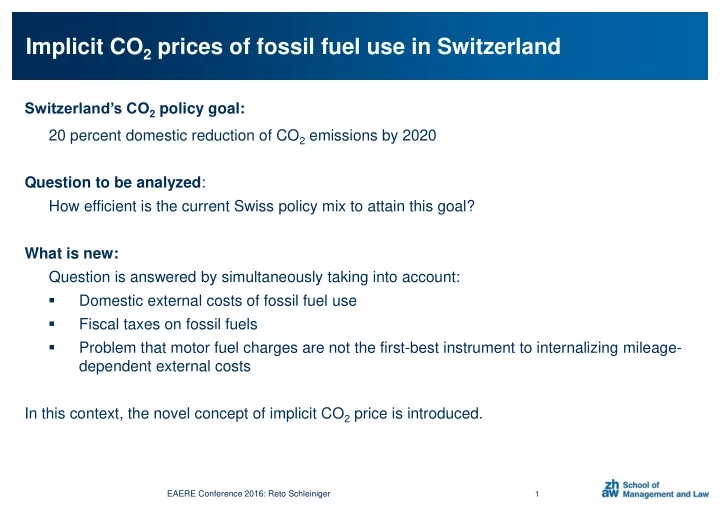
Switzerland’s CO2 policy goal: 20 percent domestic reduction of CO2 emissions by 2020 Question to be analyzed: How efficient is the current Swiss policy mix to attain this goal? What is new: Question is answered by simultaneously taking into account:

  • Domestic external costs of fossil fuel use
  • Fiscal taxes on fossil fuels
  • Problem that motor fuel charges are not the first-best instrument to internalizing mileage-

dependent external costs In this context, the novel concept of implicit CO2 price is introduced.

Implicit CO2 prices of fossil fuel use in Switzerland

EAERE Conference 2016: Reto Schleiniger

1

slide-2
SLIDE 2

The burning of fossil fuels causes:

  • Global external costs: Global warming due to CO2 emissions
  • Domestic external costs: e.g. air pollution due to PM10 emission

Costs of global warming are extremely difficult to monetize. β†’ Price-standard approach is an appropriate alternative to Pigouvian taxes Quantification of domestic external costs is not an easy task either but its results are less contentious. Efficient policy mix consists of:

  • Pigouvian tax with a rate that equals domestic external costs and varies for different fossil

fuel uses

  • Plus a uniform CO2 price for all fossil fuels

The multiple externality problem of fossil fuel use

EAERE Conference 2016: Reto Schleiniger

2

slide-3
SLIDE 3

Within the context of multiple externalities the implicit CO2 price is defined as: Current consumer price of fossil fuel minus efficient domestic fossil fuel price Efficient domestic fossil fuel price consists of:

  • Private production costs

(assuming to equal producer price)

  • Mark-up to finance public expenditure

(mirrored by a uniform VAT rate)

  • Domestic external costs of fossil fuel use

With a uniform VAT, the implicit price is simply the difference of specific charges and domestic external costs (s. Figure). The uniformity of the implicit CO2 price is taken as efficiency indicator of the current CO2 policy.

The implicit CO2 price

EAERE Conference 2016: Reto Schleiniger

3 costs price private costs producer price general public outlays VAT domestic external costs specific charges

implicit CO2-price CHF/t CO2

slide-4
SLIDE 4

Passenger cars Heavy good vehicles Note: A fuel charge is an imperfect substitute of a mileage-dependent charge, since it impacts fuel

  • efficiency. In this case, the optimal fuel tax rate is:

𝑒𝑄 = 𝑁𝐹𝐷

π‘”π‘£π‘“π‘š + πœπ›Ώπ‘πΉπ·π‘’π‘—π‘‘π‘’π‘π‘œπ‘‘π‘“

ρ: share of tax-induced fuel reduction due to reduced driving γ: fuel efficiency The implicit CO2 price for passenger cars is negative, i.e. the current price is below its efficient price. The implicit CO2 price for heavy goods vehicles is 72 CHF/t CO2 which is close to the explicit CO2 levy of 84 CHF/t CO2 on heating oil and natural gas.

Results: Road traffic

EAERE Conference 2016: Reto Schleiniger

4 (1) CHF/l (2) CHF/vkm (1) + (2) CHF/t CO2 Total external costs

0.12 0.13 748

Total charges

0.75 313

Difference charges minus external costs

0.63 0.13

  • 435

Pigou tax rate (ρ = 0.5) on fuel use

0.96 400

Implicit CO2 price (ρ = 0.5)

  • 0.21
  • 87

(1) CHF/l (2) CHF/tkm (1) + (2) CHF/t CO2 Total external costs

0.36 0.11 1β€˜114

Total specific charges

0.77 0.09 1β€˜100

Difference charges minus external costs

0.41

  • 0.02
  • 13

Pigou tax rate (ρ = 0.5) on fuel use

0.59 224

Implicit CO2 price (ρ = 0.5)

0.19 72

slide-5
SLIDE 5
  • The specific charges do not cover external costs.
  • There is not VAT levied in aviation fuel.
  • As a result, the implicit CO2 price is clearly negative.

Results: Passenger aviation

EAERE Conference 2016: Reto Schleiniger

5

CHF/t CO2 External costs Air pollution

28

Noise

36

Accidents

2

Total external costs

66

Specific charges Air pollutant charge

1

Noise charge

12

Missing VAT on aviation fuel

  • 18

Total charges

  • 5

Charges minus ext. costs = implicit CO2 price

  • 71
slide-6
SLIDE 6

Note: The VAT is charged on the price including the CO2 levy. This part of VAT is considered a specific tax. The implicit CO2 prices are below the explicit levy rate of 84 CHF/t CO2 since it partly covers external costs of air pollution. Due to the relatively clean burning of natural gas its implicit CO2 price is higher than the price of heating oil.

Results: Heating oil and natural gas

EAERE Conference 2016: Reto Schleiniger

6

Heating oil Natural gas

CHF/t CO2 CHF/t CO2 External costs air pollution

40 20

Specific charges Mineral oil tax

1 2

CO2 charge

84 84

VAT on CO2 charge

7 7

Total charges

92 93

Charges minus ext. costs = impl. CO2 price

52 73

slide-7
SLIDE 7

Overview on implicit CO2 prices

  • There are striking differences of implicit CO2 prices for different fossil fuel uses.

β†’ There is a large potential to reduce CO2 emissions at lower costs.

  • The negative implicit CO2 price for passenger cars and aviation indicates that raising prices

would be efficiency enhancing from a purely domestic point of view. Policy recommendations

  • For passenger cars a mileage dependent fee analogous to the heavy vehicle fee could

internalize mileage dependent external cost directly.

  • The notorious undertaxation of aviation is based on an international treaty, the so called Chicago

Convention, which prohibits the taxation of aviation fuel. Here international action is needed.

Conclusions

EAERE Conference 2016: Reto Schleiniger

7

Road traffic Aviation Heat production Passenger cars Heavy good vehicles Heating oil Natural gas Implicit CO2 price (CHF/ t CO2)

  • 87

72

  • 71

52 73