Impac t of Mar ijuana Use on Patie nt Car e : F r om R e c r - - PowerPoint PPT Presentation

impac t of mar ijuana use on patie nt car e f r om r e c
SMART_READER_LITE
LIVE PREVIEW

Impac t of Mar ijuana Use on Patie nt Car e : F r om R e c r - - PowerPoint PPT Presentation

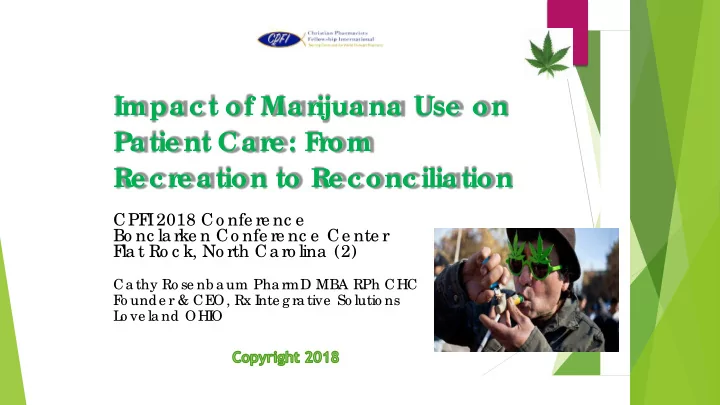
Impac t of Mar ijuana Use on Patie nt Car e : F r om R e c r e ation to R e c onc iliation CPF I 2018 Co nfe re nc e Bo nc la rke n Co nfe re nc e Ce nte r F la t Ro c k, No rth Ca ro lina (2) Ca thy Ro se nb a um Pha rmD MBA RPh


slide-1
SLIDE 1

Impac t of Mar ijuana Use on Patie nt Car e : F r

  • m

R e c r e ation to R e c onc iliation

CPF I 2018 Co nfe re nc e Bo nc la rke n Co nfe re nc e Ce nte r F la t Ro c k, No rth Ca ro lina (2)

Ca thy Ro se nb a um Pha rmD MBA RPh CHC F

  • unde r & CE

O, Rx I nte g ra tive So lutio ns L

  • ve la nd OHI

O

slide-2
SLIDE 2
slide-3
SLIDE 3

Disclaimer

 I have no financial interest or direct affiliation with any

company or organization involved with medical or recreational marij uana or hemp products.

 This is an educational program. Please consult with your

PCP for medical advice.

slide-4
SLIDE 4

Obje c tive s

 Disc uss le g a l la ndsc a pe a nd pro duc t

q ua lity-re la te d issue s re g a rding re c re a tio na l ma rijua na

 Re vie w sig nific a nt ma rijua na side e ffe c ts

a nd c o mmo n drug inte ra c tio ns

 De sc rib e ‘ a t risk’ pa tie nt po pula tio ns using

re c re a tio na l ma rijua na c a se sc e na rio s

 Re vie w the pha rma c ist-le d ho spita l

a dmissio n Me dRe c pro c e ss & ma rijua na po lic y de ve lo pme nt fo r he a lth syste ms

slide-5
SLIDE 5

International MJ Legislation

Argentina Canada Czech Republic India Ecuador Netherlands Jamaica S pain Mexico Uruguay

slide-6
SLIDE 6
slide-7
SLIDE 7

S tates/ Territories Permitting Recreational Marij uana Use

Colorado (2012)

Washington (2012)

Alaska (2014)

District of Columbia (2014)

Oregon (2014)

California (2016)

Massachusetts (2017)

Nevada (2017)

Maine (2017)

Vermont (2018)

slide-8
SLIDE 8
slide-9
SLIDE 9

Oregon Recreational Marijuana Retail Sale Limits

slide-10
SLIDE 10
slide-11
SLIDE 11
slide-12
SLIDE 12

∆- 9- T

HC De te c tion

 Ser

um – Ac tive T HC (c annabinoids) (positive at 20 ng/ mL )

Me dT

  • x I

mmuno c hro mato g raphic te st

 Ur

ine – I

na c tive T

HC- COOH- gluc ur

  • nide

(positive at 50 ng/ mL ). Answe rs, “ha s this

pe rso n use d c a nna b is o ve r the la st da ys o r we e ks? ”

L e ve ls o f T HC o r me ta b o lite s do no t c o rre la te with e ffic a c y o r to xic ity.

slide-13
SLIDE 13

De te c te d in the Ur ine

T HC- COOH- Gluc ur

  • nide

Sing le Use 3 Da ys Mo de ra te Use (4x/ We e k) 5 – 7 Da ys Da ily Use 10 – 15 Da ys L

  • ng -T

e rm He a vy Smo ke r > 30 Da ys T HC - T1/ 2 2-7 Da ys

slide-14
SLIDE 14

Recreational Marijuana Issues

 Quality control/ product safety (legal vs street)  Lingering contaminants in marij uana sold on the

street

 Dealers typically sell cannabis by weight; some use

sand or glass beads to make their products heavier

 Breathing these particles over years may inflame

and scar the lungs

 Higher THC content than medical marij uana limits?  Not detectable with Breathalyzer test  Risk of accidents for drivers with THC levels higher

than 5 ng/ mL blood (similar to blood alcohol concentration of 0.08% )

slide-15
SLIDE 15
slide-16
SLIDE 16
slide-17
SLIDE 17

Dabbing

F la sh va po rizing b uta ne ha sh o il b a se d c o nc e ntrate

Mo re into xic a ting tha n smo king o r va ping

slide-18
SLIDE 18

Butane Hash Oil Burns

 Names: dabs, wax, earwax, honey, honey oil, shatter  Contain up to 97%

THC

 Products commercially manufactured; some users

make them at home

 20 yo man presented to ED after explosion with burns

to face, hands, trunk

 He had been manufacturing hash oil using butane

extraction (highly flammable solvent)

 Treated with surgical debridement, pain meds,

standard burn care

Am J Health S yst Pharm 2017;74:1907

slide-19
SLIDE 19

Compare Illegal Chemical Structures for JWH-018 and THC - Marij uana Alternatives

  • K2, S

pice, AK47 belong to a group of blends that contain a mixture of inert plant matter plus chemical grade synthetic cannabinoids sprayed on it

  • S

treet drug symptoms similar to marij uana PLUS sympathomimetic S XS : agitation, anxiety, tachycardia, tremors, seizures, HEP ATOTOXICITY . Plus in April 2018 IL & other states incident with rat poison in 94 cases including 2 deaths (brodifacoum)

  • Agonists at CB1 and CB2 receptors

  • May be NDMA glutamatergic antagonists (like

ketamine – euphoria, analgesic)

slide-20
SLIDE 20

Solimini, et al. Hepatotoxicity associated with

illegal synthetic cannabinoids use. Eur Rev Med Pharmacol Sci 2017;21 (1 Suppl):1-6. (Table 1)

Synthetic Cannabinoids Family Principal Compounds

Benzoylindole AM-694, AM-2233, AM-679, RCS

  • 4, RCS
  • 8

Naphthoylindole JWH-018, JWH-022, JWH-073, JWH-081, JWH-122, JWH-210, AM- 2201, AM-2232, MAM-2201 Phenylacetylindole JWH-167, JWH-250, JWH-316 Indazolecarboxamide ADB-PINCACA, ADB-FUBINACA, AB-FUBINACA, AB-PINACA, 5F- APINACA, AKB48 (APINACA), MAB-CHMINACA Cyclohexylphenyl CP-55, 940, CP-47, 497, 497-C8 homologue Naphthylmethylindole JWH-175 Naphthylpyrrole JWH-145, JWH-307, JWH-370 Naphthylmethylindene JWH-176, JWH-220 Aminoalkylindole WIN-55, 212-2 Adamantoylindoles AB-001 Tetramethylcyclopropylketone indole UR-144, XLR-11 Quinolinyl ester indole 5F-PB-22, PB-22 Ibenzopyran HU-210, JWH-133
slide-21
SLIDE 21

Young-Wolff. Trends in Self-Reported and Biochemically Tested Marijuana Use Among Pregnant Females in California From 2009-

  • 2016. JAMA 2017: 318:2490.

Kaiser Permanente Northern California review. Questionnaire and tox test within two weeks of questionnaire

From 2002 to 2014 prevalence of self-reported, past month marij uana use among US adult pregnant women increased from 2.4% to 3.9%

In aggregated 2002-2012 data, 14.6%

  • f US

pregnant adolescents reported past month use

From 2009 to 2016 adj usted prevalence of prenatal marij uana use based on self report or tox increased from 4.2% (95% CI, 4%

  • 4.5%

) to 7.1% (95% I, 6.7%

  • 7.5%

)

Prenatal marij uana use may impair fetal growth and neurodevelopment despite women’s perception of little to no harm in prenatal use

slide-22
SLIDE 22
slide-23
SLIDE 23

Endocannabinoids

 Anandamide and 2-AG  Neural and nonneural cells in

inj ured tissues produce arachidonic acid derivatives called endocannabinoids.

 They modulate neural

conduction of pain signals by mitigating sensitization and inflammation through the activation of cannabinoid receptors that are also targeted by delta-9-THC.

slide-24
SLIDE 24
slide-25
SLIDE 25

Main Phytoc annabinoids

 Psyc ho ac tive : T

HC (∆-9-T

HC, ∆-8-T HC, 11- hydro xy-T HC [a c tive me ta b o lite ]). Binds to CB1 & CB2 re c e pto rs a s a pa rtia l a g o nist.

 Not Psyc hoac tive : T

HCV

(te tra hydro c a nna b iva rin):a na lo g ue o f T HC

slide-26
SLIDE 26

Main Phytocannabinoids

Not Psychoactive:

 CBD (cannabidiol)  CBN (cannabinot) – degradation product of THC  CBC (cannabichromene) – sedative and analgesic  CBG (cannabigerol) – precursor of other cannabinoids

slide-27
SLIDE 27

Cannabinoid CB1 Re c e ptor s

 Mo stly in br

ain (c e r e be llum, c e r e br al c or te x, basal ganglia), spine , GItra c t, live r,

pa nc re a s, ske le ta l musc le c o mb ine d with

GABAe r gic & dopamine r gic & se r

  • tonine r

gic r e c e ptor s; to a ffe c t a ppe tite , pa in se nsa tio n,

me mo ry, mo o d

 I

n the hippoc ampus a nd amygdala, a re a s a sso c ia te d with pa rtia l se izure s. CB1 receptors are also present in nociceptive and non- nociceptive sensory neurons of dorsal root ganglion and trigeminal ganglion as well as in defense cells such as macrophages, mast cells, and epidermal keratinocytes.

slide-28
SLIDE 28

Cannabinoid CB2 Re c e ptors

 Ac tiva tio n c a use s inhib itio n o f pro infla mma to ry

c yto kine pro duc tio n, c yto kine , a nd c he mo kine re le a se , a nd b lo c ka de o f ne utro phil a nd ma c ro pha g e mig ra tio n (anti- inflammator

y)

 I

n pe r

iphe r al immune syste m T

  • c e lls, B c e lls, sple e n,

ma c ro pha g e s (immuno suppre ssio n), kidne ys, lung s

 I

n pe riphe ra l ne rve te rmina ls with a ro le in anti-

noc ic e ption

slide-29
SLIDE 29

CANNABIS

slide-30
SLIDE 30

Marijuana Use May Raise Risk of Dying from Hypertension

European Journal of Preventive Cardiology August 8, 2017

Three fold risk increase with each additional year of use (NHANES survey); adj usted hazard ratio for death due to hypertension of 3.42 (CI 1.2 – 9.79)

HR greater than that for current cigarette smokers (HR 1.06; 95% CI 0.4 – 2.77), former smokers (1.33; 95% CI 0.57 – 3.1), alcohol users (HR 0.95; 95% CI 0.37 – 2.45), and those with a prior diagnosis of hypertension (HR 0.81; 95% CI 0.32 – 2.06) or CVD (HR 1.94; 95% CI 0.42 – 8.97)

Risk may be greater than the risk established for cigarette smoking

Adults aged 20 and older in survey; N = 1213 (mean age 37.7 years) in cohort

slide-31
SLIDE 31

Marijuana/Hashish Bi-Phasic DOSE Effect on Autonomic Nervous System

 LOW DOS

ES : sympathetic activity is increased while parasympathetic activity is depressed, resulting in mild increases in heart rate and blood pressure

 HIGH DOS

ES : parasympathetic activity is increased and sympathetic activity is inhibited resulting in the potential for hypotension and bradycardia

slide-32
SLIDE 32

Cardiovascular Disorders Associated with ACUTE vs CHRONIC Cannabis Use

Arrhythmias precipitated by excessive physical activity especially during the first few hours of consumption

Heterogenous effects on central and peripheral circulation

Acute cannabis consumption shown to cause increase in BP (S BP) and orthostatic hypotension

ECS is involved in regulation of heart rate and blood pressure

THC can cause vasodilation by activating TRP A-1 channel, then reflex tachycardia

Chronic use associated with decrease in HR and disappearance

  • f orthostatic hypotension

CB2 receptors are expressed in cardiomyocytes, coronary endothelial cells and smooth muscle cells

slide-33
SLIDE 33

Cardiovascular Complications

Cannabis use may be associated with:

 Development of atrial fibrillation  Reversible cerebral vasoconstriction syndrome

(strong headaches, neurological focal deficit with reversible vasoconstriction)

 S

troke among youth - significantly underestimated

 S

ynthetic cannabinoids (S pice) can cause tachycardia & other sympathomimetic symptoms

slide-34
SLIDE 34
slide-35
SLIDE 35

Recreational MJ Use & Acute Ischemic Stroke (AIS): A Population Analysis of Hospitalized Patients in the

  • US. J Neurol Sci 2016;364:191

MOA: reversible vasoconstriction syndrome associated with subarachnoid hemorrhage, intracerebral hemorrhage, acute ischemic stroke with MJ use

MOA S troke: hypotension, cerebral vasospasm, arrhythmia associated cardioembolism

Retrospective cohort analysis, recreational MJ associated with 17% increased likelihood of AIS hospitalization

Likelihood increased when MJ combined with tobacco use (31% ) and with cocaine use (42% )

Incidence of AIS greater among MJ users compared to non users (RR: 1.13, 95% CI: 1.11-1.15, p < 0.0001) and had greatest difference in the 24-34 age group (RR: 2.26, 95% CI: 2.13-2.38, p < 0.0001)

slide-36
SLIDE 36
  • Shere. Cannabis Can Augment Thrombolytic

Properties of rtPA: Case Report of Intracranial Hemorrhage in a Heavy Cannabis User. Am J Emer Med 2017.

Cannabis can affect cerebral auto-regulation and vascular tone leading to vasoconstriction and acute ischemic stroke

51 yo female

PMHx: HTN, asthma, heavy cannabis use

CC: left upper and lower extremity weakness (2 hours); BP 256/ 112 mm Hg

Code stroke called, emergent CT scan of her head without contrast revealed acute right cerebral infarct

Urine drug screen positive for cannabis

Treatment: IV labetalol, rtP

  • A. Marked confusion, slurred speech, repeat CT showed

new hemorrhage in left pons, death

THC decreases platelet aggregation via activating 2-AG, increased cardiac oxygen demand, vasoconstriction

CB1 & CB2 receptors on platelets

rtP A is 80% cleared after 10 minutes but effects on coagulation cascade may last up to 24 hours (prolongs PT and aPTT)

slide-37
SLIDE 37
  • Behrouz. Cannabis Use and Outcomes in

Patients with Aneurysmal Subarachnoid

  • Hemorrhage. Stroke 2016;47:1371.

N = 108 patients, 26% CB+. Delayed cerebral ischemia diagnosed in 50%

  • f CB+ and 24%
  • f urine drug screen negative patients

(p = 0.01).

CB+ independently associated with development of delayed cerebral ischemia (OR, 2.68; 95% CI, 1.03-6.99; p = 0.01).

S ignificantly higher number of CB+ than urine drug screen negative patients had poor outcomes (35.7% vs 13.8% ; p = 0.01)

Univariate analysis, CB+ associated with composite end point of hospital mortality/ severe disability (OR, 2.93; 95% CI, 1.07- 8.01;p=0.04)

After adj ustment for other predictors, this effect was no longer significant

Preliminary Conclusion: CB+ is independently associated with delayed cerebral ischemia and possibly poor outcome in patients with aS AH

slide-38
SLIDE 38

CANNABIS

slide-39
SLIDE 39

CANNABIS

slide-40
SLIDE 40

Cannabis/ Dr ug Inte r ac tions & E ffe c ts

 Ma y inte ra c t with wa rfa rin (T

HC a nd CBD inc re a se wa rfa rin le ve ls) (Yamao ri e t al

2012)

Increases bleeding when used with

anticoagulants (warfarin, Xarelto, Eliquis), antiplatelet agents (Plavix, Brilinta), NSAIDs (Celebrex, Motrin, Aleve, ASA)

slide-41
SLIDE 41

Patient Scenarios

slide-42
SLIDE 42

Psychiatric and Medical Management of Marijuana Intoxication in the EMR Dept

West J Emerg Med 2015: XVI (3): 414-417

slide-43
SLIDE 43

Patient #1

 34yof who recently gave birth and is lactating  CC: racing thoughts, insomnia, euphoria x 1

week

 Disruptive behavior psychotic symptoms after

recreational marij uana edible cannabis (THC). Auditory hallucinations. “ Broke into neighbor’s home requesting to go to heaven. Feared people were stealing from her and that something bad was going to happen.”

 S

  • cial History: Adopted

 Illicit Drug History: recreational cannabis lip

balm, cannabis chocolate bars, cannabis dabbing daily over past week

slide-44
SLIDE 44

Patient #1

Labs/Diagnostic Tests:

K+ = 3.2 mg/ dL 12-Lead EKG: QTcB interval = 508 msec Temp = 97.5F; HR = 96 BP = 148/ 111; Resp Rate = 11 Random BS = 196 9-carboxy-THC Blood Level – over 500 ng/ mL Unremarkable CT head Unremarkable CBC

slide-45
SLIDE 45

Patient #1

 PTA OTC/Meds:

Energy drinks (+ coffee) Propranolol 20 mg po BID for hypertension Sumatriptan 50 mg po PRN migraines Feverfew 100 mg po daily migraine prevention Benadryl 25 mg po HS PRN sleep Imodium (loperamide) po at higher than package recommended dose of 8 mg/ day (euphoria)

 Diagnosis: Marij uana-induced psychotic disorder,

Marij uana use disorder

slide-46
SLIDE 46

Patient #1

 Chronic marij uana users have lower serum sodium and

potassium than non users

 Heavy consumption of carbs while intoxicated leads to

increase in serum insulin levels driving potassium into cells and causing serum hypokalemia

 Hypokalemia produces reentrant arrhythmias by decreasing

conductivity and increasing resting membrane potential, duration of action potential, and duration of the refractory period

 May see periodic hypokalemic paralysis  EKG changes include decrease in T wave amplitude,

presence of U waves, and prolonged QTcB (THC or Imodium)

slide-47
SLIDE 47

Patient #1 Workup

 Check co-ingestion of other medications

(positive urine tox screen for opioids)

 Check coffee consumption - via

mesolimbic dopamine activity, caffeine may precipitate psychosis or worsen affective lability and mood states

 EKG – tele monitor (checking DI with

cannabis/ propranolol)

slide-48
SLIDE 48

Patient #1 Treatment

 Treat hypokalemia and blood sugar excursions  Risperidone 0.5 mg q 6 h and lorazepam 1 mg q6 h

for psychosis and anxiety, respectively

 DC coffee & energy drinks (caffeine)  Opioid Detox Program – 72 hours in hospital. Warm

referral to addiction management center for MAT therapy; Lactation consultant for alternatives

 DC Imodium (prolonged QTCB) on discharge MedRec

slide-49
SLIDE 49
slide-50
SLIDE 50

Peri-Op Implications of Cannabis Use

 Important to obtain complete illicit drug use history

and confirmatory tests if suspected before surgical intervention

 S

ignificant respiratory symptoms and changes in spirometry

 Avoid CNS

depressants like barbiturates, opioids, benzos, phenothiazines?

 Avoid drugs that increase HR like ketamine, atropine,

epinephrine?

 Intra-op and immediate post-op need of opiates for

analgesia in patients with history of recent or chronic cannabis consumption may be significantly increased

slide-51
SLIDE 51

Propofol Induction

slide-52
SLIDE 52
  • Flisberg. Induction Dose of Propofol in

Patients Using Cannabis. Euro J Anaesthesiology 2009;26:192.

Prospective, randomized, single blind study

N = 30 males using cannabis > once/ week; N = 30 nonusers

Primary outcomes: Propofol ED50 and successful induction determined by loss of consciousness with bispectral index (BIS ) value < 60 and insertion of laryngeal mask

Results: Propofol dose needed to achieve target BIS value not significantly higher in user group, but this group needed significantly higher propofol dose to insert laryngeal mask (314.9 mg ± 109.3 mg vs 263.2 mg ± 69.5 mg, p < 0.04)

Limitation: no blood level of cannabinoids measured for users

Cannabis use increases propofol dose required to insert laryngeal mask

slide-53
SLIDE 53
  • Jefferson. Postoperative Analgesia in

the Jamaican Cannabis User. J Psychoactive Drugs 2013;45:227.

Prospective, randomized study

N = 42 cannabis users (based only on history)

N = 31 non-users

All: elective ortho surgery, received Demerol

Primary Outcome: Mean pain intensity difference at the first postop hour (MPID1) and sum of pain intensity differences (S PID1)

Results: Users had significantly higher supplemental Demerol requirements (82.7 mg, S D = 3.4 vs 51.6 mg, S D = 42.7, p = 0.003) and significantly greater MPID1 scores (1.88, S D = 1.09 vs 1.35, S D = 1.12, p = 0.001) compared to non users

Female users required significantly more analgesic than males (93.3 mg, S D = 45.8 mg vs 78.3 mg, S D = 44.3, p = 0.025)

Conclusions: Greater demand of rescue opioid analgesia within first 6 hours after surgery

slide-54
SLIDE 54
slide-55
SLIDE 55

Types of Pain

Visceral, neuropathic, somatic, bone

INP ATIENT MULTI MODAL P AIN TREATMENT: AP AP , topical NS AIDs, gabapentin, pregabalin, antidepressants, aromatherapy, acupuncture, narcotics, ginger cream, lidocaine patch

OUTP ATIENT P AIN TREATMENT: Pain Contracts? Drug abuse screening tool? Multi-modal treatments? Warm water therapy? Thermal wraps? Acupuncture? Turmeric? S alanpas Patch? Icy Hot products? Medical marij uana?

slide-56
SLIDE 56

Pain Origins (Objective vs Subjective Responses)

 Nociceptive pain –damage to body tissue (sharp,

aching, throbbing). Invading immune cells secrete histamine, serotonin, bradykinin, prostaglandin, tumor necrosis factor alpha, interleukin 1 beta, interleukin 6, interleukin 17. S ignals carried by C and A gamma peripheral nerves to dorsal root ganglia to thalamus to cortical area.

 Neuropathic pain –damage to sensory or spinal nerves

sending inaccurate pain messages to higher centers. Diabetic neuropathy. S UBJECTIVE

 Centralized pain results from amped peripheral

  • signals. Pain persists despite lack of clear peripheral
  • cause. Fibromyalgia. S

UBJECTIVE

slide-57
SLIDE 57

Marijuana and Pain Management

 Subj ective?  There is no way to calculate an equi-analgesic dose

  • f opioid to supplant any marij uana used prior to

surgery even though there is a cannabis conversion table for different dose forms

 Surgical anesthesia may be more complex in recent

cannabis users with reports of more difficulty with sedation and induction of anesthesia

slide-58
SLIDE 58

Patient #2 - 70 yof 5’3” 223#

 Social Hx: Recreational

marij uana, 2 j oints smoked daily (neuropathic pain)

FS BS = 124 (70-99 mg/ dL)

Na = 138 (135-145 mEq/ L)

K = 4.6 (3.6 – 5.1 mEq/ L)

Cl = 99 (101-111 mEq/ L)

BUN = 21 (8-26 mg/ dL)

Cr = 6.6 (0.4 – 1 mg/ dL)

Calcium = 4.2 (4.6 – 5.4 mg/ dL) ionized

 CC: Foot ulcer (debride)  Allergies: Morphine

(confusion) Percocet (itch), Vicodan (itch)

 PMHx: CHF

, non S TEMI, CAD, PCI-stent, S / P CABG x 2, high cholesterol, DM Type I, ESRD on dialysis MWF, HTN, P AD, Diabetic Foot Ulcer/ Osteomyelitis, Peripheral Neuropathy, Anxiety

slide-59
SLIDE 59

Patient #2

PTA Meds:

Coreg 6.25 mg BID

Lipitor 80 mg q HS

Neurontin 100 mg TID

Xanax 0.25 mg BID PRN anxiety after HD

Levemir, Novolog daily

Epogen 3200 Units daily MWF only (anemia)

S evelamer 2400 mg TID with meals (phosphate binder)

Miralax PRN New Meds:

Vancomycin 1 gram IV x 1

Cefepime 2 grams IV daily MWF only

AP AP 650 mg po q 4h PRN mild pain (1-3) or fever

Tramadol 50 mg po q 4h PRN moderate pain (4-6)

Dilaudid 0.5 – 1 mg IV q 6h PRN severe pain (7-10)

Dilaudid 4 mg po q 4h PRN severe pain (7-10)

Propofol, Versed, mepivacaine 2% to debride foot wound

slide-60
SLIDE 60
slide-61
SLIDE 61

Patient #2 – Cannabis/Drug Interactions

 Cardiovascular – CBD and Coreg

increased [ ]. Monitor EKG, BP? THC cardiovascular side effects of long term use?

 Pain/ Anxiety – CBD and increased

[ ] Opioids, increased Xanax [ ]. Monitor pain med dosing?

slide-62
SLIDE 62

Patient #2 (Treatment)

 Pain management (debridement):

– Propofol dosing increase?

  • Address benzos and opioids together
  • DC Dilaudid, keep tramadol (acute)
  • Other modalities for chronic pain?

 Hemodialysis effects on THC removal from the

blood:

  • None as THC metabolites are lipid soluble,

not water soluble

slide-63
SLIDE 63

Patient #2 Discharge MedRec

slide-64
SLIDE 64
slide-65
SLIDE 65

Admission MedRec Process

slide-66
SLIDE 66
slide-67
SLIDE 67

Motivational Interviewing (Miller & Rollnich)

 Person-centered, goal-oriented methods of

communication for eliciting and strengthening intrinsic motivation for change

 Provider patient relationships characterized by P

ACE: partnership, acceptance, compassion, and evocation (drawing out of patients their own internal reasons for changes)

 Open-ended questions, affirmations, reflections,

summaries

 S

EEK FIRS T TO UNDERS TAND

 www.motivationalinterviewing.org

slide-68
SLIDE 68

Medical Marijuana Policy Development

 Hospital Inpatient Policy: Pharmacist-Led

Medication Reconciliation

 Computer Documentation: ‘ social history’

versus ‘ medication’

 Storage, chain of evidence/ log, employee

FMLA usage, random drug screens, education (interactions), management of

  • utpatient MD certification requests

 SOAP notes

slide-69
SLIDE 69

Impac t of Mar ijuana Use on Patie nt Car e : F r

  • m

R e c r e ation to R e c onc iliation

CPF I 2018 Co nfe re nc e Bo nc la rke n Co nfe re nc e Ce nte r F la t Ro c k, No rth Ca ro lina

Ca thy Ro se nb a um Pha rmD MBA RPh CHC F

  • unde r & CE

O, Rx I nte g ra tive So lutio ns L

  • ve la nd OHI

O

slide-70
SLIDE 70

Thank Y

  • u