History of the TFCAs in the SADC Region 07 July 2020 Seth - - PowerPoint PPT Presentation

history of the tfcas in the sadc region
SMART_READER_LITE
LIVE PREVIEW

History of the TFCAs in the SADC Region 07 July 2020 Seth - - PowerPoint PPT Presentation

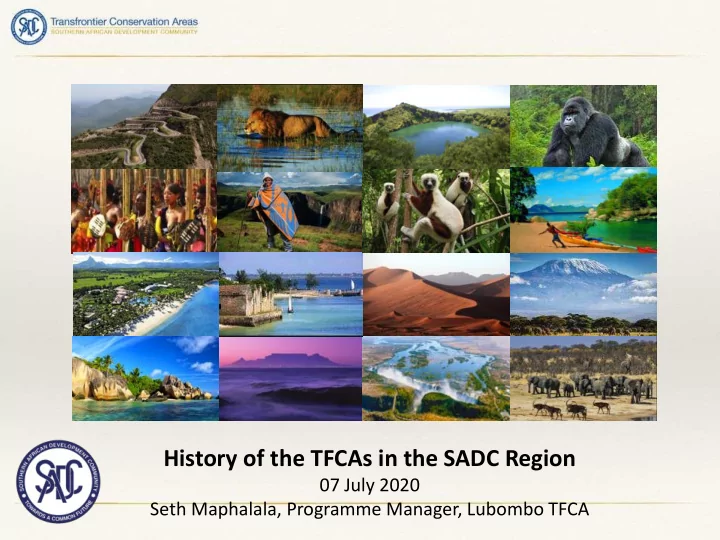
History of the TFCAs in the SADC Region 07 July 2020 Seth Maphalala, Programme Manager, Lubombo TFCA COMMUNITY ENGAGEMENT AND THE ECONOMIC POTENTIAL OF SADC TFCAs LTFCA- Community oriented routes Underlying thought Transfrontier

slide-1
SLIDE 1

History of the TFCAs in the SADC Region

07 July 2020 Seth Maphalala, Programme Manager, Lubombo TFCA

slide-2
SLIDE 2

COMMUNITY ENGAGEMENT AND THE ECONOMIC POTENTIAL OF SADC TFCAs

LTFCA- Community oriented routes

slide-3
SLIDE 3

Underlying thought

  • Transfrontier Conservation Area (TFCA)

Is an area straddling across two or more international borders where the natural and cultural resources are collaboratively managed by the governments/authorities involved.

slide-4
SLIDE 4

Global Background

  • 1928- Krakow Protocol between Poland-

Czechoslovakia established first TFCA

  • Glacier-Waterton Transboundary Park between US

and Canada (1932) – world renowned.

  • The 1945 United Nations Charter lays down the

foundations for co-operation among nation states

  • 1972-Gran Paradiso between Italy and France
slide-5
SLIDE 5

SADC

  • 1930-38: Negotiations between Mozambique,

SA and Mozambique in what is now GLTP

  • 1993 World Bank initiated the development of

the TFCA concept in the SADC by introducing the idea of community involvement

  • 1997 Peace Parks Foundation established to

drive TFCA development in the region

  • SADC Protocol on Wildlife Conservation and

Law Enforcement, 1999 defines TFCA

slide-6
SLIDE 6
  • “the area or component of a large ecological

region that straddles the boundaries of two or more countries, encompassing one or more protected areas as well as multiple resource use areas”

slide-7
SLIDE 7

Objectives of TFCAs

ECOLOGICAL

Enhance biodiversity conservation through cross- border planning and management of shared ecosystems. Re-establish ecological functions such seasonal migration routes for wildlife that were disrupted by fences along political borders. Promote basin-wide approaches to the management of international rivers and wetlands

SOCIO-ECONOMIC

Promote growth of the tourism sector specifically cross-border tourism Increasing the economies

  • f scale for economic

activities such as ecotourism, and natural resource based enterprises. Promote cultural linkages between countries in the

  • region. People are often

linked across borders by kinship, language and culture

GOVERNANCE

Deepening regional integration and cooperation Promote peace and harmony

slide-8
SLIDE 8

SADC Opening

  • In 1999 the PPF facilitation resulted in the

signing of the Lubombo Spatial Development Initiative between Mozambique, Eswatini and South Africa

slide-9
SLIDE 9

SADC First TFCA

  • Kgalagadi Transfrontier Park launched in 12 May

2000 by President Mbeki and President Mogae

slide-10
SLIDE 10
  • 22 June 2000 General Lubombo Protocol

signed

slide-11
SLIDE 11
  • 9 December 2002 GLTP Treaty signed
slide-12
SLIDE 12
slide-13
SLIDE 13

SADC TFCAs

  • 18 TFCAs at different levels of development

– Category A: Established TFCA with legal instrument (Treaty/Protocol)- 8 – Category B: Emerging TFCAs with MOU - 4 – Category C: Conceptual TFCAs - 6

slide-14
SLIDE 14

PROGRAMMES

14

  • SADC TFCA Programme
  • TFCA Network
  • SADC Tourism Programme (Goal 3 focusses on

Tourism in TFCAs)

  • SADC/GIZ Transboundary Use and Protection of

National Resources (TUPNR)

  • Boundless Southern Africa
slide-15
SLIDE 15

SADC TFCA Programme Priority Areas

  • Harmonization of policies and/or legal framework, rules:

– to create an enabling environment for addressing conservation issues that transcend international borders (e.g. translocation, control of AIS, disease control and fire management) – regarding cross-border tourism operations in order to facilitate cross-border tourism – Develop Integrated Development Plans

  • Use TFCA mechanisms to reduce wildlife crimes through alignment of penalties and procedures for:

– dealing with wildlife crimes; – joint law enforcement operations, – exchange of information on wildlife crimes, – development of cooperation agreements on joint protection and – conservation of key species e.g. Rhino, Lion and Elephant

  • Develop and promote market cross-border tourism products as well as travel packages and itineraries to and within

in TFCAs (in partnership with private sector)

  • Promote investment in tourist facilities and supporting infrastructure in order to enhance tourism attractiveness of

TFCAs

  • Finalize and roll-out the implementation of an assessment tool that will measure management effectiveness of

each TFCA and inform the process of instituting corrective measures

  • Facilitate implementation of community beneficiation initiatives and/or programmes
  • Establish sustainable funding mechanism for TFCAs e.g. innovative financing mechanisms through public-private-

community partnerships

15

slide-16
SLIDE 16

TFCA Milestones

  • SADC Protocol of Wildlife Conservation and Law

Enforcement(1999) and others

  • SADC TFCAs Programme (2013)
  • SADC TFCAs Network Establishment (2013)
  • Governance of TFCAs Network and priorities for

TFCAs Development (Symposium 2016)

  • ICP Support: German Development Cooperation,

USAiD, DFID, SIDA etc (Training/capacity building, infrastructure, institutional support, technical support etc)

slide-17
SLIDE 17

Other Achievements

  • Development and implementation of joint management

tools informing collaborative wildlife management activities

  • Improved landscape level biodiversity conservation
  • Establishment of Community Conservation Areas and

buffer zones

  • Development of critical infrastructure in TFCAs
  • Increase in tourism arrivals and revenue and
  • perationalization of tourist access facilities
  • Packaging and promotion of investment opportunities in

TFCAs

  • Facilitation of cross-border tourism and raising the tourism

profile of TFCAs

slide-18
SLIDE 18

Tourism In TFCAs

Objectives

  • Profiling each TFCA in terms of

Nature, Culture and Community

  • Supporting the development and

growth of innovative tourism experiences in TFCAs

  • Developing and promoting

cross-border routes and itineraries with a stronger TFCA focus

In collaboration with

  • TFCA partners across the Southern African

Region

  • National Tourism Organisations
  • Tourism Ministries and Departments
  • SADC Secretariat
  • Private Sector tourism operators
  • International Cooperation Partners
slide-19
SLIDE 19

Thank You