
SLIDE 1
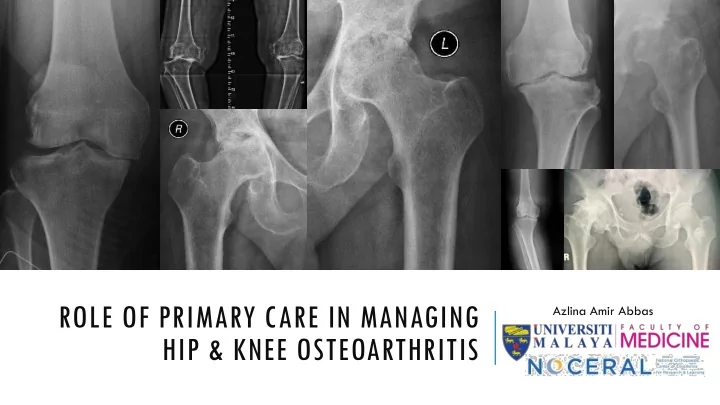
ROLE OF PRIMARY CARE IN MANAGING HIP & KNEE OSTEOARTHRITIS
Azlina Amir Abbas Dept of Orthopaedic Surgery Faculty of Medicine, University
- f Malaya
HIP & KNEE OSTEOARTHRITIS Faculty of Medicine, University of - - PowerPoint PPT Presentation
ROLE OF PRIMARY CARE IN MANAGING Azlina Amir Abbas Dept of Orthopaedic Surgery HIP & KNEE OSTEOARTHRITIS Faculty of Medicine, University of Malaya Most common cause of joint pain Functional limitation and reduced quality of life SITES
Azlina Amir Abbas Dept of Orthopaedic Surgery Faculty of Medicine, University
Most common cause of joint pain Functional limitation and reduced quality of life
No obvious cause
After certain predisposing factors Joint dysplasia
DDH, Perthe’s, Blount’s disease
Trauma
Fractures involving articular surface
Joint instability Occupation Obesity
NORMAL OSTEOARTHRITIS
Diagnose osteoarthritis clinically without investigations if a person:
is 45 or over and has activity-related joint pain and has either no morning joint-related stiffness or morning stiffness that lasts no longer than 30minutes.
Be careful of atypical features in history and physical examination
NICE Guidelines: OA Care & Management 2014
Weight-bearing films
Pelvis
Reduction in joint space Osteophytes Subchondral sclerosis Subchondral cysts
Generally not necessary If suspect secondary OA Blood investigations: Inflammatory arthritis, Septic arthritis Joint aspiration for FEME/C&S: large effusion, gout, septic arthritis CT or MRI: post-traumatic, congenital deformity CT MRI
Infection Instability Fracture
Take into account individual needs and preferences
Holistic Approach
Mood
Occupation
Sleep Social/ Function
Relation- ships
Health beliefs Pain Assessment
Comorbid- ities Expectations
NICE Guidelines: OA Care & Management 2014
Works quickly Lasts a long time Causes few side effects Can be used alongside other pain relievers
Does not have physiological effects eg on:
Nociceptive afferent fiber Spinal cord Inflammatory chemical mediators Damaged joint tissue Prostaglandin Pathway
CI = confidence interval; coxib = COX-2 inhibitor; NSAID = non-steroidal anti-inflammatory drug; nsNSAID = non-selective non-steroidal anti-inflammatory drug
Castellsague J et al. Drug Saf 2012; 35(12):1127-46. 3.8
Pooled Relative Risks and 95% CIs of Upper Gastrointestinal Complications
100 10 1 0.1 Pooled relative risk log scale
1.4 1.5 1.8 2.3 2.9 3.3 3.5 3.9 4.1 4.1 4.1 4.4 7.4 11.5 18.5
NSAIDs
Composite includes non-fatal myocardial infarction, non-fatal stroke, or cardiovascular death compared with placebo; chart based on network meta-analysis involving 30 trials and over 100,000 patients. Coxib = COX-2 inhibitor; nsNSAID = non-specific non-steroidal anti-inflammatory drug
Trelle S et al. BMJ 2011; 342:c7086.
Nociceptive afferent fiber
Descending modulation Ascending input
Spinal cord
Transduction Transmission
Brain
Perception
INTERACTION WITH THE MU (Μ) OPIOID RECEPTOR AS THE PRIMARY TARGET
Modify perception, modulate transmission and affect transduction by:
Altering limbic system activity; modify sensory and affective pain aspects Activating descending pathways that modulate transmission in spinal cord Affecting transduction of pain stimuli to nerve impulses
Reisine T, Pasternak G. In: Hardman JG et al (eds). Goodman and Gilman’s: The Pharmacological Basics of Therapeutics. 9th ed. McGraw-Hill; New York, NY: 1996; Scholz J, Woolf CJ. Nat Neurosci 2002; 5(Suppl):1062-7; Trescot AM et al. Pain Physician 2008; 11(2 Suppl):S133-53.
Looks like endorphins Binds to opioid receptors in the brain, spinal cord, and GI tract Release of dopamine – block pain transmission to brain
Prostaglandin Pathway
Central Nervous System Pathway
GI Respiratory CNS
Common: Confusion, drowsiness, hallucinations, bad dreams, dry mouth, nausea,
vomiting, constipation
Less common: Pruritus, sweating, opioid-induced hyperalgesia, myoclonus, delirium
Respiratory depression rare if titrated carefully to individual patient response Side effects may become apparent as the opioid dose is increased.
May be managed with other medications, e.g. antiemetics/antipsychotics but sometimes they persist or become intolerable and thus dose-limiting
Opiates are useful where alternatives are contraindicated or not tolerated or don’t work Opiates can be a nightmare if used in the wrong clinical context Especially in chronic pain syndromes Emphasizes the importance of the comprehensive pain assessment and using a holistic model
Adjunct Heat helps soothe stiff joints and relax muscles. Cold helps numb sharp pain and reduce inflammation TENS: stimulating nerves closes a "gate" mechanism in the spinal cord, and that can help eliminate the sensation of pain
Weight loss
weight loss of 10% or more over 18 months led to a 50% reduction in pain and significant improvements in mobility for people with arthritic knees weight loss of 20% or more led to an additional 25% reduction in pain (Messier et al, Arthritis Care & Research 2018)
Low impact Local muscle strengthening
Hip: Hip abductors Knee: Quadriceps
Mobilization exercises Improve general aerobic fitness
Glucosamine etc Viscosupplementation: Intra-articular hyaluronic acid injections
Local Adverse Reactions
Altered skin pigmentation Atrophy of subcutaneous and
periarticular tissue
Tendon rupture, tendon attrition Cartilage damage
Pain not responding to conservative treatment Mechanical pain/symptoms Severe deformity Reducing/poor/unacceptable Quality of life NOT EVERY PATIENT WITH OSTEOARTHRITIS NEEDS SURGERY!
Optimise any comorbid conditions
Nutrition Obesity Diabetes mellitus HbA1C < 8% Blood pressure No history of traditional medication use/ prolonged steroid ingestion – Cushing syndrome No source of infection
Arthroscopic washout Osteotomy – realignment procedure
NOT EVERY PATIENT WITH OSTEOARTHRITIS NEEDS JOINT REPLACEMENT!
Joint replacement
Enhance understanding of the condition and its management, and to counter misconceptions On-going – not just one-off
Managing patients with osteoarthritis is a team effort Treatment: Non-operative & Operative Always attempt non-operative unless severe functional limitation or pain Refer for surgery before there is prolonged and established functional limitation and severe pain Education and information sharing is an integral part of the management
EMPOWER YOUR PATIENTS!
azabbas@um.edu.my