
SLIDE 1
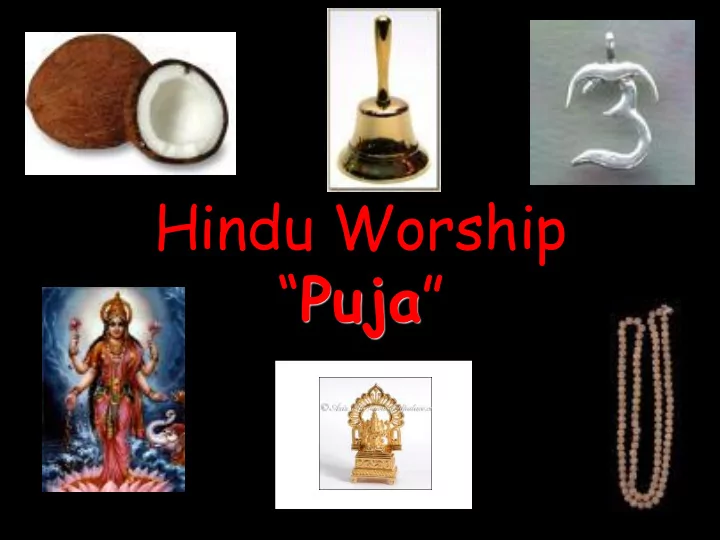
Hindu Worship Puja LQs: Can I explain what puja is and why it is - - PowerPoint PPT Presentation
Hindu Worship Puja LQs: Can I explain what puja is and why it is important for Hindus? Can I explain the important items on a puja tray and what they symbolise? Question How would d you describe e God? 1. 1. Because God is
◼ Can I explain what puja is and why it is
important for Hindus?
◼ Can I explain the important items on a
puja tray and what they symbolise?
1. 1.
Because God is difficult to describe, Hindu’s often use their 5 senses to help them understa tand God.
2. 2.
If God could ld be understo tood by touch, what t woul uld God be like? (Give a reason).
◼ Many objects of worship used during
Puja at the shrine appeal to the five senses of sight, hearing, smell, taste and touch.
◼ This is to involve the whole person in
the worship.
How many senses does a rose use?
Puja is a daily routine for Hindus. Puja is an act
worship. Puja is made at least
the morning. It is a simple form of worship using Mantras (prayers) and making
At the end of Puja, any food offered to the god is shared out amongst the worshippers. This food is known as prashad.
RNWU
s0mN5P8jo
The image of the god is “awakened” by the lighting of a flame (Agni) and by the sound of the prayer (Mantra),
the playing of music (Raga)
ringing
bell.
word ‘Aum’ is a sound symbol for Brahman.
chanted over and over again during worship.
called ‘Prasad’ are placed on the
shares this food after worship.
be important in worship?
Incense is burned and Arti performed before the image (Murti).
The scent of ghee or incense fills the room. Why? To remind that Brahman is everywhere.
An arti lamp with five wicks, each of which represent s one of the five elements, earth, air, fire, water and
that fire can be used to communicate with God and transfer his blessings.
meditate upon Mandalas or Rangoli whilst worshipping. Why?
signifies Brahman.
a god (called Murtis) are placed on the shrine.
the Goddess Lakshimi.
use to “see” God
The five elements are referred to in Hindu worship
Label the parts of the puja tray and expain how each object is used during Puja worship
Murti
The murti (image) is a picture or statue of one or more of the gods that the family has specifically chosen to worship. The murti helps the person to focus on their god and the abilities or role of their god. The murti is washed regularly.
Murti
The murti (image) is a picture
gods that the family has specifically chosen to worship. The murti helps the person to focus on their god and the abilities or role of their god. The murti is washed regularly.
Incense
Incense sticks are lit to purify and cleanse the air where the prayers are being said and to create a holy atmosphere.
Bell
The bell is rung at the start
worship is about to start. Hindus feel it unreasonable to expect something as great as a god to be sat around waiting for humans to worship them.
Light
The light is moved around the shrine symbolising the presence of their god. First they pass their hands over the flame then over their head, this symbolises being covered with the presence
Offerings
Offerings of food such as rice, nuts, sweets and fruit; are seen as symbolic gifts
to their deity
Water
This is used for purification. Water is offered to the gods and worshippers will take three sips before saying their mantra. Some shrines have water from the Ganga (River Ganges).
Kum Kum Powder
Worshippers make a paste from this powder and use it to mark their forehead. This is a sign of their devotion and the blessings and protection of their god.
After performing puja all five senses have been awakened to begin the day Think about each element on the puja
do you think each element on the puja tray awakens e.g. Bell - hearing
Sense Puja Tray Helps to…
Touch Sandalwood paste Show God’s blessing Smell Taste Hearing Sight
Burned before the murti