High-dimensional and infinite-dimensional hyperbolic crosses and - - PowerPoint PPT Presentation

high dimensional and infinite dimensional hyperbolic
SMART_READER_LITE
LIVE PREVIEW

High-dimensional and infinite-dimensional hyperbolic crosses and - - PowerPoint PPT Presentation

High-dimensional and infinite-dimensional hyperbolic crosses and their applications in approximation and uncertainty quantification Dinh D ung Vietnam National University, Hanoi, Vietnam Workshop on Information-Based Complexity and


slide-1
SLIDE 1

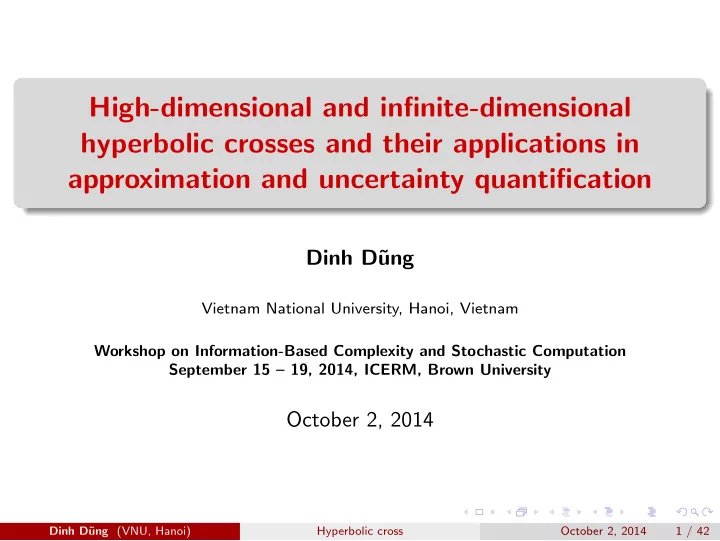
High-dimensional and infinite-dimensional hyperbolic crosses and their applications in approximation and uncertainty quantification

Dinh D˜ ung

Vietnam National University, Hanoi, Vietnam Workshop on Information-Based Complexity and Stochastic Computation September 15 – 19, 2014, ICERM, Brown University

October 2, 2014

Dinh D˜ ung (VNU, Hanoi) Hyperbolic cross October 2, 2014 1 / 42

slide-2
SLIDE 2

This talk is based in the recent joint works: 1 DD and T. Ullrich, N-Widths and ε-dimensions for high-dimensional approximations, Foundations Comp. Math. 13 (2013), 965-1003. 2 A. Chernov and DD, New explicit-in-dimension estimates for the cardinality of high-dimensional hyperbolic crosses and approximation

  • f functions having mixed smoothness, (2014)

http://arxiv.org/abs/1309.5170. 3 DD and M. Griebel, Hyperbolic cross approximation in infinite dimensions and applications in sPDEs, Manuscript (2014).

Dinh D˜ ung (VNU, Hanoi) Hyperbolic cross October 2, 2014 2 / 42

slide-3
SLIDE 3

The “curse of dimensionality”

There has been a great interest in solving numerical problems involving functions of big number s of variables. By classical methods as usually, the computation cost grows exponentially in s. We suffer the “curse of dimensionality” [Bellmann,1957] (“Dimensionality” is referred to the number s of variables). A way to get rid of it is

to assume that mixed derivatives of functions are bounded, then to apply hyperbolic cross (HC) approximation.

Dinh D˜ ung (VNU, Hanoi) Hyperbolic cross October 2, 2014 3 / 42

slide-4
SLIDE 4

Infinite-dimensional approximation

The efficient approximation of a function of infinitely many variables is important in applications in physics, finance, engineering and statistics. It arises in UQ, computational finance and computational physics and is encountered for stochastic or parametric PDEs. Attempt: Apply infinite-dimensional HC to construct a linear approximation method to the solution of stochastic or parametric PDEs.

Dinh D˜ ung (VNU, Hanoi) Hyperbolic cross October 2, 2014 4 / 42

slide-5
SLIDE 5

Classical hyperbolic crosses

Classical HCs Γ(s, T) are a domain of frequencies of trigonometric polynomials used for approximations of periodic functions having mixed derivative. They are given by Γ(s, T) :=

  • k ∈ Zs :

s

  • i=1

max(|ki|, 1) ≤ T

  • .

Their cardinality is estimated as C(s) T logs−1 T ≤ |Γ(s, T)| ≤ C ′(s) T logs−1 T, where |G| denotes the cardinality of G.

Dinh D˜ ung (VNU, Hanoi) Hyperbolic cross October 2, 2014 5 / 42

slide-6
SLIDE 6

n-Widths and ε-dimensions

Kolmogorov n-widths: dn(W , H) := inf

{Ln linear subspaces, dim Ln≤n} sup f ∈W

inf

g∈Ln f − gH.

ε-dimension is the inverse of dn(W , H): nε(W , H) := inf{n : ∃Ln : dim Ln ≤ n, sup

f ∈W

inf

g∈Ln f − gH ≤ ε}.

nε(W , H) is the necessary dimension of linear subspace for approximation of functions from W with accuracy ε. From the computational view it is more convenient to study nε(W , H) since it is directly related to the computation cost.

Dinh D˜ ung (VNU, Hanoi) Hyperbolic cross October 2, 2014 6 / 42

slide-7
SLIDE 7

High-dimensional approach

Sobolev space of mixed smoothness α ∈ N f 2

mix =

  • |k|∞≤α
  • ∂|k|1f

∂xk1

1 · · · ∂xks s

  • 2

2,

|k|∞ := max

1≤i≤s ki.

mix is the unit ball in Hα mix.

Traditional estimations [Babenko 1960]: A(α, s) ε−1/α | log ε|s−1 ≤ nε(Uα

mix, L2) ≤ A′(α, s) ε−1/α | log ε|s−1.

Our goal: to compute A(α, s), A′(α, s) explicitly in s. The basis for estimation of nε: Reduction to computation of cardinality of the associated HCs: |Γ(s, 1/ε)| − 1 ≤ nε(Uα

mix, L2) ≤ |Γ(s, 1/ε)|

Dinh D˜ ung (VNU, Hanoi) Hyperbolic cross October 2, 2014 7 / 42

slide-8
SLIDE 8

Plan of our talk

High-dimensional HC approximation for two models of mixed smoothness:

Dyadic version [DD&Ullrich 2013]; Korobov version [Chernov&DD 2014].

Infinite-dimensional HC approximation for two models of regularity:

Korobov version [DD&Griebel 2014]; Analytic version [DD&Griebel 2014].

Application of infinite-dimensional HC approximation in stochastic or parametric PDEs.

Dinh D˜ ung (VNU, Hanoi) Hyperbolic cross October 2, 2014 8 / 42

slide-9
SLIDE 9

Dyadic version: decomposition in frequency domain

L2(Ts) is the space of periodic functions on the torus Ts := [0, 1]s equipped with the inner product (f , g) :=

  • Ts f (x)g(x) dx.

Let ek(x) := s

j=1 e2πi kjxj.

For m ∈ Zs

+ and f ∈ L2(Ts), define the operator:

δm(f ) :=

k∈m ˆ

f (k)ek, m := {k ∈ Zs : ⌊2mi−1⌋ ≤ |ki| < 2mi}, where ˆ f (k) is the kth Fourier coefficient. Based on Parseval’s identity f 2

2 = m∈Zs

+ δm(f )2

2, we define the

space Hα

mix of mixed smoothness α:

f 2

mix :=

  • m∈Zs

+

22α|m|1δm(f )2

2 < ∞,

|m|1 :=

s

  • j=0

mj.

Dinh D˜ ung (VNU, Hanoi) Hyperbolic cross October 2, 2014 9 / 42

slide-10
SLIDE 10

Dyadic version: Fourier HC approximation

Step HCs are formed from dyadic boxes m: Gstep(s, n) := m : m ∈ Zs

+, |m|1 ≤ n

  • .

V s(n) – the trigonometric polynomials with frequencies in Gstep(s, n). Linear Fourier operator: Sn(f ) :=

  • k∈Gstep(s,n)

ˆ f (k) ek. Let Uα

mix be the unit ball in Hα

  • mix. For n ∈ N,

sup

f ∈Uα

mix

inf

g∈V s(n) f − g2 ≤

sup

f ∈Uα

mix

f − Sn(f )2 ≤ 2−n; We have dim V s(n) = |Gstep(s, n)|.

Dinh D˜ ung (VNU, Hanoi) Hyperbolic cross October 2, 2014 10 / 42

slide-11
SLIDE 11

Dyadic version: nε and the cardinality of HCs

Estimation of nε is reduced to estimation of |Gstep(s, n)| for ε = 2−n: |Gstep(s, n)| − 1 ≤ nε(Uα

mix, L2(Ts)) ≤ |Gstep(s, n)|,

For any n ∈ Z+, 2n n + s − 1 s − 1

  • ≤ |Gstep(s, n)| ≤ 2n+1

n + s − 1 s − 1

  • .

Theorem (DD&Ullrich 2014)

Let α > 0. Then we have for any 0 < ε ≤ 2−αs, 1 2[α(s − 1)]−(s−1) ≤ nε(Uα

mix, L2(Ts))

ε−1/α| log ε|s−1 ≤ 4 α(s − 1) 2e −(s−1) . The ratio decays exponentially fast in s.

Dinh D˜ ung (VNU, Hanoi) Hyperbolic cross October 2, 2014 11 / 42

slide-12
SLIDE 12

Dyadic version

[DD&Ullrich 2013] Estimates in this manner have been proven also for nε(Uα

mix, Hγ(Ts)) in energy norm of Sobolev space Hγ(Ts).

In the dyadic version, we can prove lower and upper bounds for nε(Uα

mix, L2(Ts)) only for very small ε ≤ 2−αs.

The reason: The step HC approximation for the class Uα

mix involve a

whole dyadic block δk(f ) :=

  • m∈k

ˆ f (m)em with the cardinality |k| ≥ 2s. Let us consider another model of mixed smoothness: Korobov-type mixed smoothness.

Dinh D˜ ung (VNU, Hanoi) Hyperbolic cross October 2, 2014 12 / 42

slide-13
SLIDE 13

A modification of Korobov space K r

s

For r > 0 and k ∈ Zs, define the scalar λ(k) by λ(k) :=

s

  • j=1

λ(kj), λ(kj) := (1 + |kj|), Korobov function: κr

s :=

  • k∈Zs

λ(k)−r ek. Korobov space K r

s :

K r

s := {f : f = κr s ∗ g, g ∈ L2(Ts)}

with the norm f K r

s

:= g2.

Dinh D˜ ung (VNU, Hanoi) Hyperbolic cross October 2, 2014 13 / 42

slide-14
SLIDE 14

Hyperbolic crosses for K r

s

The symmetric continuous HC: G(s, T) :=

  • k ∈ Zs :

s

  • i=1

(|ki| + 1) ≤ T

  • .

Ur

s is the unit ball in K r s .

Using Fourier approximation by trigonometric polynomials with frequencies in HC G(s, T) we have |G(s, T)| − 1 ≤ nε(Ur

s , L2(Ts)) ≤ |G(s, T)|, T = ε−1/r.

⇒ Estimation of nε(Ur

s , L2(Ts)) is reduced to estimation of |G(s, T)|.

Dinh D˜ ung (VNU, Hanoi) Hyperbolic cross October 2, 2014 14 / 42

slide-15
SLIDE 15

New estimates for the cardinality of HCs

Theorem (Chernov&DD 2014)

For T ≥ 1, |G(s, T)| < 2s T(ln T + s ln 2)s (s − 1)!

  • ln T + s ln 2 + s − 1

, and for T > (3/2)s, |G(s, T)| > 2s T(ln T − s ln(3/2))s (s − 1)! (ln T − s ln(3/2) + s) For ε > 0, |G(s, T)| − 1 ≤ nε(Ur

s , L2(Ts)) ≤ |G(s, T)|, T = ε−1/r.

Dinh D˜ ung (VNU, Hanoi) Hyperbolic cross October 2, 2014 15 / 42

slide-16
SLIDE 16

New bounds for nε(Ur

s , L2(Ts))

Theorem (Chernov&DD 2014)

Let r > 0, s ≥ 2. Then we have for every ε ∈ (0, 1], nε(Ur

s , L2(Ts)) ≤

2s ε−1/r (ln ε−1/r + s ln 2)s (s − 1)!

  • ln ε−1/r + s ln 2 + s − 1

, and for every ε ∈ (0, [3/2]−sr), nε(Ur

s , L2(Ts)) ≥

2s ε−1/r (ln ε−1/r − s ln(3/2))s (s − 1)! (ln ε−1/r − s ln(3/2) + s) − 1 In traditional estimations, ε−1/r| log ε|(s−1)/r is a priori split from constants which are a function of dimension parameter s. ⇒ Any high-dimensional estimate based on them leads to a rougher bound.

Dinh D˜ ung (VNU, Hanoi) Hyperbolic cross October 2, 2014 16 / 42

slide-17
SLIDE 17

Related results

[K¨ uhn, Sickel & Ullrich 2014] have established upper and lower bounds explicit in s for large n and small n (preasymptotics), for the approximation number an(Is : Hα

mix → L2(Ts))

(given in the talk by Winfried Sickel yesterday).

Dinh D˜ ung (VNU, Hanoi) Hyperbolic cross October 2, 2014 17 / 42

slide-18
SLIDE 18

Infinite-dimensional HC approximation

Infinite tensor product probability measure Let I := [−1, 1]. Let dµ∞ be the tensor product infinite tensor product measure on I∞ of the univariate uniform probability measures

  • n I:

dµ∞(y) :=

  • j∈Z

1 2dyj. The sigma algebra Σ for dµ∞ is generated by the finite rectangles

  • j∈N

Ij, Ij ⊂ I, where only a finite number of the Ij are different from I. Let dµn = dx be the uniform probability measure on the n-dimensional torus Tn := [0, 1]n. We define dµ(x, y) := dµn(x)

  • dµ∞(y).

Dinh D˜ ung (VNU, Hanoi) Hyperbolic cross October 2, 2014 18 / 42

slide-19
SLIDE 19

Space L2(Tn ⊗ I∞, dµ)

L2(Tn ⊗ I∞, dµ) is the Hilbert space of functions on Tn ⊗ I∞: (f , g) :=

  • I∞ f (x, y)g(x, y) dµ(x, y).

The norm in L2(Tn ⊗ I∞, dµ) is defined as f := (f , f )1/2. L2(Tn ⊗ I∞, dµ) = L2(Tn, dµn) ⊗ L2(I∞, dµ∞).

Dinh D˜ ung (VNU, Hanoi) Hyperbolic cross October 2, 2014 19 / 42

slide-20
SLIDE 20

Bochner space H := Hb(Tn) ⊗ L2(I∞, dµ∞)

For b ≥ 0, H := Hb(Tn) ⊗ L2(I∞, dµ∞), Hb(Tn) is the Sobolev space of smoothness b. ⇒ H is a Bochner space: H = L2(I∞, dµ∞; Hb(Tn)) – the set of all functions f : I∞ → Hb(Tn) such that f 2

H :=

  • I∞ f (·, y2

Hb(Tn) dµ∞(y) < ∞.

For b = 0, H = L2(Tn ⊗ I∞, dµ) = L2(Tn, dµn) ⊗ L2(I∞, dµ∞).

Dinh D˜ ung (VNU, Hanoi) Hyperbolic cross October 2, 2014 20 / 42

slide-21
SLIDE 21

Infinite-dimensional Legendre polynomials

Let {Lk}∞

k=0 be the family of univariate orthonormal Legendre

polynomials in L2(I, 1

2dx), i.e.

1 2

  • I

Lk(y)Ls(y)dy = δks. Z∞ – the set of all sequences k = (kj)∞

j=1 with kj ∈ Z;

Z∞

+∗ := {k ∈ Z∞ : kj ≥ 0, j = 1, 2, ..., supp(k) is finite}.

For s ∈ Z∞

+∗, we define

Ls(y) :=

  • j∈supp(s)

Lsj(yj). (Ls)s∈Z∞

+∗ is an orthonormal basic of L2(I∞, dµ). Dinh D˜ ung (VNU, Hanoi) Hyperbolic cross October 2, 2014 21 / 42

slide-22
SLIDE 22

Infinite-dimensional mixed polynomials

Let {ek}k∈Zn be the orthonormal trigonometric basis in L2(Tn, dx). For (k, s) ∈ Zn ⊗ Z∞

+∗, we define

h(k,s)(x, y) := ek Ls. (h(k,s))(k,s)∈Zn⊗Z∞

+∗ is an orthonormal basis of L2(Tn ⊗ I∞, dµ).

For every f ∈ L2(Tn ⊗ I∞, dµ), f =

  • (k,s)∈Zn⊗Z∞

+∗

f(k,s)h(k,s), f(k,s) = (f , h(k,s)).

Dinh D˜ ung (VNU, Hanoi) Hyperbolic cross October 2, 2014 22 / 42

slide-23
SLIDE 23

Infinite-variate Korobov-type space

Let n ∈ Z+, a > 0 and r = (rj)∞

j=1 ∈ I∞ with rj > 0.

For a (k, s) ∈ Zn ⊗ Z∞

+∗, we define

λa,n,r(k, s) := max

1≤j≤n(1 + |kj|)a ∞

  • j=1

(1 + sj)rj. The Korobov-type space K a,r(Tn ⊗ I∞) is the set of all functions f ∈ L2(Tn ⊗ I∞, dµ) such that f =

  • (k,s)∈Zn⊗Z∞

+∗

λa,n,r(k, s)g(k,s)h(k,s), g ∈ L2(Tn ⊗ I∞, dµ). The norm of K a,r(Tn ⊗ I∞) is defined by f K a,r(Tn⊗I∞) := g.

Dinh D˜ ung (VNU, Hanoi) Hyperbolic cross October 2, 2014 23 / 42

slide-24
SLIDE 24

Infinite-variate Korobov-type space

For n = 0, K a,r(Tn ⊗ I∞) := K r(I∞). K a,r(Tn ⊗ I∞) = Ha(Tn) ⊗ K r(I∞). The subspace K a,r(Tn ⊗ Is) in K a,r(Tn ⊗ I∞) is the set of all functions f ∈ L2(Tn ⊗ I∞, dµ) such that f =

  • (k,s)∈Zn⊗Z∞

+∗: supp(k)⊂{1,··· ,s}

λa,n,r(k, s)g(k,s)h(k,s), with g ∈ L2(Tn ⊗ I∞, dµ).

Dinh D˜ ung (VNU, Hanoi) Hyperbolic cross October 2, 2014 24 / 42

slide-25
SLIDE 25

Infinite-dimensional HC approximation

The infinite-dimensional HC with different weights: G(T) :=

  • (k, s) ∈ Zn ⊗ Z∞

+∗ : λa−b,n,r(k, s) ≤ T

  • (a > b ≥ 0).

Let P(T) be the HC subspace of polynomials g of the form g =

  • (k,s)∈G(T)

g(k,s)h(k,s). dim P(T) = |G(T)|. The HC operator ST : H → P(T) ST(f ) :=

  • (k,s)∈G(T)

f(k,s)h(k,s).

Dinh D˜ ung (VNU, Hanoi) Hyperbolic cross October 2, 2014 25 / 42

slide-26
SLIDE 26

Infinite-dimensional HC approximation

H := Hb(Tn) ⊗ L2(I∞, dµ∞); Ua,r is the unit ball in K a,r(Tn ⊗ I∞); Ua,r

s

is the unit ball in K a,r(Tn ⊗ Is). For arbitrary T ≥ 1, sup

f ∈Ua,r

inf

g∈P(T) f − gH = sup f ∈Ua,r f − ST(f )H ≤ T −1

For ε ∈ (0, 1], |H(1/ε)| − 1 ≤ nε(Ua,r, H)) ≤ |H(1/ε)|

Dinh D˜ ung (VNU, Hanoi) Hyperbolic cross October 2, 2014 26 / 42

slide-27
SLIDE 27

Cardinality of infinite-dimensional HCs

Theorem (DD&Griebel 2014)

Let n ∈ N, 0 ≤ b < a < r/n and r = (rj)∞

j=1 ∈ I∞ with

0 < r = rn+1 = · · · = rn+ν+1 < rn+ν+2 ≤ rn+ν+3 ≤ · · · . Assume that there holds the condition M :=

  • j=ν+2

1 nrj/(a − b) − 1 3 2 −(nrj/(a−b)−1) < ∞. Then we have for every T ≥ 1, ⌊T n/(a−b)⌋ ≤ |G(T)| ≤ C(a, n, r) T n/(a−b), (1) where C(a, b, n, r) := eM 3n 1 +

1 rn/(a−b)−1

3

2

rn/(a−b)−1ν .

Dinh D˜ ung (VNU, Hanoi) Hyperbolic cross October 2, 2014 27 / 42

slide-28
SLIDE 28

Estimates of ε-dimensions

Theorem (DD&Griebel 2014)

Let nε := nε(Ua,r, H), nε(s) := nε(Ua,r

s , H)).

Under the assumptions and notation of the previous theorem, we have for every ε ∈ (0, 1], ⌊ε−n/(a−b)⌋ − 1 ≤ nε(s) ≤ nε ≤ C(a, n, r) ε−n/(a−b).

Dinh D˜ ung (VNU, Hanoi) Hyperbolic cross October 2, 2014 28 / 42

slide-29
SLIDE 29

Estimates of ε-dimensions

Remarks The terms C(a, b, n, r) is independent of s when s may be very large. The main component ε−n/(a−b) depends on ε and a, b, n, only. The restriction on r

  • j=ν+2

1 n rj/(a − b) − 1 3 2 −(n rj/(a−b)−1) < ∞ is moderate. It is satisfied if a, b, n are fixed and the subsequence (rj)∞

j=ν+2 is mildly increasing say as an arithmetic progression.

The problem of nε(Ua,r

s , L2(Tn ⊗ Rs, dµ)) is strongly polynomially

tractable with respect to large s.

Dinh D˜ ung (VNU, Hanoi) Hyperbolic cross October 2, 2014 29 / 42

slide-30
SLIDE 30

Infinite-variate space Aa,r(Tn ⊗ I∞)

Let n ∈ Z+, a > 0 and r = (rj)∞

j=1 ∈ I∞ with rj > 0. For a

(k, s) ∈ Zn ⊗ Z∞

+∗, we define

ρa,n,r(k, s) := max

1≤j≤n(1 + |kj|)a exp(r, s),

(r, s) :=

  • j=1

rjsj. The space Aa,r(Tn ⊗ I∞) is the set of all functions f ∈ L2(Tn ⊗ I∞, dµ) such that f =

  • (k,s)∈Zn⊗Z∞

+∗

ρa,n,r(k, s)g(k,s)h(k,s), g ∈ L2(Tn ⊗ I∞, dµ). The norm of Aa,r(Tn ⊗ I∞) is defined by f Aa,r(Tn⊗I∞) := g.

Dinh D˜ ung (VNU, Hanoi) Hyperbolic cross October 2, 2014 30 / 42

slide-31
SLIDE 31

Infinite-variate space Aa,r(Tn ⊗ I∞) = Ha(Tn) ⊗ Ar(I∞)

For n = 0, K a,r(Tn ⊗ I∞) := Ar(I∞). Aa,r(Tn ⊗ I∞) = Ha(Tn) ⊗ Ar(I∞). ⇒ Aa,r(Tn ⊗ I∞) is a subspace of H for a > b.

Dinh D˜ ung (VNU, Hanoi) Hyperbolic cross October 2, 2014 31 / 42

slide-32
SLIDE 32

HC approximation in Bochner space

The infinite-dimensional exp. HC with different weights: E(T) :=

  • (k, s) ∈ Zn ⊗ Z∞

+∗ : ρa−b,n,r(k, s) ≤ T

  • , (a > b).

Let E(T) be the HC subspace of polynomials g of the form g =

  • (k,s)∈E(T)

g(k,s)h(k,s). The HC operator: PT(f ) :=

  • (k,s)∈E(T)

f(k,s)h(k,s).

Dinh D˜ ung (VNU, Hanoi) Hyperbolic cross October 2, 2014 32 / 42

slide-33
SLIDE 33

HC approximation in Bochner space

H := Hb(Tn) ⊗ L2(I∞, dµ∞). Ba,r is the unit ball in Aa,r(Tn ⊗ I∞) = Ha(Tn) ⊗ Ar(I∞). Let a > b ≥ 0. For arbitrary T ≥ 1, sup

f ∈Ba,r

inf

g∈E(T) f − gH = sup f ∈Ba,r f − PT(f )H ≤ T −1.

For ε ∈ (0, 1], |E(1/ε)| − 1 ≤ nε(Ba,r, H) ≤ |E(1/ε)|.

Dinh D˜ ung (VNU, Hanoi) Hyperbolic cross October 2, 2014 33 / 42

slide-34
SLIDE 34

Cardinality of infinite-dimensional HCs

Theorem (DD&Griebel 2014)

Let n ∈ N, a > b ≥ 0 and r = (rj)∞

j=1 ∈ I∞ with rj > 0. Assume that

there holds the condition ∞

j=1(enrj/(a−b) − 1)−1 < ∞.

Then we have for every T ≥ 1, ⌊T n/(a−b)⌋ ≤ |E(T)| ≤ D(a, b, n, r) T n/(a−b), (2) where D(a, b, n, r) := 32n exp ∞

j=1(enrj/(a−b) − 1)−1

.

Dinh D˜ ung (VNU, Hanoi) Hyperbolic cross October 2, 2014 34 / 42

slide-35
SLIDE 35

ε-dimensions in Bochner space

Theorem (DD&Griebel 2014)

Under the assumptions and notation of the previous theorem, we have for every ε ∈ (0, 1], ⌊ε−n/(a−b)⌋ − 1 ≤ nε(Ba,r, H)) ≤ D(a, b, n, r) ε−n/(a−b). Related papers: Liberating the dimension for function approximation [Wasilkowski,Wozniakowski 2011], [Wasilkowski 2012].

Dinh D˜ ung (VNU, Hanoi) Hyperbolic cross October 2, 2014 35 / 42

slide-36
SLIDE 36

Application in Elliptic sPDEs (periodic model)

Let D := (0, 1)n ⊂ Rn. Consider the following parametric (stochastic) periodic elliptic problem − ∇x (a(x, y)∇x u(x, y)) = f (x, y) in D, u|∂D = 0, (3) where the diffusion coefficients a(x, y) are functions 1-periodic functions in x, and parameters y = (yj)∞

j=1 ∈ Y := I∞, and f (·, y) is

a fixed 1-periodic function in L2(D). In a typical case, a(x, y) has the following expansion a(x, y) := ¯ a(x) +

  • j=1

yjψj(x, y), (4) where ¯ a is 1-periodic, ¯ a ∈ L∞(D) and (ψj)∞

j=1 ⊂ L∞(D) with

1-periodic ψj. A choice for (ψj)∞

j=1 in sPDEs is the Karh´

unen-Lo` eve basis where ¯ a is the average of a and yj is pairwise decorrelated random variables.

Dinh D˜ ung (VNU, Hanoi) Hyperbolic cross October 2, 2014 36 / 42

slide-37
SLIDE 37

Papers on sPDEs

[Nobile,Tempone,Webster 2008] Sparse grid collcation method. [Cohen,DeVore,Schwab 2010], [Hoang,Schwab 2014] N-term Galerkin approximations. [Beck,Nobile,Tammelli,Tempone 2012, 2013] Polynomial approximation by Galerkin and collocation methods.

Dinh D˜ ung (VNU, Hanoi) Hyperbolic cross October 2, 2014 37 / 42

slide-38
SLIDE 38

Application in Elliptic sPDEs (periodic model)

The solution u is living in the Bochner spase H0 := L2(I∞, dµ; V ), V := Hb

0 (Tn) (b = 0, 1).

Depending on the properties of the diffusion function a(x, y) and the function f (x, y), we have higher regularity of u in both, x and y. We may assume that (K) u ∈ Ha(Tn) ⊗ K r(I∞) = K a,r(Tn ⊗ I∞) (mixed smoothness), or (A) u ∈ Ha(Tn) ⊗ Ar(I∞) = Aa,r(Tn ⊗ I∞) (analyticity) for some a > b (a = 1, 2), r ∈ R∞

+ satisfying the assumptions of the

above theorems on the infinite-dimensional HCs G(T) and E(T). With some natural restrictions (for instance, ψjL∞(D) ≤ C j−s, s > 1, in K-L expansion), u has analytic regularity in y [Cohen,DeVore,Schwab 2010] ⇒ the assumption (A) is quite reasonable.

Dinh D˜ ung (VNU, Hanoi) Hyperbolic cross October 2, 2014 38 / 42

slide-39
SLIDE 39

Linear approximation to the solution u of elliptic sPDEs

Let a > b ≥ 0. For arbitrary T ≥ 1, (K) u − ST(u)L2(I∞,dµ;V ) ≤ uHa(Tn)⊗K r(I∞)T −1 and (A) u − PT(u)L2(I∞,dµ;V ) ≤ uHa(Tn)⊗Ar(I∞)T −1 The cardinality index sets of the associated HCs are bounded by (K) |G(T)| ≤ C(a, b, n, r)T n/(a−b), and (A) |E(T)| ≤ D(a, b, n, r)T n/(a−b).

Dinh D˜ ung (VNU, Hanoi) Hyperbolic cross October 2, 2014 39 / 42

slide-40
SLIDE 40

Linear approximation to the solution u of elliptic sPDEs

Case (K) N := |G(T)| ⇒ rank ST = N ⇒ ST as a linear operator of rank N: LN := ST, for which u − LN(u)L2(I∞,dµ;V ) ≤ C ∗ uHa(Tn)⊗K r(I∞) N−(a−b)/n where C ∗ := C(a, b, n, r)(a−b)/n. Case (A) N := |E(T)| ⇒ rank PT = N ⇒ PT as a linear operator of rank N: ΛN := PT, for which u − ΛN(u)L2(I∞,dµ;V ) ≤ D∗ uHa(Tn)⊗Ar(I∞) N−(a−b)/n where D∗ := D(a, b, n, r)(a−b)/n.

Dinh D˜ ung (VNU, Hanoi) Hyperbolic cross October 2, 2014 40 / 42

slide-41
SLIDE 41

Conclusion

We have shown that, under our assumptions and for linear information, the bounds are completely free of the dimension. In any case, the stochastic part has disappeared from the complexities and only appears in the constants. The analysis for standard information still needs to be done.

Dinh D˜ ung (VNU, Hanoi) Hyperbolic cross October 2, 2014 41 / 42

slide-42
SLIDE 42

Thank you for your attention!

Dinh D˜ ung (VNU, Hanoi) Hyperbolic cross October 2, 2014 42 / 42