Healing Hearts Thank you for offering me the docket to share about - - PowerPoint PPT Presentation

healing hearts
SMART_READER_LITE
LIVE PREVIEW

Healing Hearts Thank you for offering me the docket to share about - - PowerPoint PPT Presentation

Healing Hearts Thank you for offering me the docket to share about Presbyterian mission and ministries in Africa. My husband Jeff and I were commissioned as PC(USA) Mission Co-Workers at the General Assembly of 1990 in Salt Lake City and have


slide-1
SLIDE 1

Healing Hearts christi.boyd@pcusa.org 1

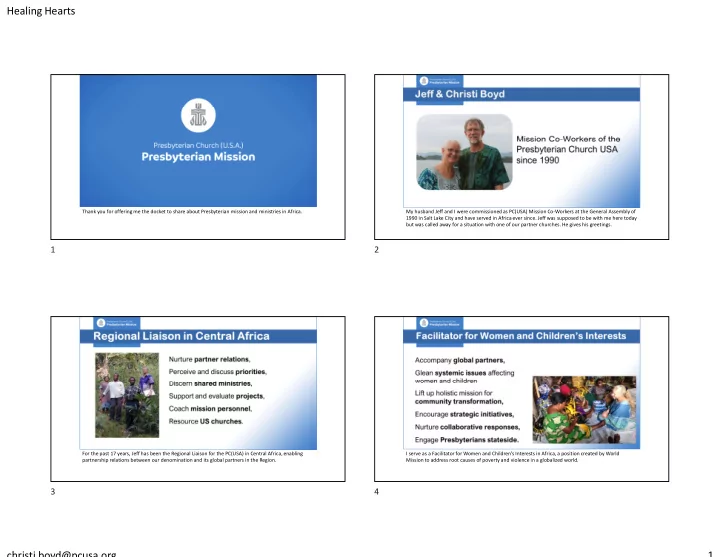
Thank you for offering me the docket to share about Presbyterian mission and ministries in Africa. My husband Jeff and I were commissioned as PC(USA) Mission Co-Workers at the General Assembly of 1990 in Salt Lake City and have served in Africa ever since. Jeff was supposed to be with me here today but was called away for a situation with one of our partner churches. He gives his greetings. For the past 17 years, Jeff has been the Regional Liaison for the PC(USA) in Central Africa, enabling partnership relations between our denomination and its global partners in the Region. I serve as a Facilitator for Women and Children’s Interests in Africa, a position created by World Mission to address root causes of poverty and violence in a globalized world.

1 2 3 4

slide-2
SLIDE 2

Healing Hearts christi.boyd@pcusa.org 2

Between Jeff and me, we work in seven nations across the African continent, with the Democrat Republic of Congo as the only country that we share. It is where we are based, in the capital city of Kinshasa. In this era of Presbyterian Mission, we collaborate in a multi-dimensional partnership paradigm between global ecumenical partners, Presbyterian constituent partners in the US, and Presbyterian World Mission as our denominational Ministry Area. As a connectional Church, we can be most effective when focusing our efforts in shared areas of common interests. Many women and children are trapped at the intersection of cultural, legal, religious, political and economic systems that generate and perpetuate their hardship. Rather than working in individual sectoral programs, it takes an integrated and collaborative approach for the Church to take on these societal and global concerns, building communities of solidarity, with the church as a beacon of hope for community transformation. When mapped out across the African continent, a larger picture appears of systemic issues that are lifted up by our African partners with Presbyterians in the US coming alongside.

5 6 7 8

slide-3
SLIDE 3

Healing Hearts christi.boyd@pcusa.org 3

Childhood Trauma is one of the concerns our Congolese partners are addressing and for which they have asked the PC(USA) to come alongside. Ever since history has been written, the Congolese people have endured violence - from the early slave trade, the exploitative colonial rule and self-enriching dictatorships, to proxy wars, terrorizing militias and inter-communal strife. The overlooked witnesses of these manmade disasters are children. They’ve lost their parents, been displaced or recruited by the armed groups, and sexually assaulted or conceived of rape by soldiers or militia members. If the pain of the emotional wounds of these traumatic experiences is not transformed, it can be transferred in the form of violent behavior towards others or harmful acts to oneself. This is how the cycle of trauma and violence is perpetuated and transmitted from one generation onto another with violence becoming endemic in society.

9 10 11 12

slide-4
SLIDE 4

Healing Hearts christi.boyd@pcusa.org 4

I invite you to listen to the account of Ngasa, a young girl from the Kasai region. Please, be forewarned that the description of her experiences is graphic. Ngasa speaks in Tshiluba, but you can follow her by reading the subtitles. For children like Ngasa, the Protestant Council of Churches in Congo (ECC) embraced Healing Hearts as a trauma-healing ministry based on the 10-lesson curriculum developed by the Trauma-Healing Institute of the American Bible Society. This holistic program weaves faith-based interpretations into conventional mental health approaches. The activities help children understand their reactions to trauma and engage them in a process of healing to restore relations with self, God, and others. To extend trauma-healing ministries into communities, the Church needs skilled volunteers. To that extent the Council, in partnership with the Congolese Bible Alliance and the PC(USA), organizes training events for Healing Hearts facilitators. Congo is as large as the US East of the Mississippi, and many facilitators are needed to meet the huge needs. The common themes that run through the Healing Hearts curriculum are based on the Biblical stories

  • f Creation and of Joseph and his family. Because these stories can also be found in the Koran, the

Council approached the Muslim Community in Congo with an invitation to join the most recent trainings in the Greater Kasai. All people have been traumatized and all need healing.

13 14 15 16

slide-5
SLIDE 5

Healing Hearts christi.boyd@pcusa.org 5

This is how we worked with the major faith communities in Congo to identify 36 facilitator trainees, from mainstream Protestant denominations to the Catholic and Greek Orthodox Church, from the Salvation Army, Independent Revivalist Churches and the indigenous Kimbanguist Church to the Muslim community. We also sought diversity in the facilitators’ professional background and their roles in the community, such as teachers, women leaders, army and hospital chaplains and social workers. The last criteria for trainees was the geographical representation of the most affected areas. Working with all these parameters, the Council invited the leaders of the respective faith communities to select the best suited candidates. An integral part of the training is a five-day children’s camp, where facilitator trainees work with small groups of six or seven children to put into practice the lessons they learned in the week-long training sessions preceding the camp. Each of these children have had experiences like Ngasa.

17 18 19 20

slide-6
SLIDE 6

Healing Hearts christi.boyd@pcusa.org 6

The camp starts with playful activities for the children and facilitators to get to know each other and afterwards establish group rules together. The children then learn that they each have been created by a loving God, beautiful like the flowers they craft. By making self-portraits framed in fingerprints, they are reminded how unique and special they are. But bad things can happen to the flower. The children identify traumatic events that one after the

  • ther damage the flower.

21 22 23 24

slide-7
SLIDE 7

Healing Hearts christi.boyd@pcusa.org 7

Through various activities, the facilitators help children recognize emotions, whether in non-verbal expressions or as feelings in the body. What happens when those emotions are kept inside, is illustrated by submersing empty bottles in a bucket of water, one after the other: As the pressure builds and cannot be contained, they all come jumping out. The children learn this way that it is best to share their feelings with people they trust. Through role play, the children learn about the journey of grief. It starts in the village of shock, denial and anger, and passes through that of hopelessness to end with the village of new beginnings. Some children will stay longer in a village than others and they may even go back to one of the earlier villages. To finish the journey well, all villages need to be visited. None should be skipped, as people may suggest the children to do, because it would be a false bridge that will eventually make them fall back. By writing a letter of lament, children express their feelings to God. They may do so even if they’re angry with God. In a solemn ceremony, they bring their heaviest burdens to the cross, where they are consumed by flames and lifted up to God.

25 26 27 28

slide-8
SLIDE 8

Healing Hearts christi.boyd@pcusa.org 8

This is a deeply emotional ceremony. By then the children have already bonded with their facilitators and seek their comfort. For new beginnings, it is important to let go of grudges. The children draw pictures of bad memories. Voldan remembers the soldier who killed his parents, while other drawings show militia members. In a playful way, the children learn that holding on to grudges hinders their daily activities: It’s as if that person is always tied up to you. That makes it difficult to go about daily things normally, like going to school, or sitting at the table, and even going to the bathroom. To be freed, it is important to let go and start the difficult process of forgiveness, just as God forgives us. To rebuild life, you need good bricks. The children identify love, peace, friends, a home, prayer. A life made of bad bricks, like fighting, witchcraft, jealousy or gossip crumbles easily.

29 30 31 32

slide-9
SLIDE 9

Healing Hearts christi.boyd@pcusa.org 9

To understand that recovery isn’t a linear process but has its ups and downs, children play a game of chutes and ladders. They should not be discouraged when they fall back. A game of cat and mice illustrates that by working with others, you can be more effective in reaching your goal. Working as a team doesn’t mean being in competition with one another: In the end, ALL will be winners. As mutual encouragement helps the process of recovery, the children write words of appreciation and well-wishes to each other before they say their goodbyes.

33 34 35 36

slide-10
SLIDE 10

Healing Hearts christi.boyd@pcusa.org 10

Being together for this long and intense of a time builds a great sense of community between all

  • participants. Several of the children stay in touch with their facilitators afterwards.

The Healing Hearts ministry is most sustainable when it is incorporated in community life. It can be taught as part of a Sunday School class or in Youth Clubs but is also suited for weekly or bi-weekly extra-curricular activities in schools. Organizing a children’s camp is a fun and effective but more expensive option. Ultimately, Healing Hearts is a training-of trainers (ToT) certification program. Certified facilitators who demonstrate exceptional skills get an additional certification as facilitator trainers and can prepare new facilitator trainees. In East Congo, the number of facilitators has this way already doubled, and similar efforts are underway for the Greater Kasai. Thousands of children and adults have already participated in the ministry. Besides continuing the Healing Hearts ministry at the community level and increasing the number of facilitators in the East and the Greater Kasai, the Protestant women leaders are considering launching the Healing Hearts ministry in Yumbi, Maï Ndombe, in the West of Congo. Almost a year ago, nearly 900 people were killed there in an inter-communal conflict that lasted just three days.

37 38 39 40

slide-11
SLIDE 11

Healing Hearts christi.boyd@pcusa.org 11

As PC(USA) Mission-Co-Workers, Jeff and I are privileged to work alongside the amazing women leaders

  • f the Protestant Council. I help discernment of strategic ways to advance the Healing Hearts ministry,

facilitate communications, and nurture synergy among the facilitators. In follow-up visits, I document the efforts and testimonies to share them as resources with Presbyterian congregations in the US. Jeff spends a lot of time with the Protestant women leaders, building their capacity in financial reporting and enabling new fund transfers for their ministry. An increasing number of US congregations have come alongside with prayerful support of the Healing Hearts ministry to break the cycle of violence. Advocacy with lawmakers in Washington on policies to address underlying political and economic instigators of conflict and war undergird those efforts. I am deeply grateful for support in your Presbytery for Jeff’s and my mission service with the PC(USA). Thank you for your Presbytery’s concerns for our Congolese sisters and brothers, and more specifically for the congregations that have come alongside in support of the Healing Hearts ministry. To paraphrase Matthew 25:40: Whenever you do this to one of the overlooked or ignored who are members of my family - that is me, you do it to me.

41 42 43 44