Haircuts and Repo Rates: Evidence from Money Market Mutual Fund - - PDF document

haircuts and repo rates evidence from money market mutual
SMART_READER_LITE
LIVE PREVIEW

Haircuts and Repo Rates: Evidence from Money Market Mutual Fund - - PDF document

Aggregate Patterns of Repo Funding Theory Empirical Results Haircuts and Repo Rates: Evidence from Money Market Mutual Fund Filings Arvind Krishnamurthy 1 Stefan Nagel 2 Dmitry Orlov 2 1 Northwestern University 2 Stanford University November


slide-1
SLIDE 1

Aggregate Patterns of Repo Funding Theory Empirical Results

Haircuts and Repo Rates: Evidence from Money Market Mutual Fund Filings

Arvind Krishnamurthy1 Stefan Nagel2 Dmitry Orlov2

1Northwestern University 2Stanford University

November 2010

Arvind Krishnamurthy, Stefan Nagel, Dmitry Orlov Repo Aggregate Patterns of Repo Funding Theory Empirical Results

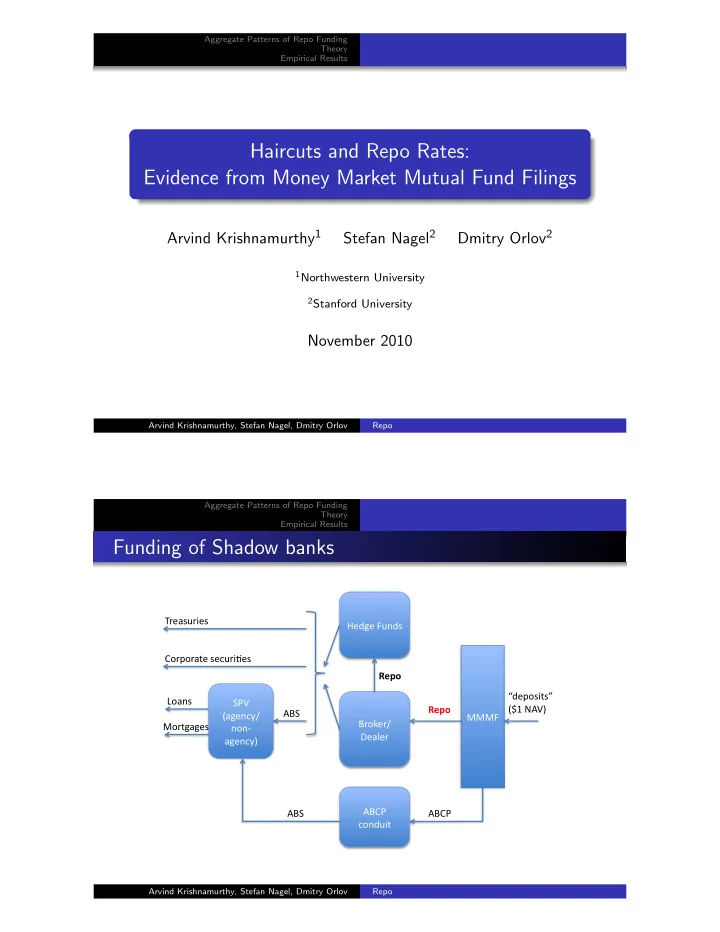
Funding of Shadow banks

MMMF
 Broker/ Dealer
 Hedge
Funds
 SPV
 (agency/ non‐ agency)
 Repo
 Repo
 ABCP
 ABS
 Treasuries

 Corporate
securiAes
 ABCP
 conduit
 Mortgages
 Loans
 ABS
 “deposits”
 ($1
NAV)


Arvind Krishnamurthy, Stefan Nagel, Dmitry Orlov Repo

slide-2
SLIDE 2

Aggregate Patterns of Repo Funding Theory Empirical Results

Tri-Party Repurchase Agreements

MMMF
 Tri‐party
 Clearing
 Agent
 $95m
 Collateral
 worth $100m
 $95m
 Collateral
 worth $100m
 Broker/ Dealer


Haircut: 5% in this example Repo rate: Interest paid by borrower on loan amount ($95m) Daily unwind: Irrespective of repo term, each morning cash returned to lender and security to borrower. Thus, intra-day counterparty risk shifted to tri-party agent.

Arvind Krishnamurthy, Stefan Nagel, Dmitry Orlov Repo Aggregate Patterns of Repo Funding Theory Empirical Results

Objectives

Which role did repo market play in financial crisis?

How big is repo funding? Often used federal Reserve data on primary dealer repos includes inter-dealer repos (double-counting issue) “Run on repo” an in important part of the breakdown of “securitized banking” (Gorton and Metrick 2009)? Evaluate size of repo funding with private-label ABS/MBS as collateral

How are repos structured and risks priced?

Participation constraints, haircuts, repo rates Evaluate role of counterparty risk, collateral risk, ... View through lens of theories of collateralized lending and security design

We obtain data on repo agreements of MMF from quarterly SEC filings (N-CSR, N-CSRS, N-Q) 2006Q4-2010Q2

Arvind Krishnamurthy, Stefan Nagel, Dmitry Orlov Repo

slide-3
SLIDE 3

Aggregate Patterns of Repo Funding Theory Empirical Results

Example: Reserve Fund – Primary Fund

February 29, 2008 Repurchase Agreements

Notional Counterparty Rate Init. Rep. Collateral

  • Coll. mkt.val.

1,000,000,000 Bear Stearns 3.28%, 2/29/08, 3/3/08 ABS, CMO, TRR, TR3 1,048,922,871 450,000,000 Bear Stearns 3.33% 2/29/08 3/3/08 ABS, CMO 472,500,201 500,000,000 Citigroup 3.23% 2/29/08 3/3/08 MNI, TRR 556,131,379 140,000,000 Merrill Lynch 3.43% 2/29/08 3/3/08 WLR 146,599,193 1,000,000,000 Morgan Stanley 3.29% 2/29/08 3/3/08 WLR 1,020,794,540 ... Arvind Krishnamurthy, Stefan Nagel, Dmitry Orlov Repo Aggregate Patterns of Repo Funding Theory Empirical Results

Data collection

Concentrated market: Biggest 10 MMF families control about 60% of MMF assets under management Aim: Collect data for 20 biggest MMF families Completed so far:

Blackrock Fidelity JPMorgan Reserve Funds Morgan Stanley Vanguard Dreyfus Goldman Sachs Federated Funds

Arvind Krishnamurthy, Stefan Nagel, Dmitry Orlov Repo

slide-4
SLIDE 4

Aggregate Patterns of Repo Funding Theory Empirical Results

Outline

1 Aggregate Patterns in Repo Funding

“Run on Repo” quantitatively important?

2 Theory: repo market participation, collateral choice, maturity,

haircuts, repo rates

3 Empirical results Arvind Krishnamurthy, Stefan Nagel, Dmitry Orlov Repo Aggregate Patterns of Repo Funding Theory Empirical Results

Coverage of MMF Filings Sample

Quarter MMF Repo MMF Repo MMF Primary collected Total Assets Dealer Repo ($bn.) (FoF, $bn.) (FoF, $bn.) (NY Fed, $bn.) 2006Q4 (133)1 395 2312 3442 2007Q1 202 387 2372 3619 2007Q2 205 426 2466 3889 2007Q3 258 528 2780 3886 2007Q4 283 606 3033 4106 2008Q1 307 592 3383 4278 2008Q2 273 518 3318 4222 2008Q3 261 592 3355 3989 2008Q4 276 542 3757 3208 2009Q1 367 562 3739 2743 2009Q2 339 488 3585 2582 2009Q3 325 495 3363 2499 2009Q4 338 480 3259 2469 2010Q1 296 440 2931 2477 2010Q2 (66)1

1Incomplete coverage in 2006Q4 and 2010Q2 Arvind Krishnamurthy, Stefan Nagel, Dmitry Orlov Repo

slide-5
SLIDE 5

Aggregate Patterns of Repo Funding Theory Empirical Results

Share of Collateral by Type (by value)

.4 .6 .8 1 Share 2007q1 2008q1 2009q1 2010q1 Quarter U.S. Treasury Agency

  • Priv. ABS

Corporate Other

Arvind Krishnamurthy, Stefan Nagel, Dmitry Orlov Repo Aggregate Patterns of Repo Funding Theory Empirical Results

Comparison with ABCP Issuance

.05 .1 .15

  • Priv. ABS Share

50 100 150 200 250 Issuance () 2007q1 2008q1 2009q1 2010q1 Quarter ABCP Issuance

  • Priv. ABS Share

Issuance of 80day+ ABCP net of amount funded through Fed CPFF program Total contraction of ABCP outstanding ≈ $700bn. compared with pre-crisis repo with priv. ABS/MBS collateral ≈ $60bn.

Arvind Krishnamurthy, Stefan Nagel, Dmitry Orlov Repo

slide-6
SLIDE 6

Aggregate Patterns of Repo Funding Theory Empirical Results

Maturity percentiles (vw.)

50 100 150 200 250 Maturity (business days) 2006q3 2007q3 2008q3 2009q3 2010q3 Quarter 99th 98th 95th 90th

Arvind Krishnamurthy, Stefan Nagel, Dmitry Orlov Repo Aggregate Patterns of Repo Funding Theory Empirical Results

Maturity percentiles (ew.)

50 100 150 200 250 Maturity (business days) 2006q3 2007q3 2008q3 2009q3 2010q3 Quarter 90th 80th 70th 60th

Arvind Krishnamurthy, Stefan Nagel, Dmitry Orlov Repo

slide-7
SLIDE 7

Aggregate Patterns of Repo Funding Theory Empirical Results

Haircuts by Collateral Type (vw.)

2 4 6 8 Percent 2007q1 2008q1 2009q1 2010q1 Quarter U.S. Treasury Agency

  • Priv. ABS

Corporate Other

Arvind Krishnamurthy, Stefan Nagel, Dmitry Orlov Repo Aggregate Patterns of Repo Funding Theory Empirical Results

Average Repo Rate (vw.) and Fed Funds Rate/OIS

2 4 6 Percent 2006q3 2007q3 2008q3 2009q3 2010q3 Quarter Fed Funds Rate/OIS Average Repo Rate (vw.)

Arvind Krishnamurthy, Stefan Nagel, Dmitry Orlov Repo

slide-8
SLIDE 8

Aggregate Patterns of Repo Funding Theory Empirical Results

Excess Repo Rate by Collateral Type (vw.)

−1 −.5 .5 1 Percent 2007q1 2008q1 2009q1 2010q1 Quarter U.S. Treasury Agency

  • Priv. ABS

Corporate Other

Arvind Krishnamurthy, Stefan Nagel, Dmitry Orlov Repo Aggregate Patterns of Repo Funding Theory Empirical Results Literature Model Results

Haircuts and Repo Rates: Theory

Modigliani-Miller: Haircut and repo rate indeterminate

Haircut = leverage Repo rate = cost of debt

Theories of equilibrium haircuts with frictions

Geanakoplos (2009): Differences in beliefs between borrower and lender about payoffs from collateral. Equilibrium haircut creates default-free debt Duffie and DeMarzo (1999); Dang, Gorton, Holmstrom (2010): Asymmetric information about collateral payoffs between borrower and lender. Equilibrium haircut creates information-insensitive security (if sufficient concern about adverse selection).

Arvind Krishnamurthy, Stefan Nagel, Dmitry Orlov Repo

slide-9
SLIDE 9

Aggregate Patterns of Repo Funding Theory Empirical Results Literature Model Results

Theory of Haircuts and Repo Rates

Common predictions of belief divergence and asy. information stories

Haircuts should vary with risk of collateral, but repo rates should (mostly) not Counterparty risk should have little effect on haircuts and repo rates

Theories miss some aspects that seem important in practice

Repo is not no-recourse: Repo lenders have recourse to borrowers balance sheet in event of default Differences in beliefs and asy. information can not explain exclusion of high-risk counterparties and low-quality collateral from repo market

Arvind Krishnamurthy, Stefan Nagel, Dmitry Orlov Repo Aggregate Patterns of Repo Funding Theory Empirical Results Literature Model Results

Model

Two dates, t0 and t1. Single risky asset with t0 price P0 = 1 (partial equilibrium) Borrower (trading desk in a bank) considers purchase of one unit of risky asset with funding

1 − h from repo lender (MMF), collateralized by risky asset, i.e., with haircut h h from bank (“equity”)

Four states of nature: At time t−

1 just before date t1, the

bank defaults with probability πd. Then, at t1, independent of whether the bank defaulted or not, the risky asset can be traded at price of R > 1 in the good state and L < 1 in the bad state. Lenders are competitive. Lender, bank, and borrower are risk-neutral.

Arvind Krishnamurthy, Stefan Nagel, Dmitry Orlov Repo

slide-10
SLIDE 10

Aggregate Patterns of Repo Funding Theory Empirical Results Literature Model Results

Key assumptions

Belief divergence: Borrower and bank perceive the probability

  • f the bad state to be pb, while lenders have a more

pessimistic belief pl > pb, as in Geanakoplos (2009) Equity financing friction: Bank discounts expected payment from “trading desk” by by 0 ≤ α ≤ 1 Liquidation cost: Lender pays cost δ per $1 of face value if she has to take possession of the collateral in the event the bank defaults Recourse: In the event of default on repo loan, lender has recourse to bank balance sheet, so unless bank defaults, the bank bears the losses on the risky asset in the bad state

Arvind Krishnamurthy, Stefan Nagel, Dmitry Orlov Repo Aggregate Patterns of Repo Funding Theory Empirical Results Literature Model Results

Valuation and Objective

Repo: Lender has to offer face value (repurchase value) F(h) that satisfies (1 − h) =(1 − πd)F(h) + πd [(1 − pl)F(h) + pl min(L, F(h))] − πdδF(h) Equity: Borrower pays bank payment of E(h) in good state, which must satisfy h =α[(1 − pb)E(h) + (1 − πd)pb(L − F(h))+ πdpb max(L − F(h), 0)] The borrower’s objective is given by max

h

(1 − πd)(1 − pb)(R − E(h) − F(h))

Arvind Krishnamurthy, Stefan Nagel, Dmitry Orlov Repo

slide-11
SLIDE 11

Aggregate Patterns of Repo Funding Theory Empirical Results Literature Model Results

Results

Borrowers objective is piecewise linear: Borrower (weakly) prefers either zero leverage, risk-free repo with high haircut, or risky zero-haircut repo Non-participation: Zero leverage is preferred over risk-free repo if 1 − πdδ α < 1 Haircut: Risk-free repo preferred over risky zero-haircut repo if 1 − πdpl 1 − πdpl − δπd 1 − πdpb 1 − πdpl + (α − 1)(1 − pb) 1 − πdpl

  • > 1

Arvind Krishnamurthy, Stefan Nagel, Dmitry Orlov Repo Aggregate Patterns of Repo Funding Theory Empirical Results Literature Model Results

Illustration of Non-Participation: Borrower Objective

0.1 0.2 0.3 0.4 0.5 0.6 0.7 0.8 0.9 1 0.031 0.032 0.033 0.034 0.035 0.036 0.037 Haircut Base Higher default prob. Higher liq. cost

Base case: R = 1.1, L = 0.8, pb = 0.2, pl = 0.5, α = 0.996, πd = 0.02, and δ = 0.1. Alternative cases with πd = 0.04 or δ = 0.2.

Arvind Krishnamurthy, Stefan Nagel, Dmitry Orlov Repo

slide-12
SLIDE 12

Aggregate Patterns of Repo Funding Theory Empirical Results Participation, Collateral Choice, Maturity Haircuts Repo Rates

Counterparty Participation

Model Model: Non-participation (zero leverage) is preferred over risk-free repo if 1 − πdδ α < 1 Holding δ and α fixed, this implies participation constraint based on πd Empirically Counterparty risk measure x (5yr Sr. CDS rate) as empirical counterpart to πd We only observe participants, so not possible to estimate participation condition

Arvind Krishnamurthy, Stefan Nagel, Dmitry Orlov Repo Aggregate Patterns of Repo Funding Theory Empirical Results Participation, Collateral Choice, Maturity Haircuts Repo Rates

Distribution of Counterparty CDS Rates

.05 .1 .15 .2 Fraction 200 400 600 800 1000 Counterparty 5−yr. Senior CDS rate (bps)

Arvind Krishnamurthy, Stefan Nagel, Dmitry Orlov Repo

slide-13
SLIDE 13

Aggregate Patterns of Repo Funding Theory Empirical Results Participation, Collateral Choice, Maturity Haircuts Repo Rates

Collateral Choice

Model Non-participation (zero leverage) is preferred over risk-free repo if 1 − πdδ α < 1 Holding α fixed, participation with high-δ collateral only if πd low δ likely higher with higher collateral risk

Arvind Krishnamurthy, Stefan Nagel, Dmitry Orlov Repo Aggregate Patterns of Repo Funding Theory Empirical Results Participation, Collateral Choice, Maturity Haircuts Repo Rates

Collateral Choice

Empirically Collateral category q ∈ {0, 1, 2} ordered by collateral risk (Treasuries, Agencies, Others) Choice of q modeled as function of latent variable q∗, q∗ = a′

0z + a1x + a2g + η,

η|z, x, g ∼ N(0, 1) where q = 0 if q∗ ≤ θ1, q = 1 if θ1 < q∗ ≤ θ2, q = 3 if q∗ < θ3. Macro variables z may help capture time-variation in δ Government MMF dummy g, can be viewed as proxy for funds that face extremely high δ for riskier collateral Estimation of P(q = 0|x, z), ..., P(q = 3|x, z) with ordered probit

Arvind Krishnamurthy, Stefan Nagel, Dmitry Orlov Repo

slide-14
SLIDE 14

Aggregate Patterns of Repo Funding Theory Empirical Results Participation, Collateral Choice, Maturity Haircuts Repo Rates

Collateral by Counterparty CDS Rate

.2 .4 .6 .8 1 Fraction (by value) < 50bps 50bps − 100bps 100bps − 250bps > 250bps U.S. Treasury Agency Other Arvind Krishnamurthy, Stefan Nagel, Dmitry Orlov Repo Aggregate Patterns of Repo Funding Theory Empirical Results Participation, Collateral Choice, Maturity Haircuts Repo Rates

Collateral Choice: Ordered Probit

Marginal effects on collateral-category probabilities 3mLIBOR-OIS spread and CDS rates in percent VIX in percent divided by √ 250

(1) (2) (3) U.S. Treasury Agency Other 3mLIBOR-OIS

  • 0.053

0.009 0.045 (0.065) (0.010) (0.055) VIX 0.137

  • 0.022
  • 0.115

(0.035) (0.005) (0.032)

  • Govt. MMF dummy

0.570

  • 0.128
  • 0.442

(0.023) (0.019) (0.022) Counterparty CDS Rate

  • 0.009

0.001 0.008 (0.013) (0.002) (0.010) Observations 7968 7968 7968

Arvind Krishnamurthy, Stefan Nagel, Dmitry Orlov Repo

slide-15
SLIDE 15

Aggregate Patterns of Repo Funding Theory Empirical Results Participation, Collateral Choice, Maturity Haircuts Repo Rates

Maturity Choice

Higher counterparty risk also likely implies increased probability of a future substantial revision of counterparty risk: With shorter maturity lender retains option to terminate, which reduces expected liquidiation costs Shortening of maturity may be first response before reaching non-participation status Regression log(m) = b′

0z + b1x + ν

Arvind Krishnamurthy, Stefan Nagel, Dmitry Orlov Repo Aggregate Patterns of Repo Funding Theory Empirical Results Participation, Collateral Choice, Maturity Haircuts Repo Rates

Maturity by Counterparty CDS Rate

5 10 15 Average Initial Maturity (days, value−weighted) < 50bps 50bps − 100bps 100bps − 250bps > 250bps Arvind Krishnamurthy, Stefan Nagel, Dmitry Orlov Repo

slide-16
SLIDE 16

Aggregate Patterns of Repo Funding Theory Empirical Results Participation, Collateral Choice, Maturity Haircuts Repo Rates

Maturity Choice: OLS

Dependent variable: Log of initial maturity

3mLIBOR-OIS 0.236 (0.183) VIX

  • 0.161

(0.138) Custodian CDS Rate

  • 0.147

(0.223) Counterparty CDS Rate

  • 0.304

(0.052) Observations 7967 Adjusted R2 0.024

Arvind Krishnamurthy, Stefan Nagel, Dmitry Orlov Repo Aggregate Patterns of Repo Funding Theory Empirical Results Participation, Collateral Choice, Maturity Haircuts Repo Rates

Maturity Choice: Probit

Marginal effects on probability that repo is overnight

3mLIBOR-OIS 0.012 (0.044) VIX

  • 0.003

(0.028) Custodian CDS Rate

  • 0.057

(0.047) Counterparty CDS Rate 0.092 (0.019) Observations 7968

Arvind Krishnamurthy, Stefan Nagel, Dmitry Orlov Repo

slide-17
SLIDE 17

Aggregate Patterns of Repo Funding Theory Empirical Results Participation, Collateral Choice, Maturity Haircuts Repo Rates

Haircuts

Model Haircut set so that repo is riskless Generalizing to more realistic setting where haircut makes repo almost, but not entirely riskless: Collateral risk should be primary influence, as higher haircut does alter πd and δ

Arvind Krishnamurthy, Stefan Nagel, Dmitry Orlov Repo Aggregate Patterns of Repo Funding Theory Empirical Results Participation, Collateral Choice, Maturity Haircuts Repo Rates

Haircuts

Empirically Regression h = c′

0z + c1x + c2m + c3w + ξ

with collateral risk measures w

Collateral volatility: Standard deviation of collateral index price changes in prior month Collateral worst return: Worst daily price change of collateral index in prior five years

Arvind Krishnamurthy, Stefan Nagel, Dmitry Orlov Repo

slide-18
SLIDE 18

Aggregate Patterns of Repo Funding Theory Empirical Results Participation, Collateral Choice, Maturity Haircuts Repo Rates

Haircuts: Collateral Risk and Counterparty Credit Risk

Collateral indices

Treasuries: Barclays US Treasury Index Agency: Barclays US MBS index Private-label MBS/ABS: Barclays US ABS home equity Corporate: Barclays US Corporate Investment Grade Commercial Paper: Fed St. Louis Commercial paper (price index constructed from yields) Certificates of Deposit: BBA 3m LIBOR (price index constructed from yields) Munis: Barclays Municipal Bond Equity: S&P500 index

Arvind Krishnamurthy, Stefan Nagel, Dmitry Orlov Repo Aggregate Patterns of Repo Funding Theory Empirical Results Participation, Collateral Choice, Maturity Haircuts Repo Rates

Decomposing Variation in Haircuts

Nonparametric approach: Dummy variable regressions

Time dummies (year-month) Time dummies interacted with collateral, counterparty, maturity dummies

Incremental R2 DGF F p-value Collateral×Time 0.38 219 37.51 0.00 Counterparty×Time 0.02 801 1.67 0.00 Maturity×Time 0.02 50 7.01 0.00 Full 0.67 1114 15.05 0.00

Arvind Krishnamurthy, Stefan Nagel, Dmitry Orlov Repo

slide-19
SLIDE 19

Aggregate Patterns of Repo Funding Theory Empirical Results Participation, Collateral Choice, Maturity Haircuts Repo Rates

Haircuts: Regression

3mLIBOR-OIS

  • 0.607

(0.159) VIX

  • 0.197

(0.099) Initial maturity 0.004 0.003 (0.001) (0.001) Collateral volatility 1.546 1.657 (0.255) (0.271) Collateral worst return

  • 0.282
  • 0.243

(0.020) (0.022) Counterparty CDS Rate 0.167 0.131 (0.063) (0.056) Year-month dummies N Y Observations 7521 7521 Adjusted R2 0.357 0.384

Arvind Krishnamurthy, Stefan Nagel, Dmitry Orlov Repo Aggregate Patterns of Repo Funding Theory Empirical Results Participation, Collateral Choice, Maturity Haircuts Repo Rates

Repo rates

Model Haircut set so that repo is riskless, but in more general case where risk not entirely eliminated, risk-neutral valuation implies repo rate r = πd 1 − πdpl − πdδ(λ(h) + δ) where λ(h) = pl

  • 1 −

L 1 − h

  • is the expected loss (to the lender) given default.

Arvind Krishnamurthy, Stefan Nagel, Dmitry Orlov Repo

slide-20
SLIDE 20

Aggregate Patterns of Repo Funding Theory Empirical Results Participation, Collateral Choice, Maturity Haircuts Repo Rates

Repo rates

Empirically Empirical measurement of λ(h)

Gaussian expected loss φ(−h/σ) Φ(−h/σ)σ where σ is measured by the standard deviation of collateral index price changes in prior month Haircut-adj. collateral worst-return: Worst daily price change

  • f collateral index in prior five years in excess of haircut

Regression r = d′

0z + d1m + d2x + d3λ(h) + d4(x × λ(h)) + ξ

Arvind Krishnamurthy, Stefan Nagel, Dmitry Orlov Repo Aggregate Patterns of Repo Funding Theory Empirical Results Participation, Collateral Choice, Maturity Haircuts Repo Rates

Decomposing Variation in Excess Repo Rates

Incremental R2 DGF F p-value Collateral×Time 0.32 219 29.49 0.00 Counterparty×Time 0.06 806 1.59 0.00 Maturity×Time 0.04 50 17.42 0.00 Full 0.62 1119 13.14 0.00

Arvind Krishnamurthy, Stefan Nagel, Dmitry Orlov Repo

slide-21
SLIDE 21

Aggregate Patterns of Repo Funding Theory Empirical Results Participation, Collateral Choice, Maturity Haircuts Repo Rates

Excess Repo Rates: Regression

3mLIBOR-OIS 0.146 0.145 (0.083) (0.083) VIX

  • 0.080
  • 0.075

(0.064) (0.066) Custodian CDS Rate 0.069 0.059 (0.075) (0.075) Initial maturity

  • 0.000

0.000

  • 0.000

0.000 (0.000) (0.000) (0.000) (0.000) Counterparty CDS Rate

  • 0.031
  • 0.041
  • 0.069
  • 0.086

(0.039) (0.036) (0.073) (0.070) Expected loss λ(h) 0.092 0.089 0.081 0.073 (0.013) (0.013) (0.015) (0.014) Haircut-adj. collateral worst return

  • 0.012
  • 0.007
  • 0.025
  • 0.014

(0.006) (0.006) (0.010) (0.009) λ(h)× Counterparty CDS rate 0.010 0.013 (0.013) (0.013) Haircut-adj. coll. worst return × Counterparty CDS rate 0.013 0.009 (0.010) (0.009) Year-month dummies N Y N Y Observations 7065 7065 7065 7065 Adjusted R2 0.131 0.222 0.133 0.224 Arvind Krishnamurthy, Stefan Nagel, Dmitry Orlov Repo Aggregate Patterns of Repo Funding Theory Empirical Results Participation, Collateral Choice, Maturity Haircuts Repo Rates

Conclusion

Aggregate amounts of repo funding provided by MMF

Private-label ABS/MBS completely disappear as collateral in 2008/2009, but aggregate amount small relative to contraction in ABCP: “Run on repo” may be symptomatic for related problems, but by itself not a major factor in breakdown of shadow bank financing

Terms of tri-party repo agreements

Counterparty risk in repo markets affects participation, collateral choice, and maturity Conditional on participation and collateral choice, counterparty risk has little influence on haircuts and repo rates Collateral risk is main driver of haircuts and repo rates, and “long memory” of realized tail events seems to matter in addition to recent volatility Elevated levels of haircuts and repo rates still persist since crisis

Arvind Krishnamurthy, Stefan Nagel, Dmitry Orlov Repo