h ( t ) x ( t ) y ( t ) x ( t ) y ( t ) H ( j ) CT Fourier Series as - - PowerPoint PPT Presentation

h t
SMART_READER_LITE
LIVE PREVIEW

h ( t ) x ( t ) y ( t ) x ( t ) y ( t ) H ( j ) CT Fourier Series as - - PowerPoint PPT Presentation

Overview of CT Fourier Series Topics Motivation Orthogonality of CT complex sinusoidal harmonics h ( t ) x ( t ) y ( t ) x ( t ) y ( t ) H ( j ) CT Fourier Series as a Design Task Picking the frequencies e jt H ( jt )e jt


slide-1
SLIDE 1

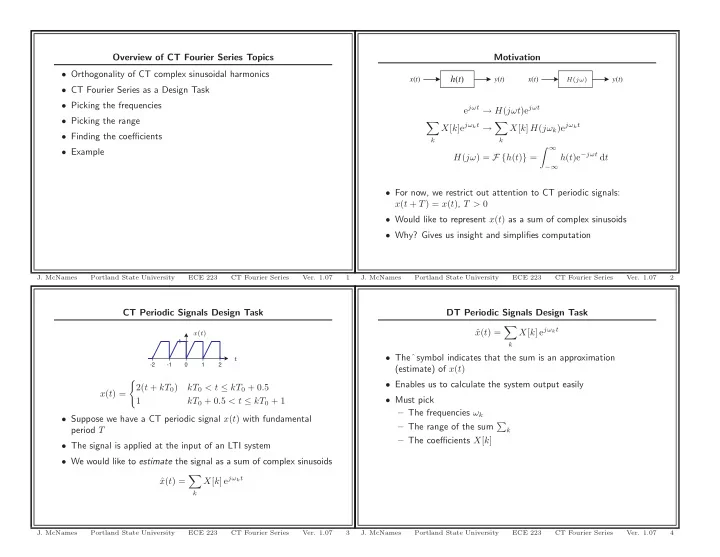
CT Periodic Signals Design Task

1 2 1

  • 1
  • 2

t x(t)

x(t) =

  • 2(t + kT0)

kT0 < t ≤ kT0 + 0.5 1 kT0 + 0.5 < t ≤ kT0 + 1

  • Suppose we have a CT periodic signal x(t) with fundamental

period T

  • The signal is applied at the input of an LTI system
  • We would like to estimate the signal as a sum of complex sinusoids

ˆ x(t) =

  • k

X[k] ejωkt

  • J. McNames

Portland State University ECE 223 CT Fourier Series

  • Ver. 1.07

3

Overview of CT Fourier Series Topics

  • Orthogonality of CT complex sinusoidal harmonics
  • CT Fourier Series as a Design Task
  • Picking the frequencies
  • Picking the range
  • Finding the coefficients
  • Example
  • J. McNames

Portland State University ECE 223 CT Fourier Series

  • Ver. 1.07

1

DT Periodic Signals Design Task ˆ x(t) =

  • k

X[k] ejωkt

  • Theˆsymbol indicates that the sum is an approximation

(estimate) of x(t)

  • Enables us to calculate the system output easily
  • Must pick

– The frequencies ωk – The range of the sum

k

– The coefficients X[k]

  • J. McNames

Portland State University ECE 223 CT Fourier Series

  • Ver. 1.07

4

Motivation h(t)

x(t) y(t) x(t) y(t)

H(jω)

ejωt → H(jωt)ejωt

  • k

X[k]ejωkt →

  • k

X[k] H(jωk)ejωkt H(jω) = F {h(t)} = ∞

−∞

h(t)e−jωt dt

  • For now, we restrict out attention to CT periodic signals:

x(t + T) = x(t), T > 0

  • Would like to represent x(t) as a sum of complex sinusoids
  • Why? Gives us insight and simplifies computation
  • J. McNames

Portland State University ECE 223 CT Fourier Series

  • Ver. 1.07

2

slide-2
SLIDE 2

Design Task: Picking the Coefficients ˆ x(t) =

  • k=−∞

X[k] ejkωt MSE = 1 T

  • T

|x(t) − ˆ x(t)|2 dt

  • We would like to pick the coefficients X[k] so that ˆ

x(t) is as close to x(t) as possible

  • But what is close?
  • One measure of the difference between two signals is the mean

squared error (MSE)

  • There are other measures, but this is a convenient one because we

can differentiate it

  • If MSE = 0, does this imply x(t) = ˆ

x(t)?

  • Since the signal is periodic, the MSE is calculated over a single

fundamental period of T

  • How do we pick the coefficients X[k] to minimize the MSE?
  • J. McNames

Portland State University ECE 223 CT Fourier Series

  • Ver. 1.07

7

Design Task: Picking the Frequencies ˆ x(t) =

  • k

X[k] ejωkt

  • We know x(t) is periodic with some fundamental period T
  • If ˆ

x(t) is to approximate x(t) accurately, it should also repeat every T seconds

  • In order for ˆ

x(t) to be periodic with period T, every complex sinusoid must also be periodic

  • Only a harmonic set of complex sinusoids have this property
  • Thus ωk = kω where ω = 2π

T

ˆ x(t) =

  • k

X[k] ejkωt

  • J. McNames

Portland State University ECE 223 CT Fourier Series

  • Ver. 1.07

5

Orthogonality Two periodic signals x1(t) and x2(t) with the same period T are

  • rthogonal if and only if
  • T

x1(t)x∗

2(t) dt = 0

where

  • T denotes an integral over any contiguous interval of duration

T,

  • T

x(t) dt = t0+T

t0

x(t) dt for any t0

  • J. McNames

Portland State University ECE 223 CT Fourier Series

  • Ver. 1.07

8

Design Task: Picking the Range ˆ x(t) =

  • k

X[k] ejkωt

  • Unlike DT complex sinusoids, ejkωt = ejℓωt unless k = ℓ
  • Thus the range of the sum must be infinite to include all possible

frequencies

  • This is different than the DT case
  • J. McNames

Portland State University ECE 223 CT Fourier Series

  • Ver. 1.07

6

slide-3
SLIDE 3

Workspace

  • J. McNames

Portland State University ECE 223 CT Fourier Series

  • Ver. 1.07

11

Orthogonality: Complex Sinusoids Consider two harmonic complex sinusoids x1(t) = ejk1ωt x2(t) = ejk2ωt Are they orthogonal?

  • T

x1(t)x∗

2(t) dt =

  • T

ejk1ωte−jk2ωt dt =

  • T

ej(k1−k2)ωt dt

?

= 0

  • J. McNames

Portland State University ECE 223 CT Fourier Series

  • Ver. 1.07

9

Design Task: Coefficient Optimization ˆ x(t) =

  • k=−∞

X[k] ejkωt MSE = 1 T

  • T

|x(t) − ˆ x(t)|2 dt

  • We’ve already solved for the coefficients using orthogonality
  • It turns out (see advanced texts or classes) that this solution

results in MSE = 0

  • But unlike the DT case, this does NOT imply ˆ

x(t) = x(t) necessarily

  • But the squared error has zero area, so any difference is probably

negligible

  • J. McNames

Portland State University ECE 223 CT Fourier Series

  • Ver. 1.07

12

Importance of Orthogonality Suppose that we know a signal is composed of a linear combination of harmonic complex sinusoids with fundamental period T x(t) =

  • k=−∞

X[k] ejkωt How do we solve for the coefficients X[k] for all k?

  • J. McNames

Portland State University ECE 223 CT Fourier Series

  • Ver. 1.07

10

slide-4
SLIDE 4

Convergence ˆ x(t) =

  • k=−∞

X[k]ejkωt X[k] = 1 T

  • T

x(t)e−jkωt dt

  • Since the CTFS includes an infinite series, we must consider under

what conditions it converges

  • An infinite sum is said to converge so long as it is bounded

– Not infinite −∞ < lim

K→∞ K

  • k=−K

X[k]ejkωt < ∞

  • Why didn’t we do this in the DT case?
  • Why don’t we have to consider convergence of the analysis

equation?

  • J. McNames

Portland State University ECE 223 CT Fourier Series

  • Ver. 1.07

15

CTFS Observations x(t) =

  • k=−∞

X[k] ejkωt X[k] = 1 T

  • T

x(t)e−jkωt dt

  • The first equation is called the synthesis equation
  • The second equation is called the analysis equation
  • The coefficients X[k] are called the spectral coefficients or

Fourier series coefficients of x[n]

  • We denote the relationship of x(T) and X[k] by

x(t)

FS

⇐ ⇒ X[k]

  • Both are complete representations of the signal: if we know one,

we can compute the other

  • X[k] is a function of frequency (kω)
  • J. McNames

Portland State University ECE 223 CT Fourier Series

  • Ver. 1.07

13

Convergence Continued A sufficient condition for convergence (not proven) is

  • T

|x(t)|2 dt < ∞

  • In other words, the signal has

– Finite power – Finite energy over a single period

  • This is true of all signals you could generate in the lab
  • If x(t) is a continuous signal, then it is safe to assume that

ˆ x(t) = x(t)

  • This is a stronger statement then merely stating that the CTFS

converges

  • All of the periodic signals generated by a function generator have

an equivalent FS representation

  • J. McNames

Portland State University ECE 223 CT Fourier Series

  • Ver. 1.07

16

Discontinuities ˆ x(t) =

  • k=−∞

X[k]ejkωt X[k] = 1 T

  • T

x(t)e−jkωt dt

  • Just because MSE = 0 does not imply x(t) = ˆ

x(t)

  • It does imply any differences occur only at a finite number of

discrete (zero duration) points in time

  • In general, if t0 is a point of discontinuity, then

ˆ x(t0) = 1 2 lim

△→0 [x(t0 + △) + x(t0 − △)]

  • At all other points the signals are equal
  • J. McNames

Portland State University ECE 223 CT Fourier Series

  • Ver. 1.07

14

slide-5
SLIDE 5

Example 4: Workspace

  • J. McNames

Portland State University ECE 223 CT Fourier Series

  • Ver. 1.07

19

Dirichlet Conditions for Convergence The Fourier series representation of a periodic signal x(t) converges if all of the following conditions are met. 1.

  • T |x(t)| dt < ∞
  • 2. Finite number of discontinuities in a period T
  • 3. Finite number of distinct maxima and minima in T
  • 4. x(t) is single valued

These are sufficient, but not necessary, conditions.

  • J. McNames

Portland State University ECE 223 CT Fourier Series

  • Ver. 1.07

17

Example 4: Fourier Series Coefficients

−25 −20 −15 −10 −5 5 10 15 20 25 0.2 0.4 0.6 0.8 |X[k]| Fourier Series Coefficients −25 −20 −15 −10 −5 5 10 15 20 25 −4 −2 2 4 kth (harmonic) ∠ X[k]

  • J. McNames

Portland State University ECE 223 CT Fourier Series

  • Ver. 1.07

20

Example 4: CT Fourier Series Coefficients

1 2 1

  • 1
  • 2

t x(t)

Find the Fourier series coefficients for the signal shown above. Plot partial sums ˆ x(t) ≈ N

k=−N X[k]ejkωt of the Fourier series for N = 1,

2, 5, 10, 50 & 100. Hints:

  • teat dt =

1 a2 eat(at − 1) + C and

  • eat dt = 1

aeat + C.

  • J. McNames

Portland State University ECE 223 CT Fourier Series

  • Ver. 1.07

18

slide-6
SLIDE 6

Example 4: Partial Fourier Series N=5

−1.5 −1 −0.5 0.5 1 1.5 −0.4 −0.2 0.2 0.4 0.6 0.8 1 1.2 Time (sec) Fourier Series Approximation (N=5)

  • J. McNames

Portland State University ECE 223 CT Fourier Series

  • Ver. 1.07

23

Example 4: Partial Fourier Series N=1

−1.5 −1 −0.5 0.5 1 1.5 −0.4 −0.2 0.2 0.4 0.6 0.8 1 1.2 Time (sec) Fourier Series Approximation (N=1)

  • J. McNames

Portland State University ECE 223 CT Fourier Series

  • Ver. 1.07

21

Example 4: Partial Fourier Series N=10

−1.5 −1 −0.5 0.5 1 1.5 −0.4 −0.2 0.2 0.4 0.6 0.8 1 1.2 Time (sec) Fourier Series Approximation (N=10)

  • J. McNames

Portland State University ECE 223 CT Fourier Series

  • Ver. 1.07

24

Example 4: Partial Fourier Series N=2

−1.5 −1 −0.5 0.5 1 1.5 −0.4 −0.2 0.2 0.4 0.6 0.8 1 1.2 Time (sec) Fourier Series Approximation (N=2)

  • J. McNames

Portland State University ECE 223 CT Fourier Series

  • Ver. 1.07

22

slide-7
SLIDE 7

Example 4: Mean Squared Error

10 20 30 40 50 60 70 80 90 100 0.01 0.02 0.03 0.04 0.05 0.06 0.07 0.08 0.09 0.1 Harmonics (k) MSE

  • J. McNames

Portland State University ECE 223 CT Fourier Series

  • Ver. 1.07

27

Example 4: Partial Fourier Series N=50

−1.5 −1 −0.5 0.5 1 1.5 −0.4 −0.2 0.2 0.4 0.6 0.8 1 1.2 Time (sec) Fourier Series Approximation (N=50)

  • J. McNames

Portland State University ECE 223 CT Fourier Series

  • Ver. 1.07

25

Example 4: MATLAB Code

function [] = RampFlat(); close all; T = 1; w0 = 2*pi/T; Ts = 0.002; t = (-1.5:Ts:1.5)’; tm = mod(t,T); x = 2*tm.*(tm>=0 & tm<0.5) + 1*(tm>=0.5 & tm<1); figure(1); FigureSet(1,’LTX’); N = 25; k = [-N:-1 1:N]; a = j*2*pi*k; fs = (2./a.^2).*(1-exp(a/2)) + (1./a).*exp(a); k = [k(1:N) k(N+1:2*N) ]; fs = [fs(1:N) 3/4 fs(N+1:2*N)]; subplot(2,1,1); h = stem(k,abs(fs)); set(h,’Marker’,’.’); set(h,’Color’,[0 0.6 0]); set(h,’MarkerSize’,8); ylabel(’|X[k]|’); title(’Fourier Series Coefficients’); box off; subplot(2,1,2); h = stem(k,angle(fs)); set(h,’Marker’,’.’); set(h,’Color’,[0 0.6 0]); set(h,’MarkerSize’,8); xlabel(’kth (harmonic)’);

  • J. McNames

Portland State University ECE 223 CT Fourier Series

  • Ver. 1.07

28

Example 4: Partial Fourier Series N=100

−1.5 −1 −0.5 0.5 1 1.5 −0.4 −0.2 0.2 0.4 0.6 0.8 1 1.2 Time (sec) Fourier Series Approximation (N=100)

  • J. McNames

Portland State University ECE 223 CT Fourier Series

  • Ver. 1.07

26

slide-8
SLIDE 8

CTFS Terminology ˆ x(t) =

  • k=−∞

X[k]ejkωt X[k] = 1 T

  • T

x(t)e−jkωt dt

  • X[k] is complex-valued in general
  • The function |X[k]| is called the magnitude spectrum of x(t)
  • The function arg X[k] is called the phase spectrum of x(t)
  • J. McNames

Portland State University ECE 223 CT Fourier Series

  • Ver. 1.07

31

ylabel(’\angle X[k]’); xlabel(’kth (harmonic)’); box off; AxisSet(8); drawnow; print -depsc RampFlatSpectrum; N = [1,2,5,10,50,100]; %N = [1 5]; MSE = zeros(length(max(N)),1); for cnt = 1:length(N), xh = 3/4; % DC Offset c_0 figure; FigureSet(1,’Ltx’); t2 = [-1.5 1.5]; h = plot(t2,xh*[1 1],’g’); set(h,’Color’,[0.0 0.6 0.0]); hold on; for cnt2 = 1:N(cnt), k = cnt2; a = -j*2*pi*k; ck = (2./a.^2).*(1-exp(a/2)) + (1./a).*exp(a); xk = 2*abs(ck)*cos(k*w0*t + angle(ck)); xh = xh + xk; t2 = (-1.5:0.02:1.5); xk = 2*abs(ck)*cos(k*w0*t2 + angle(ck)); h = plot(t2,xk,’g’); set(h,’Color’,[0.0 0.6 0.0]); MSE(cnt2) = sum((x-xh).^2)*Ts/T; end; h = plot(t,x,’r’,t,xh,’b’,[-2 2],[0 0],’k:’,[0 0],[-2 2],’k:’); hold off; set(h(1),’LineWidth’,1.2); set(h(2),’LineWidth’,1.7);

  • J. McNames

Portland State University ECE 223 CT Fourier Series

  • Ver. 1.07

29

Limits on Coefficients If x(t) is a real-valued signal and can be represented as a Fourier series, x(t) =

  • k=−∞

X[k]ejkωt x∗(t) =

  • k=−∞

X∗[k]e−jkωt let ℓ = −k x∗(t) =

  • ℓ=−∞

X∗[−ℓ]ejℓωt = x(t) =

  • k=−∞

X[k]ejkωt Thus, by comparison of coefficients, X∗[−k] = X[k] X[−k] = X∗[k] This complex-conjugate symmetry ensures that the imaginary components of the sum cancel each other and x(t) is therefore real-valued.

  • J. McNames

Portland State University ECE 223 CT Fourier Series

  • Ver. 1.07

32

xlabel(’Time (sec)’); st = sprintf(’Fourier Series Approximation (N=%d)’,N(cnt)); title(st); axis([-1.5 1.5 -0.50 1.25]); box off; AxisSet(8); drawnow; st = sprintf(’print -depsc RampFlat%d’,N(cnt)); eval(st); end; figure; FigureSet(1,’LTX’); h = stem(1:max(N),MSE,’k’); set(h(1),’Marker’,’.’); set(h(1),’MarkerSize’,11); set(h(1),’LineWidth’,1.4); xlabel(’Harmonics (k)’); ylabel(’MSE’); box off; AxisSet(8); drawnow; print -depsc RampFlatMSE;

  • J. McNames

Portland State University ECE 223 CT Fourier Series

  • Ver. 1.07

30

slide-9
SLIDE 9

Alternative Forms: Amplitude-Phase Continued x(t) = X[0] + 2

  • k=1

|X[k]|Re{ej(kωt+θ[k])} = X[0] + 2

  • k=1

A[k] cos(kωt + θ[k]) Here A[k] |X[k]| and θ[k] arg X[k] is the complex phase angle of X[k].

  • J. McNames

Portland State University ECE 223 CT Fourier Series

  • Ver. 1.07

35

Complex Conjugate Symmetry X[−k] = X∗[k] The complex-conjugate symmetry of the coefficients ensures that for real-valued signals x(t)

  • The amplitude is even: |X[−k]| = |X[k]|
  • The phase is odd: ∠X[−k] = −∠X[k]
  • The real part is even: Re{X[−k]} = Re{X[k]}
  • The imaginary part is odd: Im{X[−k]} = −Im{X[k]}

The DT Fourier transform has the same property.

  • J. McNames

Portland State University ECE 223 CT Fourier Series

  • Ver. 1.07

33

Alternative Forms: Trigonometric x(t) =

  • k=−∞

X[k]ejkωt = X[0] + 2

  • k=1

Re{X[k]ejkωt} = X[0] + 2

  • k=1

Re{X[k] cos(kωt) + jX[k] sin(kωt)} = X[0] + 2

  • k=1

Re{X[k]} cos(kωt) − Im{X[k]} sin(kωt) = X[0] + 2

  • k=1

B[k] cos(kωt) − C[k] sin(kωt) where B[k] Re{X[k]} and C[k] Im{X[k]}. Note different notation than text.

  • J. McNames

Portland State University ECE 223 CT Fourier Series

  • Ver. 1.07

36

Alternative Forms: Amplitude-Phase There are alternative expressions for Fourier series. X[−k] = X[k]∗ so x(t) =

  • k=−∞

X[k]ejkωt = X[0] +

  • k=1

X[k]ejkωt +

  • k=1

X[−k]e−jkωt = X[0] +

  • k=1
  • X[k]ejkωt

+

  • X[k]ejkωt∗

= X[0] + 2

  • k=1

Re{X[k]ejkωt} = X[0] + 2

  • k=1

Re{|X[k]|ejθ[k]ejkωt}

  • J. McNames

Portland State University ECE 223 CT Fourier Series

  • Ver. 1.07

34

slide-10
SLIDE 10

Example 5: Pulse Waveform

1 2 1

  • 1
  • 2

t

What is the fundamental period of x(t)? What type of symmetry does the signal have? Find the Fourier series coefficients. Plot the partial Fourier series sum and MSE for N = 1, 5, 10, 25, 50 & 100.

  • J. McNames

Portland State University ECE 223 CT Fourier Series

  • Ver. 1.07

39

Alternate Forms Summary Exponential: x(t) =

  • k=−∞

X[k]ejkωt Amplitude-Phase: x(t) = X[0] + 2

  • k=1

A[k] cos(kωt + θ[k]) Trigonometric: x(t) = X[0] + 2

  • k=1

B[k] cos(kωt) − C[k] sin(kωt) X[k] = A[k]ejθ[k] = B[k] + jC[k] A[k] =

  • B[k]2 + C[k]2 = |X[k]|

θ[k] = arg B[k] + jC[k] = arg X[k] B[k] = A[k] cos(θ[k]) = Re{X[k]} C[k] = A[k] sin(θ[k]) = Im{X[k]}

  • J. McNames

Portland State University ECE 223 CT Fourier Series

  • Ver. 1.07

37

Example 3: Workspace

  • J. McNames

Portland State University ECE 223 CT Fourier Series

  • Ver. 1.07

40

Fourier Series: Key Equations Exponential & Amplitude-Phase Forms x(t) =

  • k=−∞

X[k] ejkωt = X[0] + 2

  • k=1

A[k] cos(kωt + θ[k]) X[k] = 1 T

  • T

x(t) e−jkωt dt Trigonometric Form x(t) = X[0] + 2

  • k=1

B[k] cos(kωt) − C[k] sin(kωt) B[k] = Re{X[k]} = 1 T

  • T

x(t) cos(kωt) dt C[k] = Im{X[k]} = − 1 T

  • T

x(t) sin(kωt) dt

  • J. McNames

Portland State University ECE 223 CT Fourier Series

  • Ver. 1.07

38

slide-11
SLIDE 11

Example 5: Partial Fourier Series N=5

−2.5 −2 −1.5 −1 −0.5 0.5 1 1.5 2 2.5 −0.4 −0.2 0.2 0.4 0.6 0.8 1 Time (sec) Fourier Series Approximation (N=5)

  • J. McNames

Portland State University ECE 223 CT Fourier Series

  • Ver. 1.07

43

Example 5: Coefficient Spectrum

−25 −20 −15 −10 −5 5 10 15 20 25 −0.1 −0.05 0.05 0.1 0.15 0.2 0.25 kth (harmonic) Bk Fourier Series Coefficients Amplitude B

k

  • J. McNames

Portland State University ECE 223 CT Fourier Series

  • Ver. 1.07

41

Example 5: Partial Fourier Series N=10

−2.5 −2 −1.5 −1 −0.5 0.5 1 1.5 2 2.5 −0.4 −0.2 0.2 0.4 0.6 0.8 1 Time (sec) Fourier Series Approximation (N=10)

  • J. McNames

Portland State University ECE 223 CT Fourier Series

  • Ver. 1.07

44

Example 5: Partial Fourier Series N=1

−2.5 −2 −1.5 −1 −0.5 0.5 1 1.5 2 2.5 −0.4 −0.2 0.2 0.4 0.6 0.8 1 Time (sec) Fourier Series Approximation (N=1)

  • J. McNames

Portland State University ECE 223 CT Fourier Series

  • Ver. 1.07

42

slide-12
SLIDE 12

Example 5: Partial Fourier Series N=100

−2.5 −2 −1.5 −1 −0.5 0.5 1 1.5 2 2.5 −0.4 −0.2 0.2 0.4 0.6 0.8 1 Time (sec) Fourier Series Approximation (N=100)

  • J. McNames

Portland State University ECE 223 CT Fourier Series

  • Ver. 1.07

47

Example 5: Partial Fourier Series N=25

−2.5 −2 −1.5 −1 −0.5 0.5 1 1.5 2 2.5 −0.4 −0.2 0.2 0.4 0.6 0.8 1 Time (sec) Fourier Series Approximation (N=25)

  • J. McNames

Portland State University ECE 223 CT Fourier Series

  • Ver. 1.07

45

Example 5: Mean Squared Error

10 20 30 40 50 60 70 80 90 100 0.05 0.1 0.15 0.2 0.25 Harmonics (k) MSE

  • J. McNames

Portland State University ECE 223 CT Fourier Series

  • Ver. 1.07

48

Example 5: Partial Fourier Series N=50

−2.5 −2 −1.5 −1 −0.5 0.5 1 1.5 2 2.5 −0.4 −0.2 0.2 0.4 0.6 0.8 1 Time (sec) Fourier Series Approximation (N=50)

  • J. McNames

Portland State University ECE 223 CT Fourier Series

  • Ver. 1.07

46

slide-13
SLIDE 13

h = stem(1:max(N),MSE,’k’); set(h(1),’Marker’,’.’); set(h(1),’MarkerSize’,11); set(h(2),’LineWidth’,1.4); xlabel(’Harmonics (k)’); ylabel(’MSE’); box off; AxisSet(8); print -depsc PulseMSE;

  • J. McNames

Portland State University ECE 223 CT Fourier Series

  • Ver. 1.07

51

Example 5: MATLAB Code

function [] = Pulse(); close all; T = 2; w0 = 2*pi/T; Ts = 0.005; t = (-2.5:Ts:2.5)’; tm = mod(t,T); x = 1.*(tm<0.25) + 1.*(tm>=1.75); figure(1); FigureSet(1,’LTX’); N = 25; k = [-N:-1 1:N]; a = j*2*pi*k; Bk = (1./(k*pi)).*sin(k*pi/4); k = [k(1:N) k(N+1:2*N) ]; Bk = [Bk(1:N) 0.25 Bk(N+1:2*N)]; h = goodstem(k,Bk); set(h,’Color’,[0 0.6 0]); set(h,’MarkerSize’,8); xlabel(’kth (harmonic)’); ylabel(’B_k’); title(’Fourier Series Coefficients Amplitude B_k’); box off; AxisSet(8); print -depsc PulseSpectrum; %N = [1,2,5,10,50,100]; N = [1 5 10 25 50 100]; MSE = zeros(max(N),1);

  • J. McNames

Portland State University ECE 223 CT Fourier Series

  • Ver. 1.07

49

Sinc Functions sinc(t) sin(πt) πt ∞

−∞

sinc(t) dt = 1

  • The sinc function arises frequently in Fourier analysis
  • sinc(0) = 1
  • sinc(k) = 0 for all integers k
  • The main lobe spans t = −1 to t = 1
  • The other ripples are called side lobes
  • J. McNames

Portland State University ECE 223 CT Fourier Series

  • Ver. 1.07

52

for cnt = 1:length(N), xh = 1/4; % DC Offset a_0 figure; FigureSet(1,’LTX’); t2 = [-2.5 2.5]; h = plot(t2,xh*[1 1],’g’); set(h,’Color’,[0.0 0.6 0.0]); hold on; for cnt2 = 1:N(cnt), k = cnt2; ak = (2/(k*pi))*sin(k*pi/4); bk = 0; xk = ak*cos(k*w0*t) + bk*sin(k*w0*t); xh = xh + xk; t2 = (-2.5:0.02:2.5); xk = ak*cos(k*w0*t2) + bk*sin(k*w0*t2); h = plot(t2,xk,’g’); set(h,’Color’,[0.0 0.6 0.0]); MSE(cnt2) = sum((x-xh).^2)*Ts/T; end; h = plot(t,x,’r’,t,xh,’b’,[-2 2],[0 0],’k:’,[0 0],[-2 2],’k:’); hold off; set(h(1),’LineWidth’,1.2); set(h(2),’LineWidth’,1.7); xlabel(’Time (sec)’); st = sprintf(’Fourier Series Approximation (N=%d)’,N(cnt)); title(st); axis([-2.5 2.5 -0.6 1.2]); box off; AxisSet(8); st = sprintf(’print -depsc Pulse%d’,N(cnt)); eval(st); end; figure; FigureSet(1,’LTX’);

  • J. McNames

Portland State University ECE 223 CT Fourier Series

  • Ver. 1.07

50

slide-14
SLIDE 14

Applications

  • There are many applications of Fourier spectral analysis
  • Fourier series analysis is best suited for periodic signals
  • Example: machinery vibration operating at a constant frequency

(rpm) – Fault monitoring by vibration analysis – Conditioned Based Maintenance (CBM) – Health Usage and Monitoring Systems (HUMS)

  • J. McNames

Portland State University ECE 223 CT Fourier Series

  • Ver. 1.07

55

Example 5: Sinc Plot

−10 −8 −6 −4 −2 2 4 6 8 −0.4 −0.2 0.2 0.4 0.6 0.8 1 t Sinc(t)

  • J. McNames

Portland State University ECE 223 CT Fourier Series

  • Ver. 1.07

53

Real-World Example

Data Acquisition System Antialiasing Filter Planet Sun Annulus Accelerometer Carrier

  • 119 teeth on the annulus gear
  • Eight planet gears
  • What would you expect the spectral analysis of the accelerometer

signal to look like?

  • What frequencies would be present?
  • What would be distinctive about the vibration under fault

conditions?

  • J. McNames

Portland State University ECE 223 CT Fourier Series

  • Ver. 1.07

56

Gibb’s Phenomenon

  • For finite Fourier series estimates there is apparent overshoot
  • As N increases, the edges become sharper and more accurate
  • The maximum overshoot (error) does not decrease as N → ∞
  • This is called Gibb’s phenomenon
  • You’ve probably observed this in lab
  • J. McNames

Portland State University ECE 223 CT Fourier Series

  • Ver. 1.07

54

slide-15
SLIDE 15

Real Synchronous Average

0.1 0.2 0.3 0.4 0.5 0.6 0.7 0.8 0.9 1 −25 −20 −15 −10 −5 5 10 15 20 25 xlabel ylabel title

  • J. McNames

Portland State University ECE 223 CT Fourier Series

  • Ver. 1.07

59

Ideal Synchronous Average

0.1 0.2 0.3 0.4 0.5 0.6 0.7 0.8 0.9 1 −0.8 −0.6 −0.4 −0.2 0.2 0.4 0.6 0.8 xlabel ylabel title

  • J. McNames

Portland State University ECE 223 CT Fourier Series

  • Ver. 1.07

57

Real Synchronous Average Fourier Series

95 100 105 110 115 120 125 130 135 140 0.1 0.2 0.3 0.4 0.5 0.6 0.7 0.8 0.9 1 xlabel ylabel title

  • J. McNames

Portland State University ECE 223 CT Fourier Series

  • Ver. 1.07

60

Ideal Synchronous Average Fourier Series

80 90 100 110 120 130 140 150 0.05 0.1 0.15 0.2 0.25 xlabel ylabel title

  • J. McNames

Portland State University ECE 223 CT Fourier Series

  • Ver. 1.07

58

slide-16
SLIDE 16

Imbalance 0.2 0.4 0.6 0.8 1 −1 −0.5 0.5 1 Revolutions Acceleration (scaled)

  • J. McNames

Portland State University ECE 223 CT Fourier Series

  • Ver. 1.07

63

Planet Failure

0.1 0.2 0.3 0.4 0.5 0.6 0.7 0.8 0.9 1 −1 −0.8 −0.6 −0.4 −0.2 0.2 0.4 0.6 0.8 1 xlabel ylabel title

  • J. McNames

Portland State University ECE 223 CT Fourier Series

  • Ver. 1.07

61

Imbalance Fourier Series 80 90 100 110 120 130 140 150 0.05 0.1 0.15 0.2 0.25 Frequency (Hz) Acceleration2

  • J. McNames

Portland State University ECE 223 CT Fourier Series

  • Ver. 1.07

64

Planet Failure Fourier Series

80 90 100 110 120 130 140 150 0.05 0.1 0.15 0.2 0.25 xlabel ylabel title

  • J. McNames

Portland State University ECE 223 CT Fourier Series

  • Ver. 1.07

62

slide-17
SLIDE 17

CT Fourier Series Summary

  • Similar to DTFS
  • Can represent most CT periodic signals exactly

– May differ at discontinuities – Gibb’s phenomena – In any case, the MSE = 0

  • CTFS representation may differ at points of discontinuity in the

signal

  • Three equivalent forms
  • J. McNames

Portland State University ECE 223 CT Fourier Series

  • Ver. 1.07

65