
SLIDE 1
H ints from the DAI M ON project
M .Sc. M ICHAŁ CZUB | Institute of Oceanology, Polish Academy of Sciences
- Prof. J
ACEK BEŁDOWSKI HELCOM SUBM ERGED 04.05.2018
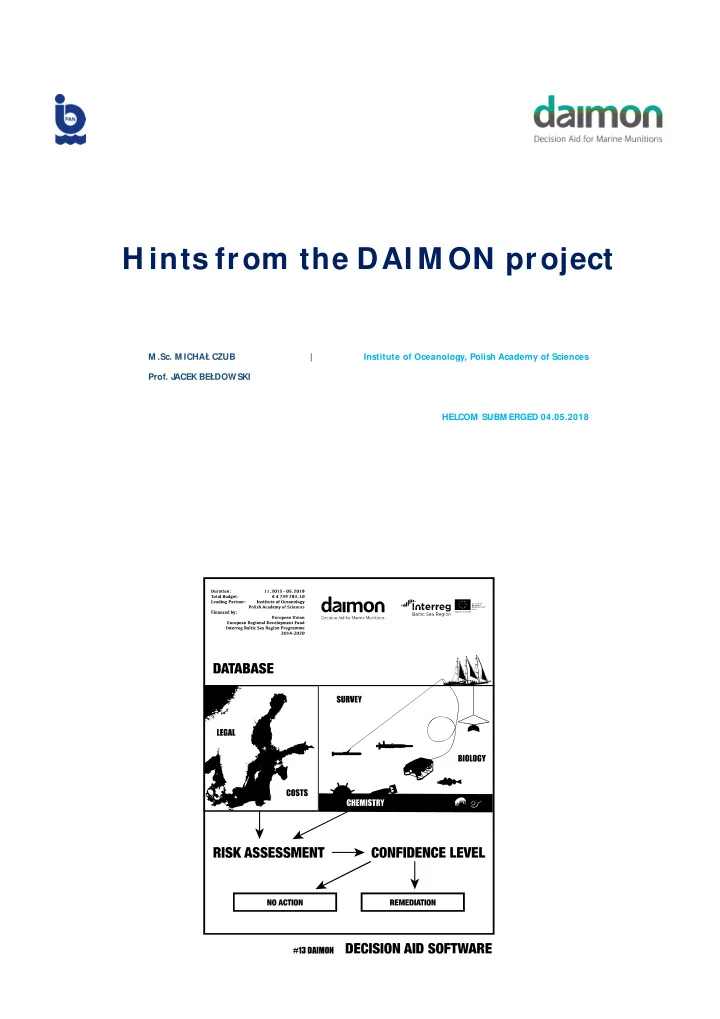
H ints from the DAI M ON project M .Sc. M ICHA CZUB | Institute of - - PDF document
H ints from the DAI M ON project M .Sc. M ICHA CZUB | Institute of Oceanology, Polish Academy of Sciences ACEK BE DOWSKI Prof. J HELCOM SUBM ERGED 04.05.2018 Munition Status Examination Modelling of possible release Pollution of
M .Sc. M ICHAŁ CZUB | Institute of Oceanology, Polish Academy of Sciences
ACEK BEŁDOWSKI HELCOM SUBM ERGED 04.05.2018
PILOT STUDIES S/ Y Oceania, R/ V Walther Herwig III, R/ V Aranda SURVEYS S/ Y Oceania, R/ V Imor, R/ V Walther Herwig III, R/ V Littorina, R/ V Aranda, R/ V Akademik Nikolay Strakhov MAIN AREAS OF INTEREST Bornholm Deep – CW dumpsite | Kolberger Heide - Explosives dumpsite | Skagerrak - Wrecks ADDITIONAL AREAS OF INTEREST Gdańsk Deep – CW, Gulf of Finland – Explosives EQUIPMENT ROV – Remotely Operated Vehicle, AUV - Autonomous Underwater Vehicle (+ magnetometer), SSS - Side Scan Sonar
Bornholm Deep Gotland Deep Gdańsk Deep
CW Dumpsites 70m depth Hypoxic zones in 2012 Anoxic zones in 2012
50 100 250 km100 km 25 50 Baltic Sea
Blablabla
Initial state and situation after about ~100 seconds of estimated potential leakage. Horizontal and vertical axes represent distance in relative units. Color scale can be interpreted as the level of contamination.
March – April 2018 (approx., 28 days)
Daphnia magna
Phenyldichlorarsine– Pfiffikus – 50% – LC50 = 125 µg∙dm⁻³ Diphenylchlorarsine – Clark I – 35% – LC50 = 38,2 µg∙dm⁻³ ± 1,507 Triphenylarsine– TPA – 5% – NOEC = 4 mg∙dm⁻³ (max. solubility) Arsine trichloride– 5% – LC50 = 10 mg∙dm⁻³ Arsine oil – LC50 = 110 µg∙dm⁻³ (35% ∙ 110 = 38,5 µg∙dm⁻³ ) Lewisite A, B, C – LC50 = 11,731 µg∙dm⁻³ Adamsite – LC50 = 46,726 µg∙dm⁻³ Lewisite, Clark I, Adamsite, PDCA and Arsine Oil remain very toxic when transferred into aquatic systems. TPA has no toxic effects, while AsCl3 is potentially harmful.
https:/ / shared.egeos.de/ amucad/ english/ #g=1&p=map
Klajpeda / Lithuania: 26.09.2018 – 28.09.2018