
SLIDE 1
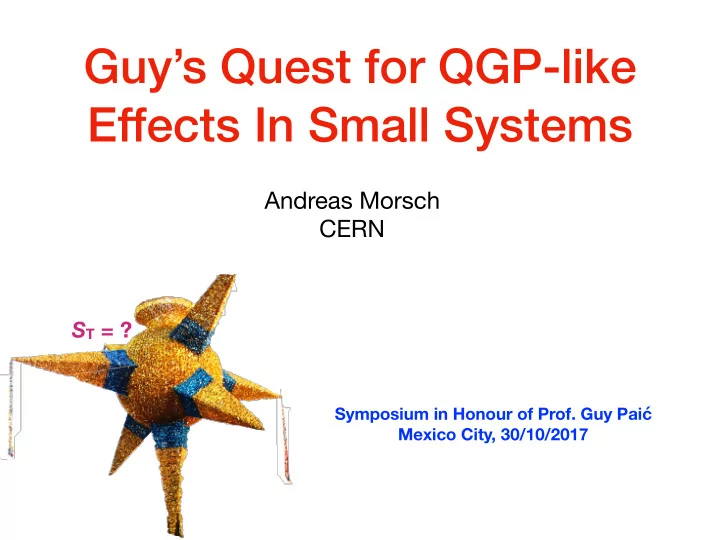
Guy’s Quest for QGP-like Effects In Small Systems
Andreas Morsch CERN
Symposium in Honour of Prof. Guy Paić Mexico City, 30/10/2017
ST = ?
Guys Quest for QGP-like Effects In Small Systems Andreas Morsch - - PowerPoint PPT Presentation
Guys Quest for QGP-like Effects In Small Systems Andreas Morsch CERN S T = ? Symposium in Honour of Prof. Guy Pai Mexico City, 30/10/2017 Preparing For Day One more simplicity? Physic Coordinator 1997 - 2003 new phenomena? + such
Andreas Morsch CERN
Symposium in Honour of Prof. Guy Paić Mexico City, 30/10/2017
ST = ?
+ such profane topics as … 3. pp as reference for AA 4. pile-up 5. detector commissioning
Physic Coordinator 1997 - 2003
more simplicity? new phenomena?
Understand complex events as superposition of elementary collisions (MPI) and their quantum fluctuations ? …
Multiple collisions at perturbative scales High Multiplicity a way to select events with large number of semi-hard collisions
⟨Ninteractions⟩
Hard Cross-Section [mb]
… or new surprises in the soft sector in a regime where energy densities reach those of heavy ion collisions ?
1 p
T
2
Two area scales: proton size hard scattering scale breaking of factorisation, saturation effects, …. several scatterings in the same area
since 2003
researchers
Chris Quigg
arXiv: 1004.0975
Unusual event or expected fluctuation? For some classes of events, analyses of bulk properties, such as studies of elliptic flow and determinations of thermodynamic parameters may prove
learn to see what the LHC data have to show. CDF Hedgehog Event
a pandora box piñata full of phenomena … hit it!
JHEP09(2010)091
event classes ?? novel tfchniques ??
from to
Eigenvalues λ1,2
ST ~ 0 ST = 1
Multiplicity
Events become more isotropic with increasing multiplicity
Increase saturates (in data), reverts (in MC) as consequence of bias on jet production.
Tests subtle interplay between increase of MPI and increase of particle production per hard scattering. no hard trigger hard trigger all
Weak energy (0.9, 2.76, 7 TeV) dependence …
Challenge generators in the extreme limits of phase space: low multiplicity/high sphericity and vice versa
low Nch high Nch
Heavy Flavour Light Flavour Event-by-Event Fluctuations *see next talk
and also in ATLAS and CMS …
as a function of summed pT multiplicity dependence of Υ production
(coherence effects between MPI in pp)
no sphericity selection 0-10% sphericity
… hallmark measurement for coherence effects in pp
XN Wang and R Hwa (Phys.Rev. D39 (1989) 187)
Ledge: rise – plateau – rise 1st rise: increased dominance of hard over soft interactions 2nd rise: jet bias
Geometrical Branching Model. two component model hard and soft process impact parameter dependent jet fragmentation
22
Add a soft component and low-pT jets … … and get structures
Color Reconnections (CR)
20 40
Nch
23
two-component Modern implementations of 2-component models do not explain data …
p-Pb follows pp up to Nch = 14 (10% of the pp cross-section)
Qualitatively same behaviour in all collisions systems
In Pythia characteristic peak structure consequence of color reconnections.
π+ K+ p
Pythia without CR cannot reproduce the trend!
multiplicity in high multiplicity pp events
the one in Pb-Pb (where ratio saturates)
arXiv:1608.02101v1
ε𝛖 (GeV/fm2) ε𝛖 (GeV/fm2) ε𝛖 (GeV/fm2) k=pp, p-Pb, Pb-Pb
Ξ Λ Ω
Dear Guy Keep Thinking, Provoking, Discussing, …. Enjoying Science and Life!