Gregor Mendel What is Genetics? the study of heredity Gregor - - PowerPoint PPT Presentation

gregor mendel
SMART_READER_LITE
LIVE PREVIEW

Gregor Mendel What is Genetics? the study of heredity Gregor - - PowerPoint PPT Presentation

Gregor Mendel What is Genetics? the study of heredity Gregor Mendels Peas Born in 1822. Pollen: plants sperm His work with pea Egg Cells: plants plants laid the reproductive cells foundation for Genetics. Fertilization:


slide-1
SLIDE 1

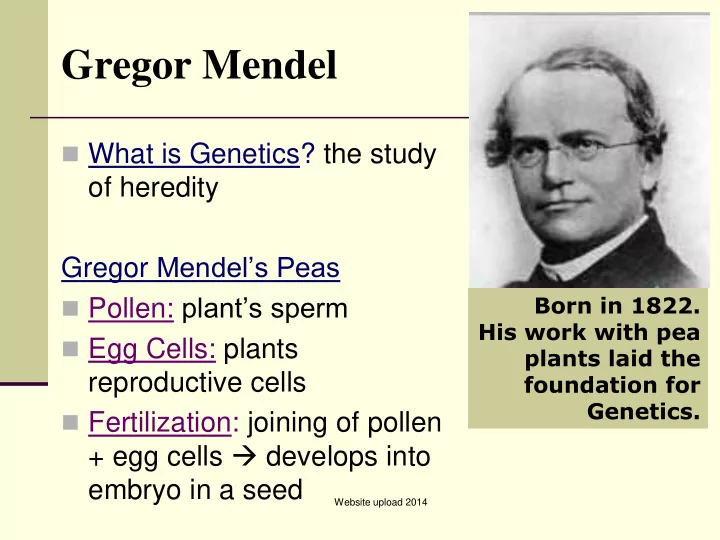
Gregor Mendel

 What is Genetics? the study

  • f heredity

Gregor Mendel’s Peas

 Pollen: plant’s sperm  Egg Cells: plants

reproductive cells

 Fertilization: joining of pollen

+ egg cells  develops into embryo in a seed

Born in 1822. His work with pea plants laid the foundation for Genetics.

Website upload 2014

slide-2
SLIDE 2

Working with pea plants…

 Self-pollinating: pollen fertilizes egg cells in the

SAME flower (single parent reproduction)

 True-breeding: offspring genetically identical to

parents due to self-pollination

 Cross-pollination: combining reproductive cells

from 2 DIFFERENT parent plants Mendel could cross- breed a purple flower with a white flower… What do you think is the color of the

  • ffspring?

Website upload 2014

slide-3
SLIDE 3

Genes and Dominance

 TRAIT: specific characteristic (seed color,

plant height, etc) What did Mendel do in his pea plant experiments?

 Studied 7 different traits each with

contrasting characteristics (ex) Height, short or tall

 He crossed the plants (with contrasting

characters) and looked at their offspring

Website upload 2014

slide-4
SLIDE 4

P = parental generation = original pair of plants F1 = first filial generation= first generation Hybrids: offspring from parents with different traits

Website upload 2014

slide-5
SLIDE 5

Tracking Generations

 Parental generation

P mates to produce

 First-generation offspring

F1 mate to produce

 Second-generation offspring

F2

Website upload 2014

slide-6
SLIDE 6

CROSS-POLLINATION:

Mendel cut the male parts of one flower and dusted the female parts with pollen from another flower.

P GENERATION: purple x white flowers F1 GENERATION: all purple flowers

HYBRID PLANTS

Website upload 2014

slide-7
SLIDE 7

What happened in Mendel’s crosses? All the offspring only had one of the parent’s characters…the other parent’s character disappeared! Mendel’s Conclusions:

1.

Inheritance is determined by factors that are passed down

2.

GENES: the factors that determine traits

3.

Contrasting characters are different forms of a gene called ALLELES

Website upload 2014

slide-8
SLIDE 8

 some alleles are dominant, some are recessive  DOMINANT ALLELE: form of trait that will

always be exhibited; usually expressed in capitals

 RECESSIVE ALLELE: form of trait is only

exhibited when the dominant allele is NOT present

 (ex) Allele for tall is dominant for and the allele

for short is recessive

Mendel’s Principle of Dominance

Website upload 2014

slide-9
SLIDE 9

What happened to the recessive allele?

 Mendel wanted to

know if the recessive allele disappeared from the F1 plants.

 F1 CROSS: He

self-crossed the F1 generations to make F2 offspring

Website upload 2014

slide-10
SLIDE 10

THE F2 GENERATION…

 The recessive traits reappeared!!

~¼ plants had white flowers, the recessive trait

 Summary of Crosses:

tall plants X short plants  tall plants P P F1 tall plants self-pollinating  ¼ short, ¾ tall F1 Cross F2

Website upload 2014

slide-11
SLIDE 11

Explaining the F1 Cross

 Why did the recessive allele reappear? At

some point, the recessive allele had to separate from the dominant allele. This is called…

SEGREGATION: separation of alleles 

  • ccurs during formation of gametes (eggs &

sperm) in anaphase II of meiosis.

Website upload 2014

slide-12
SLIDE 12

Explaining the F1 Cross

 F1 plants inherited 1 tall allele & 1 short allele

from parents

 When gametes are formed, the two alleles

segregate from each other  each gamete has 1 copy of each gene

 So, 2 different types of gametes are formed

(one w/ tall allele, one w/ short allele)

Website upload 2014

slide-13
SLIDE 13

SEGREGATION

Website upload 2014

slide-14
SLIDE 14

Punnett Squares

What is a Punnett Square?

 A diagram showing the possible genetic

combinations from a particular cross

 Can be used to predict and compare the genetic

variations that will result from a cross

Website upload 2014

slide-15
SLIDE 15

Punnett Squares

What do the letters represent in a Punnett square?

 Letters represent alleles: capital = dominant

lowercase = recessive

 Homozygous: has two identical alleles for a trait

(ex) TT or tt

 Heterozygous: has two different alleles for the

same trait (ex) Tt

Website upload 2014

slide-16
SLIDE 16

Punnett Square for TT x Tt

Punnett Square for YY x yy

Website upload 2014

slide-17
SLIDE 17

Genotype vs Phenotype

 GENOTYPE: the genetic

makeup of an organism (ex) TT

 PHENOTYPE: the

physical characteristics exhibited (ex) tall plant

Website upload 2014

slide-18
SLIDE 18

Probability and Segregation

 F2 generation from

Tall F1 plants  ¾ tall, ¼ short

 3:1 ratio of tall to

short plants Punnet squares work to predict outcomes, so Mendel’s ideas about segregation are accurate!

Website upload 2014

slide-19
SLIDE 19

Exploring Mendelian Genetics

 Mendel performed TWO-FACTOR CROSSES:

crossing 2 different genes and following traits as they pass from one generation to the next

Website upload 2014

slide-20
SLIDE 20

Two-Factor Cross: F1

 Two Genes: shape of pea & color of pea  The Cross:  Round yellow peas x wrinkled green peas

RRYY x rryy

 What are the possible alleles parent 1 can pass? RY  What are the possible alleles parent 2 can pass? ry  All F1 were RrYy (round and yellow) or HYBRIDS

Website upload 2014

slide-21
SLIDE 21

Two-Factor Cross: F2

 F1 Generation = RrYy  How would these alleles segregate when F1 self-

pollinated?

 RrYy x RrYy

 Do the two dominant alleles stay together?  What are the possible alleles each parent can pass

  • n?

 There are 4 possible combinations: Ry, RY, rY, ry

Website upload 2014

slide-22
SLIDE 22

 The F1 Hybrid cross

produces a 9:3:3:1 phenotype ratio

 Mendel found that

the 2 alleles (seed shape & seed color) don’t influence each

  • ther’s inheritance

 This is called the

principle of Independent Assortment: genes for different traits can segregate independently during the formation of gametes

INDEPENDENT ASSORTMENT

Website upload 2014

slide-23
SLIDE 23

Independent Assortment

Metaphase I: Metaphase II: Gametes:

1/4 AB 1/4 ab 1/4 Ab 1/4 aB A A A A A A A A A A A A B B B B B B B B B B B B a a a a a a a a a a a a b b b b b b b b b b b b

OR

Website upload 2014

slide-24
SLIDE 24

Summary of Mendel’s Principles

A.

Inheritance of characteristics is determined by genes which are passed to offspring

B.

If 2+ alleles of a trait exist, some alleles may be dominant, others may be recessive

C.

Sexually reproducing organisms have 2 copies

  • f each gene which segregate during gamete

formation

D.

Alleles for different genes segregate independently

Website upload 2014

slide-25
SLIDE 25

Beyond Dominant & Recessive Alleles

 Genetics is more complicated  Some alleles are neither dominant nor

recessive

 Many traits are controlled by multiple alleles

  • r multiple genes

Website upload 2014

slide-26
SLIDE 26

Other Inheritance Patterns…

  • 1. Incomplete Dominance
  • 2. Codominance
  • 3. Multiple Alleles
  • 4. Polygenic Traits

Website upload 2014

slide-27
SLIDE 27

X Homozygous parent (RR) Homozygous Parent (rr) All F1 are heterozygous X F2 shows three phenotypes in 1:2:1 ratio

Incomplete Dominance

 When one allele

is not completely dominant; recessive allele is not totally masked

 Heterozygous

phenotype is in between the two homozygous phenotypes

Website upload 2014

slide-28
SLIDE 28

X Homozygous parent (RR) Homozygous Parent (rr) All F1 are heterozygous X F2 shows three phenotypes in 1:2:1 ratio

Incomplete Dominance

 (ex) Red

snapdragon flowers (RR) X snapdragon white (rr) flowers  pink hybrid flowers (Rr)

Website upload 2014

slide-29
SLIDE 29

X

homozygous parent homozygous parent

All F1 offspring heterozygous for flower color: Cross two of the F1 plants and the F2

  • ffspring will show

three phenotypes in a 1:2:1 ratio:

Incomplete Dominance

Website upload 2014

slide-30
SLIDE 30

Codominance

 Both alleles contribute to the phenotype  Heterozygous genotype expresses both

phenotypes

 (ex) Feather colors in chickens: white feathers &

black feathers  speckled chicken

 (ex) Horse coats: red & white roan coat

Website upload 2014

slide-31
SLIDE 31

Codominance:ABO Blood Types

 Alleles that controls blood type

are codominant

 Two alleles A & B are both

exhibited when paired, a third allele (i) is recessive to others

 AA or Ai = Type A Blood  BB or Bi = Type B Blood  AB = Type AB Blood  ii = Type O Blood

Website upload 2014

slide-32
SLIDE 32

Multiple Alleles

> 2 possible alleles for a gene

 Individuals can still only have 2 alleles each

but more than 2 alleles exist in a population

 (ex) coat color in rabbits  lots of options due

to 4 different alleles

 (ex) blood type is determined by multiple

alleles

Website upload 2014

slide-33
SLIDE 33

Polygenic Traits

 Traits controlled by the

interaction of 2+ genes

 (ex) Fruit fly eye color

(3+ different genes)

 (ex) Skin color in

humans (4+ different genes), eye color, height, weight

Website upload 2014