Greedy Algorithms Solve problems with the simplest possible - - PDF document

greedy algorithms
SMART_READER_LITE
LIVE PREVIEW

Greedy Algorithms Solve problems with the simplest possible - - PDF document

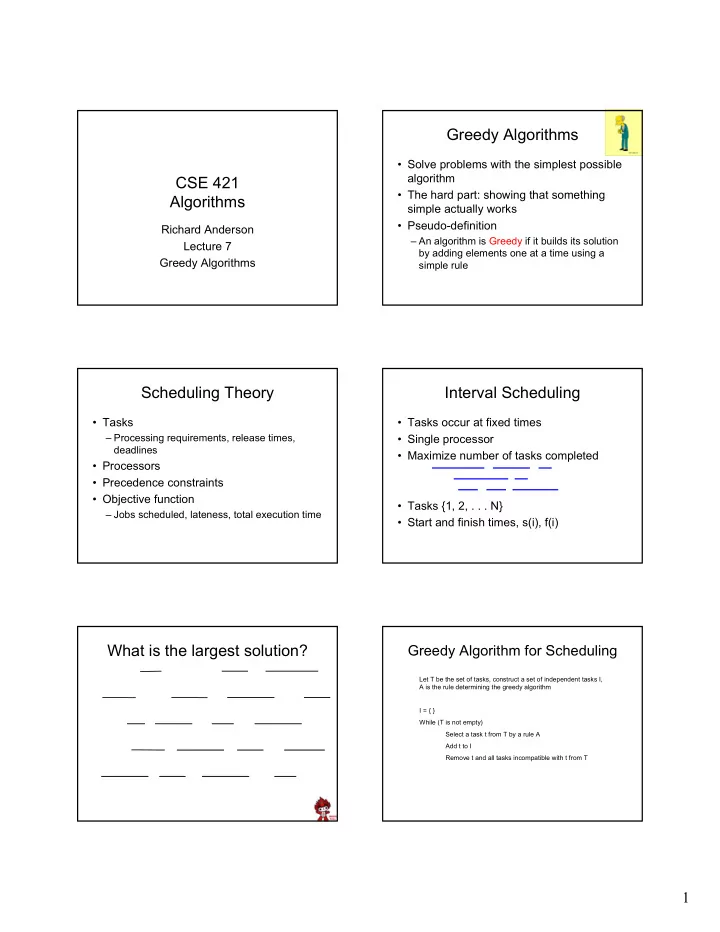
Greedy Algorithms Solve problems with the simplest possible algorithm CSE 421 The hard part: showing that something Algorithms simple actually works Pseudo-definition Richard Anderson An algorithm is Greedy if it builds its


slide-1
SLIDE 1

1

CSE 421 Algorithms

Richard Anderson Lecture 7 Greedy Algorithms

Greedy Algorithms

  • Solve problems with the simplest possible

algorithm

  • The hard part: showing that something

simple actually works

  • Pseudo-definition

– An algorithm is Greedy if it builds its solution by adding elements one at a time using a simple rule

Scheduling Theory

  • Tasks

– Processing requirements, release times, deadlines

  • Processors
  • Precedence constraints
  • Objective function

– Jobs scheduled, lateness, total execution time

  • Tasks occur at fixed times
  • Single processor
  • Maximize number of tasks completed
  • Tasks {1, 2, . . . N}
  • Start and finish times, s(i), f(i)

Interval Scheduling What is the largest solution?

Greedy Algorithm for Scheduling

Let T be the set of tasks, construct a set of independent tasks I, A is the rule determining the greedy algorithm I = { } While (T is not empty) Select a task t from T by a rule A Add t to I Remove t and all tasks incompatible with t from T

slide-2
SLIDE 2

2

Simulate the greedy algorithm for each of these heuristics

Schedule earliest starting task Schedule shortest available task Schedule task with fewest conflicting tasks

Greedy solution based on earliest finishing time

Example 1 Example 2 Example 3

Theorem: Earliest Finish Algorithm is Optimal

  • Key idea: Earliest Finish Algorithm stays

ahead

  • Let A = {i1, . . ., ik} be the set of tasks found

by EFA in increasing order of finish times

  • Let B = {j1, . . ., jm} be the set of tasks

found by a different algorithm in increasing

  • rder of finish times
  • Show that for r<= min(k, m), f(ir) <= f(jr)

Stay ahead lemma

  • A always stays ahead of B, f(ir) <= f(jr)
  • Induction argument

– f(i1) <= f(j1) – If f(ir-1) <= f(jr-1) then f(ir) <= f(jr)

Completing the proof

  • Let A = {i1, . . ., ik} be the set of tasks found by

EFA in increasing order of finish times

  • Let O = {j1, . . ., jm} be the set of tasks found by

an optimal algorithm in increasing order of finish times

  • If k < m, then the Earliest Finish Algorithm

stopped before it ran out of tasks

Scheduling all intervals

  • Minimize number of processors to

schedule all intervals

slide-3
SLIDE 3

3

How many processors are needed for this example?

Prove that you cannot schedule this set

  • f intervals with two processors

Depth: maximum number of intervals active

Algorithm

  • Sort by start times
  • Suppose maximum depth is d, create d

slots

  • Schedule items in increasing order, assign

each item to an open slot

  • Correctness proof: When we reach an

item, we always have an open slot

Scheduling tasks

  • Each task has a length ti and a deadline di
  • All tasks are available at the start
  • One task may be worked on at a time
  • All tasks must be completed
  • Goal minimize maximum lateness

– Lateness = fi – di if fi >= di

Example

2 3 2 4 Deadline Time 2 3 2 3 Lateness 1 Lateness 3

slide-4
SLIDE 4

4

Determine the minimum lateness

2 3 4 5 6 4 5 12 Deadline Time

To be continued . . .