Grammar: The Heart of Numeracy 18 Nov, 2017 0B 2017 NNN2 Grammar: - - PDF document

grammar the heart of numeracy 18 nov 2017
SMART_READER_LITE
LIVE PREVIEW

Grammar: The Heart of Numeracy 18 Nov, 2017 0B 2017 NNN2 Grammar: - - PDF document

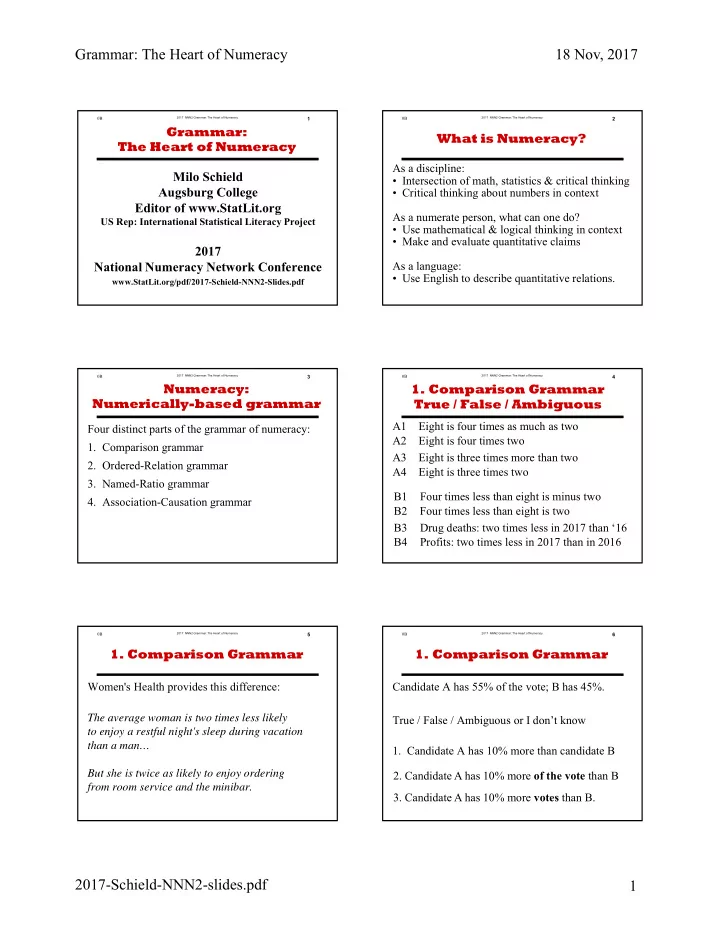
Grammar: The Heart of Numeracy 18 Nov, 2017 0B 2017 NNN2 Grammar: The Heart of Numeracy 1 0B 2017 NNN2 Grammar: The Heart of Numeracy 2 Grammar: What is Numeracy? The Heart of Numeracy As a discipline: Milo Schield Intersection of


slide-1
SLIDE 1

Grammar: The Heart of Numeracy 18 Nov, 2017 2017-Schield-NNN2-slides.pdf 1

2017 NNN2 Grammar: The Heart of Numeracy

0B

1

Milo Schield Augsburg College Editor of www.StatLit.org

US Rep: International Statistical Literacy Project

2017 National Numeracy Network Conference

www.StatLit.org/pdf/2017-Schield-NNN2-Slides.pdf

Grammar: The Heart of Numeracy

2017 NNN2 Grammar: The Heart of Numeracy

0B

2

As a discipline:

  • Intersection of math, statistics & critical thinking
  • Critical thinking about numbers in context

As a numerate person, what can one do?

  • Use mathematical & logical thinking in context
  • Make and evaluate quantitative claims

As a language:

  • Use English to describe quantitative relations.

What is Numeracy?

2017 NNN2 Grammar: The Heart of Numeracy

0B

3

Four distinct parts of the grammar of numeracy:

  • 1. Comparison grammar
  • 2. Ordered-Relation grammar
  • 3. Named-Ratio grammar
  • 4. Association-Causation grammar

Numeracy: Numerically-based grammar

2017 NNN2 Grammar: The Heart of Numeracy

0B

4

A1 Eight is four times as much as two A2 Eight is four times two

  • 1. Comparison Grammar

True / False / Ambiguous

B1 Four times less than eight is minus two B2 Four times less than eight is two A3 Eight is three times more than two A4 Eight is three times two B3 Drug deaths: two times less in 2017 than ‘16 B4 Profits: two times less in 2017 than in 2016

2017 NNN2 Grammar: The Heart of Numeracy

0B

5

Women's Health provides this difference: The average woman is two times less likely to enjoy a restful night's sleep during vacation than a man… But she is twice as likely to enjoy ordering from room service and the minibar.

  • 1. Comparison Grammar
2017 NNN2 Grammar: The Heart of Numeracy

0B

6

Candidate A has 55% of the vote; B has 45%. True / False / Ambiguous or I don’t know

  • 1. Candidate A has 10% more than candidate B
  • 1. Comparison Grammar
  • 2. Candidate A has 10% more of the vote than B
  • 3. Candidate A has 10% more votes than B.
slide-2
SLIDE 2

Grammar: The Heart of Numeracy 18 Nov, 2017 2017-Schield-NNN2-slides.pdf 2

2017 NNN2 Grammar: The Heart of Numeracy

0B

7

Addition and multiplication are order-independent Subtraction and division are order-dependent From and to can be either.

  • Distance from LA to NY same as from NY to LA.
  • Take away 3 from 5 ≠ Take away 5 from 3.

Participant survey:

  • Q. How much is two into four?
  • a. two b. one-half c. I don’t know
  • 2. Grammar of

Ordered Operations

2017 NNN2 Grammar: The Heart of Numeracy

0B

8

Distance grammar

  • Q1. The distance from Saint Paul to Minneapolis is 12

miles (downtown to downtown). What is the distance from Minneapolis to St. Paul? The same (24) Something different (2) Don’t know (2) Subtraction grammar:

  • Q2. How much is two from five?

Minus three (2) Three (25) I don’t know (1)

  • Q3. How much is five from two?

Minus three (21) Three (6) I don’t know (1)

  • 2. Ordered Operations Survey

28 Augsburg Students

2017 NNN2 Grammar: The Heart of Numeracy

0B

9

Study of 28 Augsburg undergrad business students Division grammar:

  • Q4. Divide four by two gives

Two (25) One-half (2) Don’t know (1)

  • Q5. Divide two into four gives

Two (5) One-half (21) Don’t know (2) Division ‘into’ is a real problem!!!

  • 2. Ordered Operations

Division grammar: by vs. into

2017 NNN2 Grammar: The Heart of Numeracy

0B

10

  • 1. it comes from the early schooling context of

learning long division, where the operation is invariably described as answering the question "How many times does X go into Y?".

  • 2. there are two [ways] for performing division,

and two common prepositions. So if we know what "divide 4 by 2" means, we're happy to accept "divide 4 into 2" to designate the "opposite or inverse" operation. E.g., The ball went by (into) the pocket.

https://english.stackexchange.com/questions/58209/divide-two-into-four-and-divide-two-by-four https://www.macmillandictionary.com/us/dictionary/american/divide-into https://ell.stackexchange.com/questions/114194/divide-into-or-in

  • 2. Division using “Into”:

Two Explanations

2017 NNN2 Grammar: The Heart of Numeracy

0B

11

  • Q10. “The ratio of men to women is three”.

What does that mean? a) Three times as many women as men (3) b) Three times as many men as women (22) c) Something else (1) d) I don't know (2) 22 correct; six other. 79% correct

  • 2. Division Grammar:

Ratio Grammar Survey

2017 NNN2 Grammar: The Heart of Numeracy

0B

12

  • Q11. “The male-female ratio is two”.

What does this mean? a) Two times as many men as women (21) b) Two times as many women as men (1) c) Something else (4) d) I don't know (2) 21 correct; 7 other. 75% correct

  • 2. Division Grammar:

Ratio Grammar Survey

slide-3
SLIDE 3

Grammar: The Heart of Numeracy 18 Nov, 2017 2017-Schield-NNN2-slides.pdf 3

2017 NNN2 Grammar: The Heart of Numeracy

0B

13

  • Q12. Jan likes small classes. Which does Jan like?

a) A small teacher-student ratio (3) b) A large teacher-student ratio (12) 71% c) I don't know (2)

  • Q13. Amy likes small classes. Which does Amy like?

a) A small student-teacher ratio (10) 91% b) A larger student-teacher ratio (1) c) I can't tell (0) Different students: Q12 young FT; Q13 older working.

  • 2. Division Grammar:

Ratio Grammar Survey

2017 NNN2 Grammar: The Heart of Numeracy

0B

14

Ordinary grammar ratios use just per, of or out of Named ratios include

  • Percent
  • Percentage (fraction and share)
  • Rate (incidence and prevalence)
  • Chance (odds, risk, likelihood and probability

Schield (2000). www.statlit.org/pdf/2000SchieldASA.pdf

  • 3. Named Ratio Grammar
2017 NNN2 Grammar: The Heart of Numeracy

0B

15

% is preceded by a number or adjective. Percentage is preceded by the or what.

  • 1. 20% [per cent] of men are smokers
  • 2. The percentage of men who are smokers is 20%
  • 3. A small percent of men are smokers
  • 4. What is the percentage of men who are smokers?
  • 5. What percentage of men are smokers?

Schield (2000). www.statlit.org/pdf/2000SchieldASA.pdf

  • 3. Named Ratio Grammar

Percent vs. percentage

2017 NNN2 Grammar: The Heart of Numeracy

0B

16

Association is a mathematical idea; Causation is not a mathematical idea. Mathematics describes associations in many ways: comparisons, correlation (total and partial) There is no mathematical operator for ‘causes’. Philosophically,

  • mathematics deals with the form (association);
  • statistics deals with form and matter (causation)
  • 4. Association vs. Causation
2017 NNN2 Grammar: The Heart of Numeracy

0B

17

A: Association grammar (associate, correlate) Comparisons: Whites more likely to suicide… Internal change: As kids age, height increases. C: Causation grammar (Cause, effect, result of) Sufficiency: Lightning resulted in a fire. Contra-fact: Those who do X get more Y than if they hadn’t done X. B: Between grammar: Implies – but does not assert – causation

  • 4. Association vs. Causation:

A-B-C Grammar

2017 NNN2 Grammar: The Heart of Numeracy

0B

18

B: Between grammar: states an association. ‘Implies’ – but does not assert – causation

  • Action verbs: cuts, ups, raises, increases.

Red wine cuts cancer risk. TV ups kids’ risk of

  • flunking. Smoking raises asthma risk.
  • Action nouns: Spinach is an asthma protector.
  • Combinations: Smoking is a causal factor.
  • Connectors: Nuts linked to cancer.

Source: www.statlit.org/pdf/2008RaymondSchieldASA.pdf

  • 4. Association vs. Causation:

A-B-C Grammar: 20-60%-10

slide-4
SLIDE 4

Grammar: The Heart of Numeracy 18 Nov, 2017 2017-Schield-NNN2-slides.pdf 4

2017 NNN2 Grammar: The Heart of Numeracy

0B

19

B: Between grammar: states an association. ‘Implies’ – but does not assert – causation

  • Change-in-subject comparisons: As teacher pay

increases, student scores increase

  • Time: Autism develops right after vaccination
  • Modals: Smoking may cause cancer.
  • Logical: Anxiety increases due to (because of)

high stakes testing.

  • 1. Association vs. Causation:

A-B-C Grammar

2017 NNN2 Grammar: The Heart of Numeracy

0B

20

Lack of insurance associated with 45,000 deaths Study: 45,000 Uninsured Die a Year Lack of insurance linked to 45,000 deaths Study links 45,000 U.S. deaths to lack of insurance No health coverage tied to 45,000 deaths a year 45,000 deaths attributable to uninsurance Study: 45,000 U.S. Deaths from Lack of Insurance

  • 4. Association vs. Causation:

News Headlines: Same Story

2017 NNN2 Grammar: The Heart of Numeracy

0B

21

Lack of Health Insurance Kills 45,000 a Year One [death] every 12 minutes due to no insurance 45,000 die ... because of lack of health insurance Lack of Health Insurance cause 44,789 deaths Lack of insurance to blame for 45,000 deaths

Schield (2010). www.statlit.org/pdf/2010SchieldICOTS.pdf

Association vs. Causation News Headlines: Same Story

2017 NNN2 Grammar: The Heart of Numeracy

0B

22

Conclusions

Students need help in using ordinary English

  • to describe quantitative relationships
  • to distinguish association from causation
  • to distinguish part from whole in percentages
  • 1. Take survey: www.statlit.org/pdf/2017-Schield-

Association-Causation-Survey.pdf

2017 NNN2 Grammar: The Heart of Numeracy

0B

23

References

Gigerenzer, G., Wegwarth, O., & Feufel, M. (2010). Misleading communication of risk: Editors should enforce transparent reporting in abstracts. British Medical Journal, 341, 791-792.

slide-5
SLIDE 5

2017 NNN2 Grammar: The Heart of Numeracy

0B

1

Milo Schield Augsburg College Editor of www.StatLit.org

US Rep: International Statistical Literacy Project

2017 National Numeracy Network Conference

www.StatLit.org/pdf/2017-Schield-NNN2-Slides.pdf

Grammar: The Heart of Numeracy

slide-6
SLIDE 6

2017 NNN2 Grammar: The Heart of Numeracy

0B

2

As a discipline:

  • Intersection of math, statistics & critical thinking
  • Critical thinking about numbers in context

As a numerate person, what can one do?

  • Use mathematical & logical thinking in context
  • Make and evaluate quantitative claims

As a language:

  • Use English to describe quantitative relations.

What is Numeracy?

slide-7
SLIDE 7

2017 NNN2 Grammar: The Heart of Numeracy

0B

3

Four distinct parts of the grammar of numeracy:

  • 1. Comparison grammar
  • 2. Ordered-Relation grammar
  • 3. Named-Ratio grammar
  • 4. Association-Causation grammar

Numeracy: Numerically-based grammar

slide-8
SLIDE 8

2017 NNN2 Grammar: The Heart of Numeracy

0B

4

A1 Eight is four times as much as two A2 Eight is four times two

  • 1. Comparison Grammar

True / False / Ambiguous

B1 Four times less than eight is minus two B2 Four times less than eight is two A3 Eight is three times more than two A4 Eight is three times two B3 Drug deaths: two times less in 2017 than ‘16 B4 Profits: two times less in 2017 than in 2016

slide-9
SLIDE 9

2017 NNN2 Grammar: The Heart of Numeracy

0B

5

Women's Health provides this difference: The average woman is two times less likely to enjoy a restful night's sleep during vacation than a man… But she is twice as likely to enjoy ordering from room service and the minibar.

  • 1. Comparison Grammar
slide-10
SLIDE 10

2017 NNN2 Grammar: The Heart of Numeracy

0B

6

Candidate A has 55% of the vote; B has 45%. True / False / Ambiguous or I don’t know

  • 1. Candidate A has 10% more than candidate B
  • 1. Comparison Grammar
  • 2. Candidate A has 10% more of the vote than B
  • 3. Candidate A has 10% more votes than B.
slide-11
SLIDE 11

2017 NNN2 Grammar: The Heart of Numeracy

0B

7

Addition and multiplication are order-independent Subtraction and division are order-dependent From and to can be either.

  • Distance from LA to NY same as from NY to LA.
  • Take away 3 from 5 ≠ Take away 5 from 3.

Participant survey:

  • Q. How much is two into four?
  • a. two b. one-half c. I don’t know
  • 2. Grammar of

Ordered Operations

slide-12
SLIDE 12

2017 NNN2 Grammar: The Heart of Numeracy

0B

8

Distance grammar

  • Q1. The distance from Saint Paul to Minneapolis is 12

miles (downtown to downtown). What is the distance from Minneapolis to St. Paul? The same (24) Something different (2) Don’t know (2) Subtraction grammar:

  • Q2. How much is two from five?

Minus three (2) Three (25) I don’t know (1)

  • Q3. How much is five from two?

Minus three (21) Three (6) I don’t know (1)

  • 2. Ordered Operations Survey

28 Augsburg Students

slide-13
SLIDE 13

2017 NNN2 Grammar: The Heart of Numeracy

0B

9

Study of 28 Augsburg undergrad business students Division grammar:

  • Q4. Divide four by two gives

Two (25) One-half (2) Don’t know (1)

  • Q5. Divide two into four gives

Two (5) One-half (21) Don’t know (2) Division ‘into’ is a real problem!!!

  • 2. Ordered Operations

Division grammar: by vs. into

slide-14
SLIDE 14

2017 NNN2 Grammar: The Heart of Numeracy

0B

10

  • 1. it comes from the early schooling context of

learning long division, where the operation is invariably described as answering the question "How many times does X go into Y?".

  • 2. there are two [ways] for performing division,

and two common prepositions. So if we know what "divide 4 by 2" means, we're happy to accept "divide 4 into 2" to designate the "opposite or inverse" operation. E.g., The ball went by (into) the pocket.

https://english.stackexchange.com/questions/58209/divide-two-into-four-and-divide-two-by-four https://www.macmillandictionary.com/us/dictionary/american/divide-into https://ell.stackexchange.com/questions/114194/divide-into-or-in

  • 2. Division using “Into”:

Two Explanations

slide-15
SLIDE 15

2017 NNN2 Grammar: The Heart of Numeracy

0B

11

  • Q10. “The ratio of men to women is three”.

What does that mean? a) Three times as many women as men (3) b) Three times as many men as women (22) c) Something else (1) d) I don't know (2) 22 correct; six other. 79% correct

  • 2. Division Grammar:

Ratio Grammar Survey

slide-16
SLIDE 16

2017 NNN2 Grammar: The Heart of Numeracy

0B

12

  • Q11. “The male-female ratio is two”.

What does this mean? a) Two times as many men as women (21) b) Two times as many women as men (1) c) Something else (4) d) I don't know (2) 21 correct; 7 other. 75% correct

  • 2. Division Grammar:

Ratio Grammar Survey

slide-17
SLIDE 17

2017 NNN2 Grammar: The Heart of Numeracy

0B

13

  • Q12. Jan likes small classes. Which does Jan like?

a) A small teacher-student ratio (3) b) A large teacher-student ratio (12) 71% c) I don't know (2)

  • Q13. Amy likes small classes. Which does Amy like?

a) A small student-teacher ratio (10) 91% b) A larger student-teacher ratio (1) c) I can't tell (0) Different students: Q12 young FT; Q13 older working.

  • 2. Division Grammar:

Ratio Grammar Survey

slide-18
SLIDE 18

2017 NNN2 Grammar: The Heart of Numeracy

0B

14

Ordinary grammar ratios use just per, of or out of Named ratios include

  • Percent
  • Percentage (fraction and share)
  • Rate (incidence and prevalence)
  • Chance (odds, risk, likelihood and probability

Schield (2000). www.statlit.org/pdf/2000SchieldASA.pdf

  • 3. Named Ratio Grammar
slide-19
SLIDE 19

2017 NNN2 Grammar: The Heart of Numeracy

0B

15

% is preceded by a number or adjective. Percentage is preceded by the or what.

  • 1. 20% [per cent] of men are smokers
  • 2. The percentage of men who are smokers is 20%
  • 3. A small percent of men are smokers
  • 4. What is the percentage of men who are smokers?
  • 5. What percentage of men are smokers?

Schield (2000). www.statlit.org/pdf/2000SchieldASA.pdf

  • 3. Named Ratio Grammar

Percent vs. percentage

slide-20
SLIDE 20

2017 NNN2 Grammar: The Heart of Numeracy

0B

16

Association is a mathematical idea; Causation is not a mathematical idea. Mathematics describes associations in many ways: comparisons, correlation (total and partial) There is no mathematical operator for ‘causes’. Philosophically,

  • mathematics deals with the form (association);
  • statistics deals with form and matter (causation)
  • 4. Association vs. Causation
slide-21
SLIDE 21

2017 NNN2 Grammar: The Heart of Numeracy

0B

17

A: Association grammar (associate, correlate) Comparisons: Whites more likely to suicide… Internal change: As kids age, height increases. C: Causation grammar (Cause, effect, result of) Sufficiency: Lightning resulted in a fire. Contra-fact: Those who do X get more Y than if they hadn’t done X. B: Between grammar: Implies – but does not assert – causation

  • 4. Association vs. Causation:

A-B-C Grammar

slide-22
SLIDE 22

2017 NNN2 Grammar: The Heart of Numeracy

0B

18

B: Between grammar: states an association. ‘Implies’ – but does not assert – causation

  • Action verbs: cuts, ups, raises, increases.

Red wine cuts cancer risk. TV ups kids’ risk of

  • flunking. Smoking raises asthma risk.
  • Action nouns: Spinach is an asthma protector.
  • Combinations: Smoking is a causal factor.
  • Connectors: Nuts linked to cancer.

Source: www.statlit.org/pdf/2008RaymondSchieldASA.pdf

  • 4. Association vs. Causation:

A-B-C Grammar: 20-60%-10

slide-23
SLIDE 23

2017 NNN2 Grammar: The Heart of Numeracy

0B

19

B: Between grammar: states an association. ‘Implies’ – but does not assert – causation

  • Change-in-subject comparisons: As teacher pay

increases, student scores increase

  • Time: Autism develops right after vaccination
  • Modals: Smoking may cause cancer.
  • Logical: Anxiety increases due to (because of)

high stakes testing.

  • 1. Association vs. Causation:

A-B-C Grammar

slide-24
SLIDE 24

2017 NNN2 Grammar: The Heart of Numeracy

0B

20

Lack of insurance associated with 45,000 deaths Study: 45,000 Uninsured Die a Year Lack of insurance linked to 45,000 deaths Study links 45,000 U.S. deaths to lack of insurance No health coverage tied to 45,000 deaths a year 45,000 deaths attributable to uninsurance Study: 45,000 U.S. Deaths from Lack of Insurance

  • 4. Association vs. Causation:

News Headlines: Same Story

slide-25
SLIDE 25

2017 NNN2 Grammar: The Heart of Numeracy

0B

21

Lack of Health Insurance Kills 45,000 a Year One [death] every 12 minutes due to no insurance 45,000 die ... because of lack of health insurance Lack of Health Insurance cause 44,789 deaths Lack of insurance to blame for 45,000 deaths

Schield (2010). www.statlit.org/pdf/2010SchieldICOTS.pdf

Association vs. Causation News Headlines: Same Story

slide-26
SLIDE 26

2017 NNN2 Grammar: The Heart of Numeracy

0B

22

Conclusions

Students need help in using ordinary English

  • to describe quantitative relationships
  • to distinguish association from causation
  • to distinguish part from whole in percentages
  • 1. Take survey: www.statlit.org/pdf/2017-Schield-

Association-Causation-Survey.pdf

slide-27
SLIDE 27

2017 NNN2 Grammar: The Heart of Numeracy

0B

23

References

Gigerenzer, G., Wegwarth, O., & Feufel, M. (2010). Misleading communication of risk: Editors should enforce transparent reporting in abstracts. British Medical Journal, 341, 791-792.