Gluon bremsstrahlung in QCD plasmas at very high energy Why - - PowerPoint PPT Presentation

gluon bremsstrahlung in qcd plasmas at very high energy
SMART_READER_LITE
LIVE PREVIEW

Gluon bremsstrahlung in QCD plasmas at very high energy Why - - PowerPoint PPT Presentation

Peter Arnold Gluon bremsstrahlung in QCD plasmas at very high energy Why interesting? Perturbatively, gluon bremsstrahlung (and related process of pair production) dominates energy loss of high energy particles ( E >> T ) traversing a


slide-1
SLIDE 1

Gluon bremsstrahlung in QCD plasmas at very high energy

Peter Arnold

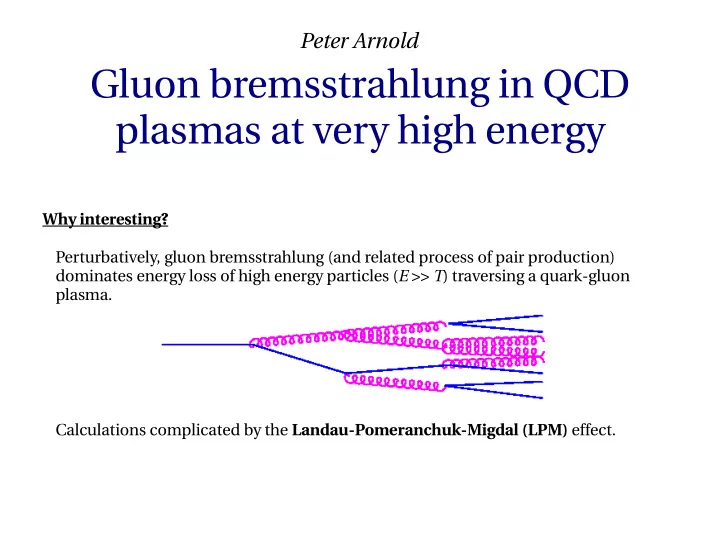
Why interesting? Perturbatively, gluon bremsstrahlung (and related process of pair production) dominates energy loss of high energy particles (E >> T) traversing a quark-gluon plasma. Calculations complicated by the Landau-Pomeranchuk-Migdal (LPM) effect.

slide-2
SLIDE 2

The LPM Effect

brem from several successive (small angle) collisions not very different from brem from one collision. Result: a reduction of the naive brem rate. Naively brem rate ~ nσv ~ (density of scatterers) × × 1 At very high energy, probabilities of brem from successive scatterings no longer independent; Problem

slide-3
SLIDE 3
  • II. A theoretical puzzle
  • I. Review of the LPM effect
  • III. Its resolution

QED 1953-56, QCD 1996-98

slide-4
SLIDE 4

The LPM Effect (QED)

Warm-up: Recall that light cannot resolve details smaller than its wavelength. [Photon emission from different scatterings have same phase  coherent.]

Now: Just Lorentz boost above picture by a lot!

slide-5
SLIDE 5

The LPM Effect (QED)

Note: (1) bigger E requires bigger boost → more time dialation → longer formation length (2) big boost → this process is very collinear.

slide-6
SLIDE 6

versus Are these two possibilities in phase? Do they interfere coherently? YES if (i) everything is nearly collinear ✓ (ii) particle and photon have nearly same velocity ✓ (speed of light)

An alternative picture

slide-7
SLIDE 7

The important point:

The more collinear the underlying scattering, the longer the formation time. Note: the formation length depends on the net angular deflection during the formation length, which depends on the formation length [ Self-consistency → standard parametric formulas for formation length. ]

slide-8
SLIDE 8

The LPM Effect (QCD)

There is a qualitative difference for soft bremsstrahlung.: QED Softer brem photon → longer wavelength → less resolution → more LPM suppression QCD Softer brem gluon → easier for brem gluon to scatter → less collinearity → less LPM suppression Unlike a brem photon, a brem gluon can easily scatter from the medium. vs. Upshot: Soft brem more important in QCD than in QED (for high-E particles in a medium)

slide-9
SLIDE 9

A theoretical puzzle (background)

slide-10
SLIDE 10

A theoretical puzzle (background)

slide-11
SLIDE 11

A theoretical puzzle (background)

  • Naively: medium effect grows linearly with L..

For small enough L, instead grows like L2 lnL because of the LPM effect. [BDMPS 1996]

slide-12
SLIDE 12

A theoretical puzzle (background)

  • Naively: medium effect grows linearly with L..

For small enough L, instead grows like L2 lnL because of the LPM effect. [BDMPS 1996] Assumptions I will make in this talk: and moreover and moreover mean free path for elastic collisions formation length

slide-13
SLIDE 13

The puzzle

Treating ln(E/T) >> 1, and trying to analyze the problem to leading order in inverse powers of this logarithm: Harmonic oscillator (HO) approximation [BDMPS] Consider only typical scattering events (no rare, large-than-usual scatterings) single scattering (N=1) approximation [GLV , Salgado & Wiedemann] Consider only one scattering from medium (both typical and rare deflection angles) Naively, this might seem weird given my assumption that mean free path for elastic collisions

slide-14
SLIDE 14

The puzzle: energy loss

Treating ln(E/T) >> 1, and trying to analyze the problem to leading order in inverse powers of this logarithm: Harmonic oscillator (HO) approximation [BDMPS] single scattering (N=1) approximation [GLV , Salgado & Wiedemann]

slide-15
SLIDE 15

The puzzle: spectrum

Which approximation, if either, is right (at leading log order)?

[ Zakharov 2001, BDMS 2001, Peigne & Smilga 2008, Arnold 2009 ] harmonic oscillator (HO) approximation [BDMPS] single scattering (N=1) approximation

  • vs. L for fixed ω
slide-16
SLIDE 16

The puzzle: spectrum

Which approximation, if either, is right (at leading log order)?

[ Zakharov 2001, BDMS 2001, Peigne & Smilga 2008, Arnold 2009 ] harmonic oscillator (HO) approximation [BDMPS] single scattering (N=1) approximation

Answer: They're both important.

  • vs. L for fixed ω
slide-17
SLIDE 17

Scattering probabilities

typical rare net transverse momentum transfer in distance L net deflection angle typical

slide-18
SLIDE 18

Return to thin media puzzle

Typical scatterings Probability of underlying scattering event large but relatively small deflection angle → large formation time → small medium effect on brem

  • =

small Rare scatterings Probability of underlying scattering event small but relatively large deflection angle → small formation time → significant medium effect on brem

  • =

large

slide-19
SLIDE 19

Return to thin media puzzle

Typical scatterings Probability of underlying scattering event large but relatively small deflection angle → large formation time → small medium effect on brem

  • =

small Rare scatterings Probability of underlying scattering event small but relatively large deflection angle → small formation time → significant medium effect on brem

  • =

large

slide-20
SLIDE 20

Brem probability underlying scattering prob. LPM suppression Which peak wins depends on frequency ω of gluon.

slide-21
SLIDE 21

∆(spectrum) vs. L for fixed ω Total ∆E as function medium size L = formation time in infinite medium

slide-22
SLIDE 22

Lessons

When computing average quantities like <∆E>, the average is sometimes dominated by extremely rare events and so is not characteristic of what happens in most events. The LPM effect is easy to understand qualitatively.

slide-23
SLIDE 23
slide-24
SLIDE 24

Scattering probabilities

typical rare net transverse momentum transfer in distance L net deflection angle

slide-25
SLIDE 25

in weakly-coupled plasmas

formation time depends on collinearity of brem depends on transverse momentum transfer Q⊥ squared transverse momentum transfer per unit length UV log divergent (leading order) for large q⊥

slide-26
SLIDE 26

in weakly-coupled plasmas

formation time depends on collinearity of brem depends on transverse momentum transfer Q⊥ squared transverse momentum transfer per unit length UV log divergent (leading order) for large q⊥

slide-27
SLIDE 27

Λ = UV cut-off on q⊥ Leading-order-in-α

s result for UV-regulated qhat

[Arnold & Xiao(2008)] WARNING: Corrections which are formally higher-order in coupling, of order md/T = O(g). are of order 100% for realistic couplings. [Caron-Huot (2008)] Pure gluon gas, for example: