General remarks Algorithms Algorithms Oliver Oliver Kullmann - - PowerPoint PPT Presentation

general remarks
SMART_READER_LITE
LIVE PREVIEW

General remarks Algorithms Algorithms Oliver Oliver Kullmann - - PowerPoint PPT Presentation

CS 270 CS 270 General remarks Algorithms Algorithms Oliver Oliver Kullmann Kullmann Week 2 Growth of Growth of Functions Functions Divide-and- First we consider an important tool for the analysis of Divide-and- Divide and Conquer


slide-1
SLIDE 1

CS 270 Algorithms Oliver Kullmann Growth of Functions Divide-and- Conquer

Min-Max- Problem

Tutorial

Week 2 Divide and Conquer

1

Growth of Functions

2

Divide-and-Conquer Min-Max-Problem

3

Tutorial

CS 270 Algorithms Oliver Kullmann Growth of Functions Divide-and- Conquer

Min-Max- Problem

Tutorial

General remarks

First we consider an important tool for the analysis of algorithms: Big-Oh. Then we introduce an important algorithmic paradigm: Divide-and-Conquer. We conclude by presenting and analysing a simple example.

Reading from CLRS for week 2

Chapter 2, Section 3 Chapter 3

CS 270 Algorithms Oliver Kullmann Growth of Functions Divide-and- Conquer

Min-Max- Problem

Tutorial

Growth of Functions

A way to describe behaviour of functions in the limit. We are studying asymptotic efficiency. Describe growth of functions. Focus on what’s important by abstracting away low-order terms and constant factors. How we indicate running times of algorithms. A way to compare “sizes” of functions:

O corresponds to ≤ Ω corresponds to ≥ Θ corresponds to =

We consider only functions f , g : N → R

≥0. CS 270 Algorithms Oliver Kullmann Growth of Functions Divide-and- Conquer

Min-Max- Problem

Tutorial

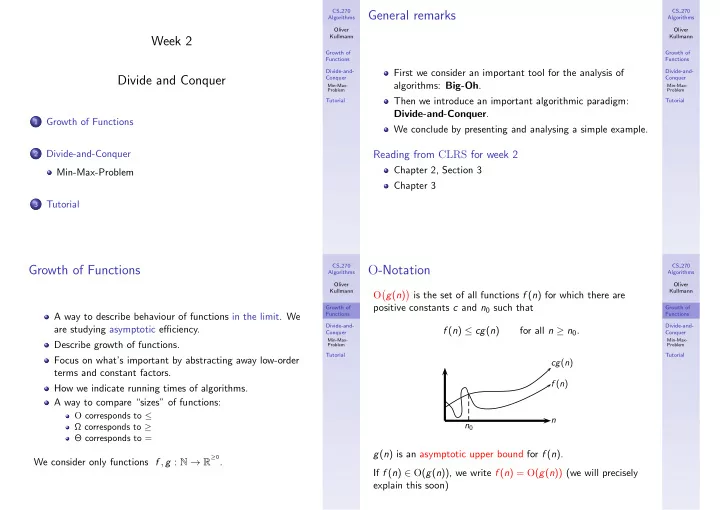
O-Notation

O

  • g(n)
  • is the set of all functions f (n) for which there are

positive constants c and n0 such that f (n) ≤ cg(n) for all n ≥ n0.

cg(n) f (n) n n0

g(n) is an asymptotic upper bound for f (n). If f (n) ∈ O(g(n)), we write f (n) = O(g(n)) (we will precisely explain this soon)

slide-2
SLIDE 2

CS 270 Algorithms Oliver Kullmann Growth of Functions Divide-and- Conquer

Min-Max- Problem

Tutorial

O-Notation Examples

2n2 = O(n3), with c = 1 and n0 = 2. Example of functions in O(n2): n2 n2 + n n2 + 1000n 1000n2 + 1000n Also n n/1000 n1.999999 n2/ lg lg lg n

CS 270 Algorithms Oliver Kullmann Growth of Functions Divide-and- Conquer

Min-Max- Problem

Tutorial

Ω-Notation

  • g(n)
  • is the set of all functions f (n) for which there are

positive constants c and n0 such that f (n) ≥ cg(n) for all n ≥ n0.

cg(n) f (n) n n0

g(n) is an asymptotic lower bound for f (n).

CS 270 Algorithms Oliver Kullmann Growth of Functions Divide-and- Conquer

Min-Max- Problem

Tutorial

Ω-Notation Examples

√n = Ω(lg n), with c = 1 and n0 = 16. Example of functions in Ω(n2): n2 n2 + n n2 − n 1000n2 + 1000n 1000n2 − 1000n Also n3 n2.0000001 n2 lg lg lg n 22n

CS 270 Algorithms Oliver Kullmann Growth of Functions Divide-and- Conquer

Min-Max- Problem

Tutorial

Θ-Notation

Θ

  • g(n)
  • is the set of all functions f (n) for which there are

positive constants c1, c2 and n0 such that c1g(n) ≤ f (n) ≤ c2g(n) for all n ≥ n0.

c2g(n) c1g(n) f (n) n n0

g(n) is an asymptotic tight bound for f (n).

slide-3
SLIDE 3

CS 270 Algorithms Oliver Kullmann Growth of Functions Divide-and- Conquer

Min-Max- Problem

Tutorial

Θ-Notation (cont’d)

Examples 1

n2/2 − 2n = Θ(n2), with c1 = 1

4, c2 = 1 2, and n0 = 8.

Theorem 2

f (n) = Θ(g(n)) if and only if f (n) = O(g(n)) and f (n) = Ω(g(n)). Leading constants and lower order terms do not matter.

CS 270 Algorithms Oliver Kullmann Growth of Functions Divide-and- Conquer

Min-Max- Problem

Tutorial

Asymptotic notation in equations

When on right-hand side

Θ(n2) stands for some anonymous function in the set Θ(n2). 2n2 + 3n + 1 = 2n2 + Θ(n) means 2n2 + 3n + 1 = 2n2 + f (n) for some f (n) ∈ Θ(n). In particular, f (n) = 3n + 1.

When on left-hand side

No matter how the anonymous functions are chosen on the left-hand side, there is a way to choose the anonymous functions

  • n the right-hand side to make the equation valid.

Interpret 2n2 + Θ(n) = Θ(n2) as meaning for all functions f (n) ∈ Θ(n), there exists a function g(n) ∈ Θ(n2) such that 2n2 + f (n) = g(n).

CS 270 Algorithms Oliver Kullmann Growth of Functions Divide-and- Conquer

Min-Max- Problem

Tutorial

Asymptotic notation chained together

2n2 + 3n + 1 = 2n2 + Θ(n) = Θ(n2) Interpretation: First equation: There exists f (n) ∈ Θ(n) such that 2n2 + 3n + 1 = 2n2 + f (n). Second equation: For all g(n) ∈ Θ(n) (such as the f (n) used to make the first equation hold), there exists h(n) ∈ Θ(n2) such that 2n2 + g(n) = h(n).

Note

What has been said of “Θ” on this and the previous slide also applies to “O” and “Ω”.

CS 270 Algorithms Oliver Kullmann Growth of Functions Divide-and- Conquer

Min-Max- Problem

Tutorial

Example Analysis

Insertion-Sort(A) 1 for j = 2 to A.length 2 key = A[j] 3 / / Insert A[j] into sorted sequence A[1 . . j−1]. 4 i = j−1 5 while i > 0 and A[i] > key 6 A[i+1] = A[i] 7 i = i−1 8 A[i+1] = key The for -loop on line 1 is executed O(n) times; and each statement costs constant time, except for the while -loop on lines 5-7 which costs O(n). Thus overall runtime is: O(n) × O(n) = O(n2). Note: In fact, as seen last week, worst-case runtime is Θ(n2).

slide-4
SLIDE 4

CS 270 Algorithms Oliver Kullmann Growth of Functions Divide-and- Conquer

Min-Max- Problem

Tutorial

Divide-and-Conquer Approach

There are many ways to design algorithms. For example, insertion sort is incremental: having sorted A[1 . . j−1], place A[j] correctly, so that A[1 . . j] is sorted. Divide-and-Conquer is another common approach: Divide the problem into a number of subproblems that are smaller instances of the same problem. Conquer the subproblems by solving them recursively. Base case: If the subproblem are small enough, just solve them by brute force. Combine the subproblem solutions to give a solution to the

  • riginal problem.

CS 270 Algorithms Oliver Kullmann Growth of Functions Divide-and- Conquer

Min-Max- Problem

Tutorial

Naive Min-Max

Find minimum and maximum of a list A of n>0 numbers. Naive-Min-Max(A) 1 least = A[1] 2 for i = 2 to A.length 3 if A[i] < least 4 least = A[i] 5 greatest = A[1] 6 for i = 2 to A.length 7 if A[i] > greatest 8 greatest = A[i] 9 return (least, greatest) The for-loop on line 2 makes n−1 comparisons, as does the for-loop on line 6, making a total of 2n−2 comparisons. Can we do better? Yes!

CS 270 Algorithms Oliver Kullmann Growth of Functions Divide-and- Conquer

Min-Max- Problem

Tutorial

Divide-and-Conquer Min-Max

As we are dealing with subproblems, we state each subproblem as computing minimum and maximum of a subarray A[p . . q]. Initially, p = 1 and q = A.length, but these values change as we recurse through subproblems. To compute minimum and maximum of A[p . . q]: Divide by splitting into two subarrays A[p . . r] and A[r+1 . . q], where r is the halfway point of A[p . . q]. Conquer by recursively computing minimum and maximum of the two subarrays A[p . . r] and A[r+1 . . q]. Combine by computing the overall minimum as the min of the two recursively computed minima, similar for the overall maximum.

CS 270 Algorithms Oliver Kullmann Growth of Functions Divide-and- Conquer

Min-Max- Problem

Tutorial

Divide-and-Conquer Min-Max Algorithm

Initially called with Min-Max(A, 1, A.length). Min-Max(A, p, q) 1 if p = q 2 return (A[p], A[q]) 3 if p = q−1 4 if A[p] < A[q] 5 return (A[p], A[q]) 6 else return (A[q], A[p]) 7 r = ⌊(p+q)/2⌋ 8 (min1, max1) = Min-Max(A, p, r) 9 (min2, max2) = Min-Max(A, r+1, q) 10 return

  • min(min1, min2), max(max1, max2)
  • Note

In line 7, r computes the halfway point of A[p . . q]. n = q − p + 1 is the number of elements from which we compute the min and max.

slide-5
SLIDE 5

CS 270 Algorithms Oliver Kullmann Growth of Functions Divide-and- Conquer

Min-Max- Problem

Tutorial

Solving the Min-Max Recurrence

Let T(n) be the number of comparisons made by Min-Max(A, p, q), where n = q−p+1 is the number of elements from which we compute the min and max. Then T(1) = 0, T(2) = 1, and for n > 2: T(n) = T (⌈n/2⌉) + T (⌊n/2⌋) + 2.

Claim

T(n) = 3

2n − 2

for n = 2k ≥ 2, i.e., powers of 2.

Proof.

The proof is by induction on k (using n = 2k). Base case: true for k=1, as T(21) = 1 = 3

2 · 21 − 2.

Induction step: assuming T(2k) = 3

22k − 2, we get

T(2k+1) = 2T(2k)+2 = 2

  • 3

22k−2

  • +2 =

3 22k+1−2

CS 270 Algorithms Oliver Kullmann Growth of Functions Divide-and- Conquer

Min-Max- Problem

Tutorial

Solving the Min-Max Recurrence (cont’d)

Some remarks:

1 If we replace line 7 of the algorithm by r = p+1, then the

resulting runtime T ′(n) satisfies T ′(n) = 3n

2

  • −2 for all

n > 0.

2 For example, T ′(6) = 7 whereas T(6) = 8. 3 It can be shown that at least

3n

2

  • − 2 comparisons are

necessary in the worst case to find the maximum and minimum of n numbers for any comparison-based algorithm: this is thus a lower bound on the problem.

4 Hence this (last) algorithm is provably optimal. CS 270 Algorithms Oliver Kullmann Growth of Functions Divide-and- Conquer

Min-Max- Problem

Tutorial

Big-Oh, Omega, Theta by examples

1 5n + 111 = O(n) ? YES 2 5n + 111 = O(n2) ? YES 3 5n + 111 = Ω(n) ? YES 4 5n + 111 = Ω(n2) ? NO 5 5n + 111 = Θ(n) ? YES 6 5n + 111 = Θ(n2) ? NO 7 2n = O(3n) ? YES 8 2n = Ω(3n) ? NO 9 120n2 + √n + 99n = O(n2) ? YES 10 120n2 + √n + 99n = Θ(n2) ? YES 11 sin(n) = O(1) ? YES CS 270 Algorithms Oliver Kullmann Growth of Functions Divide-and- Conquer

Min-Max- Problem

Tutorial

Can we improve the Min-Max algorithm?

Determine T(6), the number of comparisons the Min-Max algorithms performs for 6 elements. As usual, the argumentation is important (why is this correct?). Perhaps best is that you run the algorithm (on paper) for 6 elements. Notice that the basic parameters for a run do not depend on the values of the elements, but only on their total number. Once you found T(6), is this really optimal?

slide-6
SLIDE 6

CS 270 Algorithms Oliver Kullmann Growth of Functions Divide-and- Conquer

Min-Max- Problem

Tutorial

Unfolding the recursion for Min-Max

We have T(n) =      if n = 1 1 if n = 2 T( n

2

  • ) + T(

n

2

  • ) + 2

else .

1 T(1) = 0 2 T(2) = 1 3 T(3) = T(2) + T(1) + 2 = 1 + 0 + 2 = 3 4 T(4) = T(2) + T(2) + 2 = 1 + 1 + 2 = 4 5 T(5) = T(3) + T(2) + 2 = 3 + 1 + 2 = 6 6 T(6) = T(3) + T(3) + 2 = 3 + 3 + 2 = 8 7 T(7) = T(4) + T(3) + 2 = 4 + 3 + 2 = 9 8 T(8) = T(4) + T(4) + 2 = 4 + 4 + 2 = 10 9 T(9) = T(5) + T(4) + 2 = 6 + 4 + 2 = 12 10 T(10) = T(5) + T(5) + 2 = 6 + 6 + 2 = 14.

We count 4 steps +1 and 5 steps +2 — we guess T(n) ≈ 3

2n.

CS 270 Algorithms Oliver Kullmann Growth of Functions Divide-and- Conquer

Min-Max- Problem

Tutorial

Finding the best min-max algorithm

1 As you can see in the section on the min-max problem, for

some input sizes we can validate the guess T(n) ≈ 3

2n.

2 One can now try to find a precise general formula for T(n), 3 However we see that we have T(6) = 8, while we can

handle this case with 7 comparisons. So perhaps we can find a better algorithm?

4 And that is the case: 1

If n is even, find the min-max for the first two elements using 1 comparison; if n is odd, find the min-max for the first element using 0 comparisons.

2

Now iteratively find the min-max of the next two elements using 1 comparison, and compute the new current min-max using 2 further comparisons. And so on ....

This yields an algorithm using precisely 3

2n

  • − 2
  • comparisons. And this is precisely optimal for all n.

We learn: Here divide-and-conqueor provided a good stepping stone to find a really good algorithm.

CS 270 Algorithms Oliver Kullmann Growth of Functions Divide-and- Conquer

Min-Max- Problem

Tutorial

Designing an algorithm: Median

The median of a sequence of numbers is the “middle value” — the value in the middle position of the list after sorting. Can we do better than the obvious algorithm (by sorting), using divide-and-conquer? (Here some judgement is needed, that the precise details about what actually is the “middle value” won’t make a fundamental difference, and so it’s best to ignore them for the initial phase, where developing the ideas is of utmost importance.)

CS 270 Algorithms Oliver Kullmann Growth of Functions Divide-and- Conquer

Min-Max- Problem

Tutorial

First strategy: divide in half

1 Divide the array A of numbers into two parts, B and C, of

equal size (more precisely, nearly equal size, but such details are best ignored in the beginning).

2 In principle B and C could be anything, but easiest is to let

them be the first half and the second half of A.

3 Compute (that is now the conquer-phase) the medians

mB, mC of the arrays B, C.

4 If mC < mB, then swap B and C. 5 Re-order B and C internally, so that the elements smaller

than the median are on the left, and the larger elements on the right.

6 Now consider the array of elements from mB to mC (note

that this is again half of the size of A): The median of this array (computed again in the conquer-phase, recursively) is the median of A.
slide-7
SLIDE 7

CS 270 Algorithms Oliver Kullmann Growth of Functions Divide-and- Conquer

Min-Max- Problem

Tutorial

Example run

1, 20, 5, 18, 7, 10, 10 | 4, 20, 7, 7, 17, 14, 1, 12

  • f length 15, partitioned into 7 and 8 elements.

The left median is 10. The right median is 7 or 12; let’s take 7. Swap, and partition the two parts according to their medians: 4, 7, 1, 7, 20, 17, 14, 12 | 1, 5, 7, 10, 20, 18, 10. Compute the median of the new middle part 20, 17, 14, 12, 1, 5, 7, 10 which is 10 (the right answer) or 12. So, it could work (or not).

CS 270 Algorithms Oliver Kullmann Growth of Functions Divide-and- Conquer

Min-Max- Problem

Tutorial

The recurrence

We are in this phase only interested in the recurrence: T(n) = 3 · T(n/2) + O(n). We ignore here all issues about the precise partitioning (and whether we can get it to work at all!) — all what counts here is the insight whether we could get a good algorithm! Next week we develop tools to see immediately how good this approach could be.