SLIDE 1
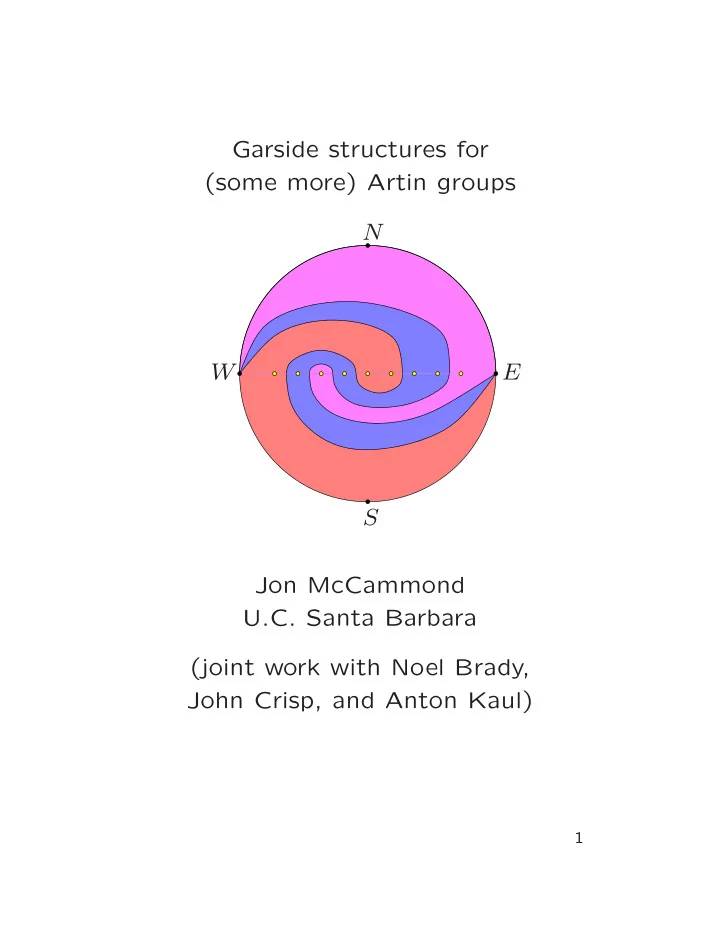
Garside structures for (some more) Artin groups S N E W Jon McCammond U.C. Santa Barbara (joint work with Noel Brady, John Crisp, and Anton Kaul)
1
SLIDE 2
Overview I. Coxeter groups and Artin groups II. Garside structures III. Garside structures for free groups IV. Garside structures for Artin groups V. Other partial results
2
SLIDE 3
- I. Coxeter groups and Artin groups
Let Γ be a finite graph with edges labeled by integers greater than 1, and let (a, b)n be the length n prefix of (ab)n. Def: The Artin group AΓ is generated by its vertices with a relation (a, b)n = (b, a)n when- ever a and b are joined by an edge labeled n. Def: The Coxeter group WΓ is the Artin group AΓ modulo the relations a2 = 1 ∀a ∈ Vert(Γ). Graph a b c 2 3 4 Artin presentation a, b, c| aba = bab, ac = ca, bcbc = cbcb Coxeter presentation
- a, b, c| aba = bab, ac = ca, bcbc = cbcb
a2 = b2 = c2 = 1
SLIDE 4 Coxeter groups are natural Coxeter groups are a natural generalization of finite reflection groups and they are amazingly nice to work with.
- 1. They have a decidable word problem
- 2. They are virtually torsion-free
- 3. They have finite CAT(0) K(π, 1)s
- 4. They are linear
- 5. They are automatic
4
SLIDE 5 Artin groups are natural yet mysterious Artin groups are “natural” in the sense that they are closely tied to the complexified ver- sion of the hyperplane arrangements for Cox- eter groups. But they are “mysterious” in the sense that it is unknown if
- 1. They have a decidable word problem
- 2. They are (virtually) torsion-free
- 3. They have finite (dimensional) K(π, 1)s
- 4. They are linear
- 5. The positive monoid injects into the group
Actually 5 was recently shown to be true by Luis Paris, but the proof is still mysterious.
5
SLIDE 6
A Garside structure on a group G is given by a submonoid M and an element ∆ in M. The necessary conditions are
2. M is the positive cone of a left-invariant lattice order ≤ on G.
- 3. M is generated by x ∈ M with x ≤ ∆.
- 4. conjugation by ∆ respects the lattice order.
6
SLIDE 7
Constructing Garside structures One way to produce such a structure is to start with a bounded, graded, atomic, consistently edge-labeled lattice which is balanced. Balanced means that the words readable start- ing at the bottom are the words readable end- ing at the top. a b c A Garside structure for Z3 is shown.
7
SLIDE 8
Examples of Garside structures Braid groups and other finite-type Artin groups each have two Garside structures. For the 3- string braid group the two posets are shown. The second one is the dual of the first. a b c a b a, b|aba = bab = a, b, c|ab = bc = ca
8
SLIDE 9 The A3 Poset and its dual The standard Garside structure a braid group is a height function applied to the 1-skeleton
- f a permutahedron (which is the Cayley graph
- f S4 with respect to the adjacent transposi-
tions). The dual structure is what combinatorialists call the “non-crossing partition lattice”.
1 2 3 4
9
SLIDE 10
The dual D4 Poset
10
SLIDE 11
The dual F4 Poset
11
SLIDE 12
Why “dual”? [Bessis - “The Dual Braid Monoid”] S = standard generators T = set of all “reflections” c = a Coxeter element = s w0 = the longest element in W n = the rank (dimension) of W N = # reflections = # of positive roots h = Coxeter number = order of c Classical monoid Dual monoid Set of atoms S T Product of atoms c w0 Number of atoms n N Regular degree h 2 ∆ w0 c Length of ∆ N n Order of p(∆) 2 h
12
SLIDE 13
Garside structures for non-finite type Artin groups S = standard generators T = set of all “reflections” c = a Coxeter element = s w0 = the longest element in W n = the rank (dimension) of W N = # reflections = # of positive roots h = Coxeter number = order of c Extending the previous table we have: Classical monoid Dual monoid Set of atoms S T Product of atoms c NA Number of atoms n NA Regular degree ∞ NA ∆ NA c Length of ∆ NA n Order of p(∆) NA ∞
13
SLIDE 14 What Garside structures are good for If G is a group with a Garside structure, then it
- 1. has a presentation derived from the poset
- 2. is the group of fractions of this presentation
- 3. has a decidable word problem*
- 4. has a finite (dimensional) K(π, 1)
- 5. is torsion-free.
Thus finding Garside structures for Artin groups would be a very good thing. The hardest part is almost always showing that the candidate poset is a lattice. *(in the appropriate sense)
14
SLIDE 15
- III. Garside structures for free groups
Let Fn be a free group with basis x1, x2, . . . , xn and let ∆ = x1x2 · · · xn. We can start build- ing a Garside structure by continuing to add paths (and generators) to create a bounded graded, consistently edge-labeled poset which is balanced. a b a b c d . . . . . . The construction in this case leads to a univer- sal cover which is an infinitely branching tree cross the reals with a free F2 action. ai|aiai+1 = ajaj+1
15
SLIDE 16 A more topological definition Let D∗ denote the unit disc with n puntures and 4 distinguished boundary points, N, S, E and W. Def: A cut-curve is an isotopy class (in D∗) of a path from E to W (rel endpoints, of course). S N E W Notice that cut-curves divide D∗ into two pieces,
- ne containing S and the other containing N.
Its height is the number of puncture in the lower piece.
16
SLIDE 17
Poset of cut-curves Let [c] and [c′] be cut-curves. We write [c] < [c′] if there are representatives c and c′ which are disjoint (except at their endpoints) and c is “below” c′. S N E W Notice that if representative c is given, then we can tell whether [c] < [c′] by keeping c fixed and isotoping c′ into a “minimal position” with respect to c (i.e. no football shaped regions with no punctures).
17
SLIDE 18
Proving the lattice property Lemma The poset of cut-curves is a lattice. S N E W Proof: Suppose [c] is above [c1] and [c2]. Place representatives c1 and c2 in minimal position with respect to each other (i.e. no football re- gions) and then isotope c so that it is disjoint from both. This c is above the dotted line. Thus the dotted line represents a least upper bound for [c1] and [c2].
18
SLIDE 19
- IV. Garside structures for Artin groups
For a general Artin group, we start with a specific marking of D∗ (in the form of cuts) and draw arcs connecting the punctures which avoid the cuts. S N E W 1 9 x1 From the graph Γ we define a subgroup H of the braid group which is generated by powers
- f half-twists along the arcs with the powers
determined by the labels on the edges.
19
SLIDE 20
Topological Version of PΓ Define a graded poset P Top
Γ
as equivalence classes of cut curves [c]H where two cut curves are equivalent if they differ by an element of H acting on the disc. The ordering is [c]H < [c′]H iff there are repre- sentatives which are disjoint. When trying to convert this to a purely alge- braic definition there is an issue of left vs. right actions of the braid group on the disc.
20
SLIDE 21 Algebraic Version of PΓ Let Γ be an ordered Dynkin diagram and let H = HΓ be the twist subgroup of Bn. Let B(i) be the subgroup of the braid group Bn which never crosses the i and i + 1 strands (isomorphic to Bi × Bn−i). Define a graded poset P Alg
Γ
by using the double cosets H\Bn/B(i) as the set of vertices at level
- i. The ordering is given by
HαB(i) < HβB(j) (α, β ∈ Bn) if and only if i < j and the double coset inter- section is non-empty.
21
SLIDE 22
Coxeter Version of PΓ Define P Cox
Γ
be pushing the free group version into the Coxeter group WΓ using the natural map. More specifically, the free group Garside struc- ture can be viewed as “residing” in the Cayley graph of the free group with respect to an in- finite generating set C indexed by the braid group. The image of C in WΓ gives a generating set CΓ and the poset P Cox is determined by the image of the free structure in Cayley(WΓ, CΓ).
22
SLIDE 23
The PΓ Theorem Thm(BCKM): ∀ ordered Dynkin diagrams Γ, P Top
Γ
∼ = P Alg
Γ
։ P Cox
Γ
The edge-labeled poset P Top
Γ
∼ = P Alg
Γ
is called PΓ. Moreover, we can prove the following: Thm(BCKM): ∀ ordered Dynkin diagrams Γ, P Top
Γ
∼ = P Alg
Γ
∼ = P Cox
Γ
The bars indicate a quotient which uses images in AΓ.
23
SLIDE 24
A space for AΓ Using standard techniques from the theory of Garside structures, we can turn PΓ into a topo- logical space KΓ. Thm(BCKM): ∀ ordered Dynkin diagrams Γ, π1(KΓ, ∗) ∼ = AΓ Thus, we are presenting the right group. The (currently missing) lattice is crucial to show- ing that the universal cover of this space is contractible.
24
SLIDE 25 An idea in the air Here are some partial results to date: [BCKM] (October 03, Talks, Slides posted) Free groups / 3-generator [D. Bessis] (January 04, Preprint posted) Free groups [F. Digne] (February 04, Preprint posted) Type
25