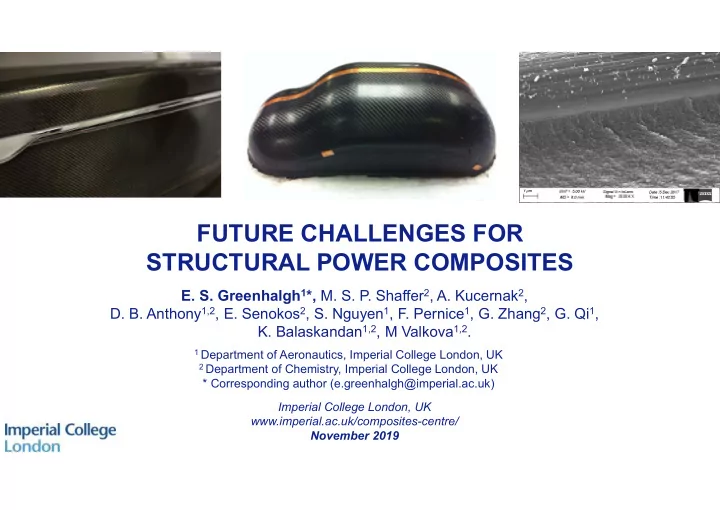
FUTURE CHALLENGES FOR STRUCTURAL POWER COMPOSITES E. S. Greenhalgh 1 - - PowerPoint PPT Presentation

future challenges for structural power composites
SMART_READER_LITE
LIVE PREVIEW

FUTURE CHALLENGES FOR STRUCTURAL POWER COMPOSITES E. S. Greenhalgh 1 - - PowerPoint PPT Presentation

FUTURE CHALLENGES FOR STRUCTURAL POWER COMPOSITES E. S. Greenhalgh 1 *, M. S. P. Shaffer 2 , A. Kucernak 2 , D. B. Anthony 1,2 , E. Senokos 2 , S. Nguyen 1 , F. Pernice 1 , G. Zhang 2 , G. Qi 1 , K. Balaskandan 1,2 , M Valkova 1,2 . 1 Department of


slide-1
SLIDE 1

FUTURE CHALLENGES FOR STRUCTURAL POWER COMPOSITES

  • E. S. Greenhalgh1*, M. S. P. Shaffer2, A. Kucernak2,
  • D. B. Anthony1,2, E. Senokos2, S. Nguyen1, F. Pernice1, G. Zhang2, G. Qi1,
  • K. Balaskandan1,2, M Valkova1,2.

Imperial College London, UK www.imperial.ac.uk/composites-centre/ November 2019

1 Department of Aeronautics, Imperial College London, UK 2 Department of Chemistry, Imperial College London, UK

* Corresponding author (e.greenhalgh@imperial.ac.uk)

slide-2
SLIDE 2

Going beyond Smart Materials....

  • Conventional reductionalist approach to design - maximise efficiency of individual subcomponents.

Difficult compromises; Limiting technological advance and stifling innovative design.

  • Different holistic approach; structures & materials which simultaneously perform more than one function.

Thomas & Qidwai, JOM.

  • v57. 2005.

Smart (Multifunctional Structures)… Implanting of secondary materials or devices within a parent laminate to imbue additional functionality...  e.g. embedding devices within structural materials

Fu-Kuo Chang et al, J Power Sources, v414, 2019.

Multifunctional Materials…. Constituents synergistically and holistically perform two very different roles....  e.g. a nanostructured carbon lattice carrying mechanical load whilst storing electrochemical energy.

Jacques E., et.al, Electrochemistry Communications, v35, 2013. Greenhalgh, E, et.al, ICCM22, 2019.

slide-3
SLIDE 3
  • We can now tailor composite properties beyond purely the

mechanical perspective.  New and diverse functionalities being added.

  • Multifunctional composite materials has potential to

revolutionize transportation, portable electronics and infrastructure.

  • Focus of this presentation is structural supercapacitors:

 Carry mechanical loads whilst storing and delivering electrical energy.

  • Objectives:

 Overview of the structural supercapacitor research at Imperial College London;  Outline the near and medium-term challenges for these new materials;  Suggest industrial adoption strategies.

Motivation for Multifunctional Materials

Multifunctional structural power concept (Volvo Cars) Multifunctional demonstrator from STORAGE project

slide-4
SLIDE 4

4

International Landscape

Complied list for papers on “Multifunctional composite materials for energy storage, harvesting and sensing,” 157 journal papers since 2000 (WoS)

Unconnected (VOS Viewer)

  • Dot size relates to number
  • f publications by
  • rganisation.
  • Dot position relates to

frequency of citation by

  • thers.
slide-5
SLIDE 5

Structural Supercapacitors – Imperial College Research

5

slide-6
SLIDE 6
  • -
  • +

+ + + + + + + + + + + + + + + + + + + + + + + + + + + + + + + + + + + + + + + + + + + + + + + + + +

+

  • Ion permeable

Separator (Insulator) Current collector (Electrode) Electrolyte

Conventional Supercapacitor

Supercapacitor Device

Structural Supercapacitor

slide-7
SLIDE 7

Research Streams

Structural Supercapacitors

Constituent development Electrical & mechanical characterisation Multifunctional Design & Modelling Device fabrication & demonstration

2.05 kW/kg 3.73 kW/kg 1.75 Wh/kg 1.77 Wh/kg

Mechanical characterisation Electrochemical characterisation Microstructure topology optimisation Electrochemical modelling Mechanical modelling Consolidation modelling Carbon aerogel reinforced CFs Pseudocapacitance Biphasic multifunctional matrices New architectures Monofunctional/ multifunctional boundaries Automotive demonstration Aerospace demonstration

slide-8
SLIDE 8

Summary of semi-structural & MF cell performance

*Normalised to active mass

C arbon fabrics 138 mg A erogel 62 mg S eparator (PC) 53 mg E lectrolyte 107 mg

Electrodes Separator Electrolyte C (F) m (g) V (V) ESR (Ω) C* (F/g)

E* (Wh/kg) P* (kW/kg)

CAG CF 43 gsm Woven GF (242 µm) EMI-TFSI 0.68 0.91 2.7 2.66 0.8

0.8 0.8

CAG CF 43 gsm PET/ceramic (23 µm) EMI-TFSI 1.01 0.36 2.7 1.49 3.1

3.2 3.4

CAG CF 43 gsm Woven GF (50 µm) MF (40%) 0.34 0.39 2.7 7.45 0.9

0.9 0.6

CAG CF 43 gsm PET/ceramic (23 µm) MF (40%) 0.51 0.36 2.7 4.80 1.4

1.4 1.1

Maxwell BCAP01501, length = 50 mm, dia. = 25 mm 150 32 2.7 14 mΩ 4.7

4.7 4.1

Conventional supercapacitor G=4.7Wh/kg & P=4.1kW/kg

slide-9
SLIDE 9

Future Challenges

slide-10
SLIDE 10
  • Conventional design approach

 Implement new properties and then characterize how the improved performance compares to that of the COTS (Current Off The Shelf) for the same function.

  • However, structural power material cannot…

 Offer better mechanical load-carrying capability than a fully optimized conventional structural material  Offer better electrochemical performance than a conventional battery or supercapacitor.

  • Taking a holistic view during design is vital

 Structural power materials partially undertake the role of both the structural components (e.g. spars or skins) and the energy storage (e.g. battery, supercapacitor, etc.);  Hence a system approach to design, rather than the conventional compartmentalized approach, should be followed.

  • Structural Power Materials also offer

 Localization of power sources (i.e. reducing wiring)  Opportunities to tailor mass distribution across a platform.

  • Need to capture this within a new design methodology

Future Challenges – Multifunctional Design

slide-11
SLIDE 11
  • Fabrication methodologies for structural power materials very different to conventional approaches.
  • Melding of polymer composite manufacture and electrochemical device fabrication.

 Any exposure of the matrix/electrolyte to ambient moisture is critical to electrochemical performance.  ‘Moisture-free’ composite fabrication required

  • Fabrication of curved components present additional challenges:

 Currently being addressed with University of Bristol through the development of masking of fold lines/barriers, to permit monofunctional and multifunctional domains.  Investigating as a route to achieve continuity of carbon-fibres across monofunctional/multifunctional boundaries.

Future Challenges –Fabrication

Carbon fibre fabric Carbon fibre fabric infused with carbon aerogel Carbonised Epoxy barrier

Multifunctional web and cap Continuity across monofunctional loading pads Fabrication demonstration using barriers Multifunctional web and cap Monofunctional fold-lines

slide-12
SLIDE 12
  • Critical near-term challenge is how to encapsulate the structural power material.
  • Isolate from the surrounding systems, conventional structure, and ultimately the environment, whilst still

transferring mechanical load across the monofunctional/multifunctional interfaces.

  • Conventional energy storage devices are encased in inert, insulating sheaths.
  • Electrolyte phase (Ionic liquid) is leached out by the uncured epoxy, leading to considerable loss of electrical

performance.

Future Challenges - Encapsulation

2 GF+ MTM57 B-staged for 30 min, at 80°C Capacitance (60% drop) & ESR (90% rise)

Pristine Encapsulated

slide-13
SLIDE 13

Future Challenges – Current Collection / Scale-up

Component scale (446 cm2) Lab scale (16 cm2) Swagelok cell (1 cm diameter) 10 mm Electrolyte: EMIM TFSI

Area of electrodes: 0.785 cm2 Area of separator: 1.13 cm2 All values normalised by device mass (CAG/C-weave + GF separator + IL to fill all pores)

Swagelok (m = 51 mg) C* = 1.73 F/g E*max = 1.75 Wh/kg P*max = 2.05 kW/kg Cu Mesh 0/90 A4 (m = 40 g) C* = 1.3 F/g E*max = 1.3 Wh/kg P*max = 0.066 kW/kg Plain 0/90 A4 (m = 32 g) C* = 0.82 F/g E*max = 0.83 Wh/kg P*max = 0.027 kW/kg

slide-14
SLIDE 14

Lee, C., et.al., Multifunctional Materials, v2, 2019

Future Challenges – Multifunctional Material Design

slide-15
SLIDE 15
  • Most significant hurdle is that of certification, particularly for

aerospace applications.  Conventional structural materials are required to demonstrate airworthiness through the “Rouchon pyramid”.

  • Structural power materials would not only have to be mechanically

certified, but also electrochemically too.  Any mechanical/electrochemical interactions (e.g. mechanical cycling inducing damage that reduces the electrical performance) needs to be considered.

  • Best addressed through developing predictive modelling

 Development of finite element models which can predict both mechanical and electrochemical behavior, and any coupling interactions.

Future Challenges – Certification & Predictive Modelling

15

slide-16
SLIDE 16

Future Challenges – Predictive Modelling Strategy

Consolidation modelling Electrochemical Modelling Mechanical Modelling

  • Provide a framework to support certification
  • f structural power devices
  • Couple electrical and mechanical models

Multifunctional structural element

slide-17
SLIDE 17
  • Range of in-service requirement and conditions to which structural

power materials could be exposed, and would be required to tolerate.

  • These include

 Cycling (both mechanical and electrical)  Temperature extremes,  Fire resistance  Machining/Finishing  Impact and Damage Tolerance.  Inspection/Repair/Disposal

Future Challenges – In-service Conditions

85% retention after 3000 CD cycles at 2.7V and 1 A/g Before impact At impact 15s after impact

Local heating following penetrative impact Cyclic performance Drilling damage

slide-18
SLIDE 18
  • Structural power is still a very immature technology.
  • Performance is too low to replace existing propulsion (aerospace and automotive)
  • More reasonable target is to replace auxiliary power sources, such as to reduce

the electrical load on main power sources.

  • Automotive

 Utilize in secondary sources (stop/start battery, etc);  Focus on panels and non-safety critical applications.

  • Aerospace

 Cabin applications (benign temperature regime);  Powering seat-back personal displays, etc;  Local power sources for safety equipment;  Systems and electronics boxes.

  • Other Sectors

 Electric bicycles – energy recovery, etc;  Mobile electronics.

Potential Adoption Routes

18

Volvo bootlid demonstrator from STORAGE project Doorframe demonstrator from SORCERER

slide-19
SLIDE 19
  • Structural power composites is an exciting emerging technology for transportation and portable electronics.
  • Current performance - c.f. conventional supercapacitor at device level (4.7Wh/kg & 4.1kW/kg)

 3.2Wh/kg & 3.4kW/kg (semi-structural); 1.4Wh/kg & 1.1kW/kg (structural).

  • Still considerable technical hurdles to be addressed, but the outlook is promising.

 Multifunctional Design  Fabrication  Encapsulation  Current Collection / Scale-up  Multifunctional Material Design  Certification and Predictive Modelling  In-service Conditions

  • Early adoption routes – auxiliary applications and power sources (aircraft cabin)
  • My personal view – structural power, and the generic concept of truly multifunctional materials, is such an simple idea

which will provide huge performance benefits and design freedom, it’s clearly a case of when not if it is widely adopted.

  • In 50 years time, we won’t be using discrete monofunctional batteries, we will build structures from multifunctional

materials with innate electrical energy storage.

Conclusions

slide-20
SLIDE 20
  • Ex-researchers - Habtom Asfaw, Guohui Zhang, & Kaan Bilge
  • Collaborators - University of Durham, University of Bristol, KTH (Sweden), Chalmers (Sweden), IMDEA (Spain)

Acknowledgements

Acknowledge the funding provided by the EPSRC Future Composites Research Manufacturing Hub (EP/P006701/1), the EPSRC Beyond Structural project (EP/P007465/1), the European Office of Aerospace Research and Development (IOE Grant FA9550-17-1-0251) and EU Clean Sky 2 (SORCERER Project #738085).