
SLIDE 1
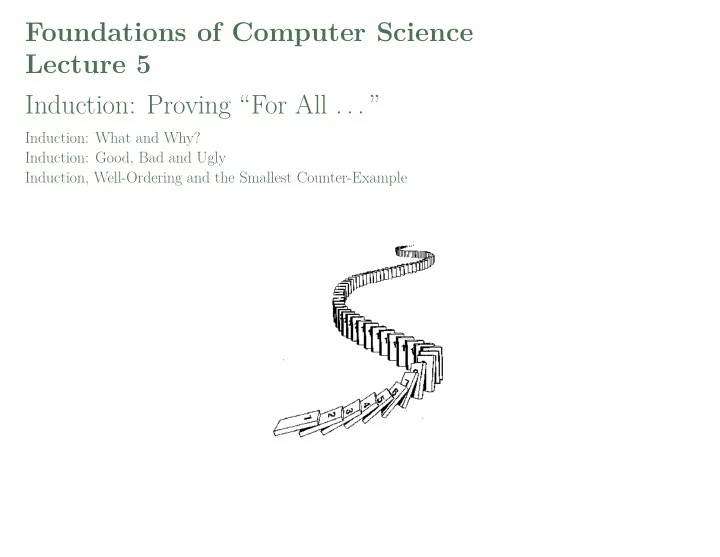
Foundations of Computer Science Lecture 5 Induction: Proving “For All . . . ”
Induction: What and Why? Induction: Good, Bad and Ugly Induction, Well-Ordering and the Smallest Counter-Example
Foundations of Computer Science Lecture 5 Induction: Proving For - - PowerPoint PPT Presentation
Foundations of Computer Science Lecture 5 Induction: Proving For All . . . Induction: What and Why? Induction: Good, Bad and Ugly Induction, Well-Ordering and the Smallest Counter-Example Last Time 1 Proving if . . . , then . . .
Induction: What and Why? Induction: Good, Bad and Ugly Induction, Well-Ordering and the Smallest Counter-Example
1 Proving “if . . . , then . . . ”. 2 Proving “. . . if and only if . . . ”. 3 Proof patterns: ◮ direct proof; ⋆ If x, y ∈ Q, then x + y ∈ Q. ⋆ If 4x − 1 is divisible by 3, then 4x+1 − 1 is divisible by 3. ◮ contraposition; ⋆ If r is irrational, then √r is irrational. ⋆ If x2 is even, then x is even. ◮ contradiction. ⋆ √
2 is irrational.
⋆ a2 − 4b = 2. ⋆ 2√n + 1/√n + 1 ≤ 2√n + 1. Creator: Malik Magdon-Ismail Induction: Proving “For All . . . ”: 2 / 18 Today →
1
2
3
4
5
Creator: Malik Magdon-Ismail Induction: Proving “For All . . . ”: 3 / 18 Postage →
Creator: Malik Magdon-Ismail Induction: Proving “For All . . . ”: 4 / 18 Why Induction? →
19¢ 20¢ 21¢ 22¢ 23¢ 24¢ 25¢ 26¢ 27¢ 28¢ 7,7,5 5,5,5,5 7,7,7 5,5,5,7 – 7,7,5,5 5,5,5,5,5 7,7,7,5 5,5,5,5,7 7,7,7,7
Creator: Malik Magdon-Ismail Induction: Proving “For All . . . ”: 4 / 18 Why Induction? →
19¢ 20¢ 21¢ 22¢ 23¢ 24¢ 25¢ 26¢ 27¢ 28¢ 7,7,5 5,5,5,5 7,7,7 5,5,5,7 – 7,7,5,5 5,5,5,5,5 7,7,7,5 5,5,5,5,7 7,7,7,7
Creator: Malik Magdon-Ismail Induction: Proving “For All . . . ”: 4 / 18 Why Induction? →
19¢ 20¢ 21¢ 22¢ 23¢ 24¢ 25¢ 26¢ 27¢ 28¢ 7,7,5 5,5,5,5 7,7,7 5,5,5,7 – 7,7,5,5 5,5,5,5,5 7,7,7,5 5,5,5,5,7 7,7,7,7
Creator: Malik Magdon-Ismail Induction: Proving “For All . . . ”: 4 / 18 Why Induction? →
∀n ≥ 24 : P(n)
∀n ≥ 1 : P(n)
∀n ≥ 1 : P(n)
Creator: Malik Magdon-Ismail Induction: Proving “For All . . . ”: 5 / 18 Does 3 divide 4n − 1? →
∀n ≥ 24 : P(n)
∀n ≥ 1 : P(n)
∀n ≥ 1 : P(n)
Creator: Malik Magdon-Ismail Induction: Proving “For All . . . ”: 5 / 18 Does 3 divide 4n − 1? →
∀n ≥ 24 : P(n)
∀n ≥ 1 : P(n)
∀n ≥ 1 : P(n)
n
· · · n2 − n + 41
(4n − 1)/3
Creator: Malik Magdon-Ismail Induction: Proving “For All . . . ”: 5 / 18 Does 3 divide 4n − 1? →
∀n ≥ 24 : P(n)
∀n ≥ 1 : P(n)
∀n ≥ 1 : P(n)
n
· · ·
n2 − n + 41
(4n − 1)/3
Creator: Malik Magdon-Ismail Induction: Proving “For All . . . ”: 5 / 18 Does 3 divide 4n − 1? →
∀n ≥ 24 : P(n)
∀n ≥ 1 : P(n)
∀n ≥ 1 : P(n)
n
· · ·
n2 − n + 41
(4n − 1)/3
Creator: Malik Magdon-Ismail Induction: Proving “For All . . . ”: 5 / 18 Does 3 divide 4n − 1? →
∀n ≥ 24 : P(n)
∀n ≥ 1 : P(n)
∀n ≥ 1 : P(n)
n
· · ·
n2 − n + 41
(4n − 1)/3
Creator: Malik Magdon-Ismail Induction: Proving “For All . . . ”: 5 / 18 Does 3 divide 4n − 1? →
∀n ≥ 24 : P(n)
∀n ≥ 1 : P(n)
∀n ≥ 1 : P(n)
n
· · ·
n2 − n + 41
(4n − 1)/3
Creator: Malik Magdon-Ismail Induction: Proving “For All . . . ”: 5 / 18 Does 3 divide 4n − 1? →
P(n) = “4n − 1 is divisible by 3.”
Creator: Malik Magdon-Ismail Induction: Proving “For All . . . ”: 6 / 18 3|4n − 1 →
P(n) = “4n − 1 is divisible by 3.”
, then 4n+1 − 1 is divisible by 3
.
Proof. We prove the claim using a direct proof. 1: Assume that P(n) is t, that is 4n − 1 is divisible by 3. 2: This means that 4n − 1 = 3k for an integer k, or that 4n = 3k + 1. 3: Observe that 4n+1 = 4 · 4n, and since 4n = 3k + 1, it follows that 4n+1 = 4 · (3k + 1) = 12k + 4. Therefore 4n+1 − 1 = 12k + 3 = 3(4k + 1) is a multiple of 3 (4k + 1 is an integer). 4: Since 4n+1 − 1 is a multiple of 3, we have shown that 4n+1 − 1 is divisible by 3. 5: Therefore, P(n + 1) is t.
Creator: Malik Magdon-Ismail Induction: Proving “For All . . . ”: 6 / 18 3|4n − 1 →
P(n) = “4n − 1 is divisible by 3.”
, then 4n+1 − 1 is divisible by 3
.
Proof. We prove the claim using a direct proof. 1: Assume that P(n) is t, that is 4n − 1 is divisible by 3. 2: This means that 4n − 1 = 3k for an integer k, or that 4n = 3k + 1. 3: Observe that 4n+1 = 4 · 4n, and since 4n = 3k + 1, it follows that 4n+1 = 4 · (3k + 1) = 12k + 4. Therefore 4n+1 − 1 = 12k + 3 = 3(4k + 1) is a multiple of 3 (4k + 1 is an integer). 4: Since 4n+1 − 1 is a multiple of 3, we have shown that 4n+1 − 1 is divisible by 3. 5: Therefore, P(n + 1) is t.
P(n) → P(n + 1)
Creator: Malik Magdon-Ismail Induction: Proving “For All . . . ”: 6 / 18 3|4n − 1 →
P(n) = “4n − 1 is divisible by 3.”
, then 4n+1 − 1 is divisible by 3
.
Proof. We prove the claim using a direct proof. 1: Assume that P(n) is t, that is 4n − 1 is divisible by 3. 2: This means that 4n − 1 = 3k for an integer k, or that 4n = 3k + 1. 3: Observe that 4n+1 = 4 · 4n, and since 4n = 3k + 1, it follows that 4n+1 = 4 · (3k + 1) = 12k + 4. Therefore 4n+1 − 1 = 12k + 3 = 3(4k + 1) is a multiple of 3 (4k + 1 is an integer). 4: Since 4n+1 − 1 is a multiple of 3, we have shown that 4n+1 − 1 is divisible by 3. 5: Therefore, P(n + 1) is t.
P(n) → P(n + 1)
(Reasoning in the absense of facts.)
Creator: Malik Magdon-Ismail Induction: Proving “For All . . . ”: 6 / 18 3|4n − 1 →
P(n) = “4n − 1 is divisible by 3.” P(n) → P(n + 1)
Creator: Malik Magdon-Ismail Induction: Proving “For All . . . ”: 7 / 18 By Induction, 3|4n − 1 →
P(n) = “4n − 1 is divisible by 3.” P(n) → P(n + 1)
← divisible by 3 (new fact)
P(1)
Creator: Malik Magdon-Ismail Induction: Proving “For All . . . ”: 7 / 18 By Induction, 3|4n − 1 →
P(n) = “4n − 1 is divisible by 3.” P(n) → P(n + 1)
← divisible by 3 (new fact)
P(1) → ✓ P(2)
Creator: Malik Magdon-Ismail Induction: Proving “For All . . . ”: 7 / 18 By Induction, 3|4n − 1 →
P(n) = “4n − 1 is divisible by 3.” P(n) → P(n + 1)
← divisible by 3 (new fact)
P(1) → ✓ P(2)
Creator: Malik Magdon-Ismail Induction: Proving “For All . . . ”: 7 / 18 By Induction, 3|4n − 1 →
P(n) = “4n − 1 is divisible by 3.” P(n) → P(n + 1)
← divisible by 3 (new fact)
P(1) → ✓ P(2) → ✓ P(3)
Creator: Malik Magdon-Ismail Induction: Proving “For All . . . ”: 7 / 18 By Induction, 3|4n − 1 →
P(n) = “4n − 1 is divisible by 3.” P(n) → P(n + 1)
← divisible by 3 (new fact)
P(1) → ✓ P(2) → ✓ P(3)
Creator: Malik Magdon-Ismail Induction: Proving “For All . . . ”: 7 / 18 By Induction, 3|4n − 1 →
P(n) = “4n − 1 is divisible by 3.” P(n) → P(n + 1)
← divisible by 3 (new fact)
P(1) → ✓ P(2) → ✓ P(3) → ✓ P(4)
Creator: Malik Magdon-Ismail Induction: Proving “For All . . . ”: 7 / 18 By Induction, 3|4n − 1 →
P(n) = “4n − 1 is divisible by 3.” P(n) → P(n + 1)
← divisible by 3 (new fact)
P(1) → ✓ P(2) → ✓ P(3) → ✓ P(4)
Creator: Malik Magdon-Ismail Induction: Proving “For All . . . ”: 7 / 18 By Induction, 3|4n − 1 →
P(n) = “4n − 1 is divisible by 3.” P(n) → P(n + 1)
← divisible by 3 (new fact)
P(1) → ✓ P(2) → ✓ P(3) → ✓ P(4) → · · · →
P(n − 1)
Creator: Malik Magdon-Ismail Induction: Proving “For All . . . ”: 7 / 18 By Induction, 3|4n − 1 →
P(n) = “4n − 1 is divisible by 3.” P(n) → P(n + 1)
← divisible by 3 (new fact)
P(1) → ✓ P(2) → ✓ P(3) → ✓ P(4) → · · · →
P(n − 1) → ✓ P(n)
Creator: Malik Magdon-Ismail Induction: Proving “For All . . . ”: 7 / 18 By Induction, 3|4n − 1 →
P(n) = “4n − 1 is divisible by 3.” P(n) → P(n + 1)
← divisible by 3 (new fact)
P(1) → ✓ P(2) → ✓ P(3) → ✓ P(4) → · · · →
P(n − 1) → ✓ P(n) → · · ·
Creator: Malik Magdon-Ismail Induction: Proving “For All . . . ”: 7 / 18 By Induction, 3|4n − 1 →
P(n) = “4n − 1 is divisible by 3.”
1 P(1) is t.✓ 2 P(n) → P(n + 1) is t.✓
Creator: Malik Magdon-Ismail Induction: Proving “For All . . . ”: 8 / 18 Induction Template →
P(n) = “4n − 1 is divisible by 3.”
1 P(1) is t.✓ 2 P(n) → P(n + 1) is t.✓
P(1) → P(2) → P(3) → P(4) → P(5) → · · ·
1 2 3 4 5 6 7 8
. . .
P(n) form an infinite chain of dominos. Topple the first and they all fall.
Creator: Malik Magdon-Ismail Induction: Proving “For All . . . ”: 8 / 18 Induction Template →
Creator: Malik Magdon-Ismail Induction: Proving “For All . . . ”: 9 / 18 Sum of Integers →
1: Show that P(1) is t. (“simple” verification.) [base case]
Creator: Malik Magdon-Ismail Induction: Proving “For All . . . ”: 9 / 18 Sum of Integers →
1: Show that P(1) is t. (“simple” verification.) [base case] 2: Show P(n) → P(n + 1) for n ≥ 1 [induction step]
Creator: Malik Magdon-Ismail Induction: Proving “For All . . . ”: 9 / 18 Sum of Integers →
1: Show that P(1) is t. (“simple” verification.) [base case] 2: Show P(n) → P(n + 1) for n ≥ 1 [induction step] Prove the implication using direct proof or contraposition. Direct Contraposition Assume P(n) is t.
❄
(valid derivations) must show for any n ≥ 1 must use P(n) here Show P(n + 1) is t. Assume P(n + 1) is f.
❄
(valid derivations) must show for any n ≥ 1 must use ¬P(n + 1) here Show P(n) is f.
Creator: Malik Magdon-Ismail Induction: Proving “For All . . . ”: 9 / 18 Sum of Integers →
1: Show that P(1) is t. (“simple” verification.) [base case] 2: Show P(n) → P(n + 1) for n ≥ 1 [induction step] Prove the implication using direct proof or contraposition. Direct Contraposition Assume P(n) is t.
❄
(valid derivations) must show for any n ≥ 1 must use P(n) here Show P(n + 1) is t. Assume P(n + 1) is f.
❄
(valid derivations) must show for any n ≥ 1 must use ¬P(n + 1) here Show P(n) is f. 3: Conclude: by induction, ∀n ≥ 1 : P(n).
Creator: Malik Magdon-Ismail Induction: Proving “For All . . . ”: 9 / 18 Sum of Integers →
1: Show that P(1) is t. (“simple” verification.) [base case] 2: Show P(n) → P(n + 1) for n ≥ 1 [induction step] Prove the implication using direct proof or contraposition. Direct Contraposition Assume P(n) is t.
❄
(valid derivations) must show for any n ≥ 1 must use P(n) here Show P(n + 1) is t. Assume P(n + 1) is f.
❄
(valid derivations) must show for any n ≥ 1 must use ¬P(n + 1) here Show P(n) is f. 3: Conclude: by induction, ∀n ≥ 1 : P(n).
Creator: Malik Magdon-Ismail Induction: Proving “For All . . . ”: 9 / 18 Sum of Integers →
1: Show that P(1) is t. (“simple” verification.) [base case] 2: Show P(n) → P(n + 1) for n ≥ 1 [induction step] Prove the implication using direct proof or contraposition. Direct Contraposition Assume P(n) is t.
❄
(valid derivations) must show for any n ≥ 1 must use P(n) here Show P(n + 1) is t. Assume P(n + 1) is f.
❄
(valid derivations) must show for any n ≥ 1 must use ¬P(n + 1) here Show P(n) is f. 3: Conclude: by induction, ∀n ≥ 1 : P(n).
Creator: Malik Magdon-Ismail Induction: Proving “For All . . . ”: 9 / 18 Sum of Integers →
1: Show that P(1) is t. (“simple” verification.) [base case] 2: Show P(n) → P(n + 1) for n ≥ 1 [induction step] Prove the implication using direct proof or contraposition. Direct Contraposition Assume P(n) is t.
❄
(valid derivations) must show for any n ≥ 1 must use P(n) here Show P(n + 1) is t. Assume P(n + 1) is f.
❄
(valid derivations) must show for any n ≥ 1 must use ¬P(n + 1) here Show P(n) is f. 3: Conclude: by induction, ∀n ≥ 1 : P(n).
Creator: Malik Magdon-Ismail Induction: Proving “For All . . . ”: 9 / 18 Sum of Integers →
1: Show that P(1) is t. (“simple” verification.) [base case] 2: Show P(n) → P(n + 1) for n ≥ 1 [induction step] Prove the implication using direct proof or contraposition. Direct Contraposition Assume P(n) is t.
❄
(valid derivations) must show for any n ≥ 1 must use P(n) here Show P(n + 1) is t. Assume P(n + 1) is f.
❄
(valid derivations) must show for any n ≥ 1 must use ¬P(n + 1) here Show P(n) is f. 3: Conclude: by induction, ∀n ≥ 1 : P(n).
Creator: Malik Magdon-Ismail Induction: Proving “For All . . . ”: 9 / 18 Sum of Integers →
1 + 2 + 3 + · · · + (n − 1) + n = ?
Creator: Malik Magdon-Ismail Induction: Proving “For All . . . ”: 10 / 18 n
i=1 i = 1 2n(n + 1) →
1 + 2 + 3 + · · · + (n − 1) + n = ?
S(n) = 1 + 2 + · · · + n S(n) = n + n − 1 + · · · + 1 2S(n) = (n + 1) + (n + 1) + · · · + (n + 1) = n × (n + 1)
Creator: Malik Magdon-Ismail Induction: Proving “For All . . . ”: 10 / 18 n
i=1 i = 1 2n(n + 1) →
1 + 2 + 3 + · · · + (n − 1) + n = ?
S(n) = 1 + 2 + · · · + n S(n) = n + n − 1 + · · · + 1 2S(n) = (n + 1) + (n + 1) + · · · + (n + 1) = n × (n + 1) S(n) = 1 + 2 + 3 + · · · + (n − 1) + n = 1
2n(n + 1)
Creator: Malik Magdon-Ismail Induction: Proving “For All . . . ”: 10 / 18 n
i=1 i = 1 2n(n + 1) →
n
2n(n + 1).
Creator: Malik Magdon-Ismail Induction: Proving “For All . . . ”: 11 / 18 VERY BAD! Induction →
n
2n(n + 1).
1: [Base case] P(1) claims that 1 = 1
2 × 1 × (1 + 1), which is clearly t.
Creator: Malik Magdon-Ismail Induction: Proving “For All . . . ”: 11 / 18 VERY BAD! Induction →
n
2n(n + 1).
1: [Base case] P(1) claims that 1 = 1
2 × 1 × (1 + 1), which is clearly t.
2: [Induction step] We show P(n) → P(n + 1) for all n ≥ 1, using a direct proof.
Creator: Malik Magdon-Ismail Induction: Proving “For All . . . ”: 11 / 18 VERY BAD! Induction →
n
2n(n + 1).
1: [Base case] P(1) claims that 1 = 1
2 × 1 × (1 + 1), which is clearly t.
2: [Induction step] We show P(n) → P(n + 1) for all n ≥ 1, using a direct proof.
n
i=1 i = 1 2n(n + 1).
n+1
i=1 i = 1 2(n + 1)(n + 1 + 1).
Creator: Malik Magdon-Ismail Induction: Proving “For All . . . ”: 11 / 18 VERY BAD! Induction →
n
2n(n + 1).
1: [Base case] P(1) claims that 1 = 1
2 × 1 × (1 + 1), which is clearly t.
2: [Induction step] We show P(n) → P(n + 1) for all n ≥ 1, using a direct proof.
n
i=1 i = 1 2n(n + 1).
n+1
i=1 i = 1 2(n + 1)(n + 1 + 1). n+1
n
[key step]
Creator: Malik Magdon-Ismail Induction: Proving “For All . . . ”: 11 / 18 VERY BAD! Induction →
n
2n(n + 1).
1: [Base case] P(1) claims that 1 = 1
2 × 1 × (1 + 1), which is clearly t.
2: [Induction step] We show P(n) → P(n + 1) for all n ≥ 1, using a direct proof.
n
i=1 i = 1 2n(n + 1).
n+1
i=1 i = 1 2(n + 1)(n + 1 + 1). n+1
n
[key step]
=
1 2n(n + 1) + (n + 1)
[induction hypothesis P(n)]
Creator: Malik Magdon-Ismail Induction: Proving “For All . . . ”: 11 / 18 VERY BAD! Induction →
n
2n(n + 1).
1: [Base case] P(1) claims that 1 = 1
2 × 1 × (1 + 1), which is clearly t.
2: [Induction step] We show P(n) → P(n + 1) for all n ≥ 1, using a direct proof.
n
i=1 i = 1 2n(n + 1).
n+1
i=1 i = 1 2(n + 1)(n + 1 + 1). n+1
n
[key step]
=
1 2n(n + 1) + (n + 1)
[induction hypothesis P(n)]
=
1 2(n + 1)(n + 2)
[algebra]
=
1 2(n + 1)(n + 1 + 1).
Creator: Malik Magdon-Ismail Induction: Proving “For All . . . ”: 11 / 18 VERY BAD! Induction →
n
2n(n + 1).
1: [Base case] P(1) claims that 1 = 1
2 × 1 × (1 + 1), which is clearly t.
2: [Induction step] We show P(n) → P(n + 1) for all n ≥ 1, using a direct proof.
n
i=1 i = 1 2n(n + 1).
n+1
i=1 i = 1 2(n + 1)(n + 1 + 1). n+1
n
[key step]
=
1 2n(n + 1) + (n + 1)
[induction hypothesis P(n)]
=
1 2(n + 1)(n + 2)
[algebra]
=
1 2(n + 1)(n + 1 + 1).
Creator: Malik Magdon-Ismail Induction: Proving “For All . . . ”: 11 / 18 VERY BAD! Induction →
n
2n(n + 1).
1: [Base case] P(1) claims that 1 = 1
2 × 1 × (1 + 1), which is clearly t.
2: [Induction step] We show P(n) → P(n + 1) for all n ≥ 1, using a direct proof.
n
i=1 i = 1 2n(n + 1).
n+1
i=1 i = 1 2(n + 1)(n + 1 + 1). n+1
n
[key step]
=
1 2n(n + 1) + (n + 1)
[induction hypothesis P(n)]
=
1 2(n + 1)(n + 2)
[algebra]
=
1 2(n + 1)(n + 1 + 1).
3: By induction, P(n) is t for all n ≥ 1.
Creator: Malik Magdon-Ismail Induction: Proving “For All . . . ”: 11 / 18 VERY BAD! Induction →
n+1
1 2(n + 1)(n + 2)
(What we want)
Creator: Malik Magdon-Ismail Induction: Proving “For All . . . ”: 12 / 18 Sum of Squares →
n+1
1 2(n + 1)(n + 2)
(What we want)
n+1
1 2(n + 1)(n + 2) − (n + 1)
Creator: Malik Magdon-Ismail Induction: Proving “For All . . . ”: 12 / 18 Sum of Squares →
n+1
1 2(n + 1)(n + 2)
(What we want)
n+1
1 2(n + 1)(n + 2) − (n + 1) n
1 2(n + 1)(n + 2) − (n + 1)
Creator: Malik Magdon-Ismail Induction: Proving “For All . . . ”: 12 / 18 Sum of Squares →
n+1
1 2(n + 1)(n + 2)
(What we want)
n+1
1 2(n + 1)(n + 2) − (n + 1) n
1 2(n + 1)(n + 2) − (n + 1) n
2 + 1 − 1)
Creator: Malik Magdon-Ismail Induction: Proving “For All . . . ”: 12 / 18 Sum of Squares →
n+1
1 2(n + 1)(n + 2)
(What we want)
n+1
1 2(n + 1)(n + 2) − (n + 1) n
1 2(n + 1)(n + 2) − (n + 1) n
2 + 1 − 1) n
1 2n(n + 1)✓
(phew, nothing bad )
Creator: Malik Magdon-Ismail Induction: Proving “For All . . . ”: 12 / 18 Sum of Squares →
n+1
1 2(n + 1)(n + 2)
(What we want)
n+1
1 2(n + 1)(n + 2) − (n + 1) n
1 2(n + 1)(n + 2) − (n + 1) n
2 + 1 − 1) n
1 2n(n + 1)✓
(phew, nothing bad )
7 = 4 → 4 = 7
(a=b → b=a)
+ 11 = 11✓ (phew ) (Have we proved 7=4?)
Creator: Malik Magdon-Ismail Induction: Proving “For All . . . ”: 12 / 18 Sum of Squares →
n+1
1 2(n + 1)(n + 2)
Compare:
n+1
n
n+1
1 2(n + 1)(n + 2) − (n + 1) n
1 2(n + 1)(n + 2) − (n + 1) n
2 + 1 − 1) n
1 2n(n + 1)✓
(phew, nothing bad )
7 = 4 → 4 = 7
(a=b → b=a)
+ 11 = 11✓ (phew ) (Have we proved 7=4?)
Creator: Malik Magdon-Ismail Induction: Proving “For All . . . ”: 12 / 18 Sum of Squares →
S(n) = 12 + 22 + 32 + · · · + (n − 1)2 + n2 = ?
Creator: Malik Magdon-Ismail Induction: Proving “For All . . . ”: 13 / 18 n
i=1 i2 = 1 6n(n + 1)(2n + 1) →
S(n) = 12 + 22 + 32 + · · · + (n − 1)2 + n2 = ?
n
S(n)
Creator: Malik Magdon-Ismail Induction: Proving “For All . . . ”: 13 / 18 n
i=1 i2 = 1 6n(n + 1)(2n + 1) →
S(n) = 12 + 22 + 32 + · · · + (n − 1)2 + n2 = ?
n
S(n)
S′(n)
Creator: Malik Magdon-Ismail Induction: Proving “For All . . . ”: 13 / 18 n
i=1 i2 = 1 6n(n + 1)(2n + 1) →
S(n) = 12 + 22 + 32 + · · · + (n − 1)2 + n2 = ?
n
S(n)
S′(n)
S′′(n)
Creator: Malik Magdon-Ismail Induction: Proving “For All . . . ”: 13 / 18 n
i=1 i2 = 1 6n(n + 1)(2n + 1) →
S(n) = 12 + 22 + 32 + · · · + (n − 1)2 + n2 = ?
n
S(n)
S′(n)
S′′(n)
S′′′(n)
Creator: Malik Magdon-Ismail Induction: Proving “For All . . . ”: 13 / 18 n
i=1 i2 = 1 6n(n + 1)(2n + 1) →
S(n) = 12 + 22 + 32 + · · · + (n − 1)2 + n2 = ?
n
S(n)
S′(n)
S′′(n)
S′′′(n)
S(n) = a0 + a1n + a2n2 + a3n3.
Creator: Malik Magdon-Ismail Induction: Proving “For All . . . ”: 13 / 18 n
i=1 i2 = 1 6n(n + 1)(2n + 1) →
S(n) = 12 + 22 + 32 + · · · + (n − 1)2 + n2 = ?
n
S(n)
S′(n)
S′′(n)
S′′′(n)
S(n) = a0 + a1n + a2n2 + a3n3.
a0 + a1 + a2 + a3 = 1 a0 + 2a1 + 4a2 + 8a3 = 5 a0 + 3a1 + 9a2 + 27a3 = 14 a0 + 4a1 + 16a2 + 64a3 = 30 a0 = 0, a1 = 1
6, a2 = 1 2, a3 = 1 3 Creator: Malik Magdon-Ismail Induction: Proving “For All . . . ”: 13 / 18 n
i=1 i2 = 1 6n(n + 1)(2n + 1) →
S(n) = 12 + 22 + 32 + · · · + (n − 1)2 + n2 = ?
n
S(n)
S′(n)
S′′(n)
S′′′(n)
S(n) = a0 + a1n + a2n2 + a3n3.
a0 + a1 + a2 + a3 = 1 a0 + 2a1 + 4a2 + 8a3 = 5 a0 + 3a1 + 9a2 + 27a3 = 14 a0 + 4a1 + 16a2 + 64a3 = 30 a0 = 0, a1 = 1
6, a2 = 1 2, a3 = 1 3
n 1 2 3 4 5 6 7 8 9 10
1 6n + 1 2n2 + 1 3n3
1 5 14 30 55 91 140 204 285 385
Creator: Malik Magdon-Ismail Induction: Proving “For All . . . ”: 13 / 18 n
i=1 i2 = 1 6n(n + 1)(2n + 1) →
n
6n + 1 2n2 + 1 3n3 = 1 6n(n + 1)(2n + 1)
n
6n(n + 1)(2n + 1).
Creator: Malik Magdon-Ismail Induction: Proving “For All . . . ”: 14 / 18 Induction Gone Wrong →
n
6n + 1 2n2 + 1 3n3 = 1 6n(n + 1)(2n + 1)
n
6n(n + 1)(2n + 1).
1: [Base case] P(1), claims that 1 = 1
6 × 1 × 2 × 3, which is clearly t.
Creator: Malik Magdon-Ismail Induction: Proving “For All . . . ”: 14 / 18 Induction Gone Wrong →
n
6n + 1 2n2 + 1 3n3 = 1 6n(n + 1)(2n + 1)
n
6n(n + 1)(2n + 1).
1: [Base case] P(1), claims that 1 = 1
6 × 1 × 2 × 3, which is clearly t.
2: [Induction step] Show P(n) → P(n + 1) for all n ≥ 1. Direct proof.
Creator: Malik Magdon-Ismail Induction: Proving “For All . . . ”: 14 / 18 Induction Gone Wrong →
n
6n + 1 2n2 + 1 3n3 = 1 6n(n + 1)(2n + 1)
n
6n(n + 1)(2n + 1).
1: [Base case] P(1), claims that 1 = 1
6 × 1 × 2 × 3, which is clearly t.
2: [Induction step] Show P(n) → P(n + 1) for all n ≥ 1. Direct proof.
n
i=1 i2 = 1 6n(n + 1)(2n + 1).
n+1
i=1 i2 = 1 6(n + 1)(n + 2)(2n + 3).
Creator: Malik Magdon-Ismail Induction: Proving “For All . . . ”: 14 / 18 Induction Gone Wrong →
n
6n + 1 2n2 + 1 3n3 = 1 6n(n + 1)(2n + 1)
n
6n(n + 1)(2n + 1).
1: [Base case] P(1), claims that 1 = 1
6 × 1 × 2 × 3, which is clearly t.
2: [Induction step] Show P(n) → P(n + 1) for all n ≥ 1. Direct proof.
n
i=1 i2 = 1 6n(n + 1)(2n + 1).
n+1
i=1 i2 = 1 6(n + 1)(n + 2)(2n + 3). n+1
n
[key step]
Creator: Malik Magdon-Ismail Induction: Proving “For All . . . ”: 14 / 18 Induction Gone Wrong →
n
6n + 1 2n2 + 1 3n3 = 1 6n(n + 1)(2n + 1)
n
6n(n + 1)(2n + 1).
1: [Base case] P(1), claims that 1 = 1
6 × 1 × 2 × 3, which is clearly t.
2: [Induction step] Show P(n) → P(n + 1) for all n ≥ 1. Direct proof.
n
i=1 i2 = 1 6n(n + 1)(2n + 1).
n+1
i=1 i2 = 1 6(n + 1)(n + 2)(2n + 3). n+1
n
[key step]
=
1 6n(n + 1)(2n + 1) + (n + 1)2
[induction hypothesis P(n)]
Creator: Malik Magdon-Ismail Induction: Proving “For All . . . ”: 14 / 18 Induction Gone Wrong →
n
6n + 1 2n2 + 1 3n3 = 1 6n(n + 1)(2n + 1)
n
6n(n + 1)(2n + 1).
1: [Base case] P(1), claims that 1 = 1
6 × 1 × 2 × 3, which is clearly t.
2: [Induction step] Show P(n) → P(n + 1) for all n ≥ 1. Direct proof.
n
i=1 i2 = 1 6n(n + 1)(2n + 1).
n+1
i=1 i2 = 1 6(n + 1)(n + 2)(2n + 3). n+1
n
[key step]
=
1 6n(n + 1)(2n + 1) + (n + 1)2
[induction hypothesis P(n)]
=
1 6(n + 1)(n + 2)(2n + 3)
[algebra]
Creator: Malik Magdon-Ismail Induction: Proving “For All . . . ”: 14 / 18 Induction Gone Wrong →
n
6n + 1 2n2 + 1 3n3 = 1 6n(n + 1)(2n + 1)
n
6n(n + 1)(2n + 1).
1: [Base case] P(1), claims that 1 = 1
6 × 1 × 2 × 3, which is clearly t.
2: [Induction step] Show P(n) → P(n + 1) for all n ≥ 1. Direct proof.
n
i=1 i2 = 1 6n(n + 1)(2n + 1).
n+1
i=1 i2 = 1 6(n + 1)(n + 2)(2n + 3). n+1
n
[key step]
=
1 6n(n + 1)(2n + 1) + (n + 1)2
[induction hypothesis P(n)]
=
1 6(n + 1)(n + 2)(2n + 3)
[algebra]
3: By induction, P(n) is t for all n ≥ 1.
Creator: Malik Magdon-Ismail Induction: Proving “For All . . . ”: 14 / 18 Induction Gone Wrong →
Creator: Malik Magdon-Ismail Induction: Proving “For All . . . ”: 15 / 18 Well Ordering Principle →
P(1) → P(2) → P(3) → P(4) → · · ·
n ≤ n + 1 → n + 1 ≤ n + 2
P(n) → P(n + 1).
Creator: Malik Magdon-Ismail Induction: Proving “For All . . . ”: 15 / 18 Well Ordering Principle →
P(1) → P(2) → P(3) → P(4) → · · ·
n ≤ n + 1 → n + 1 ≤ n + 2
P(n) → P(n + 1).
Creator: Malik Magdon-Ismail Induction: Proving “For All . . . ”: 15 / 18 Well Ordering Principle →
P(1) → P(2) → P(3) → P(4) → · · ·
n ≤ n + 1 → n + 1 ≤ n + 2
P(n) → P(n + 1).
P(1) P(2) → P(3) → P(4) → · · ·
Induction step. Suppose any set of n balls have the same color. Consider any set of n + 1 balls b1, b2, . . . , bn, bn+1. So, b1, b2, . . . , bn have the same color and b2, b3, . . . , bn+1 have the same color. Thus b1, b2, b3, . . . , bn+1 have the same color. P(n) → P(n + 1)?
Creator: Malik Magdon-Ismail Induction: Proving “For All . . . ”: 15 / 18 Well Ordering Principle →
P(1) → P(2) → P(3) → P(4) → · · ·
n ≤ n + 1 → n + 1 ≤ n + 2
P(n) → P(n + 1).
P(1) P(2) → P(3) → P(4) → · · ·
Induction step. Suppose any set of n balls have the same color. Consider any set of n + 1 balls b1, b2, . . . , bn, bn+1. So, b1, b2, . . . , bn have the same color and b2, b3, . . . , bn+1 have the same color. Thus b1, b2, b3, . . . , bn+1 have the same color. P(n) → P(n + 1)?
Creator: Malik Magdon-Ismail Induction: Proving “For All . . . ”: 15 / 18 Well Ordering Principle →
Creator: Malik Magdon-Ismail Induction: Proving “For All . . . ”: 16 / 18 Example Well-Ordering Proof →
Creator: Malik Magdon-Ismail Induction: Proving “For All . . . ”: 16 / 18 Example Well-Ordering Proof →
Creator: Malik Magdon-Ismail Induction: Proving “For All . . . ”: 16 / 18 Example Well-Ordering Proof →
Creator: Malik Magdon-Ismail Induction: Proving “For All . . . ”: 16 / 18 Example Well-Ordering Proof →
P(1) → P(2) → P(3) → P(4) → · · · → P(n∗ − 1) → P(n∗) → · · ·
Creator: Malik Magdon-Ismail Induction: Proving “For All . . . ”: 16 / 18 Example Well-Ordering Proof →
P(1) → P(2) → P(3) → P(4) → · · · → P(n∗ − 1) → P(n∗) → · · ·
Creator: Malik Magdon-Ismail Induction: Proving “For All . . . ”: 16 / 18 Example Well-Ordering Proof →
P(1) → P(2) → P(3) → P(4) → · · · → P(n∗ − 1) → P(n∗) → · · ·
Creator: Malik Magdon-Ismail Induction: Proving “For All . . . ”: 16 / 18 Example Well-Ordering Proof →
Creator: Malik Magdon-Ismail Induction: Proving “For All . . . ”: 17 / 18 Getting Good at Induction →
Creator: Malik Magdon-Ismail Induction: Proving “For All . . . ”: 17 / 18 Getting Good at Induction →
n + 1 ≤ n + n = 2n ≤ 2 × 2n = 2n+1.
Creator: Malik Magdon-Ismail Induction: Proving “For All . . . ”: 17 / 18 Getting Good at Induction →
n + 1 ≤ n + n = 2n ≤ 2 × 2n = 2n+1.
Creator: Malik Magdon-Ismail Induction: Proving “For All . . . ”: 17 / 18 Getting Good at Induction →
n + 1 ≤ n + n = 2n ≤ 2 × 2n = 2n+1.
Creator: Malik Magdon-Ismail Induction: Proving “For All . . . ”: 17 / 18 Getting Good at Induction →
n + 1 ≤ n + n = 2n ≤ 2 × 2n = 2n+1.
Creator: Malik Magdon-Ismail Induction: Proving “For All . . . ”: 17 / 18 Getting Good at Induction →
n + 1 ≤ n + n = 2n ≤ 2 × 2n = 2n+1.
← well ordering
Creator: Malik Magdon-Ismail Induction: Proving “For All . . . ”: 17 / 18 Getting Good at Induction →
n + 1 ≤ n + n = 2n ≤ 2 × 2n = 2n+1.
← well ordering
2n∗ ≥ 1 and so,
n∗ − 1 ≥ n∗ − 1
2n∗ = 1 2n∗ ≥ 1 2 × 2n∗ = 2n∗−1.
Creator: Malik Magdon-Ismail Induction: Proving “For All . . . ”: 17 / 18 Getting Good at Induction →
n + 1 ≤ n + n = 2n ≤ 2 × 2n = 2n+1.
← well ordering
2n∗ ≥ 1 and so,
n∗ − 1 ≥ n∗ − 1
2n∗ = 1 2n∗ ≥ 1 2 × 2n∗ = 2n∗−1.
Creator: Malik Magdon-Ismail Induction: Proving “For All . . . ”: 17 / 18 Getting Good at Induction →
n + 1 ≤ n + n = 2n ≤ 2 × 2n = 2n+1.
← well ordering
2n∗ ≥ 1 and so,
n∗ − 1 ≥ n∗ − 1
2n∗ = 1 2n∗ ≥ 1 2 × 2n∗ = 2n∗−1.
Creator: Malik Magdon-Ismail Induction: Proving “For All . . . ”: 17 / 18 Getting Good at Induction →
Practice. All exercises and pop-quizzes in chapter 5. Strengthen. Problems in chapter 5.
Creator: Malik Magdon-Ismail Induction: Proving “For All . . . ”: 18 / 18