Formally Specified Computer Algebra Software DK10 Muhammad Taimoor - - PowerPoint PPT Presentation

formally specified computer algebra software dk10
SMART_READER_LITE
LIVE PREVIEW

Formally Specified Computer Algebra Software DK10 Muhammad Taimoor - - PowerPoint PPT Presentation

Introduction Past Activities Software Study Current Activities Formally Specified Computer Algebra Software DK10 Muhammad Taimoor Khan Doktoratskolleg Computational Mathematics Johannes Kepler University Linz, Austria March 11, 2010 1 /


slide-1
SLIDE 1

Introduction Past Activities Software Study Current Activities

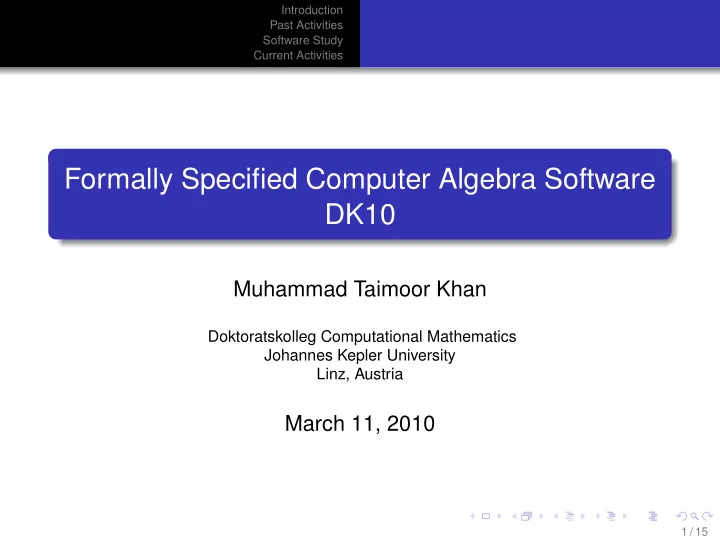
Formally Specified Computer Algebra Software DK10

Muhammad Taimoor Khan

Doktoratskolleg Computational Mathematics Johannes Kepler University Linz, Austria

March 11, 2010

1 / 15

slide-2
SLIDE 2

Introduction Past Activities Software Study Current Activities

Outline

1

Introduction

2

Past Activities

3

Software Study

4

Current Activities

2 / 15

slide-3
SLIDE 3

Introduction Past Activities Software Study Current Activities

Introduction

Project goals

Formal specification of programs written in untyped computer algebra languages Especially to find errors/inconsistencies

for example violation of method preconditions

Computer algebra software at RISC as examples

DK11: rational parametric algebraic curves (Maple) DK6: computer algebra tools for special functions in numerical analysis (Mathematica) DK1: automated theorem proving (Mathematica)

3 / 15

slide-4
SLIDE 4

Introduction Past Activities Software Study Current Activities

Past Activities (October 2009 to February 2010)

Course work

Computer Algebra Automated Theorem Proving Formal Methods in Software Development Thinking, Speaking, Writing Formal Methods Seminar Programming Project

Literature study

Type systems

Polymorphism Abstract data types

Denotational semantics Functional programming languages

Pattern matching Type checking and inference

4 / 15

slide-5
SLIDE 5

Introduction Past Activities Software Study Current Activities

Software Study - Computer Algebra

Bivariate difference-differential dimension polynomials and their computation Relative Gröbner bases computation (using M. Zhou and F . Winkler’s algorithm) Maple implementation of the algorithms Software

Maple package DifferenceDifferential Christian Dönch

Literature reference

Christian Dönch. Bivariate difference-differential dimension polynomials and their computation in Maple. Technical report no. 09-19 in RISC Report Series, University of Linz, Austria, 2009.

5 / 15

slide-6
SLIDE 6

Introduction Past Activities Software Study Current Activities

Software Study - Computer Algebra

ddsub := proc(c,b) local f, g, i, m, n, a1; f := c; g:=b; for i to nops(g) do g [i][1] := -g [i][1]; f := [op(f ),g [i]]; end do; for m from nops(f) by -1 to 1 do for n from m-1 by -1 to 1 do if f [m][2]= f [n][2] and f [m][3]=f [n][3] and f [m][4]=f [n][4] then a1 := f [m][1]+f [n][1]; f [n] := subsop(1=a1,f [n]); f := subsop(m=NULL,f ); n := m; end if; end do; end do; .... return f; end proc;

6 / 15

slide-7
SLIDE 7

Introduction Past Activities Software Study Current Activities

Software Study - Computer Algebra

Potential considerations

Limited types used i.e. integer and list Not much use of Maple libraries - mostly standalone No destructive update of data structures Imperative style of development

Procedural/functional Maple package

7 / 15

slide-8
SLIDE 8

Introduction Past Activities Software Study Current Activities

Software Study - Algorithmic Combinatorics

Advanced applications of holonomic systems approach Computations in Ore algebras Non-commutative Gröbner bases Solving linear system of differential equations Software

Symbolic summation and integration for holonomic functions Mathematica package - HolonomicFunctions Christoph Koutschan

Literature reference

Christoph Koutschan. HolonomicFunctions (User’s Guide). Technical report no. 10-01 in RISC Report Series, JKU, Austria, January 2010. Christoph Koutschan. Advanced Applications of the Holonomic Systems Approach. RISC-Linz, JKU. PhD Thesis, September 2009.

8 / 15

slide-9
SLIDE 9

Introduction Past Activities Software Study Current Activities

Software Study - Algorithmic Combinatorics

OrePlus [p1:OrePolynomial[data1_List, algebra_OreAlgebraObject, order_], p2:OrePolynomial[data2_List, algebra_OreAlgebraObject, order_]] := Module[{i1, i2, l1, l2, c, c1, c2, m1, m2, sum, coeffPlus}, l1 = Length[data1]; If[l1 === 0, Return[p2]]; l2 = Length[data2]; If[l2 === 0, Return[p1]]; coeffPlus = algebra[[3]]; i1 = 1; i2 = 1; sum = {}; While[i1 <= l1 && i2 <= l2, {c1, m1} = data1[[i1]]; {c2, m2} = data2[[i2]]; If [m1 === m2, c = coeffPlus[c1, c2]; If[Not[MatchQ[c, 0|0.]], AppendTo[sum, {c, m1}]]; i1++; i2++; , If[OreOrderedQ[m1, m2, order], AppendTo[sum, {c1, m1}]; i1++; .... ];];

9 / 15

slide-10
SLIDE 10

Introduction Past Activities Software Study Current Activities

Software Study - Algorithmic Combinatorics

Potential considerations

Based on pattern matching Imperative style of programming Use of abstract data types Use of customized Mathematica functionality Not much use of Mathematica libraries

Procedural/functional Mathematica program with abstract data types

10 / 15

slide-11
SLIDE 11

Introduction Past Activities Software Study Current Activities

Software Study - Automated Theorem Proving

Theorema set theory prover (STP) Automated prover for theorems Works with Prove-Compute-Solve (PCS) strategy Integrated with Theorma infrastructure (not standalone) Software

Mathematica package SetTheory‘Prover‘ Wolfgang Windsteiger

Literature reference

  • W. Windsteiger. An Automated Prover for Zermelo-Fraenkel

Set Theory in Theorema. JSC 41(3-4), pp. 435-470, 2006, Elsevier, ISSN 0747-7171.

  • W. Windsteiger. A Set Theory Prover in Theorema:

Implementation and Practical Applications. RISC. PhD Thesis, May 2001.

11 / 15

slide-12
SLIDE 12

Introduction Past Activities Software Study Current Activities

Software Study - Automated Theorem Proving

STP[•lf[l_,T_∈ Intersection[A_, B__],i_],a_•asml,af_]:= Module[ {goalList=MapIndexed[•lf[NewLabel[ cMembershipAlternatives,l,#2],T∈ #1,i]&, {A,B}],proofSits}, proofSits=Map[Psit[#,a, af]&,goalList]; ProofStep[Prinfo[ cMembershipFiniteIntersection,l,goalList], Sequence @@ proofSits]]

12 / 15

slide-13
SLIDE 13

Introduction Past Activities Software Study Current Activities

Software Study - Automated Theorem Proving

Potential considerations

Pattern matching rules used

Are the rules overlaping? Are the rules exhaustive?

Implicit type definitions Declarative style of programming

Functional Mathematica program, essentially based on pattern matching

13 / 15

slide-14
SLIDE 14

Introduction Past Activities Software Study Current Activities

Current Activities

Definition of simplified/typed versions of Mathematica and Maple (say MiniMma and MiniMaple)

Syntax Type system Semantics and soundness of typing

Implementation of a type checker prototype

Static typing as a prerequisite to logic specification

Experiments with software fragments available at RISC Next - Formal Specification language

14 / 15

slide-15
SLIDE 15

Introduction Past Activities Software Study Current Activities

Thanks for your attention!

15 / 15