
SLIDE 1
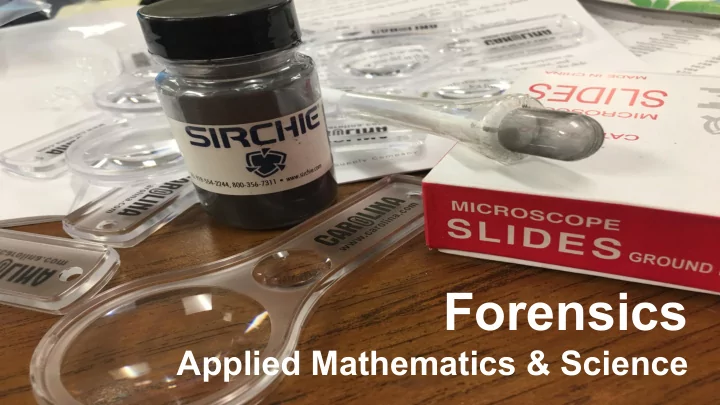
Forensics Applied Mathematics & Science Course Description - - PowerPoint PPT Presentation
Forensics Applied Mathematics & Science Course Description Through a forensic simulation, students will apply standards of mathematical and science engineering practices, use measurement, data, and statistics to investigate a crime scene
Through a forensic simulation, students will apply standards of mathematical and science engineering practices, use measurement, data, and statistics to investigate a crime scene and resulting evidence. Students will understand how forensic scientists process, use, and synthesize evidence from crime scenes to make reliable conclusions about events. Students will be able to use forensic techniques and synthesize the data gathered in order to make conclusions about a simulated crime.
conclusions, recommendations
data
being precise
Student voices
1. Place 1 drop of blood into the well marked A. 2. Place 1 drop of blood into the well marked B. 3. Place 1 drop of Antibodies A into the well marked A. Stir. 4. Place 1 drop of Antibodies B into the well marked B. Stir.
Look for agglutination. See the pictures to determine the sample’s blood type.