for Learning: A framework for good teaching, a model for student - - PDF document

for learning
SMART_READER_LITE
LIVE PREVIEW

for Learning: A framework for good teaching, a model for student - - PDF document

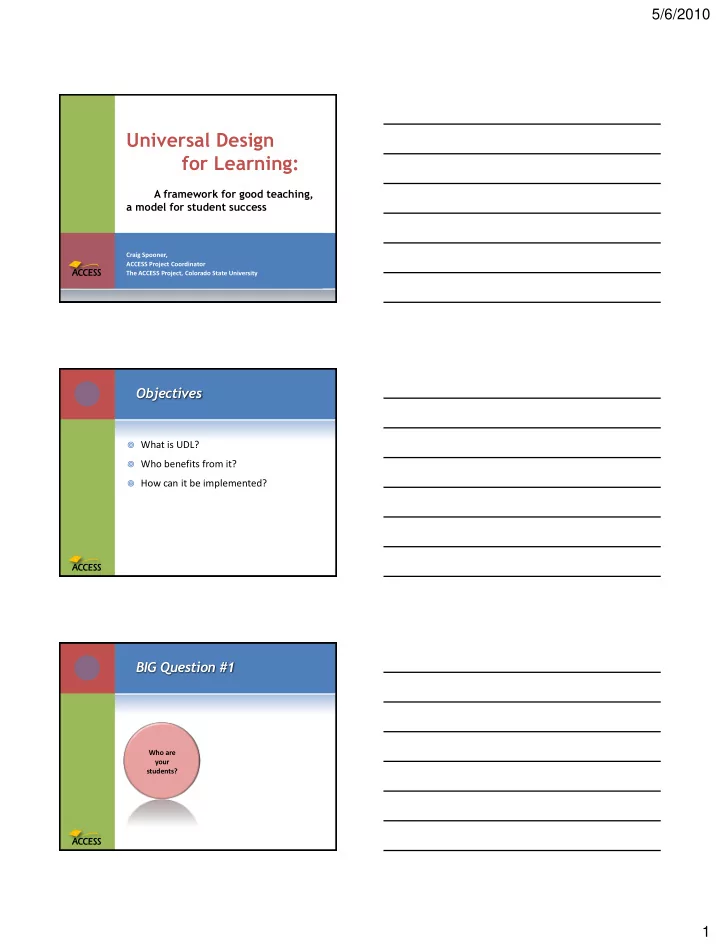
5/6/2010 Universal Design for Learning: A framework for good teaching, a model for student success Craig Spooner, ACCESS Project Coordinator The ACCESS Project, Colorado State University Objectives What is UDL? Who benefits from it?


slide-1
SLIDE 1

5/6/2010 1

Craig Spooner, ACCESS Project Coordinator The ACCESS Project, Colorado State University

Universal Design for Learning:

A framework for good teaching, a model for student success

Objectives

 What is UDL?  Who benefits from it?  How can it be implemented?

BIG Question #1

Who are your students?

slide-2
SLIDE 2

5/6/2010 2

Student diversity

 Ethnicity & Culture  ESL/Native language  Nontraditional  Gender  Learning Styles  Disabilities

Ethnicity & Culture*

CSU Students CSU Faculty Minority 13.6% 12.8% International 3.5% 4.7%

ESL / Native Language

 Potential barriers to comprehension

 For both students and instructors  Affects written and verbal communication

slide-3
SLIDE 3

5/6/2010 3

What is your good name, sir?

  • A. Full name
  • B. Last name
  • C. Nickname or pet name

 I say there are 100 Krore stars

in the sky. You say the stars number 10,000 Lakh.

 Do we agree?

Nontraditional Students

Percentage of undergraduates with nontraditional characteristics: 1992–93 and 1999–2000

slide-4
SLIDE 4

5/6/2010 4

Nontraditional Students

 Highly motivated & Achievement oriented

 Finances and family are two of the biggest concerns  Strong consumer orientation  Need flexible schedules

 Integrate learning with life and work

experiences

 Want applicability to the real world  Prefer more active approaches to learning

 Relatively independent

 Lack of a cohort, “student life” experience

Men & Women*

10,308 1,766 130 10,896 1,905 408 2,000 4,000 6,000 8,000 10,000 12,000 Undergraduate Graduate Veterinary Medicine

Men Women

Learning Styles

1.

Visual

a) Visual-Linguistic (reading and writing) b) Visual-Spatial (graphs and pictures)

2.

Auditory (listening)

3.

Kinesthetic (touching and moving)

slide-5
SLIDE 5

5/6/2010 5

 Both short-term and long-term,

apparent and non-apparent

 Mobility Impairments  Blindness/Visual Impairments  Deafness/Hearing Impairments  Learning Disabilities  Attention Deficit Disorder (ADD/ADHD)  Autistic Spectrum Disabilities  Traumatic Brain Injury (TBI)  Post Traumatic Stress Disorder (PTSD)

Disabilities Disabilities

 National statistics:

 11.3% of undergraduates report some type of

disability*  Colorado State University

 8%–11% (ACCESS research, 2007-10)  Non-apparent disabilities are by far the largest

proportion and growing  Only a small percentage seeks

accommodations

Universal Design for Learning

Universal Design for Learning is a set of principles and techniques for creating inclusive classroom instruction and accessible course materials. teaching technology

“ ”

slide-6
SLIDE 6

5/6/2010 6

History of UDL

 Universal Design (UD)

 Accommodate the widest spectrum of users

without the need for subsequent adaptation

 Public buildings, city streets, television, kitchen

utensils…  Universal Design for Learning (UDL)

 Inclusive pedagogy  Applies to both teaching and technology

UDL and T eaching

  • 1. Represent information and concepts in

multiple ways (and in a variety of formats).

  • 2. Students are given multiple ways to

express their comprehension and mastery of a topic.

  • 3. Students engage with new ideas and

information in multiple ways.

Representation

slide-7
SLIDE 7

5/6/2010 7

Representation

 Ideas and information are represented in

multiple ways and in a variety of formats

 Lectures  Group activities  Hands-on exercises  Text + Graphics, Audio, Video  Usable electronic formats (e.g., Word, PDF,

HTML)

UDL and T echnology

 Educational Videos  Course Materials  Lecture Presentation Systems  Course Management Systems

What makes a document Universally Designed?

 Searchability  Copy and Paste  Bookmarks or an Interactive TOC  Text to Speech capability  Accessibility

slide-8
SLIDE 8

5/6/2010 8

UDL T ech T utorials

 Microsoft Word

 Styles and Headings  Images

 PowerPoint  Adobe PDF  HTML  E-Text

http://accessproject.colostate.edu

Expression Expression

 Students express comprehension and

mastery in multiple ways

 Oral presentation  Written essays  Projects/Portfolios/Journals  Performance  Multimedia (text/graphics/audio/video)

slide-9
SLIDE 9

5/6/2010 9

Expression

 Colin from our video

 Student with Quadriplegia  Undergraduate in Landscape Architecture

 Assignment: Create a 3D model

 Physical model  Computerized model

Engagement Engagement

 Help students “engage” in multiple ways

 Express your own enthusiasm!  Challenge students with meaningful, real-world

assignments

 Give prompt and instructive feedback on

assignments

 Classroom response systems (clickers)  Make yourself available to students during office

hours in flexible formats

slide-10
SLIDE 10

5/6/2010 10

Engagement

 Professor from India has students video

tape Q&A during office hours

 Individual questions answered for

everyone in the course

 Video  Written explanation

What’s so special about UDL?

Represent

slide-11
SLIDE 11

5/6/2010 11

BIG Question #2

Who are your students? What are

  • ur

institution’s goals?

CSU’s Strategic Goals

 Goal 5: Access, Diversity, and

Internationalization

 Goal 6: Undergraduate Curriculum and Advising

 6.2: Enhance programmatic accessibility for students

with physical, learning and other disabilities  Goal 7: Active and Experiential Learning

Opportunities

 Goal 10: Student Engagement Outcomes

(curricular and co-curricular)

CSU’s Strategic Goals

 Goal 9: Learning Outcomes

 critical thinking  writing

 Goal 8: Retention and Graduation

 CSU’s first-year retention rate: 82%  6-year graduate rate: 63%

slide-12
SLIDE 12

5/6/2010 12

BIG Question #3

Who are your students? What are CSU’s Goals? What’s your Instructional Philosophy?

Instructional Philosophy

 How do you conceptualize knowledge?

 What is your role in the transmission of

knowledge?

 What constitutes student learning?  What learning objectives have you set for them,

and how do you know when they’ve been achieved?

Recommended Video

http://www.cornell.edu/video/?VideoID=225

slide-13
SLIDE 13

5/6/2010 13

Published Resources

Burgstahler, S., & Cory, R. (2008). Universal design in higher education from principles to practice. Cambridge, MA: Harvard Education Press.

Rose, D. H., Harbour, W. S., Johnston, C. S., Daley, S. G., & Abarbanell, L. (2006). Universal design for learning in postsecondary education: Reflections

  • n principles and their application. Journal of

Postsecondary Education and Disability, 19(2), 135- 151.

The ACCESS Project, Colorado State University Funded by U.S. Dept. of Education, Office of Postsecondary Education, Grant #P333A080026

Thank you!

ACCESS Website: accessproject.colostate.edu Craig Spooner craig.spooner@colostate.edu 970-491-0784