SLIDE 1
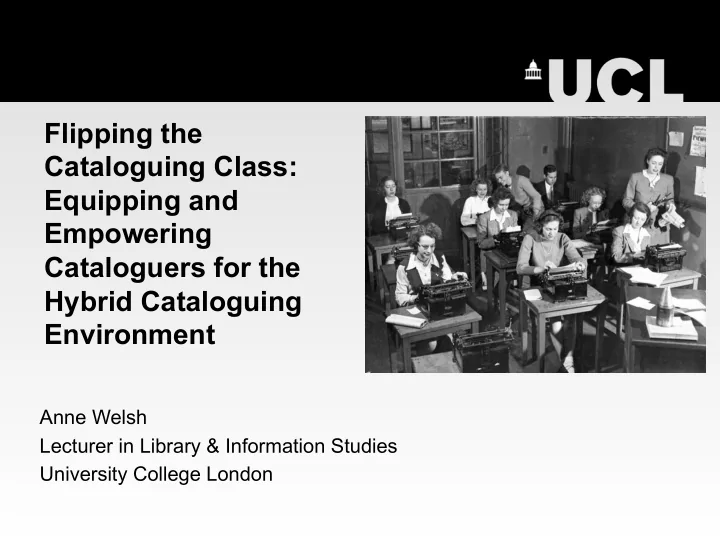
Flipping the Cataloguing Class: Equipping and Empowering Cataloguers for the Hybrid Cataloguing Environment
Anne Welsh Lecturer in Library & Information Studies University College London
SLIDE 2
Anglo-American Cataloguing
1839 British Museum Cataloguing Rules 1853 Jewett’s Rules 1876 Cutter’s Rules 1883 ALA Condensed Rules 1893 LA Cataloguing Rules 1908 LA / ALA Catalog Rules 1941 ALA Catalog Rules 1949 Library of Congress Rules 1949 ALA Cataloging Rules 1967 AACR 1978 AACR2 1988 AACR2R 1998 AACR2R 2002 AACR2R 2004 Concise AACR2 2010-2013 RDA
~ Anne Welsh. Cataloguing Codes Timeline, http://www.timetoast.com/timelines/9284
SLIDE 3
UCL MA LIS
http://www.ucl.ac.uk/dis
SLIDE 4 Alan Danskin. Implementation of RDA: British Library and Beyond. Getting Started with RDA. CILIP CIG, 3 July 2013, http://www.cilip.org.uk/sites/default/files/documents/Alan%20Danskin,%20British%20Library %20Implementation%20of%20RDA%20British%20Library%20and%20beyond.pdf
SLIDE 5 Constructive Alignment
they do (“Active Learning”).
Outcomes (ILO) are communicated to them.
assessment.
Biggs and Tang. Teaching for Quality Learning at University. McGraw-Hill, 2007.
SLIDE 6
Personal Development Diagram adapted from Kolb (1984) Education Work Experiential Learning
Experiential Learning
SLIDE 7 “Everyone arrives at UCL with dramatically varying experience
- f cataloguing. Some of my peers spent much of their
compulsory training years cataloguing, and are quite used to cataloguing all manner of unusual things, and others have already had extensive training. In contrast, some of my classmates, whose training years were perhaps more
- rientated on front-of-house activities, had no cataloguing
experience at all. I, and many other students, occupy a middle- ground where we are relatively inexperienced but do have some understanding and experience of cataloguing.”
Charlotte Middleton. (2013) ‘The Experiences of a New Cataloguer’. Catalogue and Index 173: 39-40, http://www.cilip.org.uk/sites/default/files/Catalogue%20and%20Index%20issue %20173%2C%20December%202013.pdf
SLIDE 8
SLIDE 9
“Most research on the flipped classroom employs group-based interactive learning activities inside the classroom, citing student-centred learning theories … The exact nature of these activities varies widely between studies” “We define the flipped classroom as an educational technique that consists of two parts: interactive group learning activities inside the classroom, and direct computer-based individual instruction outside the classroom.” “The flipped classroom actually represents an expansion of the curriculum, rather than a mere re-arrangement of activities”
Bishop, J.L. and Verleger, M.A. (2013). ‘The Flipped Classroom: A Survey of the Research’. 120th ASEE Annual Conference & Exposition, June 23-26, 2013, Paper ID #6219, http://www.flippedlearning.org/cms/lib07/VA01923112/Centricity/Domain/41/ WhitePaper_FlippedLearning.pdf
SLIDE 10
SLIDE 11
choice in activities
– Watching videos – Consulting catalogues – Listening to lectures
- Blended learning
- Greater confidence
- Classroom was extended
not just flipped
Key Findings
SLIDE 12
Lessons Learned for Next Session