
SLIDE 1
For the period ended January 31, 2002
First Quarter Report 2002
I am pleased to present Bank of Montreal’s First Quarter 2002 Report to Shareholders.
Tony Comper, Chairman and Chief Executive Officer February 26, 2002
First Quarter Report 2002 I am pleased to present Bank of Montreals - - PDF document
First Quarter Report 2002 I am pleased to present Bank of Montreals First Quarter 2002 Report to Shareholders. Tony Comper, Chairman and Chief Executive Officer February 26, 2002 For the period ended January 31, 2002 Financial Highlights
For the period ended January 31, 2002
I am pleased to present Bank of Montreal’s First Quarter 2002 Report to Shareholders.
Tony Comper, Chairman and Chief Executive Officer February 26, 2002
For the three months ended Change from (Canadian $ in millions except as noted) January 31, 2002 October 31, 2001 July 31, 2001 April 30, 2001 January 31, 2001 January 31, 2001
Income Statement Highlights Total revenue (teb) (a) $ 2,205 $ 1,951 $ 2,234 $ 2,485 $ 2,193 0.6% Provision for credit losses 180 546 117 217 100 80.0 Non-interest expense 1,462 1,449 1,421 1,404 1,397 4.6 Net income 372 4 444 607 416 (10.5) Common Share Data ($) (d) Diluted earnings per share $ 0.71 $ 0.00 $ 0.83 $ 1.10 $ 0.73 $ (0.02) – excluding non-recurring items 0.71 0.19 0.83 0.76 0.70 0.01 Diluted cash earnings per share 0.75 0.06 0.88 1.15 0.77 (0.02) – excluding non-recurring items 0.75 0.25 0.88 0.80 0.75 0.00 Dividends declared per share 0.30 0.28 0.28 0.28 0.28 0.02 Book value per share 20.11 19.69 20.44 19.93 19.53 0.58 Closing share price 36.00 33.86 40.85 35.20 40.89 (4.89) Total market value of common shares ($ billions) 17.6 16.6 20.7 17.8 21.5 (3.9)
As at Change from January 31, 2002 October 31, 2001 July 31, 2001 April 30, 2001 January 31, 2001 January 31, 2001
Balance Sheet Highlights Assets $ 239,440 $ 239,409 $ 230,203 $ 235,154 $ 242,230 (1.2)% Loans 136,067 136,829 136,693 136,405 139,270 (2.3) Deposits 154,758 154,290 151,003 154,415 157,875 (2.0) Common shareholders' equity 9,851 9,632 10,374 10,102 10,280 (4.2)
For the three months ended January 31, 2002 October 31, 2001 July 31, 2001 April 30, 2001 January 31, 2001
Primary Financial Measures (%) (b) (d) Average annual five year total shareholder return 12.5 14.3 23.9 20.4 23.8 Diluted earnings per share growth (2.7) (100.0) 20.3 26.4 (12.0) – excluding non-recurring items 1.4 (75.0) 23.9 (2.6) 0.0 Diluted cash earnings per share growth (2.6) (93.3) 20.5 27.8 (10.5) – excluding non-recurring items 0.0 (68.8) 23.9 0.0 1.4 Return on equity 14.5 (0.4) 16.8 23.7 15.3 – excluding non-recurring items 14.5 3.8 16.8 16.2 14.8 Cash return on equity 15.2 0.7 17.8 24.7 16.2 – excluding non-recurring items 15.2 4.8 17.8 17.2 15.7 Net economic profit (NEP) growth (21.4) (+100) 48.9 55.6 (27.6) Revenue growth 0.6 (9.7) 6.6 8.8 3.2 – excluding non-recurring items 2.6 (1.2) 7.5 0.0 6.8 Non-interest expense-to-revenue ratio 66.3 74.2 63.6 56.5 63.7 – excluding non-recurring items 66.3 68.1 63.6 63.9 65.0 Provision for credit losses as a % of average loans and acceptances 0.49 0.67 0.38 0.36 0.27 – excluding non-recurring items 0.49 0.60 0.31 0.29 0.27 Gross impaired loans and acceptances as a % of equity and allowance for credit losses 14.64 14.17 12.55 11.52 11.94 Cash and securities-to-total assets ratio 25.2 23.1 25.6 26.4 26.3 Tier 1 capital ratio (c) 8.87 8.15 8.84 8.94 8.87 Credit rating AA- AA- AA- AA- AA- Other Financial Ratios (% except as noted) (b) (d) Total shareholder return – twelve month (9.3) (1.2) 32.0 35.0 75.8 Dividend yield 3.3 3.3 2.7 3.2 2.7 Price-to-earnings ratio (times) 13.3 12.4 11.4 10.2 12.8 Market-to-book value (times) 1.79 1.72 2.00 1.77 2.09 Net economic profit ($ millions) 115 (249) 184 352 146 Return on average assets 0.60 0.01 0.75 1.00 0.67 – excluding non-recurring items 0.60 0.18 0.75 0.70 0.65 Net interest margin 2.07 1.94 2.09 1.80 1.81 Other income as a % of total revenue 41.6 38.4 44.9 56.1 49.1 – excluding non-recurring items 41.6 43.5 44.9 50.3 48.0 Expense growth 4.6 8.9 7.2 4.0 11.4 – excluding non-recurring items 4.6 5.5 7.2 4.0 11.4 Total capital ratio (c) 12.93 12.12 12.60 12.74 12.12 Tier 1 capital ratio – U.S. basis (c) 8.32 7.87 8.43 8.51 8.41 Equity-to-assets ratio 5.4 5.1 5.6 5.4 5.2
All ratios in this report are based on unrounded numbers. (a) Reported on a taxable equivalent basis (teb). (b) For the period ended, or as at, as appropriate. (c) The July 31, 2001 total capital ratio and tier 1 capital ratios reflect the inclusion of US$250 of class B preferred shares which were redeemed on August 27 , 2001. Excluding these shares, the total capital ratio would have been 12.32, the tier 1 capital ratio would have been 8.55 and the tier 1 capital ratio – U.S. basis would have been 8. 15 as at July 31, 2001. The January 31, 2001 total capital ratio and tier 1 capital ratios reflect the inclusion of $250 of class B preferred shares which were redeemed on February 26, 2001. Excluding these shares, the total capital ratio would have been 11.93, the tier 1 capital ratio would have been 8.68 and the tier 1 capital ratio – U.S. basis would have been 8.23 as at January 31, 2001. (d) See page 5 for details of non-recurring items and a caution regarding limitations of the comparability
Reported ($ millions, except per share data and as noted)
Q1-2002 Increase/(Decrease) vs. Q1-2001 Increase/(Decrease) vs. Q4-2001
Revenues (teb) $ 2,205 $ 12 1% $ 254 13% Provision for credit losses $ 180 $ 80 80% $ (366) (67)% Non-interest expenses $ 1,462 $ 65 5% $ 13 1% Net income $ 372 $ (44) (10)% $ 368 +100% Return on equity 14.5% (0.8)% 14.9% Cash return on equity 15.2% (1.0)% 14.5% Earnings per share – diluted $ 0.71 $ (0.02) (3)% $ 0.71 +100% Cash earnings per share – diluted $ 0.75 $ (0.02) (3)% $ 0.69 +100% Excluding non-recurring items (refer to page 5) Revenues (teb) $ 2,205 $ 56 3% $ 76 4% Provision for credit losses $ 180 $ 80 80% $ (366) (67)% Non-interest expenses $ 1,462 $ 65 5% $ 13 1% Net income $ 372 $ (31) (8)% $ 263 +100% Return on equity 14.5% (0.3)% 10.7% Cash return on equity 15.2% (0.5)% 10.4% Earnings per share – diluted $ 0.71 $ 0.01 1% $ 0.52 +100% Cash earnings per share – diluted $ 0.75 $ – – $ 0.50 +100%
Financial Highlights
1 Bank of Montreal First Quarter Report 2002
Bank of Montreal earned net income of $372 million and diluted earnings per share of $0.71 for its first quarter ended January 31, 2002, compared with net income of $416 million and diluted earnings per share of $0.73 in the first quarter of last year. Excluding non-recurring items in the first quarter of last year, net income was down $31 mil- lion; however, because of the favourable effect of last year’s share buyback programs, returns to shareholders improved as diluted earnings per share increased by $0.01. Compared to the fourth quarter of 2001, results of each of the oper- ating groups improved significantly as the Bank’s net income increased $368 million. Net income in the fourth quarter was affected by a sharp deterioration in economic conditions, prompting higher provisions for credit losses and write-downs totalling $682 million. Excluding non-recurring items in the fourth quarter, net income increased $263 million and diluted earnings per share increased $0.52 to $0.71 this quarter. When financial results were released on February 26, 2002, the Bank’s news release included the following quote from Mr. Comper. “Results reflect a solid quarter and a good start to the year. Loan losses were up compared to the first quarter of 2001, but are expected to decrease for the full year. Taking this into account, financial performance is on the upswing. While a lot of work lies ahead in continuing to improve performance, I am particularly encouraged by the solid growth in personal and commercial banking volumes in both Canada and the U.S.” Even though the Bank’s provisions for credit losses in fiscal 2002 are expected to be lower than for fiscal 2001, year-over-year quarterly comparisons are affected because the provision in the first quarter
deterioration in economic conditions.
Personal and Commercial Client Group performance improved from the first quarter of last year due to solid volume growth in Canada and continued strong growth in the United States, where volume growth was further enhanced by last year’s acquisition of First National Bank of Joliet (Joliet). In Canada, the premium rate savings product has attracted many new customers and positions the Group for improved profitability when interest rates rise.
Down 31 Per Cent from Q4 and Provisions for Credit Losses in Line with Guidance New impaired loan formations in the quarter were the lowest since fiscal 2000 and were down 31 per cent from the fourth quarter. The increase in this quarter’s provision for credit losses relative to the first quarter of last year is largely reflective of timing, as required quarterly provisions increased substantially over the course of fiscal 2001 as economic conditions deteriorated. Net income in the first quarter of 2002 would have been higher than in the first quarter
sions for the year remain in line with the guidance provided at the end of last year. Provisions for credit losses allocated to the banking groups are based on expected losses over an economic cycle and the timing differences between expected loss provisions and required provisions under Generally Accepted Accounting Principles (GAAP) are allocated to the Corporate Support Group.
Operating Highlights
31 per cent from the fourth quarter and provisions for credit losses in line with guidance
customer retention
Reported ($ millions, except per share data and as noted)
Q1-2002 Increase/(Decrease) vs. Q1-2001 Increase/(Decrease) vs. Q4-2001
Personal and Commercial Client Group $ 226 $ 21 10% $ 28 14% Private Client Group 37 5 14% 28 +100% Investment Banking Group 172 3 2% 285 +100% Corporate Support, including Emfisys (63) (73) (+100)% 27 30% Bank of Montreal $ 372 $ (44) (10)% $ 368 +100% Excluding non-recurring items (refer to page 5) Personal and Commercial Client Group $ 226 $ 26 13% $ 28 14% Private Client Group 37 5 14% 28 +100% Investment Banking Group 172 3 2% 180 +100% Corporate Support, including Emfisys (63) (65) (+100)% 27 30% Bank of Montreal $ 372 $ (31) (8)% $ 263 +100% 2 Bank of Montreal First Quarter Report 2002
Investment Banking Group net income rose from last year due to reduced expenses and continued momentum in interest rate- sensitive businesses. However, uncertain economic conditions continue to affect the Group’s fee-based businesses.
with High Customer Retention Private Client Group announced the acquisition of CSFBdirect on November 28, 2001. The transaction, which closed on February 4, 2002, represents another significant step in our selective and sub- stantial expansion into the United States and brings Bank of Montreal closer to becoming a truly transnational bank. We are pleased with the CSFBdirect integration process to date, which leverages the Group’s successful experience with its four previous acquisitions and includes proactive client communications. Client retention has been strong. 2002 Outlook Unchanged The Bank’s outlook for fiscal 2002 continues to anticipate cash earnings per share for the first six months to approximate comparable amounts for the first six months of 2001, excluding non-recurring items. The
cash earnings per share growth in the second six months will improve from the first half of the year. The outlook for the year now anticipates that the provision for credit losses will remain at the high end of the 40 to 50 basis points target range. As anticipated at the end of last year, the Canadian and U.S. economies are expected to gradually strengthen over the balance of this year following a short and shallow downturn in 2001. Highly stimu- lative monetary and fiscal policies are expected to provide ongoing support to consumer spending, while housing activity should remain elevated in the face of low mortgage rates. Inventory rebuilding is anticipated to complement the expansion. The unemployment rate should begin trending down in the spring. Interest rates in Canada and the United States are expected to remain relatively stable in the first half of the calendar year as central banks will likely be reluctant to tighten policy in the face of tame inflation, excess capacity and still emerging economic growth. However, as the recovery gathers momen- tum and absorbs the slack in the economy, interest rates may increase in the second half of the year. It is likely that capital markets activity will increase with a strengthening economy. Note on Performance Analysis Management and certain of the Bank’s stakeholders believe that per- formance analysis is enhanced by focusing on cash results and results excluding non-recurring items. These adjustments and their effects are outlined on page 5. Securities regulators require that corporations caution readers that earnings as adjusted for such items do not have standardized meanings under GAAP and are unlikely to be comparable to similar measures used by other companies.
Expense growth in the first quarter of 2002, while currently greater than revenue growth, was much improved from a year ago. Expense management initiatives continue to be implemented and the full impact of these actions is expected to be even more apparent in the latter half of the year.
Favourable Market Conditions Private Client Group net income improved year-over-year and rebounded from the fourth quarter, even though challenging market conditions continue to affect trading volumes. The Group remains focused on its long-term growth strategy of expanding its distribu- tion network and is well positioned for a return to more favourable market conditions. Operating Group Income
Annual Targets for 2002, Excluding Non-Recurring Items Performance to January 31, 2002
EPS comparable to the same period last year.
points of average net loans and acceptances (including securities purchased under resale agreements).
3 Bank of Montreal First Quarter Report 2002
Value Measures Annualized ROE for the quarter was 14.5 per cent. Annualized cash ROE
15 per cent. Diluted earnings per share (EPS) declined 2.7 per cent, while diluted cash EPS declined 2.6 per cent from the first quarter of last year. Excluding non-recurring items, diluted EPS growth was 1.4 per cent, while diluted cash EPS was unchanged. The Bank is targeting 8 to 12 per cent cash EPS growth for the year, but had anticipated little change year-over-year in the first six months. Net economic profit was $115 million, compared with $146 million in the first quarter of 2001 and negative $249 million in the fourth quarter of last year. The variances were largely attributable to differ- ences in net income available to common shareholders. Bank of Montreal shareholders earned a return of 7.2 per cent on their common shares in the quarter, less than the average return to shareholders of the major Canadian banks and less than the return
Net Income Net income for the first quarter of 2002 was $372 million, a decrease
items, net income was $31 million lower than in the first quarter
amortization and a more favourable income tax rate were more than
credit losses. Net income rose $368 million from the fourth quarter. Excluding non-recurring items, net income rose $263 million. The improvement was largely due to lower provisions for credit losses and investment write-downs. Revenue Bank of Montreal, like most banks, analyzes revenue on a taxable equivalent basis (teb). This basis includes an adjustment that increases GAAP revenues and the provision for income taxes by an amount that adjusts revenues on certain tax-exempt securities to an amount equivalent to what revenues would have been had they been taxed at the statutory rate. The adjustments amounted to $27 million in the current quarter and slightly higher amounts in the first and fourth quarters of last year. Revenue of $2,205 million increased $12 million from the first quarter of last year and $254 million from the fourth quarter. There were no non-recurring items in the current quarter. Excluding non- recurring gains on sales of branches and a gain on sale of a portion
year, revenue increased $56 million or 2.6 per cent. Excluding the impact of a write-down on the Bank’s equity investment in its own
collateralized bond obligations (CBOs) that was categorized as non- recurring for reporting purposes, revenue increased $76 million or 3.5 per cent from the fourth quarter. Net interest income increased $171 million from the first quarter
were driven by volume growth in Personal and Commercial Client Group and by improved net interest margins in Investment Banking
year to 2.07 per cent while overall growth in average assets was held to $1.6 billion, notwithstanding growth of $7.7 billion in retail and business banking. Net interest margins improved by 13 basis points from the fourth quarter and average assets increased $1.1 bil- lion overall and $2.7 billion in retail and business banking. Other income decreased $159 million from the prior year, but increased $167 million from the fourth quarter. Excluding non-recurring items in the comparative periods, non-interest revenue declined $115 million from the prior year and $11 million from the fourth
enue in Investment Banking Group, which more than offset higher revenue in Personal and Commercial Client Group. The decline was largely related to lower trading revenues due to challenging equity market conditions, lower securitization revenues and lower capital markets fees, which more than offset higher banking activity and credit card services revenues. Revenues in the fourth quarter were affected by $252 million of investment write-downs, including $178 million related to the CBOs. Excluding these effects, non-interest revenue decreased $85 million. Higher credit card services fees, due to seasonal factors, and higher securities trading commissions were more than offset by lower trading income, primarily due to decreased equity volumes and client-driven trading opportunities, lower capital market fees, securitization rev- enues and retail banking fees. Non-Interest Expenses Expenses of $1,462 million increased $65 million or 4.6 per cent from the first quarter of last year. Much of the year-over-year growth was attributable to the effects of acquired businesses, while the stronger U.S. dollar also contributed to the increase. Growth related largely to employee costs, while computer costs also increased. Revenue-based compensation costs declined. Expense growth was limited to $13 million or 0.9 per cent from the fourth quarter, reflective of the benefits of a cost management pro- gram designed to better manage expense growth relative to revenue
revenue-based compensation costs, which were reduced in the fourth quarter because of the impact of the increased provisions for credit losses and write-downs in that period. Professional fees, computer costs and promotional costs declined appreciably.
Users of the interim MD&A are assumed to have read or have access to the annual MD&A, which is available in the Bank’s 2001 Annual Report at www.bmo.com. Readers are encouraged to refer to the annual MD&A for a more comprehensive understanding of the Bank’s operations.
4 Bank of Montreal First Quarter Report 2002
Risk Management The provision for credit losses totalled $180 million in the quarter, up from $100 million in the first quarter of last year and down from $546 million in the fourth quarter. The provision for the quarter represents an annualized 49 basis points of average net loans and acceptances, including securities purchased under resale agreements. The Bank now expects its annual provision to be at the upper end of its target of 40 to 50 basis points, compared with a provision, excluding non-recurring items, representing 60 basis points in fiscal 2001. In 2001, provisions were increased significantly in the fourth quarter, reflective of recessionary conditions that prevailed in the United States and weakening economic conditions in Canada. The year-over-year increase in the first quarter’s provision and the decline in the quar- terly provision relative to the immediately preceding quarter were reflective of developing weakness in the economy over the course
Net impaired loans totalled $170 million, compared with $65 million at the end of 2001. The ratio of the allowance for credit losses to gross impaired loans was 92.3 per cent, compared with 96.8 per cent at the end of last year. Gross impaired loans were $2, 193 million, up from $2,014 million at the end of October. New impaired loan for- mations totalled $417 million in the quarter, which is in line with expectations at this point in the business cycle, and were down $189 million or 31 per cent from the fourth quarter. Subsequent to the end of the first quarter of 2002, the Bank committed to sell approximately $200 million of impaired loans of companies that have filed for bankruptcy, including: $35 million of $47 million of Enron Corp loans; $24 million of $56 million of Global Crossing Ltd. loans; and $130 million in loans, representing the Bank’s total loan exposure to Pacific Gas & Electric Co. These transactions, which are expected to close during the second quarter, do not impact the Bank’s outlook for the provision for credit losses for fiscal 2002. The Bank’s market risk management practices and key measures were outlined on pages 20 and 21 of the 2001 Annual Report. During the quarter, total bank market value exposure, on an after-tax basis, increased slightly from $247 million to $279 million. Twelve-month after-tax earnings volatility decreased from $97 million to $68 million. For trading and underwriting portfolios, the average after-tax market value exposure increased from $13 million in the fourth quarter of 2001 to $23 million this quarter due to the reclassification of certain portfolios for risk management purposes from the structural to the money market/accrual portfolio. For the same reason, after-tax market value exposure for trading and underwriting portfolios at January 31, 2002 was $21 million compared with $14 million on October 31, 2001. The Bank’s liquidity and funding risk management framework and its key measures related to this risk were outlined on page 22 of the Annual Report. The Bank’s core deposit ratio increased to 60.9 per cent from 60.0 per cent at the end of last year, as a result of growth in deposits from individuals. The Bank’s cash and securities-to-total assets ratio increased to 25.2 per cent from 23. 1 per cent last year-end, as a result of an increase in trading securities and deposits with
$60.4 billion. Securities pledged as collateral were substantially unchanged from the prior year. The Bank’s expense management program is intended to reduce expense growth, while increasing revenues. The program’s guidelines are designed to protect customer-related expenses that are essential to increased sales, to protect strategic initiatives designed to promote future growth and to reduce other discretionary costs. Effective this quarter, GAAP no longer requires amortization of goodwill, but instead requires that goodwill be subject to a periodic impairment review to ensure its fair value is equal to or greater than its book value. Goodwill amortization for prior periods is separately disclosed and pursuant to past practice, has not been included in non-interest expenses. The change in accounting increased net income this quarter by $13 million relative to the first quarter of last year and by $15 million relative to the fourth quarter. Income Taxes The provision for income taxes as a percentage of income, excluding non-recurring items, improved year-over-year as a result of lower statutory tax rates and other tax benefits, partially offset by a modest shift in the proportion of income taxed in higher tax rate jurisdictions. Comparability of tax rates relative to the fourth quarter is distorted by the significance of write-downs in that period. The provision for income taxes in the first quarter of last year included a $25 million non-recurring charge related to a proposed reduction in the federal income tax rate and its effect on future tax assets. Balance Sheet Total assets of $239.4 billion were unchanged from October 31, 2001. Cash resources increased $1.2 billion, largely due to an increase in money market activities. Investment securities increased $0.8 billion to $22.3 billion and trading securities increased $3.0 billion to $19.2 bil- lion, largely due to higher holdings of federal government securities in Canada. Unrealized gains on investment securities declined $96 million from year-end due to lower unrealized gains on fixed income securities. Net loans and acceptances decreased $0.8 billion from October 31,
because of efforts to exit lower return positions, while residential mortgages increased $1.6 billion. The portfolio remains well diversi- fied with minimal change in the geographic breakdown from October 31, 2001. Other assets decreased $3.7 billion from October 31, 2001. The decrease related to lower unrealized gains and amounts receivable
and brokers. Liabilities declined $0.7 billion from last year-end. Deposits increased by $0.5 billion as deposits from banks, businesses and governments declined by $1.7 billion, while deposits from individuals, which tend to be more stable, increased by $2.2 billion. Deposits from individuals accounted for 45 per cent of total deposits. Securities sold under repurchase agreements increased $2.6 billion and provided much of the funding for higher trading securities
ized losses and amounts payable on derivative contracts and lower sundry payables.
5 Bank of Montreal First Quarter Report 2002
Capital Management On December 20, 2001, the Bank issued 12 million 5.95 per cent Non-Cumulative Class B Preferred Shares Series 10 for proceeds of US$300 million. During the quarter, the Bank announced an increase in its quar- terly common share dividend from $0.28 to $0.30. Bank of Montreal has now increased its common share dividend for the tenth straight
cent at the end of the quarter, the highest of Canada’s major banks. The Tier 1 capital ratio improved to 8.87 per cent from 8.15 per cent at the end of last year. The improvement related to earnings in the period, the preferred share issue and lower risk-weighted asset
result of the acquisition of CSFBdirect. Credit Rating The Bank’s credit rating, as measured by a composite of Moody’s and Standard & Poor’s (S&P) senior debt ratings, remains unchanged at AA-, but with S&P maintaining a negative outlook. Following the Bank’s October 26th announcement of investment portfolio write-downs and higher provisions for credit losses in the fourth quarter, S&P announced that it had placed the Bank on ‘CreditWatch with negative implica- tions’ due to concerns over the Bank’s credit quality and outlook for profitability improvement in the medium term. On December 19, 2001, S&P announced that it had removed the Bank’s ratings from ‘CreditWatch’ and affirmed its ratings on the Bank, including the nega- tive outlook, indicating that they were satisfied that the Bank’s credit quality was appropriate for that point in the credit cycle and the Bank’s earnings issues were being addressed.
Reported ($ millions, except per share data and as noted)
Q1-2002 Q1-2001 Q4-2001
Revenues (teb) $ 2,205 $ 2,193 $ 1,951 Provision for credit losses $ 180 $ 100 $ 546 Non-interest expenses $ 1,462 $ 1,397 $ 1,449 Net income $ 372 $ 416 $ 4 Amortization of goodwill and intangibles $ 16 $ 24 $ 28 Cash net income $ 388 $ 440 $ 32 Return on equity 14.5% 15.3% (0.4)% Cash return on equity 15.2% 16.2% 0.7% Earnings per share – diluted $ 0.71 $ 0.73 $ – Cash earnings per share – diluted $ 0.75 $ 0.77 $ 0.06 Non-interest expense-to-revenue ratio 66.3% 63.7% 74.2% Non-recurring items
Operating Group Q1-2002 Q1-2001 Q4-2001
Increased/(Decreased) revenues Gains on sales of branches P&C $ – $ 7 $ – Gain on sale of Bancomer
– 37 – Write-down of equity investments in CBOs IBG – – (178) Increased/(Decreased) pre-tax income – 44 (178) Increased/(Decreased) income taxes Income taxes on non-recurring items – 6 (73) Adjustment of future tax asset due to proposed reduction in federal tax rates – 25 – Increased/(Decreased) income taxes – 31 (73) Increased/(Decreased) net income $ – $ 13 $ (105) Excluding non-recurring items
Q1-2002 Q1-2001 Q4-2001
Revenues (teb) $ 2,205 $ 2,149 $ 2,129 Provision for credit losses $ 180 $ 100 $ 546 Non-interest expenses $ 1,462 $ 1,397 $ 1,449 Net income $ 372 $ 403 $ 109 Amortization of goodwill and intangibles $ 16 $ 24 $ 28 Cash net income $ 388 $ 427 $ 137 Return on equity 14.5% 14.8% 3.8% Cash return on equity 15.2% 15.7% 4.8% Earnings per share – diluted $ 0.71 $ 0.70 $ 0.19 Cash earnings per share – diluted $ 0.75 $ 0.75 $ 0.25 Non-interest expense-to-revenue ratio 66.3% 65.0% 68.1%
The Bank’s results of operations periodically include non-recurring items. Such items are generally infrequent, material and quantifiable, and are not expected to recur in the near future. They are not considered to be appropriate inclusions in assessing the
when non-recurring items are excluded from results. Gains on sales of branches and the gain on sale of Bancomer were classed as non-recurring because the disposals were considered irregular occurrences and dependent on actions taken by management that had the potential to affect results significantly. The write-down of the CBOs was categorized as non-recurring because of its size and unusual nature. Management and certain of the Bank’s stakeholders believe that performance analysis is enhanced by focusing on cash results and results excluding non-recurring
regulators require that corporations caution readers that earnings as adjusted for such items do not have standardized meanings under GAAP and are unlikely to be comparable to similar measures used by other companies.
6 Bank of Montreal First Quarter Report 2002
An analysis of financial results of each operating group is provided, together with some of their business achievements for the first quarter
are incorporated within each of the operating groups, is also provided. Periodically, certain business lines and units within the business lines are transferred between client groups to more closely align the Bank’s organizational structure and its strategic priorities. All comparative figures are restated to give effect to the transfers. Note 5 to the attached interim consolidated financial statements outlines how income statement items requiring allocation are distributed among the operating groups, including the allocation of the provision for credit losses, which is discussed more fully on page 10 under Corporate Support.
Corporate, Total
Reported ($ millions, except as noted)
P&C PCG IBG
Bank
Net interest income (teb) $ 812 $ 131 $ 412 $ (67) $ 1,288 Other income 320 254 215 128 917 Total revenues (teb) 1,132 385 627 61 2,205 Provision for credit losses 70 – 56 54 180 Non-interest expense 699 328 297 138 1,462 Income before income taxes, non-controlling interest in subsidiaries and goodwill 363 57 274 (131) 563 Income taxes (teb) 137 20 102 (84) 175 Non-controlling interest in subsidiaries – – – 16 16 Net income Q1-2002 $ 226 $ 37 $ 172 $ (63) $ 372 Net income Q4-2001 $ 198 $ 9 $ (113) $ (90) $ 4 Net income Q1-2001 $ 205 $ 32 $ 169 $ 10 $ 416 Excluding non-recurring items Net income Q1-2002 $ 226 $ 37 $ 172 $ (63) $ 372 Net income Q4-2001 $ 198 $ 9 $ (8) $ (90) $ 109 Net income Q1-2001 $ 200 $ 32 $ 169 $ 2 $ 403 Other statistics – reported Net economic profit $ 126 $ 16 $ 30 nm $ 115 Cash return on equity 23.8% 16.5% 12.9% nm 15.2% Average common equity $ 3,750 $ 1,037 $ 4,832 nm $ 9,691 Average assets $101,839 $ 4,997 $140,272 nm $ 246,890 Full-time equivalent staff 18,093 5,167 2,117 8,978 34,355
nm – not meaningful
Operating Groups Summary Income Statements and Statistics for Q1-2002
Caution Regarding Forward-Looking Statements This report for the first quarter of 2002 includes forward-looking statements, which are made pursuant to the ‘safe harbor’ provisions of the United States Private Securities Litigation Reform Act of 1995. These forward-looking statements include, but are not limited to, comments with respect to our objectives, targets, strategies, financial condition, the results of our operations and our businesses, our outlook for our businesses and for the Canadian and U.S. economies, and risk management. By their very nature, forward-looking statements involve numerous assumptions, inherent risks and uncertainties, both general and specific, and the risk that predictions and other forward-looking statements will not prove to be accurate. We caution readers of this document not to place undue reliance on these forward- looking statements as a number of important factors could cause actual future results to differ materially from the plans, objectives, targets, expectations, estimates and intentions expressed in such forward-looking statements. The future outcomes that relate to forward-looking statements may be influenced by the following factors: fluctuations in interest rates and currency values; regu- latory developments; statutory changes; the effects of competition in the geographic and business areas in which we operate, including continued pricing pressure
the foregoing list of important factors is not exhaustive and that when relying on forward-looking statements to make decisions with respect to Bank of Montreal, investors and others should carefully consider the foregoing factors as well as other uncertainties and potential events. The Bank does not undertake to update any forward-looking statement, whether written or oral, that may be made from time to time by or on behalf of the Bank.
7 Bank of Montreal First Quarter Report 2002
Results Overview Net income of $226 million was higher than in each of the first and fourth quarters of last year. Excluding non-recurring gains on sales of branches last year, net income increased $26 million or 13 per cent from the first quarter of 2001. Net income growth in the United States was particularly strong. The increase in year-over-year net income was driven by revenue growth in Canadian and U.S. retail and business banking, cost containment in Canada and more favourable income tax rates, partially offset by higher provisions for credit losses. The 14 per cent improvement in net income relative to the fourth quarter was driven by revenue growth and cost containment in Canada and by revenue growth and lower provisions for credit losses in the United States. Revenue growth from the prior year was largely reflective of higher net interest earnings in U.S. retail and business banking, which ben- efited from significantly higher volumes and favourable currency translation rates. Net interest income also increased in Canada, driven by higher loan and deposit balances, but the effect was tempered by lower net interest earnings on deposit products, reflecting a low interest rate environment. Overall, net interest margins declined slightly year-over-year to 3.16 per cent. Improved card services rev- enues and activity fees contributed to higher non-interest revenues. Revenue growth from the fourth quarter was attributable to higher net interest income, as a result of volume growth in Canadian and U.S. retail and business banking. Seasonal increases in card services revenues and higher activity fees were only partially offset by lower securitization revenues. Non-interest expenses for the first quarter of 2002 increased by six per cent from last year, primarily due to the inclusion of Joliet and the effects of currency translation on U.S. retail and business banking
compared with nine per cent year-over-year growth in the first quarter
Non-interest expenses increased three per cent from the fourth quarter, largely due to higher costs in U.S. retail and business banking. The increase reflected system conversion costs for Joliet, as well as spending on strategic initiatives in the United States. In Canada, attention to cost control and stronger revenue growth resulted in an improvement in the expense-to-revenue ratio. The acquisition of Joliet affected year-over-year comparatives. In the first quarter, revenues attributable to Joliet were $21 million and expenses, including $6 million of systems conversion and integration costs, were $20 million. Business Developments and Achievements The Group’s objectives and outlook for fiscal 2002 and the environment in which it operates are outlined on page 26 of the Bank’s 2001 Annual Report. Notable business developments and achievements in the first quarter in support of the Group’s 2002 objectives are listed below.
‘Help Provided’ initiatives are designed to help customers manage their financial affairs during the economic downturn. Initiatives include guaranteeing interest rates on pre-arranged mortgages for 150 days; a 5.9 per cent promotional interest rate for all MasterCard cash advances and balances transferred from competing cards; and
nity, was extended to March 1, 2002. Under the program, new and existing customers received an automatic one-quarter per cent interest credit up to $600 on prime-based operating loans and lines
service branch technology platform, Pathway Connect. It has been launched successfully in 60 branches. This new platform will improve transaction service and equip our staff to better address our cus- tomers’ financial needs. The new platform will be phased in at branches across the country over the next year.
11 basis points from the same period the year before, while retail
continued to rank second in small business lending market share
Reported ($ millions, except as noted)
Q1-2002 Increase/(Decrease) vs. Q1-2001 Increase/(Decrease) vs. Q4-2001
Net interest income (teb) $ 812 $ 51 7% $ 29 4% Other income 320 13 4% 9 3% Total revenues (teb) 1,132 64 6% 38 4% Provision for credit losses 70 10 17% (10) (12)% Non-interest expense 699 40 6% 21 3% Income before income taxes, non-controlling interest in subsidiaries and goodwill 363 14 4% 27 8% Income taxes (teb) 137 (2) (2)% 6 4% Non-controlling interest in subsidiaries – – – (1) (50)% Amortization of goodwill, net of income taxes – (5) (100)% (6) (100)% Net income $ 226 $ 21 10% $ 28 14% Cash return on equity 23.8% (3.8)% (0.7)% Average net interest margin 3.16% (0.05)% 0.03% Non-interest expense-to-revenue ratio 61.7% – (0.2)% Average assets $101,839 $ 7,747 8% $ 2,651 3% Excluding non-recurring items Revenues (teb) $ 1,132 $ 71 7% $ 38 4% Non-interest expense $ 699 $ 40 6% $ 21 3% Net income $ 226 $ 26 13% $ 28 14% Cash return on equity 23.8% (3.1)% (0.7)% Non-interest expense-to-revenue ratio 61.7% (0.4)% (0.2)%
8 Bank of Montreal First Quarter Report 2002
Results Overview Net income improved from both the first and fourth quarters of 2001. Compared to the first quarter of last year, revenues and expenses held relatively constant notwithstanding the more challenging market environment, while overall results improved due to the discontinu- ance of goodwill amortization and a tax adjustment. The significant improvement from the fourth quarter was primarily due to improved revenues and continued expense management. Revenue increased from the first quarter of 2001 as growth from acquired businesses and initiatives more than offset the effects of challenging market conditions in Canada and the United States. The growth was achieved in spite of a market environment in which the TSE 300, S&P 500 and NASDAQ Indices declined by approximately 18 per cent, 17 per cent and 30 per cent, respectively, from last
$12 million investment write-down. Relative to the fourth quarter, growth was strong as revenue increased $25 million or seven per
full-service and direct investing contributed to the growth. Expenses of $328 million rose by $6 million from the same period last year. Lower revenue-based compensation was more than offset by incremental expenses related to acquired businesses and strategic investment in our long-term growth strategies, including expansion
management businesses. Expenses declined $8 million from the fourth quarter, as the Group remains committed to proactively man- aging expenses. for business loans $5 million and below as its market share increased 24 basis points year-over-year.
acceptances, after adding back the effects of securitizations, increased by $4.3 billion or five per cent from the first quarter of 2001 and $1.6 billion from the fourth quarter. Retail and commer- cial deposits grew $5.5 billion or 20 per cent from the first quarter
Business Developments and Achievements The Group’s objectives and outlook for fiscal 2002 and the environment in which it operates are outlined on page 30 of the Bank’s 2001 Annual
quarter in support of the Group’s 2002 objectives are listed below.
tion, which closed on February 4th, increased the Bank’s U.S. client base by 50 per cent to 1.5 million and adds a significant national franchise to its integrated U.S. wealth management business. CSFBdirect is being integrated with Harris InvestorLine, Bank of Montreal’s existing direct investing business in the United States, to form Harrisdirect.
investing industry in Canada. The achievement was largely driven by BMO InvestorLine’s success in expanding its service offering to assist clients in their long-term financial planning, with innova- tions such as the Retirement Planner tool.
als team added 50 members and now totals approximately 2,290 specialists, including more than 730 professionals located in bank
their wealth management needs.
23 per cent from the first quarter of 2001, of which eight percentage points was attributable to the First National Bank of Joliet, posi- tioning Chicagoland Banking to achieve its annual growth target (excluding acquisitions) of more than US$1 billion per year in loans
reported continued strong deposit growth of six per cent from the same period a year ago.
Reported ($ millions, except as noted)
Q1-2002 Increase/(Decrease) vs. Q1-2001 Increase/(Decrease) vs. Q4-2001
Revenues (teb) $ 385 $ 4 1% $ 25 7% Provision for credit losses – – – (1) (65)% Non-interest expense 328 6 2% (8) (2)% Income before taxes and goodwill 57 (2) (4)% 34 +100% Income taxes (teb) 20 (5) (19)% 9 94% Amortization of goodwill, net of income taxes – (2) (100)% (3) (100)% Net income $ 37 $ 5 14% $ 28 +100% Cash return on equity 16.5% (2.4)% 8.5% Average net interest margin 10.38% 0.60% (0.11)% Non-interest expense-to-revenue ratio 85.3% 0.7% (8.2)% Average assets $ 4,997 $ (718) (13)% $ 40 1%
9 Bank of Montreal First Quarter Report 2002
Results Overview Net income for the quarter rose two per cent from the prior year, as revenues were substantially unchanged despite a difficult capital markets environment, while the benefits of cost containment more than offset higher provisions for credit losses. Performance improved significantly from the fourth quarter, which was affected by a large increase in provisions for credit losses and investment write-downs, including a $178 million write-down. Revenues were slightly lower year-over-year. Continued momentum from Capital Markets interest-rate sensitive businesses was more than offset by weaker primary and equity market conditions, lower corporate loan volumes and decreased client-driven transactions in Capital Markets. Improved net interest income benefited from easing
partially offset by lower lending volumes. A decline in non-interest revenues was largely due to decreased trading opportunities, which were affected by weak capital market conditions, while an uncertain economic environment affected merger and acquisition revenue. Net investment gains in the quarter were affected by $32 million of write-downs in the merchant banking portfolio, which were more than offset by realized gains in merchant banking and other portfolios. Revenues were significantly higher than in the fourth quarter due to the investment write-downs in that period and higher net interest margins in the current period, partially offset by weaker mergers and acquisitions fees and lower trading income. Non-interest expenses decreased by seven per cent from the first quarter of last year due to lower employee costs and lower computer and professional fees. Costs increased from the fourth quarter as that period had low revenue-based costs, reflective of business results. Excluding revenue-based costs, non-interest expenses declined due to lower computer costs and lower professional fees. Business Developments and Achievements The Group’s objectives and outlook for fiscal 2002 and the environment in which it operates are outlined on page 33 of the Bank’s 2001 Annual
first quarter in support of the Group’s 2002 objectives are listed below.
underwriters for the Ontario government’s Hydro One initial public
debt and equity transactions with a value of $13.6 billion, and is advising on six merger and acquisition transactions for a value of $1.0 billion. The firm also ranked first by total volume of Canadian equity block trading for the quarter.
border capabilities resulted in the provision of a credit facility for a Canadian acquisition by Check Technology Corporation. In addition, Harris Nesbitt’s banking arm worked with Alpha Banking Co. Inc. to agent/arrange a credit to refinance existing senior and a portion
integrated solution, using a broad range of products and services, including a revolving credit facility, term loan, IRB placement, interest rate hedge, cash management and retirement services for the company’s 401-K plan.
and convertible securities in the U.S. capital markets and participated in $1.4 billion of corporate bank financing for U.S. energy clients. Notable transactions included co-managing a $160 million high-yield transaction for Forest Oil Corporation and co-managing a $1.1 billion mandatory convertible securities transaction for The Williams Companies Inc.
as one of the lead banks in financing the Wide Open West (‘WOW’) purchase of the Ameritech cable properties and the completion of a $75 million private placement of debt for Bowne Corporation, the world’s largest financial printer.
tization of wholesale receivables for DaimlerChrysler Financial Services (debis) Canada Inc. The firm also closed a $100 million asset securitization for DVI Business Credit in December.
tiated BMO Equity Partners Fund II, a North American mid-market, industry-diversified fund with a target commitment of $425 million. The group also announced a number of key senior hires to establish a centralized management approach and round out its professional staffing in Toronto, Chicago and New York.
Reported ($ millions, except as noted)
Q1-2002 Increase/(Decrease) vs. Q1-2001 Increase/(Decrease) vs. Q4-2001
Revenues (teb) $ 627 $ (8) (1)% $ 191 44% Provision for credit losses 56 15 37% (324) (85)% Non-interest expense 297 (23) (7)% 28 10% Income before income taxes and goodwill 274 – – 487 +100% Income taxes (teb) 102 (1) (1)% 204 +100% Amortization of goodwill, net of income taxes – (2) (100)% (2) (100)% Net income $ 172 $ 3 2% $ 285 +100% Cash return on equity 12.9% (2.4)% 24.4% Non-interest expense-to-revenue ratio 47.4% (3.1)% (14.4)% Average net interest margin 1.17% 0.43% 0.21% Average assets $140,272 $ (4,271) (3)% $ (510) – Excluding non-recurring items Revenues (teb) $ 627 $ (8) (1)% $ 13 2% Non-interest expense $ 297 $ (23) (7)% $ 28 10% Net income $ 172 $ 3 2% $ 180 +100% Cash return on equity 12.9% (2.4)% 14.9% Non-interest expense-to-revenue ratio 47.4% (3.1)% 3.4%
10 Bank of Montreal First Quarter Report 2002
Emfisys is the Bank’s technology and e-business group. It provides information technology planning, strategy and development services, together with transaction processing, and real estate services for the Bank of Montreal Group of Companies. In addition, the Group is responsible for North American cash management, and the creation, development, and support of the Bank’s e-business services. Corporate Support includes the corporate units that provide exper- tise and governance support for the Bank. It also includes revenues and expenses associated with certain securitization activities, the hedging of foreign source revenues, the Bank’s debenture and former equity investment in Bancomer and activities related to the manage- ment of certain balance sheet positions and the Bank’s overall asset/liability structure. Results Overview Emfisys operating results are included with Corporate Support for reporting purposes. Net income declined from the first quarter of last year due to higher provisions for credit losses, lower revenues and higher non- interest expenses, partially offset by favourable movements in income tax rates and benefits. Net income improved from the immediately preceding quarter because of lower provisions for credit losses and lower non-interest expenses, partially offset by reduced tax benefits. Results in the first quarter of last year benefited from non-recurring items, consisting of a $37 million ($33 million after-tax) gain on sale
taxes related to the effects of proposed reductions in federal tax rates
Revenues declined year-over-year due to last year’s Bancomer gain, lower levels of capital due to the common share buyback program completed in 2001 and lower securitizations revenues. Revenues were unchanged from the fourth quarter. Non-interest expenses rose year-over-year, largely due to higher pension costs and differences in the allocation of costs to the business
to differences in the allocation of costs. The Bank’s overall provision for credit losses reflects its best esti- mate of required provisions based on impairments identified in the portfolios and existing economic conditions. Provisions are allocated to the banking groups based on expected losses over an economic
loss provisions and its required provisions under GAAP are allocated to Corporate Support. Compared with the first quarter of the prior year, the current quarter’s provision for credit losses in Corporate Support
nomic environment, required provisions for credit losses are higher than this quarter’s share of expected provisions over the economic
for credit losses in Corporate Support declined. The decline occurred because in the fourth quarter, the Bank’s total required provisions were increased significantly because of the rapid deterioration in economic conditions. As a result, the excess of actual provisions over expected provisions was lower in the current quarter than in the fourth
provisions that related to Harris Bank were charged to the operating groups to which they related, rather than to Corporate Support. Emfisys Business Developments and Achievements The Group’s objectives for fiscal 2002 are outlined on page 37 of the Bank’s 2001 Annual Report. Notable business developments and achievements in the first quarter in support of the Group’s 2002
Emfisys commenced the national rollout of Pathway Connect, a state-of-the-art technology platform, in January 2002.
ness, the site provides detailed information for customers and potential customers on Harris’ product offerings for Business Banking.
the first service on the ‘Bank of Montreal Online Marketplace’, was successfully launched for small and medium sized businesses in Southwestern Ontario. Harris Bank began marketing eScout in March 2001 and has already signed up over 1,600 customers.
person-to-person Email Money Transfer service. The service will enable Everyday Banking customers to send and receive funds using the speed and convenience of email, while retaining all the security
Reported ($ millions, except as noted)
Q1-2002 Increase/(Decrease) vs. Q1-2001 Increase/(Decrease) vs. Q4-2001
Revenues (teb) $ 61 $ (48) (44)% $ – (1)% Provision for credit losses 54 55 +100% (31) (38)% Non-interest expense 138 42 44% (28) (17)% Income before taxes, non-controlling interest in subsidiaries and goodwill (131) (145) (+100)% 59 31% Income taxes (teb) (84) (77) (+100)% 33 29% Non-controlling interest in subsidiaries 16 9 +100% 3 15% Amortization of goodwill, net of income taxes – (4) (100)% (4) (100)% Net income $ (63) $ (73) (+100)% $ 27 30% Excluding non-recurring items Revenues (teb) $ 61 $ (11) (14)% $ – (1)% Non-interest expense $ 138 $ 42 44% $ (28) (17)% Income taxes (teb) $ (84) $ (48) (+100)% $ 33 29% Net income $ (63) $ (65) (+100)% $ 27 30%
Emfisys comprises two distinct units. It provides technology, consulting, processing, and e-business services for the three banking groups (P&C, PCG and IBG). Costs of these activities are transferred to the banking groups and only relatively minor variance amounts are retained within Emfisys, and thus, within Emfisys and Corporate Support results. Emfisys also has two revenue-generating e-businesses – North American Cash Management and E-Business Division. Overall, results
11 Bank of Montreal First Quarter Report 2002
Results Overview On a U.S. dollar/U.S. GAAP basis, Harris Bank’s net income was $60 mil- lion for the quarter. Earnings were $95 million in last year’s first quarter, while the fourth quarter reflected a loss of $20 million. The year-over-year comparison is affected by last year’s $60 million ($36 million after-tax) gain on sale of the Harris Bank merchant card business to a unit of Bank of Montreal in connection with the estab- lishment of the Moneris Solutions joint venture and by a $9 million ($5 million after-tax) charge relating to impairments in the value of certain equity investments recorded in the current quarter. Last year’s $60 million gain was not included in Bank of Montreal’s consolidated results because the transaction was between related
the fourth quarter was largely attributable to that period’s $125 mil- lion ($80 million after-tax) increase in the provision for credit losses, primarily associated with the slowing economy’s impact on the cor- porate loan portfolio. The effect was reduced by the current period’s $9 million ($5 million after-tax) charge for impairments in equity
reflected the $9 million charge in the fourth quarter of 2001. Revenues declined $19 million year-over-year. Excluding the effects
to $331 million. Joliet accounted for $13 million or five percentage points of the growth. The remaining 14 per cent growth was attrib- utable to continued strong business growth in consumer, mortgage and small business loans and retail deposits, and a more favourable interest rate environment that contributed to higher earnings from treasury and trading activities. Net interest margins improved by 56 basis points to 3.31 per cent due to the lower interest rate envi- ronment and a higher retail funding mix. Revenues declined modestly from the fourth quarter, but excluding the impact of the charge for impairment, revenues increased $7 mil- lion or two percent. Net interest margins improved by 16 basis points from the fourth quarter. Non-interest expenses increased from the first quarter of last year by $24 million. Excluding the effects of the divested businesses, expenses rose $26 million or 15 per cent to $195 million. Joliet accounted for $13 million or seven percentage points of the increase. The remaining increase was attributable to expansion initiatives in retail, private client and corporate and investment banking busi-
per cent. Business Developments and Achievements Harris Bank’s objectives and outlook for fiscal 2002 and the environ- ment in which it operates are outlined on page 38 of the Bank of Montreal’s 2001 Annual Report. Notable business developments and achievements in the first quarter in support of Harris Bank’s 2002
first quarter of 2001, positioning Chicagoland Banking to achieve its annual growth target (excluding acquisitions) of more than US$1 billion per year in loans outstanding. Eight percentage points
tinued strong deposit growth of six per cent from the first quarter
Arizona, provides clients one-stop access to all of Private Client Group’s products and services and is exceeding expectations for loan and deposit generation, as well as assets under management. Recently, a second integrated office located in Bellevue, Washington was announced.
ships in key mid-market sectors.
Reported (US GAAP/US$ millions, except as noted)
Q1-2002 Increase/(Decrease) vs. Q1-2001 Increase/(Decrease) vs. Q4-2001
Net interest income (teb) $ 212 $ 34 19% $ 8 4% Other income 110 (53) (32)% (10) (8)% Total revenue (teb) 322 (19) (6)% (2) (1)% Provision for credit losses 25 12 94% (128) (84)% Non-interest expense 198 24 14% 2 1% Income before income taxes and goodwill 99 (55) (36)% 124 +100% Income taxes (teb) 34 (21) (39)% 44 +100% Non-controlling interest in subsidiaries – – – – – Net income before goodwill 65 (34) (33)% 80 +100% Amortization of goodwill, net of income taxes 5 1 30% – – Net income $ 60 $ (35) (36)% $ 80 +100% Net economic profit $ 16 $ (38) (70)% $ 82 (100)% Cash return on equity (U.S. basis) 15.1% (11.2)% 0.3% Average net interest margin (U.S. basis) 3.31% 0.56% 0.16% Non-interest expense-to-revenue ratio 61.4% 10.4% 0.8% Average common equity $ 1,963 $ 312 19% $ 8 – Average assets $ 28,746 $ (201) (1)% $ (160) (1)% Total risk-weighted assets $ 22,229 $ (258) (1)% $ (503) (2)% Full-time equivalent staff 6,143 513 9% 124 2%
The results of Harris Bank are included within the results of each of Bank of Montreal’s operating groups. Harris Bank legal entity results are outlined above and discussed below.
12 Bank of Montreal First Quarter Report 2002
For the three months ended (Unaudited) (Canadian $ in millions except per share amounts) January 31, 2002 October 31, 2001 July 31, 2001 April 30, 2001 January 31, 2001
Interest, Dividend and Fee Income Loans $ 1,851 $ 2,131 $ 2,301 $ 2,563 $ 2,694 Securities 457 510 568 615 726 Deposits with banks 148 193 201 229 269 2,456 2,834 3,070 3,407 3,689 Interest Expense Deposits 849 1,228 1,389 1,630 1,936 Subordinated debt 80 86 88 87 90 Other liabilities 266 351 406 630 580 1,195 1,665 1,883 2,347 2,606 Net Interest Income 1,261 1,169 1,187 1,060 1,083 Provision for credit losses 180 546 117 217 100 Net Interest Income After Provision for Credit Losses 1,081 623 1,070 843 983 Other Income Deposit and payment service charges 175 175 170 164 161 Lending fees 75 88 85 96 83 Capital market fees 213 235 243 270 228 Card services 64 50 59 44 51 Investment management and custodial fees 81 87 85 82 82 Mutual fund revenues 71 70 61 61 59 Trading revenues 46 75 91 158 166 Securitization revenues 58 71 78 97 85 Other fees and commissions 134 (101) 131 421 161 917 750 1,003 1,393 1,076 Net Interest and Other Income 1,998 1,373 2,073 2,236 2,059 Non-Interest Expense Salaries and employee benefits 850 760 822 827 803 Premises and equipment 291 319 288 274 272 Communications 48 46 46 49 53 Other expenses 258 312 254 244 259 1,447 1,437 1,410 1,394 1,387 Amortization of intangible assets 15 12 11 10 10 Total non-interest expense 1,462 1,449 1,421 1,404 1,397 Income Before Provision for Income Taxes, Non-Controlling Interest in Subsidiaries and Goodwill 536 (76) 652 832 662 Income taxes 148 (109) 183 201 226 388 33 469 631 436 Non-controlling interest 16 14 11 10 7 Net Income Before Goodwill 372 19 458 621 429 Amortization of goodwill, net of applicable income tax (Note 2) – 15 14 14 13 Net Income $ 372 $ 4 $ 444 $ 607 $ 416 Dividends Declared • Preferred shares $ 17 $ 14 $ 20 $ 20 $ 26
$ 147 $ 137 $ 142 $ 142 $ 147 Average Number of Common Shares Outstanding 489,498,812 499,013,245 502,373,065 519,403,391 524,620,572 Average Assets $ 246,890 $ 245,757 $ 234,041 $ 248,066 $ 245,283 Earnings Per Share Before Goodwill Basic $ 0.73 $ 0.03 $ 0.87 $ 1.16 $ 0.77 Diluted 0.71 0.04 0.85 1.13 0.75 Earnings Per Share Basic 0.73 0.00 0.85 1.13 0.74 Diluted 0.71 0.00 0.83 1.10 0.73
The accompanying notes to consolidated financial statements are an integral part of this statement. The calculation of earnings per share before goodwill and earnings per share for the three months ended January 31, 2001 has been amended to reflect the stock dividend declared on March 1, 2001,
13 Bank of Montreal First Quarter Report 2002
As at (Unaudited) (Canadian $ in millions) January 31, 2002 October 31, 2001 July 31, 2001 April 30, 2001 January 31, 2001
Assets Cash resources $ 18,876 $ 17,656 $ 17,355 $ 19,059 $ 20,508 Securities Investment 22,257 21,470 21,958 22,072 22,237 Trading 19,240 16,200 19,670 20,846 21,023 Loan substitutes 6 6 6 – – 41,503 37,676 41,634 42,918 43,260 Loans Residential mortgages 43,500 41,941 41,106 39,350 39,446 Consumer instalment and other personal loans 19,463 19,107 18,777 18,255 17,873 Credit card loans 1,528 1,527 1,525 1,459 1,448 Loans to businesses and governments 58,034 61,249 59,354 58,943 61,728 Securities purchased under resale agreements 15,565 14,954 17,592 20,054 20,329 138,090 138,778 138,354 138,061 140,824 Allowance for credit losses (2,023) (1,949) (1,661) (1,656) (1,554) 136,067 136,829 136,693 136,405 139,270 Other assets Customers’ liability under acceptances 7,488 7,936 7,400 9,468 9,149 Premises and equipment 2,094 2,170 2,075 2,083 2,088 Other (Note 2) 33,412 37,142 25,046 25,221 27,955 42,994 47,248 34,521 36,772 39,192 Total Assets $ 239,440 $ 239,409 $ 230,203 $ 235,154 $ 242,230 Liabilities and Shareholders’ Equity Deposits Banks $ 20,022 $ 20,539 $ 19,188 $ 22,004 $ 25,447 Businesses and governments 64,908 66,132 65,835 66,968 68,567 Individuals 69,828 67,619 65,980 65,443 63,861 154,758 154,290 151,003 154,415 157,875 Other Liabilities Acceptances 7,488 7,936 7,400 9,468 9,149 Securities sold but not yet purchased 7,775 6,609 6,437 6,562 11,266 Securities sold under repurchase agreements 20,121 17,480 22,867 24,127 21,983 Other 33,249 37,738 25,769 24,122 25,113 68,633 69,763 62,473 64,279 67,511 Subordinated debt 4,672 4,674 4,920 4,924 4,889 Shareholders’ equity Share capital (Note 3) 4,922 4,425 4,919 4,507 4,916 Retained earnings 6,455 6,257 6,888 7,029 7,039 11,377 10,682 11,807 11,536 11,955 Total Liabilities and Shareholders’ Equity $ 239,440 $ 239,409 $ 230,203 $ 235,154 $ 242,230
The accompanying notes to consolidated financial statements are an integral part of this statement.
14 Bank of Montreal First Quarter Report 2002
For the three months ended (Unaudited) (Canadian $ in millions) January 31, 2002 January 31, 2001
Preferred Shares Balance at beginning of period $ 1,050 $ 1,681 Proceeds from the issue of preferred shares (Note 3) 478 – Translation adjustment on shares issued in a foreign currency (2) (6) Balance at End of Period 1,526 1,675 Common Shares Balance at beginning of period 3,375 3,173 Issued under the Shareholder Dividend Reinvestment and Share Purchase Plan 11 9 Issued under the Stock Option Plan 9 59 Issued on the exchange of shares of subsidiary corporations 1 – Balance at End of Period 3,396 3,241 Retained Earnings Balance at beginning of period 6,257 7,087 Cumulative impact of adopting Future Employee Benefits standard, net of applicable income tax – (250) 6,257 6,837 Net income 372 416 Dividends • Preferred shares (17) (26)
(147) (147) Unrealized loss on translation of net investment in foreign
(4) (41) Share issue expense, net of applicable income tax (6) – Balance at End of Period 6,455 7,039 Total Shareholders’ Equity $ 11,377 $ 11,955
The accompanying notes to consolidated financial statements are an integral part of this statement.
15 Bank of Montreal First Quarter Report 2002
For the three months ended (Unaudited) (Canadian $ in millions) January 31, 2002 January 31, 2001
Cash Flows From Operating Activities Net income $ 372 $ 416 Adjustments to determine net cash flows Provision for credit losses 180 100 Amortization of premises and equipment 102 96 Amortization of intangible assets 19 13 Amortization of goodwill (Note 2) – 15 Gain on sale of securitized loans (37) – Write-down of investment securities 30 – Future income tax expense 196 (244) Net (gain) on sale of investment securities (40) (54) Change in accrued interest Decrease in interest receivable 89 269 Increase (decrease) in interest payable (168) 59 Net (decrease) in deferred loan fees (4) (6) Net (increase) decrease in unrealized gains and amounts receivable
1,575 (3,419) Net increase (decrease) in unrealized losses and amounts payable
(1,777) 3,660 Net (increase) decrease in trading securities (3,040) 971 Net increase (decrease) in current income taxes payable (212) 76 Changes in other items and accruals, net (362) (1,022) Net Cash Provided by (Used in) Operating Activities (3,077) 930 Cash Flows From Financing Activities Net increase in deposits 468 1,085 Net increase in securities sold but not yet purchased 1,166 1,913 Net increase in securities sold under repurchase agreements 2,641 2,234 Net (decrease) in liabilities of subsidiaries (102) (762) Proceeds from issuance of preferred shares 478 – Proceeds from issuance of common shares 20 68 Share issue expense, net of applicable income tax (6) – Dividends paid (164) (156) Net Cash Provided by Financing Activities 4,501 4,382 Cash Flows From Investing Activities Net (increase) in interest bearing deposits with banks (1,810) (1,453) Purchase of investment securities (8,826) (7,978) Maturities of investment securities 5,680 6,852 Proceeds from sales of investment securities 2,349 3,451 Net (increase) in loans and loan substitute securities (2,708) (1,492) Proceeds from securitization of assets 3,938 – Net (increase) in securities purchased under resale agreements (611) (4,021) Premises and equipment – net purchases (26) (7) Acquisition of businesses – (117) Net Cash (Used in) Investing Activities (2,014) (4,765) Net Increase (Decrease) in Cash and Cash Equivalents (590) 547 Cash and Cash Equivalents at Beginning of Period 3,459 2,144 Cash and Cash Equivalents at End of Period $ 2,869 $ 2,691
The accompanying notes to consolidated financial statements are an integral part of this statement.
16 Bank of Montreal First Quarter Report 2002 Note 1: Basis of Presentation
These consolidated financial statements should be read in conjunction with our consolidated financial statements for the year ended October 31, 2001 as set out on pages 57 to 85 of our 2001 Annual
in accordance with Canadian generally accepted accounting principles,
Note 2: Change in Accounting Policy
On November 1, 2001, we changed our accounting for goodwill and
“Goodwill and Other Intangible Assets” . Under the new standard, good- will is no longer amortized to income over time, and is subject to a periodic impairment review to ensure that the fair value remains greater than, or equal to, book value. Any excess of book value over fair value would be charged to income in the period in which the
Note 3: Share Capital
During the three months ended January 31, 2002, we issued 12,000,000 5.95% Non-Cumulative Class B Preferred Shares, Series 10,
Note 4: United States Generally Accepted Accounting Principles
Reporting under United States generally accepted accounting principles (US GAAP) would have resulted in consolidated net income of $373, basic earnings per share of $0.73 and diluted earnings per share
$447, $0.80 and $0.78 respectively for the three months ended January 31, 2001. including the requirements of the Superintendent of Financial Institutions Canada, using the same accounting policies and methods
for the year ended October 31, 2001, except as described in note 2. impairment is determined. We have adopted this new accounting standard prospectively. As a result of this change in accounting policy, amortization of goodwill decreased by $15, net of applicable income tax of $2, for the three months ended January 31, 2002. Further information on this new accounting policy is contained in note 8 to our consolidated financial statements for the year ended October 31, 2001 on page 68 of our 2001 Annual Report. at a price of US$25.00 per share, representing an aggregate issue price
As a result of an adjustment related to the sale of our investment in Grupo Financiero BBVA Bancomer, we have restated our US GAAP consolidated net income from $431 to $447, our US GAAP basic earnings per share from $0.77 to $0.80 and our US GAAP diluted earnings per share from $0.75 to $0.78 for the three months ended January 31, 2001.
For the three months ended January 31, 2002 (Unaudited) (Canadian $ in millions except as noted)
Share Capital Information (b)
January 31, 2002 Principal Number Amount Convertible into…
Preferred Shares outstanding Class B – Series 3 16,000,000 $ 400 common shares (a) Class B – Series 4 8,000,000 200 common shares (a) Class B – Series 5 8,000,000 200 – Class B – Series 6 10,000,000 250 common shares (a) Class B – Series 10 12,000,000 476 common shares (a) Total Preferred Share Capital 1,526 Common Shares outstanding 489,909,026 3,396 – Total Share Capital $ 4,922 Stock options issued under Stock Option Plan n/a 39,854,659 common shares
(a) The number of shares issuable on conversion is not determinable until the date of conversion. (b) For additional information refer to pages 71 and 72 of our 2001 Annual Report. n/a – not applicable
17 Bank of Montreal First Quarter Report 2002 Note 5: Operating and Geographic Segmentation Notes to Consolidated Financial Statements Revenue, Net Income and Average Assets by Operating Group
Personal and Commercial Private Investment Emfisys and Client Group (a) Client Group (b) Banking Group (c) Corporate Support (d) Total Consolidated January 31, January 31, January 31, January 31, January 31, January 31, January 31, January 31, January 31, January 31, For the three months ended 2002 2001 2002 2001 2002 2001 2002 2001 2002 2001
Net Interest Income and Other Income (e) Canada $ 902 $ 896 $ 290 $ 287 $ 260 $ 302 $ (30) $ (6) $1,422 $ 1,479 United States 211 157 96 89 296 277 81 76 684 599 Other Countries 19 15 (1) 5 71 56 10 39 99 115 Total $1,132 $ 1,068 $ 385 $ 381 $ 627 $ 635 $ 61 $ 109 $2,205 $ 2,193 Net Income Canada $ 172 $ 170 $ 28 $ 27 $ 51 $ 74 $ (67) $ (41) $ 184 $ 230 United States 39 23 10 3 82 72 (2) 17 129 115 Other Countries 15 12 (1) 2 39 23 6 34 59 71 Total $ 226 $ 205 $ 37 $ 32 $ 172 $ 169 $ (63) $ 10 $ 372 $ 416 Average Assets ($ billions) Canada $ 83.4 $ 80.1 $ 1.9 $ 2.4 $ 68.0 $ 56.4 $ (3.7) $ (2.1) $ 149.6 $ 136.8 United States 18.2 13.7 3.0 3.3 53.9 65.8 3.0 2.0 78.1 84.8 Other Countries 0.2 0.3 0.1 0.1 18.4 22.3 0.5 1.0 19.2 23.7 Total $ 101.8 $ 94.1 $ 5.0 $ 5.8 $ 140.3 $ 144.5 $ (0.2) $ 0.9 $ 246.9 $ 245.3
(a) Personal and Commercial Client Group (P&C) provides financial services, including Electronic Financial Services, to households in Canada and the United States through its branch and automated banking machine networks, electronic banking products including BMO mbanx Direct services, credit card and telebanking. (b) Private Client Group (PCG) offers its clients a broad array of wealth management products and services, including retail investment products, direct and full service investing, private banking and institutional asset management. (c) Investment Banking Group (IBG) combines all of the businesses serving corporate, government and institutional clients under one umbrella. It offers clients complete financial solutions across the entire balance sheet, including treasury services, foreign exchange, trade finance, corporate lending, securitization, public and private debt and equity underwriting. IBG also offers financial advisory services in mergers and acquisitions and restructurings, while providing its investing clients with research, sales and trading services. (d) Risk management and other corporate support services are provided to operating groups by Corporate Support. The Emfisys Group, the technology and e-business group, provides IT planning, strategy and development services, together with transaction processing, North American cash management and real estate operations for the Bank of Montreal Group of Companies and its
e-business services. Emfisys and Corporate Support includes residual revenues and expenses representing the differences between actual amounts incurred and the amounts allocated to
(e) Reported on a taxable equivalent basis. Prior periods are restated to give effect to the current period's organization structure and presentation changes. Basis of presentation of results of operating groups: Expenses are matched against the revenues to which they relate. Indirect expenses, such as overhead expenses and any revenue that may be associated thereto, are allocated to the operating groups using appropriate allocation formulas applied on a consistent basis. The net income effect of funds transferred from any group with a surplus to any group with a shortfall is at market rates for the currency and appropriate term. The provision for credit losses has been allocated to the groups based on an expected loss methodology with the difference between expected loss and actual losses reflected in Emfisys and Corporate Support. Segmentation of assets by geographical region is based upon the ultimate risk of the underlying assets. Segmentation of net income is based upon the geographic location of the unit responsible for managing the related assets, liabilities, revenues and expenses.
Note 6: Subsequent Event
On February 4, 2002, we completed the acquisition of CSFBdirect, Inc., a subsidiary of Credit Suisse First Boston for $830 (US$520). CSFBdirect,
in our second quarter using the purchase method.
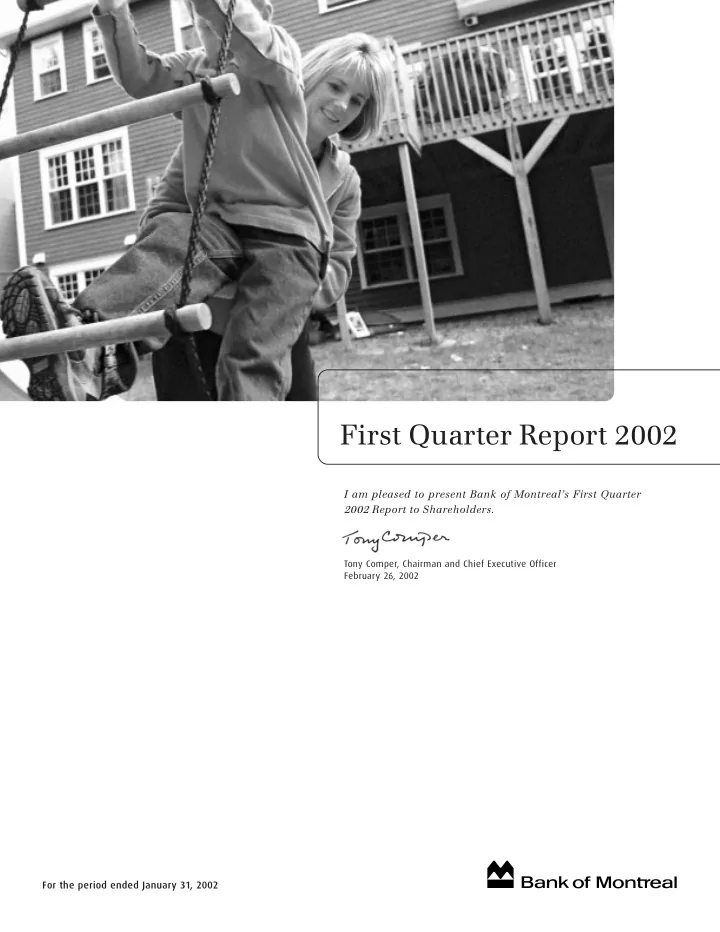
On the Cover Planning for the future. Nancy and Glen Holmes of Halifax, Nova Scotia turned to Bank of Montreal to arrange the mortgage on their beautiful new “saltbox” home. The Holmes, both small business owners, are now focused
Shareholder Dividend Reinvestment and Share Purchase Plan Average market price November 2001 $ 35.81 December 2001 $ 36.23 January 2002 $ 36.32 For dividend information, change in shareholder address
Computershare Trust Company of Canada 1800 McGill College Avenue, 6th Floor Montreal, Quebec H3A 3K9 Telephone: 1-800-332-0095 (Canada and United States) Telephone: 514-982-7800 (all other countries) Fax: 514-982-7664 E-mail: caregistryinfo@computershare.com For other shareholder information, please contact Shareholder Services Corporate Secretary’s Department One First Canadian Place, 21st Floor Toronto, Ontario M5X 1A1 Telephone: (416) 867–6785 Fax: (416) 867–6793 E–mail: corp.secretary@bmo.com For further information on this report, please contact Investor Relations Department P .O. Box 1 One First Canadian Place, 18th Floor Toronto, Ontario M5X 1A1 To review financial results online, please visit our web site at www.bmo.com The Annual Meeting of Shareholders was held on February 26, 2002 in Montreal, Quebec. At the meeting, the following fifteen individuals were elected directors of the Bank: Stephen Bachand, David Beatty, Robert Chevrier, Tony Comper, David Galloway, Eva Lee Kwok, Blair MacAulay, Frank McKenna, Bruce Mitchell, Philip Orsino, Robert Prichard, Jeremy Reitman, Joseph Rotman, Guylaine Saucier and Nancy Southern. Shareholders appointed PricewaterhouseCoopers LLP and KPMG LLP as auditors of the Bank and approved the fol- lowing items of business as outlined on pages five and six of the Proxy Circular: confirmation of an amendment to Special By-law “A”; the Non-Officer Director Stock Option Plan; and, the Bank of Montreal Qualified Employee Share Purchase Plan. The Proxy Circular forwarded to shareholders in January 2002 also included details on four shareholder proposals submitted for consideration at the meeting. None of the four proposals were approved by the shareholders. Karen Maidment, Executive Vice-President and Chief Financial Officer, reviewed the Bank's fiscal 2001 performance and 2002 first quarter results. In his keynote remarks, Chairman and Chief Executive Officer Tony Comper highlighted Bank of Montreal’s lead- ership in financial disclosure as well as the upswing in financial performance in the first quarter. He also outlined plans to improve shareholder returns while aggressively executing the Canada-U.S. growth strategy to promote strong future performance. Shareholders wishing to receive the minutes of the meeting may contact Shareholder Services, Corporate Secretary’s Department, at the address shown below.