First-princ principles iples multi tiscale cale an anal alysis - - PowerPoint PPT Presentation

first princ principles iples multi tiscale cale an anal
SMART_READER_LITE
LIVE PREVIEW

First-princ principles iples multi tiscale cale an anal alysis - - PowerPoint PPT Presentation

Prof. Perla B. Balbuena Comput putation tional al Mater erial als s Desig ign n for r Department of Chemical Engineering Department of Materials Science and Engineering Cataly alysis sis and Rene newable le Energi gies es Texas


slide-1
SLIDE 1

3

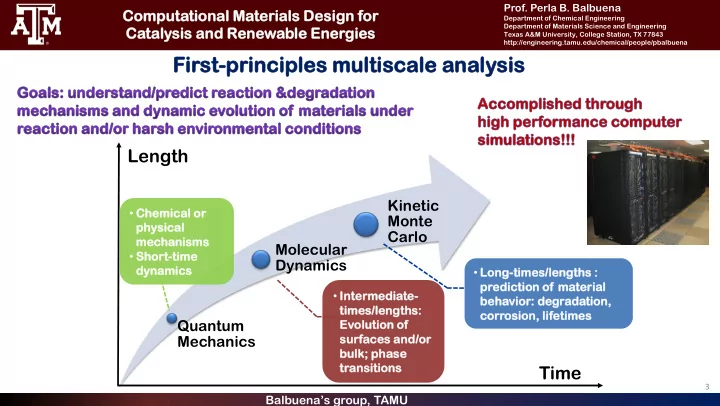
Quantum Mechanics Molecular Dynamics Kinetic Monte Carlo

Time Length

  • Long

Long-times/l times/leng ength ths s : predicti iction

  • n of mater

terial ial behavi vior

  • r:

: degrada adati tion

  • n,

, corros

  • sion
  • n,

, lifetimes imes

  • Intermedi

ermediate te- times/ es/leng lengths: ths: Evoluti lution

  • n of

surfaces ces and/or r bulk; ; phase e transiti nsitions

  • ns
  • Chemic

ical al or physical ical mechan anism sms

  • Short-ti

time me dynami amics cs Balbuena’s group, TAMU

First-princ principles iples multi tiscale cale an anal alysis

  • Prof. Perla B. Balbuena

Department of Chemical Engineering Department of Materials Science and Engineering Texas A&M University, College Station, TX 77843 http://engineering.tamu.edu/chemical/people/pbalbuena

Comput putation tional al Mater erial als s Desig ign n for r Cataly alysis sis and Rene newable le Energi gies es

slide-2
SLIDE 2

Producing electricity from fuel cells requires active and stable electro-catalyst materials

4

Core Shell ll ~2.5 nm

  • xygen reacts with protons and electrons
  • ver an electro- catalyst and is converted

into water, while in the other electro-catalyst hydrogen is dissociated into protons and electrons

Taken from: http://www.fueleconomy.gov/feg/animation/mod1.html

tiny metallic electro-catalysts (nanometers) need to survive in acid medium Challenge: test and design the appropriate material for the electro-catalyst:

  • Prof. Perla B. Balbuena

Department of Chemical Engineering Department of Materials Science and Engineering Texas A&M University, College Station, TX 77843 http://engineering.tamu.edu/chemical/people/pbalbuena

Comput putation tional al Mater erial als s Desig ign n for r Cataly alysis sis and Rene newable le Energi gies es

slide-3
SLIDE 3

What can be learned from density functional theory (DFT) and ab initio molecular dynamics (AIMD) simulations

5

Adsor

  • rptio

tion Desor

  • rpti

ption

  • n Reaction

ion Oxygen (red) dissociates in presence of water and protons

  • n the surface of tiny fuel cell

platinum electro-catalysts

Balbuena’s group, TAMU

Software: VASP Hardware: ADA, ~60 cores shown: ~ 3ps simulated time

  • Prof. Perla B. Balbuena

Department of Chemical Engineering Department of Materials Science and Engineering Texas A&M University, College Station, TX 77843 http://engineering.tamu.edu/chemical/people/pbalbuena

Comput putation tional al Mater erial als s Desig ign n for r Cataly alysis sis and Rene newable le Energi gies es

slide-4
SLIDE 4

6

Increase oxygen coverage Adsorbates are not shown

evolution of the electro- catalyst particle in longer times

  • R. Callejas Tovar and P. B. Balbuena, TAMU

classical molecular dynamics simulations; software DL-POLY; simulated time: ~ 2 ns

slide-5
SLIDE 5
  • Prof. Balbuena’s Research Group

7

  • Metal atoms dissolve

after cycling

Detached metal atoms Detached metal atoms

Vacuum

Adsorbates are not shown

slide-6
SLIDE 6

Variable potential KMC simulations

8

While driving a fuel-cell car, there are changes in the conditions in which our electrocatalyst operates Kinetic Monte Carlo (KMC) simulations (code written by R. Callejas-Tovar, TAMU) evolution of electro-catalyst morphology in much longer times!!!

Balbuena et al, Electrochimica Acta, 2013

  • Prof. Perla B. Balbuena

Department of Chemical Engineering Department of Materials Science and Engineering Texas A&M University, College Station, TX 77843 http://engineering.tamu.edu/chemical/people/pbalbuena

Comput putation tional al Mater erial als s Desig ign n for r Cataly alysis sis and Rene newable le Energi gies es

slide-7
SLIDE 7
  • J. Ma, G. Ramos-Sanchez,

PB Balbuena, N. Alonso-Vante et al, ACS Catalysis, 3, 1940-1950, (2013)

Catalyst supported on a substrate: charge transfer

  • G. Ramos-Sanchez and P. B. Balbuena, PCCP, 15, 11950-11959, (2013)

Software: VASP; Hardware: EOS, Stampede Details of the electronic transfer during reaction and the effect of the catalyst support (carbon) incorporated to the DFT simulations

  • Prof. Perla B. Balbuena

Department of Chemical Engineering Department of Materials Science and Engineering Texas A&M University, College Station, TX 77843 http://engineering.tamu.edu/chemical/people/pbalbuena

Comput putation tional al Mater erial als s Desig ign n for r Cataly alysis sis and Rene newable le Energi gies es

slide-8
SLIDE 8

Catalyzed Synthesis of Single-Walled Carbon Nanotubes

DFT Reactive MD

Computational Multiscale Approach

DFT calcul ulations tions

Small size models: detailed investigation of interatomic interactions, most stable configurations, nature of interactions, minimum energy reaction paths

Reactiv ive MD simul ulati tion

  • ns

Larger size models: growth mechanism using DFT- derived parameters. Temperature effects, dynamic- dependent properties, cost-efficient exploration of parameter space

Hypothesis:

In this catalytic process, the nanoparticle structure can act as a template to guide nanotube growth toward desired chiralities.

State and evolution of the system dictated by thermodynamic and kinetic factors

Software: Gaussian09, VASP; our own MD code ; Hardware: EOS, Lonestar, Stampede

high resolution tunneling electron microscopy image

  • Prof. Perla B. Balbuena

Department of Chemical Engineering Department of Materials Science and Engineering Texas A&M University, College Station, TX 77843 http://engineering.tamu.edu/chemical/people/pbalbuena

Comput putation tional al Mater erial als s Desig ign n for r Cataly alysis sis and Rene newable le Energi gies es

slide-9
SLIDE 9

Carbon nanotube growth phase diagrams

Phase diagrams illustrate regions where high quality (III)

  • r defective tubes may grow (IV)
  • r where the catalyst may

become deactivated (I and II) Software: Reactive MD program developed in Balbuena’s group Hardware: EOS, Lonestar, Stampede Burgos, Jones, Balbuena, JPCC, 118, 4808-4817, 2014

  • Prof. Perla B. Balbuena

Department of Chemical Engineering Department of Materials Science and Engineering Texas A&M University, College Station, TX 77843 http://engineering.tamu.edu/chemical/people/pbalbuena

Comput putation tional al Mater erial als s Desig ign n for r Cataly alysis sis and Rene newable le Energi gies es

slide-10
SLIDE 10

Combined computational and experimental approach

Gomez-Ballesteros and Balbuena, PCCP, 17, 15056-15064, (2015)

DFT Simulations

Picher, M., Lin, P.A., Gomez-Ballesteros, J.L., Balbuena, P.B., Sharma, R.. Nano Letters, 2014. 14 14(11): p. 6104-6108

Software: VASP, Hardware: ADA New insights about carbon nanostructure growth

Software: Gaussian 09, VASP; Hardware: ADA

  • Prof. Perla B. Balbuena

Department of Chemical Engineering Department of Materials Science and Engineering Texas A&M University, College Station, TX 77843 http://engineering.tamu.edu/chemical/people/pbalbuena

Comput putation tional al Mater erial als s Desig ign n for r Cataly alysis sis and Rene newable le Energi gies es

slide-11
SLIDE 11

Renewable energies (solar, wind) are intermittent

13

Energy can be produced but it must be stored

Batteries store chemical energy materials research crucial to develop electric vehicle applications

Thackeray et al., Energy Environ. Sci., 5, 7854, (2012)

molecular level understanding is vital

  • Prof. Perla B. Balbuena

Department of Chemical Engineering Department of Materials Science and Engineering Texas A&M University, College Station, TX 77843 http://engineering.tamu.edu/chemical/people/pbalbuena

Comput putation tional al Mater erial als s Desig ign n for r Cataly alysis sis and Rene newable le Energi gies es

slide-12
SLIDE 12

interfacial reactions generate a multicomponent solid- electrolyte interphase (SEI) film. Its properties are key for the battery lifetime

14

2

Lithium-ion

Lithium-Sulfur

Balbuena’s group, TAMU higher energy density but complex chemistry for small devices for electric cars Software: Gaussian 09, VASP; Hardware: ADA

  • Prof. Perla B. Balbuena

Department of Chemical Engineering Department of Materials Science and Engineering Texas A&M University, College Station, TX 77843 http://engineering.tamu.edu/chemical/people/pbalbuena

Comput putation tional al Mater erial als s Desig ign n for r Cataly alysis sis and Rene newable le Energi gies es

slide-13
SLIDE 13

SEI reactions on nanostructured carbon and Si anodes of Li-ion batteries

15

effects of surface termination, surface area, nano-architecture…

  • 0.22 e
  • 0.63 e
  • 1.12 e
  • 1.56 e
  • J. M. Martinez de la Hoz, K. Leung and P. B. Balbuena, ACS Appl. Mat. and Interfaces, 2013

electron transfer mechanisms

FA Soto, JM Martinez, JM Seminario, PB Balbuena, Chem. Mater.

  • Prof. Perla B. Balbuena

Department of Chemical Engineering Department of Materials Science and Engineering Texas A&M University, College Station, TX 77843 http://engineering.tamu.edu/chemical/people/pbalbuena

Comput putation tional al Mater erial als s Desig ign n for r Cataly alysis sis and Rene newable le Energi gies es

slide-14
SLIDE 14

The complex and interconnected chemistry of Li-S batteries

16

multiple electrolyte decomposition reactions at the surface of the Li metal anode identified by AIMD simulations

LE Camacho-Forero, T Smith, S Bertolini, PB Balbuena, JPCC, under review

Sulfur lithiation reactions at the C/S composite cathode: effect of small carbon pores studied with DFT and AIMD

JC Burgos and PB Balbuena, work in progress

design of alternative cathode materials

E Kamphaus and PB Balbuena, work in progress

Software: Gaussian 09, VASP; Hardware: ADA

  • Prof. Perla B. Balbuena

Department of Chemical Engineering Department of Materials Science and Engineering Texas A&M University, College Station, TX 77843 http://engineering.tamu.edu/chemical/people/pbalbuena

Comput putation tional al Mater erial als s Desig ign n for r Cataly alysis sis and Rene newable le Energi gies es

slide-15
SLIDE 15

CO2 capture using MOFs

DFT and AIMD study of CO2 captured in molecular trap

Li, Yu, Lu, Sun, Sculley, Balbuena, and Zhou, Nat. Comm., 2013

New material for CO2/N2 separations from flue gas streams

Wriedt, Sculley, Yakovenko, Ma, Halder, Balbuena and Zhou, Angew. Chem. Int. Ed., 2012

multipoint interaction pocket Heat of adsorption (zero coverage) = -44 Kj/mol Not too weak (high selectivity), not too strong (low regeneration cost)

CO2 storage for cleaner environments

Software: Gaussian 09, VASP; Hardware: EOS, ADA, Stampede

  • Prof. Perla B. Balbuena

Department of Chemical Engineering Department of Materials Science and Engineering Texas A&M University, College Station, TX 77843 http://engineering.tamu.edu/chemical/people/pbalbuena

Comput putation tional al Mater erial als s Desig ign n for r Cataly alysis sis and Rene newable le Energi gies es

slide-16
SLIDE 16

MOF membrane simulations

F Cabrales Navarro, JL Gomez-Ballesteros, PB Balbuena, J. Memb. Sci., 2013

Membrane simulation

CO2 storage for cleaner environments

Once an efficient material has been identified for gas storage or separations, a membrane is fabricated. The mixture of gases passes through the membrane and selectively one of the gases is trapped. Here we simulate membrane operation at the actual pressure and temperature conditions Software: DL-POLY and our own MD programs; Hardware: EOS

  • Prof. Perla B. Balbuena

Department of Chemical Engineering Department of Materials Science and Engineering Texas A&M University, College Station, TX 77843 http://engineering.tamu.edu/chemical/people/pbalbuena

Comput putation tional al Mater erial als s Desig ign n for r Cataly alysis sis and Rene newable le Energi gies es

slide-17
SLIDE 17

Novel 2D materials for photonics

19

TiS2

Rossi, D.; Camacho-Forero, L. E.; Ramos-Sánchez, G.; Han, J. H.; Cheon, J.; Balbuena, P.; Son, D. H.,

  • J. Phys. Chem. C 2015,

2015, 119 (13), 7436-7442

Calculated band structure elucidate optical transitions Imaginary part of refractive index (k) under varying degrees of lattice strain

Calculation shows effect of quantum confinement on optical properties

Software: VASP; Hardware: ADA

  • Prof. Perla B. Balbuena

Department of Chemical Engineering Department of Materials Science and Engineering Texas A&M University, College Station, TX 77843 http://engineering.tamu.edu/chemical/people/pbalbuena

Comput putation tional al Mater erial als s Desig ign n for r Cataly alysis sis and Rene newable le Energi gies es

slide-18
SLIDE 18

Acknowledgements

DOE/EERE DOE/BES Honda Research Institute National Science Foundation Qatar National Research Foundation

20

Special thanks to supercomputer time from: Brazos HPC Cluster

Collaborators:

  • Prof. Jorge Seminario (TAMU)
  • Prof. Partha Mukherjee (TAMU)
  • Prof. Dong Hee Son (TAMU)
  • Prof. Hong-Cai Zhou (TAMU)
  • Prof. Vilas Pol (Purdue U)
  • Dr. Kevin Leung (Sandia Nat. Lab)
  • Dr. Susan Rempe (Sandia Nat. Lab)
  • Dr. Chunmei Ban (NREL)
  • Dr. Omar Solorza (Cinvestav, MX)
  • Dr. N. Alonso-Vante (U Poitiers)
  • Dr. Avetik Harutyunyan (HRI)
  • Dr. Renu Sharma (NIST)
  • Dr. Fadwa El-Mellouhi (QEERI)
  • Prof. Perla B. Balbuena

Department of Chemical Engineering Department of Materials Science and Engineering Texas A&M University, College Station, TX 77843 http://engineering.tamu.edu/chemical/people/pbalbuena

Comput putation tional al Mater erial als s Desig ign n for r Cataly alysis sis and Rene newable le Energi gies es