First-Order Logic over Active Domain We consider First-Order Logic - - PDF document

first order logic over active domain
SMART_READER_LITE
LIVE PREVIEW

First-Order Logic over Active Domain We consider First-Order Logic - - PDF document

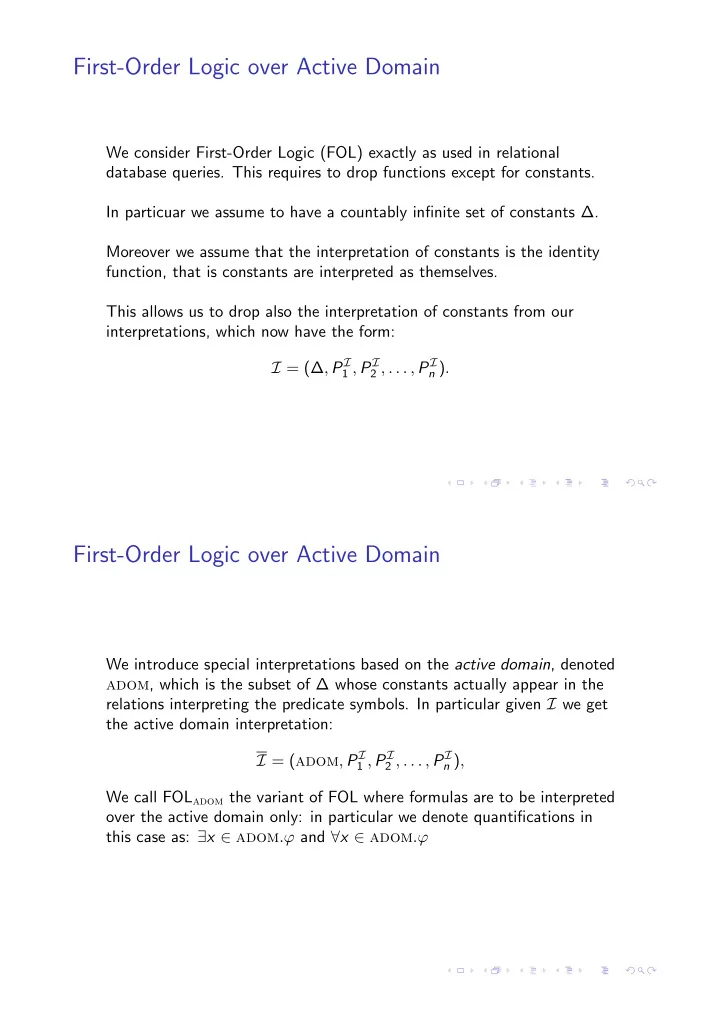
First-Order Logic over Active Domain We consider First-Order Logic (FOL) exactly as used in relational database queries. This requires to drop functions except for constants. In particuar we assume to have a countably infinite set of constants


slide-1
SLIDE 1

First-Order Logic over Active Domain

We consider First-Order Logic (FOL) exactly as used in relational database queries. This requires to drop functions except for constants. In particuar we assume to have a countably infinite set of constants ∆. Moreover we assume that the interpretation of constants is the identity function, that is constants are interpreted as themselves. This allows us to drop also the interpretation of constants from our interpretations, which now have the form: I = (∆, PI

1 , PI 2 , . . . , PI n ).

First-Order Logic over Active Domain

We introduce special interpretations based on the active domain, denoted adom, which is the subset of ∆ whose constants actually appear in the relations interpreting the predicate symbols. In particular given I we get the active domain interpretation: I = (adom, PI

1 , PI 2 , . . . , PI n ),

We call FOLadom the variant of FOL where formulas are to be interpreted

  • ver the active domain only: in particular we denote quantifications in

this case as: 9x 2 adom.ϕ and 8x 2 adom.ϕ

slide-2
SLIDE 2

Equivalence of FOL and FOLadom

Theorem

Every closed FOL formula ψ with no function symbols except constants, all of which must be present in the active domain, there is a FOLadom formula ψ, such that I | = ψ iff I | = ψ. We show the theorem constructively by define the corresponding formula ψ of ψ. We proceed by induction on the subformulas of ψ:

I P(t1, . . . , tn) = P(t1, . . . , tn) I (y = z) = (y = z) I ¬ϕ = ¬ϕ I ϕ1 ^ ϕ2 = ϕ1 ^ ϕ2 I 9x.ϕ = 9x 2 adom.ϕ _ ϕfv _ ϕ∞.

where ϕfv and ϕ∞ are defined below and are needed to suitably treat those values which are not in the active domain.

Equivalence of FOL and FOLadom

The formula ϕfv captures the cases in which x = z for some variable z

  • ccurring free in ϕ. Namely:

ϕfv = _

z∈FV

(ϕ)x

z

where

I FV = {z1, . . . zm} are the variables occurring free in ψ and I (ϕ)x z stands for the formula obtained from ψ by syntactically

replacing variable x with variable z.

slide-3
SLIDE 3

Equivalence of FOL and FOLadom

The formula ϕ∞ captures the cases in which x = d for some value d 62 adom. Namely: ϕ∞ = remx(ϕ) where remx(ϕ) is inductively defined over the subformulas of ϕ as follows (we assume wlog quantified variables are all distinct and different from x):

I remx((x = x)) = true I remx((x = v)) = false I remx(P(. . . , x, . . .)) = false I remx(P(. . . , v, . . .)) = P(. . . , v, . . .), if x does not occur I remx(¬φ) = ¬remx(φ) I remx(φ1 ^ φ2) = remx(φ1) ^ remx(φ2) I remx(9y.φ) = 9y.remx(φ)

Equivalence of FOL and FOLadom

To prove the theorem, we make use of the following the key Lemma.

Lemma

Let ψ be a (possibly open) formula with no function symbols except constants, all of which must be present in the active domain, then for all assignment α of free variables in ψ: I, α | = ψ iff I, α | = ψ.

  • Proof. By induction on the depth of nested quantification in ψ.

Base case: there are no quantification. Then the result is immediate considering that the extension of predicate is the same in both databases, and equality atoms mention only constant from the active domain. Induction on the formula guarantees that the same holds for all formulas not introducing variables (not’s and and’s). Continues

slide-4
SLIDE 4

Equivalence of FOL and FOLadom

Continuing Inductive case: we assume that the thesis holds for formulas with k nested quantifiers, and we shot it holds for those with k + 1. Let us consider formulas of the form 9x.ϕ. For them 9x.ϕ = 9x 2 adom.ϕ _ ϕfv _ ϕ∞

I Assume that I, α |

= 9x.ϕ by assigning to x a value d 2 adom. Then with the same assignment for x the formula 9x 2 adom.ϕ _ ϕfv _ ϕ∞ is true. Continues

Equivalence of FOL and FOLadom

Continuing

I Assume that I, α |

= 9x.ϕ by assigning to x a value d 62 adom, then we can concentrate on ϕfv _ ϕ∞. Suppose that for some other free variable z 2 FV we have that α(z) = d. Then I, α[x d] | = ϕ iff I, α | = ϕfv. Suppose that for all free variables z 2 FV we have that α(z) 6= d. Then we show by induction of ϕ that I, α[x d] | = ϕ iff I, α | = ϕ∞.

I I, α[x d] |

= (x = x) iff I, α | = remx((x = x)), since remx((x = x)) = true.

I I, α[x d] |

= (x = v) iff I, α | = remx((x = v)), since remx((x = v)) = true, notice that v is either a constant or a (free) variable different from x.

I I, α[x d] |

= P(. . . , x, . . .) iff I, α | = remx(P(. . . , x, . . .)), remx(P(. . . , x, . . .)) = false, notice d 62 adom.

I I, α[x d] |

= P(. . . , v, . . .) iff I, α | = remx(P(. . . , v, . . .)), since remx(P(. . . , v, . . .)) = P(. . . , v, . . .) (recall x does not occur in P(. . . , v, . . .)).

I The inductive cases are straightforward by definition of remx(·).

QED

slide-5
SLIDE 5

Equivalence of FOL and FOLadom

Proof of the Main Theorem. The above lemma shows: I, α | = ψ iff I, α | = ψ. If ψ is closed then we can drop the initial assignment, thus getting I | = ψ iff I | = ψ. Moreover, since the only quantification appearing in ψ is bounded to elements in the active domain we get : I | = ψ iff I | = ψ. Hence, the thesis holds. QED