Finnairs year 2012 fmeet investments of coming years still require - - PowerPoint PPT Presentation

finnair s year 2012
SMART_READER_LITE
LIVE PREVIEW

Finnairs year 2012 fmeet investments of coming years still require - - PowerPoint PPT Presentation

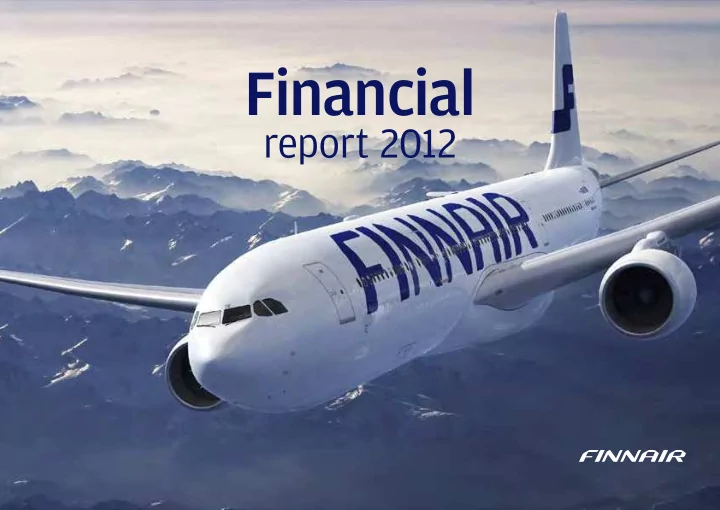
Financial report 2012 FINNAIR 2012 / KEY FIGURES / CEOS REVIEW / STRATEGY / BOARD OF DIRECTORS REPORT / FINANCIAL STATEMENTS / GOVERNANCE Financial report 2012 Contents Finnair in 2012 1 Key figures 2 CEOs review 4 Strategy 5 Board


slide-1
SLIDE 1

Financial

report 2012

slide-2
SLIDE 2

Financial

report 2012

Contents

Photos: Asian strategy and Partnerships on page 2 by Tim Bird. Other photos by Finnair.

Finnair in 2012 1 Key figures 2 CEO’s review 4 Strategy 5 Board of Directors’ Report 7

Finnair fmeet 10 Shares and shareholders 14 Financial indicators 2008–2012 18 Calculation of key indicators 19

IFRS Financial Statements, 1 January–31 December 2012 19 Auditor's Report 47 Business risks 48 Corporate Governance Statement 2012 49 Finnair Plc Remuneration Statement 2012 56 Board of Directors 61 Executive Board 62 Information for the shareholders 63 Contact information 64

FINNAIR 2012 / KEY FIGURES / CEO’S REVIEW / STRATEGY / BOARD OF DIRECTORS’ REPORT / FINANCIAL STATEMENTS / GOVERNANCE

slide-3
SLIDE 3 Safe and punctual airline Finnair improved its operational quality and was one of the top airlines in the world measured by all operational
  • indicators. According to JACDEC’s* statistics, Finnair was

the world’s safest airline in 2012. Responsibility Finnair is a leading airline in sustainability reporting and reducing emissions. The company was the fjrst airline to be included in the Leadership index of the Carbon Disclo- sure Project report. The CDP is responsible for the only global climate change reporting system in the world. Finnair's Corporate Responsibility Report for 2012 was selected as "Investors choice" in the Domestic sustain- ability reporting competition.

Finnair’s year 2012

Return to profitability Finnair was one of the top companies in its industry in terms of unit revenue development, and its cost-reduc- tion program brought results. The return to profjtability was a great achievement in a challenging environment and the fjrst step towards attaining the company’s EBIT target of 6%. Asian strategy Finnair ofgers the fastest connections between Asia and Europe, with more than 200 route pairs. During the summer season Finnair fmew a record number of fmights, 77 per week, from Helsinki to Asia. A new route to Chongqing in China was launched in May. Structural change and cost-reduction program Finnair’s structural change and cost-reduction program progressed well, and Finnair achieved permanent, an- nual cost savings of 100 million euros by the end of 2012. The company was thus well ahead of its schedule. The fmeet investments of coming years still require signifjcant profjtability improvements, and for this reason Finnair launched an additional cost-reduction program of 60 million euros in October 2012. Partnerships Finnair and Flybe expanded their cooperation in Europe- an traffjc when the operation of Finnair’s Embraer traffjc was transferred to Flybe. Finnair and LSG Sky Chefs Group made a fjve-year partnership agreement on catering ser- vices, and, in addition, Finnair and SR Technics concluded a ten-year agreement on engine and component services. Product renewal Finnair simplifjed the purchase of fmight tickets and ofgers now fjve difgerent ticket types for customers’ individual
  • needs. The Finnair Plus frequent fmyer program was also

renewed to be even more rewarding. In addition, the com- pany published an extensive design cooperation with Ma-

  • rimekko. With the cooperation, Marimekko’s classic prints

will become part of the journey of Finnair's customers. Code of Conduct Finnair revised its Code of Conduct in 2012 and will organise related training for stafg during 2013. Top management's special bonuses and the CEO's housing transaction sparked a lively discussion both in the media and inside Finnair on ethical business behaviour. Best in Northern Europe Finnair was the only Nordic airline classifjed in the four star category by Skytrax. Passengers also voted Finnair Northern Europe’s best airline at Skytrax World Airline Awards for a third year in a row. World Airline Awards™ is the most extensive and valued commercial airline rat- ing in the industry. Xi'an and Hanoi In December, Finnair announced that it will open two new summer destinations, Xi'an in China and Hanoi, Vietnam’s capital, in June 2013. Finnair is the fjrst airline to begin scheduled fmights between Xi'an and Europe and the fjrst European airline on the route between Hanoi and Europe.

* Jet Airliner Crash Data Evaluation Centre.

1 / 64

FINNAIR 2012 / KEY FIGURES / CEO’S REVIEW / STRATEGY / BOARD OF DIRECTORS’ REPORT / FINANCIAL STATEMENTS / GOVERNANCE

slide-4
SLIDE 4

08 09 10 11 12

3,000 2,500 2,000 1,500 1,000 500 € million

2,449 08 09 10 11 12

50
  • 50
  • 100
  • 150
  • 200
  • 250
2
  • 2
  • 4
  • 6
  • 8
  • 10

% of turnover * Operating result excluding changes in the fair values

  • f derivates and in the value of foreign currency

denominated fmeet maintenance reserves, non-recurring items and capital gains.

€ million %

44.9 1.8 08 09 10 11 12

250 200 150 100 50

* EBITDAR excluding changes in the fair values

  • f derivates and in the value of foreign currency

denominated fmeet maintenance reserves, non-recurring items and capital gains.

€ million

241.9 08 09 10 11 12

50
  • 50
  • 100
  • 150
  • 200
  • 250
€ million

% of turnover 35.5

%

1.4

2
  • 2
  • 4
  • 6
  • 8
  • 10

Key figures

Turnover Operational result, EBIT* Operational EBITDAR* Operating profit, EBIT

08 09 10 11 12

Result before taxes

50
  • 50
  • 100
  • 150
€ million

16.5 08 09 10 11 12

Equity ratio, gearing and adjusted gearing, %

120 100 80 60 40 20
  • 20

Equity ratio Gearing Adjusted gearing

% 35.7 17.6 76.8 08 09 10 11 12

Return on equity (ROE) and return on capital employed (ROCE), %

5
  • 5
  • 10
  • 15

Return on Equity (ROE) Return on Capital Employed (ROCE)

%

1.5 3.0 RASK* CASK** CASK excl. Fuel***

Airline Business: unit revenue and unit cost (cents/Available seat kilometre)

7.0 6.0 5.0 4.0 3.0 2.0 1.0

2011 2012 * Revenue per Available Seat Kilometre ** Cost per Available Seat Kilometre *** Cost per Available Seat Kilometre excluding fuel

Cents

4.50 6.58 6.49 2 / 64

FINNAIR 2012 / KEY FIGURES / CEO’S REVIEW / STRATEGY / BOARD OF DIRECTORS’ REPORT / FINANCIAL STATEMENTS / GOVERNANCE

slide-5
SLIDE 5

Distribution of passenger revenue, %

Asia 45% Europe 34% Leisure 10% Domestic 7% North Atlantic 4%

%

Passenger traffjc structure, %

Asia 50% Europe 29% Leisure 12% Domestic 4% North Atlantic 5%

%

08 09 10 11 12

Number of employees 31 December 2012

10,000 8,000 6,000 4,000 2,000

6,368

Finnair’s customer satisfaction with flight as a whole in 2012

100 80 60 40 20

Very poor Poor Fair Good Very good

% Inter- continental Business Class Inter- continental Economy Class Europe Business Class Europe Economy Class

1999 2009 2017

Finnair Fuel consumption 1999–2017

4 3 2 1 litres/seat/100 km

12 11 10 09 08

Jet fuel consumption

1,000,000 750,000 500,000 250,000 tonnes

785,176 08 09 10 12 11

Direct CO2 emissions in passenger traffjc

3,000,000 2,500,000 2,000,000 1,500,000 1,000,000 500,000 tonnes

2,473,304 3 / 64

FINNAIR 2012 / KEY FIGURES / CEO’S REVIEW / STRATEGY / BOARD OF DIRECTORS’ REPORT / FINANCIAL STATEMENTS / GOVERNANCE

slide-6
SLIDE 6

WE BUILT A FOUNDATION FOR SUSTAINABLE PROFITABILITY - THE WORK CONTINUES Overall, 2012 was a gratifying year for Finnair. We achieved

  • ur goal of increasing turnover and improving profjtabil-
  • ity. We were able to turn a profjt for the whole year for the

fjrst time since 2007. The operational result for the entire year stood at 44.9 million euros and turnover grew by 8.5 per cent to 2,449.4 million euros. Improving our result by

  • ver 100 million euros is a particularly notable achieve-

ment when you consider that our fuel costs increased by 115 million euros over the same period. Our sales and marketing efgorts brought results, and

  • ur unit revenue improved by a record 7.7 per cent com-

pared to the previous year. Consumers have chosen Finnair more often, which is satisfying as we have invested signifj- cantly in improving the customer experience and opera- tional quality over the past few years. We will continue to improve the travel experience in 2013 by introducing new in-fmight meal concepts and refreshing our cabins with tex- tiles and tableware designed by our partner Marimekko. Our profjtable result also shows that our structural change and cost-reduction program is bringing results. The pro- gram has progressed faster than originally scheduled and

  • ur unit cost excluding fuel decreased by 3.6 per cent in
  • 2012. Showing a profjt is a great achievement that required

hard work. Thanks for the result belong to the entire Finnair

  • team. The good work and results are also seen in the fact

that the company’s Board of Directors is proposing that a dividend of 0.10 euros per share be distributed and that 4.8 million euros be contributed to the Personnel Fund this year. Following through with the structural change and cost- reduction program of 140 million euros launched in 2011 and implementing the additional cost-reduction program of 60 million euros announced in October 2012 still requires hard work and further diffjcult changes. We will strive to implement these changes on a cooperative basis, includ- ing our personnel in the dialogue. It is important to discuss even diffjcult issues and together fjnd genuine solutions for achieving the cost-reduction targets. The effjciency of Finnair’s operations can and must be improved further. We will carefully analyse what activities can be performed with greater effjciency and in ways that are well adapted to our streamlined organisation. The part- nerships implemented in 2012 provide opportunities for re-evaluating our functions and structures. The aim is to question existing practices and to rethink ways in which we could improve our profjtability. Implementing such changes is never easy, but we hope and believe that by discussing matters together and con- sidering the difgerent options it will be possible to reach solutions that are reasonable from the point of view of both the company and its personnel. Additional cost reductions are absolutely necessary for Finnair: Our goal is sustainable profjtability so that Fin- nair can invest in new Airbus A350 aircraft, which are vi- tal for a competitive future. Finnair will be celebrating its 90th anniversary in 2013, and 2012 provided the company with a good basis for mak- ing the current year a turning point. Finnair is progressing towards its aim of doubling its revenue from Asian traf- fjc by 2020. The Xi’an and Hanoi routes that will open in the summer of 2013 will increase the number of Finnair’s Asian routes to thirteen. Our growth is set to continue. We give warm thanks to our customers, shareholders and personnel for the past year. We know how much Fin- nair as a company means to many, and we aim to develop the company in a way that will allow everyone to be proud

  • f the 90-year old airline going forward.

Mika Vehviläinen President and CEO until 28 February 2013 Ville Iho Deputy CEO as of 27 January 2013

CEO’s Review

4 / 64

FINNAIR 2012 / KEY FIGURES / CEO’S REVIEW / STRATEGY / BOARD OF DIRECTORS’ REPORT / FINANCIAL STATEMENTS / GOVERNANCE

slide-7
SLIDE 7

Helsinki New York Beijing Shanghai Xi’an** Tokyo Nagoya Osaka Seoul Singapore Bangkok Hanoi** Hong Kong Delhi Chongqing Finnair’s vision is to be the number one airline in the Nordic countries and the most desired option in traf- fic between Asia and Europe. In addition, its aim is to double its revenue from Asian traffjc in 2010–2020. As part of the implementation of its growth strategy and the structural reform of the company, Finnair fo- cused on its core business in 2012 and built a more extensive network of partners around itself. In imple- menting its strategy, Finnair is committed to creat- ing added value for its customers and shareholders. FINNAIR’S VISION IS TO

  • Double its revenue from Asian traffjc by 2020

compared with the level of 2010.

  • Be the most desired option in traffjc between Asia and

Europe and the third largest airline on routes between Asia and Europe where passengers have to change planes.

  • Be the number one airline in the Nordic countries and

grow in this home market. FINNAIR’S STRENGTHS

  • Clear strategy
  • Sustainable competitive advantage due

to geographical location

  • Modern, fuel-effjcient fmeet
  • Top-class service product – Northern Europe’s best

airline*

  • Excellent operational quality and effjciency
  • Quality and capacity of the Helsinki-Vantaa Airport
  • Good fjnancing position for implementing future fmeet

investments

* According to Skytrax World Airline Awards vote, see page 1. ** The route will be opened in June 2013.

Strategy

Finnair ofgers the fastest connections between Northern Asia and Europe 13 Asian mega-cities Over 60 destinations in Europe

5 / 64

FINNAIR 2012 / KEY FIGURES / CEO’S REVIEW / STRATEGY / BOARD OF DIRECTORS’ REPORT / FINANCIAL STATEMENTS / GOVERNANCE

slide-8
SLIDE 8 Structural chance - key events in 2012
  • Signing a ten-year contract for the sourcing of engine and component services for Finnair's aircraft
from the Swiss company SR Technics. As a result of the contract, Finnair discontinued its own engine operations and made signifjcant adjustments to its component services.
  • Signing a fjve-year agreement according to which LSG Sky Chefs Group assumed full managerial
and operational responsibility for the catering service provider Finnair Catering Oy at the beginning
  • f August.
  • Transfer of the traffjc of twelve Embraer 190 aircraft to Flybe Finland Oy in a contract fmying
  • arrangement. The transfer took place in 28 October 2012.

The core of Finnair’s strategy is taking advantage of the potential of traffjc between Asia and Europe. The strat- egy is based on the growing markets in Asia, the fastest connections between Asia and Europe, high-quality ser- vice, its position as one of the most punctual airlines in the industry and cost-effjciency. Helsinki’s geographical location provides Finnair with a clear competitive advan- tage, as the fastest connections between medium-sized cities in Northern Europe and metropolises in Northern Asia go through Helsinki. Finnair is pursuing business and leisure travellers and cargo customers in the fast growing Asian economies and particularly those European cities that do not pro- vide direct connections to Asia. Approximately 20 million people travel annually between Finnair’s current Asian and European destinations and approximately one half

  • f these are transfer passengers without direct connec-

tions to their fjnal destination. One percentage point of growth in travel between Europe and Asia would mean approximately 200,000 potential new passengers annu-

  • ally. According to Airbus’s forecast, revenue passenger

kilometres are expected to grow 4.1% annually (CAGR) between Asia and Europe in 2012–2031, which also pro- vides Finnair with strong opportunities for growth.* With Finnair’s structural reform launched in August 2011, Finnair is becoming an airline that focuses on its core business. In services supporting airline business and European feeder traffjc, Finnair has concluded partner- ships with world class operators. By concluding strategic partnerships, Finnair has been able to simultaneously improve the quality of its operations and achieve cost re- ductions, which are important in the industry. By focusing

  • n its core business, Finnair will also be able to adjust its
  • perations and cost level more fmexibly according to the

prevailing market conditions. Finnair’s four focus areas in the implementation of the company’s strategy and achieving its vision are profjtable growth, cost competi- tiveness, the customer experience and an international winning team. Finnair is investing in not only charting new market possibilities and improving profjtability, but also particularly in developing customer service and leader- ship, as satisfjed customers and competent, well-man- aged stafg are key requirements for growth. To its partners, Finnair wants to be an active partner that produces value. In the oneworld alliance, which was chosen as a leading airline alliance, Finnair holds a strong position as an expert in traffjc between Asia and Europe. RESPONSIBILITY As a responsible citizen and one of the oldest airlines in the world, Finnair knows its responsibility as part of the surrounding society in both Finland and its main mar- ket areas. The company wants to be a quality leader in its industry, shoulder its responsibility and act in an ex- emplary manner. This Financial Report 2012 describes the company’s fjnancial performance and corporate governance. The Sustainability Report 2012 published separately describes the social and environmental impact of Finnair’s opera-

  • tions. The Sustainability Report also includes a Corpo-

rate Responsibility Report based on the Global Report- ing Initiative (GRI) framework.

The growing Asian air traffic demand provides Finnair with strong

  • pportunities for growth.

FOCUS AREAS IN STRATEGY IMPLEMENTATION IN 2012

Profitable growth Cost competitiveness Customer Experience International winning team
  • New Asian destination
Chongqing, decisions on new routes to Hanoi and Xi’an
  • New ancillary services like
advance seat reservations
  • fgered to customers
  • New ticket types
  • Structural change and
cost-reduction programs
  • Procurement
  • Increased automation in
customer service process
  • Increased automation in
customer service process
  • Service identity –
Peace of Mind
  • Leadership development
* Source: Airbus Global Market Forecast 2012–2031

6 / 64

FINNAIR 2012 / KEY FIGURES / CEO’S REVIEW / STRATEGY / BOARD OF DIRECTORS’ REPORT / FINANCIAL STATEMENTS / GOVERNANCE

slide-9
SLIDE 9

Board of Directors’ Report

BUSINESS ENVIRONMENT Global air traffjc is currently undergoing structural chang- es, the typical characteristics of which are market liber- alisation, increasing competition, overcapacity, consoli- dation, alliances and specialisation. In 2012, the intense competition in the industry was seen in major cost-reduc- tion and structural change programs and bankruptcies

  • f a number of European airlines. The capacity growth

in the market is clearly more controlled than previously, and various partnerships have increased, especially in international long-haul traffjc. Finnair’s goal is to take advantage of the opportunities presented by the changes in its industry and to strengthen its position in traffjc be- tween Asia and Europe and within Europe. The price of the largest individual cost factor of air- lines, i.e. jet fuel, remained high in 2012, creating cost pressures for airlines. The weakening of the euro against the US dollar further increased the costs of fuel, leasing and traffjc charges, which are typically quoted in dollars. On the other hand, the high fuel price has made the in- dustry healthier, as the fjnancially weakest competitors have exited from the market. The global demand for air travel continued to grow in 2012, but at a slower pace. Demand development was better than expected in Europe, in particular – an area which has been sufgering from a poor economic situa- tion and an uncertain outlook. The good demand and revenue development therein was also contributed to by moderate capacity increases and various market exits of

  • airlines. During the year, Finnair also benefjted from the

fact that some of its competitors ceased to operate cer- tain routes. In the domestic market and short-haul traf- fjc, Flybe Nordic, the joint venture of Finnair and Flybe, launched a number of new routes and strengthened its competitive position. Passenger traffjc between Asia and Europe grew as expected in 2012 due to economic growth in Asia. On the other hand, a number of European airlines launched new routes from Central Europe to China, which intensi- fjed competition. However, the uncertainty in the world economy and the eurozone resulted in declining business travel and weakening demand for cargo traffjc in the in- dustry overall. The demand for cargo traffjc stabilised toward the end of the year, but the unit revenues con- tinue to be under pressure due to the decline of import demand in the eurozone and the overcapacity of air cargo

  • traffjc. There was a large amount of overcapacity in the

Finnish package tour market in the fjrst half of the year, but the situation improved toward the end of the year, as the operators in the industry adjusted their supply to corresponding demand. STRATEGY IMPLEMENTATION AND PARTNERSHIPS Finnair’s vision is to be the number one airline in the Nordic countries and the most desired option in traf- fjc between Asia and Europe. In addition, its aim is to double its revenue from Asian traffjc in 2010–2020. As part of the implementation of its growth strategy and the structural change of the company, Finnair focused

  • n its core business in 2012 and built a more extensive

network of partners around itself. In 2012, Finnair carried out the restructuring of Techni- cal Services and Catering, and transferred the European Embraer traffjc to Flybe in a contract-fmying arrangement. In July, Finnair signed a ten-year contract for the sourcing

  • f engine and component services for its aircraft from

the Swiss company SR Technics. As a result of the con- tract, Finnair discontinued its own engine operations and made signifjcant adjustments to its component services. At the beginning of August, Finnair and the German LSG Sky Chefs Group signed a fjve-year agreement according to which LSG assumed full managerial and operational responsibility for the catering service provider Finnair Catering Oy at the beginning of August. LSG has the right to acquire Finnair Catering Oy's share capital for a pre- determined price during the contract period. Finnair con- cluded a binding agreement on the transfer of the traffjc

  • f twelve Embraer 190 aircraft to be operated by Flybe

Finland Oy, and the transfer was implemented at the be- ginning of the winter season on 28 October 2012. Flybe

  • perates the aircraft in a contract fmying-arrangement,

whereby the commercial control over the routes and the risk remain with Finnair. The most signifjcant investment in the implementa- tion of the Asian growth strategy in 2012 was the open- ing of a new route to Chongqing, China in May. This was the fjrst direct scheduled fmight route from Chongqing to Europe, and the route has had a good start. At the end of the year, Finnair announced the launch of two new Asian routes in June 2013. Xi'an with eight million inhabitants, situated in central China, is a growth hub in aerospace research and the software industry. Hanoi, the capital

  • f Vietnam, is one of the key centres of science and re-

search in South-East Asia. Both cities are also well-known tourist destinations. The routes will be operated until the end of the summer season of 2013. During 2012, Finnair sought effjciency and fmexibility for the use of its fmeet by reducing its narrow-body fmeet by nine aircraft. The company is now operating traffjc of a corresponding scope with a smaller fmeet than a year previously, due to which the utilisation of narrow-body aircraft has risen by over an hour to exceed nine hours per day. During peak demand or maintenance periods, Finnair may also use its partners to operate its routes. PROGRESS OF THE STRUCTURAL CHANGE AND COST-REDUCTION PROGRAM The implementation of the structural reform and cost- reduction program commenced by Finnair in August 2011 continued in 2012. The aim of the program is to cut Finnair’s costs permanently by 140 million euros by the end of 2013. Due to the actions taken, Finnair achieved cumulative, annual savings of 100 million euros by the end of 2012. At the same time, the company has been able to move a signifjcant share of fjxed costs to volume based variable costs. The cost-reduction measures were also seen in the decrease of airline unit costs excluding fuel in 2012. As a whole, the cost-reduction program has progressed well, and Finnair believes that it will be realised in full in its target schedule. With regard to fmeet, sales and distri- bution, and catering costs, the original objectives have already been exceeded, but the progress of reductions has been slower than the original objectives particular- ly in the personnel and maintenance cost categories. Despite the lower cost level achieved in 2012, Finnair is still far from its long-term return objective, i.e. an op- erating profjt margin of six per cent. In addition, the high 08 09 10 11 12

Jet Fuel market price (Jet Fuel NWE CIF Cargoes)

1,000 750 500 250 EUR/tonne

7 / 64

FINNAIR 2012 / KEY FIGURES / CEO’S REVIEW / STRATEGY / BOARD OF DIRECTORS’ REPORT / FINANCIAL STATEMENTS / GOVERNANCE

slide-10
SLIDE 10

fuel price, intensifying competition and signifjcant fmeet investments in the coming years require a clear improve- ment in profjtability. Due to this, Finnair published a new cost-reduction program at the end of October, which aims to reduce the cost level permanently by an additional 60 million euros by the end of 2014. The new cost-reduction program supplements the pre- vious program of 140 million euros, and it primarily fo- cuses on enhancing the effjciency of the functions and processes of Finnair’s difgerent units so that they will best respond to the future needs of Finnair. The company will analyse in detail how effjciency could be further im- proved and difgerent functions adjusted in its streamlined

  • rganisation. Increasing productivity would also mean

that the remuneration structures are openly reviewed and compared to the current practices in the industry.

Revenue per available seat kilometre increased by 7.7% in 2012.

FINANCIAL PERFORMANCE In 2012, Finnair’s turnover grew by 8.5 per cent to 2,449.4 million euros (2,257.7 in 2011). Operational costs exclud- ing fuel costs remained at the level of the previous year, totalling 1,756.7 million euros (1,780.4), while capacity simultaneously grew by 3.5 per cent. Euro-denominated

  • perational costs rose to 2,427.0 million euros (2,335.6),

mainly due to increased fuel costs. Fuel costs, including hedging and costs incurred for emissions trading, in- creased by 20.7 per cent to 670.3 million euros (555.2). Personnel costs decreased by 6.3 per cent to 426.9 mil- lion euros (455.4). The company’s operational result clearly improved year-on-year, amounting to 44.9 mil- lion euros (-60.9). Finnair’s income statement includes the change in the fair value of derivatives and in the value of foreign cur- rency denominated fmeet maintenance reserves that took place during the period under review but will fall due lat-

  • er. This is an unrealised valuation result based on IFRS,

where the result has no cash fmow efgect and which is not included in the operational result. The change in the fair value of derivatives and in the value of foreign curren- cy denominated fmeet maintenance reserves weakened the operating result for 2012 by 4.0 million euros (-2.4). Capital gains amounted to 22,2 million euros (-3.0) and were related to restructuring arrangements made dur- ing the year. Non-recurring costs mainly related to the structural reform were at the level of the previous year at -27.6 million euros (-21.5). The operating result for 2012 amounted to 35.5 million euros (-87.8) and result before taxes to 16.5 million euros (-111.5). The net result was 11.8 million euros (-87.5). The unit revenue per available seat kilometre (RASK)

  • f air traffjc increased by 7.7 per cent to 6.49 euro cents

(6.03). Unit cost per available seat kilometre (CASK) rose by 2.3 per cent to 6.58 euro cents (6.43) and unit cost excluding fuel decreased by 3.6 per cent to 4.50 euro cents (4.67).

300 250 200 150 100 50
  • 50
  • 100
  • 60.9

179.4 37.0 34.4 28.6 21.4 4.8

  • 3.6
  • 14.4
  • 28.6
  • 38.2
  • 115.0

44.9

Operational EBIT build-up Change to previous year

€ million 2011
  • pera-
tional EBIT Traffjc revenue Other expenses Expenses for tour
  • pera-
tors Stafg costs Other revenue Other rents Cargo revenue Traffjc charges Ground handling and catering expenses Mainte- nance Fuel 2012
  • pera-
tional EBIT

Savings process to target by savings category, %

% %

realised implemented to target

0% 100% Maintenance Stafg Other Leasing Sales and marketing Catering Ground handling Fuel TOTAL 161% 41% 98% 97% 102% 50% 30% 73% 138% 28% 50% 1% 12% 18% 8% 8%

Distribution of targeted €140 million euro savings, %

Maintenance 25% Stafg 24% Other 14% Fleet 10%

%

Sales and marketing 9% Catering 8% Ground handling 8% Fuel 3% 8 / 64

FINNAIR 2012 / KEY FIGURES / CEO’S REVIEW / STRATEGY / BOARD OF DIRECTORS’ REPORT / FINANCIAL STATEMENTS / GOVERNANCE

slide-11
SLIDE 11 %

Fuel 27.6% Personnel 17.6% Other costs 9.6% Traffjc charges 9.3% Ground handling and catering 9.2% Maintenance 6.4% Depreciation 5.4% Other rental payments 5.1% Tour operations 4.0% Sales and marketing 3.1% Aircraft leasing 2.7% BALANCE SHEET ON 31 DECEMBER 2012 The Group’s balance sheet totalled 2,241.7 million euros

  • n 31 December 2012 (2,357.0 million euros on 31 De-

cember 2011). Shareholders’ equity totalled 785.5 mil- lion euros (752.5), which is 6.14 euros per share (5.89). Shareholders’ equity includes a fair value fund related to hedge accounting, the value of which is afgected by changes in the oil price and foreign exchange rates. The value of the item at the time of the review was 9.2 million euros (30.0) after deferred taxes, and it includes fuel and exchange rate derivatives as well as other minor items. CASH FLOW AND FINANCIAL POSITION Finnair has a strong fjnancial position, which supports business development and future investments. The com- pany’s net cash fmow from operating activities clearly improved during 2012. Net cash fmow from operating activities stood at 154.7 million euros in 2012 (50.8), and cash fmow from investments totalled -54.2 million euros (-36.8). The balance sheet strengthened clearly in 2012. The equity ratio was 35.7 per cent (32.6) and gearing was 17.6 per cent (43.3). The adjusted gearing was 76.8 per cent (108.4). At the end of the period under review, interest- bearing debt amounted to 569.0 million euros (729.3). The company’s liquidity remained excellent in 2012. The Group’s cash funds amounted to 430.5 million eu- ros (403.3) on the closing date. In addition to the cash funds on the balance sheet, the Group has the option for re-borrowing employment pension fund reserves worth approximately 430 million euros from its employment pension insurance company. Drawing these reserves re- quires a bank guarantee. The Group also has reserve funding available through an entirely unused 200 mil- lion euro syndicated credit agreement, which will ma- ture in June 2013. In November, Finnair issued a hybrid loan of 120 mil- lion euros and simultaneously repurchased 67.7 million worth of the 120 million hybrid loan issued in 2009. In June, Finnair repaid a 100 million euro bond and issued commercial papers to a net value of 70.9 million euros during the period under review. At year end, 80.9 million euros of the short-term commercial paper programme totalling 200 million euros were in use. Net cash fmow from fjnancing amounted to -98.9 million euros (-53.5). Financial expenses amounted to 25.5 million euros (-30.6) and fjnancial income to 7.9 million euros (9.0).Advance payments related to fjxed asset investments amounted to 32.7 million euros (6.5). The current state of credit market and Finnair’s good debt capacity enable the fjnancing of future fjxed-asset investments on competitive terms. The company has 31 unencumbered aircraft, whose balance sheet value cor- responds to approximately 40 per cent of the value of

Assets and liabilities

2,500 2,000 1,500 1,000 500

Fleet Other non-current assets Short-term receivables

€ million

Equity and liabilities Assets Shareholders equity Other equity Long-term liabilities Short-term liabilities

  • 15
  • 20
  • 10
  • 5
5 10 15

Airline business: RASK & CASK development in 2012, % Change, 2012 vs. 2011

% CASK, unit cost CASK, excl. fuel Fuel costs Personnel cost Depreciation & leasing costs Traffjc charges Maintenance costs Ground handling costs RASK, unit revenue Catering costs Other costs

Distribution of operating expenses €2,427 million, %

%

Change in costs, 2012 vs. 2011, %

% Fuel Personnel Other costs Ground handling and catering Traffjc charges Maintenance Other rental payments Depreciation Total Tour operations Sales and marketing Aircraft leasing 3.9%
  • 40
30
  • 30 -20 -10 0
10 20 40

08 09 10 11 12

Interest bearing liablities and liquid funds

900 800 700 600 500 400 300 200 100

Interest bearing liabilities Liquid funds

€ million

569.0 430.5 9 / 64

FINNAIR 2012 / KEY FIGURES / CEO’S REVIEW / STRATEGY / BOARD OF DIRECTORS’ REPORT / FINANCIAL STATEMENTS / GOVERNANCE

slide-12
SLIDE 12

the entire fmeet of 1.2 billion. This includes three fjnance lease aircraft. The number of unencumbered aircraft will increase to 36 by the end of 2013. Finnair’s strategy is to own more than 50 per cent of the fmeet operated by itself. Various sources and instru- ments are used for fjnancing to ensure the lowest pos- sible cost of fjnancing and the best possible operational fmexibility and continuity. CAPITAL EXPENDITURE In 2012, capital expenditure excluding advance payments totalled 41.4 million euros (203.9). Of the capital expendi- ture in the comparison year, 190 million euros were re- lated to the fmeet, and, of this, 104 million euros to the ATR 72 aircraft purchased in connection with the Flybe Nordic arrangement. Capital expenditure in 2013 is estimated at approxi- mately 150 million euros, with investments in the fmeet representing a majority of this total. FLEET Finnair’s fmeet is managed by Finnair Aircraft Finance Oy, a wholly-owned subsidiary of Finnair Plc. At the end

  • f 2012, Finnair itself operated 45 aircraft, of which 15

are wide-body and 30 narrow-body aircraft. In addition to the aircraft operated by Finnair, its balance sheet in- cludes 24 aircraft owned by the company and operated by

  • ther airlines, mainly by Flybe Finland. The average age
  • f the fmeet operated by Finnair was 9.8 years at the end
  • f 2012 and that of the fmeet operated by other airlines

4.1 years. Finnair also has eight leased aircraft, which it has subleased and which are operated by other airlines. The fmeet operated by Finnair reduced by twelve air- craft in the last quarter of the year when Finnair trans- ferred the traffjc of its Embraer 190 aircraft to be oper- ated by Flybe Finland Oy as of 28 October 2012. In addi- tion, the company received one ATR aircraft that is now leased to be operated by Flybe. Flybe operates the air- craft as contract fmying, whereby the commercial control

Fleet operated by Finnair
  • n 31 Dec 2012
Seats Pcs Own Leased (opera- tional leasing) (fjnance leasing) Average age Change from 31 Dec 2011 Ordered Add.
  • ptions
European traffjc Airbus A319 123–138 9 7 2 11.5
  • 2
Airbus A320 165 10 6 4 10.4
  • 2
Airbus A321 196 6 4 2 12.0 5 Embraer 170* 76 1 1 6.4
  • 4
Embraer 190 100
  • 12
Long-haul traffjc Airbus A330 297/271/263 8 4 1 3 3.2 Airbus A340 270/269 7 5 2 10.0 Airbus A350 na. 11 8 Leisure traffjc Boeing B757 227 4 4 15.0 Total 45 27 15 3 9.8
  • 20
16 8 Fleet owned by Finnair and operated by other airlines on 31 Dec 2012** Seats Pcs Own Average age Change from 31 Dec 2011 Ordered Add.
  • ptions
ATR 72 68–72 12 12 3.4 +1 Embraer 170 76 4 4 6.5 +4 Embraer 190 100 8 8 4.0 +8 Total 24 24 4.1 +13 * The E170 aircraft leased to Honeywell and operated by Finnair. ** All ATR aircraft, all E190 aircraft and two E170 aircraft have been leased to Flybe Nordic and two E170 aircraft to parties outside the Group.

08 09 10 11 12

Net financial income / expenses

  • 5
  • 10
  • 15
  • 20
  • 25

% of turnover

€ million 0.6 0.2 0.2 0.6 1.0 1.4 %
  • 17.6

0.7 08 09 10 11 12

Capital expenditure and net cash flow from operations

400 300 200 100
  • 100
  • 200

Capital expenditure Net cash flow from operations

€ million

41.4 154.7 10 / 64

FINNAIR 2012 / KEY FIGURES / CEO’S REVIEW / STRATEGY / BOARD OF DIRECTORS’ REPORT / FINANCIAL STATEMENTS / GOVERNANCE

slide-13
SLIDE 13

increased by 7.1 percentage points and 9.4 percentage points to 74.0 per cent and 63.5 per cent, respectively. The unit revenue grew by 7.7 per cent. Finland, Japan, Sweden and China were Finnair’s larg- est sales units in 2012. The uncertainty in the euro area economy decreased business travel in the second half

  • f the year, and corporate sales declined slightly, 1.2 per

cent, year-on-year. Finnair’s market share in the route pairs operated by the company in scheduled traffjc be- tween Asia and Europe was at the level of 2011, i.e. 5.4 per cent (5.4). In scheduled traffjc between Finland and Europe, Finnair’s market share was 46.3 per cent, ex- cluding Flybe operations. Approximately 813,600 passengers fmew on Finnair’s charter fmights in 2012, which is 10.2 per cent more than in the comparison period. The capacity of leisure fmights grew by 1.7 per cent in 2012, and the passenger load fac- tor increased by 2.6 per cent to 88.7 per cent. The growth came mainly from external customers. The demand for air cargo in the traffjc between Asia and Europe lagged behind that in the previous year, and the increased fuel costs burdened the result of cargo traf- fjc in 2012. The overall load factor of Finnair’s cargo traf- fjc improved by 3.4 percentage points to 65.2 per cent. The available tonne kilometres rose by 1.7 per cent and the revenue tonne kilometres by 7.3 per cent. The unit revenue declined by 4.0 per cent, while the amount of cargo and mail transported increased by 1.5 per cent. During the year, Finnair Cargo operated dedicated car- go fmights to Hong Kong, Seoul, Mumbai, New York and

  • Frankfurt. Cargo fmights to Seoul and Frankfurt were ter-

minated in October due to a poor demand forecast. In 2012, the share of dedicated cargo operations accounted for 22 per cent of the total capacity, measured in avail- able tonne kilometres. The arrival punctuality of Finnair’s fmights was good in 2012, even though it decreased year-on-year. 84.9 per cent of scheduled fmights (86.1) and 84.5 (85.1) per cent

  • f all traffjc arrived on schedule.

Air traffjc services and products

Route network and alliances During the summer season, Finnair fmew a record 77 fmights per weeks from Helsinki to Asia and ofgered the fastest connections between Europe and Asia with more than 200 route pairs. Finnair fmew more than 800 fmights from Helsinki to domestic destinations and elsewhere in Eu- rope on a weekly basis. During the last quarter of the year, Finnair announced that it will strengthen its Asian network in June 2013 by launching two new summer destinations to Xi'an in China and Hanoi in Vietnam. In May, Finnair was the fjrst airline to launch scheduled fmights from Europe to Chongqing,

  • China. In addition, Finnair launched codeshare coopera-

tion with Malaysia Airlines, with TAP Portugal and with Bangkok Airways. During the year, Finnair also increased its codeshare cooperation with airberlin and announced the extension of its codeshare cooperation with Japan Airlines as of March 2013. The sixth largest airline in Europe, airberlin, joined the

  • neworld alliance in March 2013. In addition, it was an-

nounced during the year that Malaysian Airlines will join the alliance in February 2013 and that Srilankan Airlines and Qatar Airways will also join at the end of 2013 or at the beginning of 2014. The fact that new airlines join

  • neworld

provides Finnair’s customers better connections to destina- tions in the home market areas of these airlines. Other renewals and services In December, Finnair simplifjed the purchase of fmight tick- ets by launching fjve difgerent ticket types: BUSINESS and

  • ver the routes and the risk remain with Finnair. In 2012,

nine aircraft were additionally eliminated from the fmeet when Finnair gave up four Airbus 32S series aircraft af- ter the end of their leasing agreements and subleased four Embraer 170 aircraft to Estonian Air. In addition, the company leased one Embraer 170 aircraft through a wet lease agreement to Honeywell for a year. The elimina- tion of the aircraft had no impact on the scope of Fin- nair’s fmying operations, but by optimising its operations Finnair has been able to operate an as extensive fmight programme as previously and improved the load factor

  • f its narrow-body fmeet by more than an hour per day.

In 2010, Finnair ordered fjve Airbus A321ER aircraft, which will replace four Boeing 757 aircraft used on lei- sure fmights in 2013–2014. The fjrst of these aircraft will be delivered at the end of 2013. In addition, in 2005, Finnair ordered 11 A350 XWB air- craft from Airbus. Some of these aircraft will replace aircraft currently in use in long-haul traffjc. The order includes an additional option for the delivery of eight more aircraft. The deliveries of the aircraft are estimat- ed to begin in the second half of 2015. Finnair is evalu- ating alternatives to minimise the efgect of possible de- lays in deliveries. Finnair has the possibility to adjust the size of its fmeet fmexibly according to demand and outlook due to its lease agreements with difgerent durations. BUSINESS AREA DEVELOPMENT The segment reporting of Finnair Group’s fjnancial state- ments is based on business areas. The reporting busi- ness areas are Airline Business, Aviation Services and Travel Services. AIRLINE BUSINESS This business area is responsible for scheduled passen- ger and charter traffjc as well as cargo sales, customer service and service concepts, fmight operations and ac- tivity connected with the procurement and fjnancing of

  • aircraft. The Airline Business segment comprises the Sales

& Marketing, Operations, Customer Service and Resources Management functions as well as the subsidiaries Finnair Cargo Oy, Finnair Cargo Terminal Operations Oy, Finnair Flight Academy Oy and Finnair Aircraft Finance Oy.

Key fjgures 2012 2011 Change Turnover and result Turnover, EUR million 2,187.0 1,970.5 11.0% Operating result, EBIT, EUR million 31.9
  • 55.5
157.5% Operating result, % of turnover 1.5%
  • 2.8%
4.3% Personnel Average number of employees 3,660 3,565 2.7%

The turnover of air traffjc grew by 11.0 per cent to 2,187.0 million euros in 2012 (1,970.5) and profjtability improved clearly. Despite the poor economic situation, the overall travel demand grew in 2012. Measured in revenue passenger kilometres, Finnair’s traffjc grew by 9.6 per cent, while total capacity increased by 3.5 per cent. The passenger load factor for all traffjc increased by 4.3 percentage points to 77.6 per cent Measured in revenue passenger kilometres, Asian traf- fjc grew by 10.2 per cent in 2012, and capacity by 6.7 per cent year-on-year. At the same time, the load factor of Asian traffjc rose by 2.5 percentage points to 77.5 per

  • cent. Measured in revenue passenger kilometres, Euro-

pean traffjc grew by 13.1 per cent and domestic traffjc by 5.6 per cent on the comparison period. Load factors 11 / 64

FINNAIR 2012 / KEY FIGURES / CEO’S REVIEW / STRATEGY / BOARD OF DIRECTORS’ REPORT / FINANCIAL STATEMENTS / GOVERNANCE

slide-14
SLIDE 14

BUSINESS SAVER in the business class, and PRO, VALUE and BASIC in the economy class. The product renewal clari- fjes the pricing of fmight tickets and ofgers suitable ticket types for the needs of various customer groups to im- prove customers’ travel experience. In the fjrst half of the year, Finnair renewed its additional services by providing customers with an opportunity to choose their preferred seat against a small charge already when booking a trip. The Finnair Plus program that celebrated its 20th an- niversary in 2012 launched new Lifetime tiers for its cus-

  • tomers. Customers who have reached Finnair Plus Life-

time Gold or Platinum tiers will in the future enjoy mem- bership benefjts during their entire lifetime. Besides the ticket renewal, the Finnair Plus frequent fmyer program was also renewed: The criterion for earning Plus points changed from a kilometre basis to a zone basis, and customers can earn 30 per cent more points on aver- age than previously. In October, Finnair and Marimekko announced a co-

  • peration agreement through which Marimekko pattern

tableware, blankets, pillows and headrest covers will be introduced in all Finnair aircraft during 2013. The symbol

  • f the three-year cooperation, Finnair’s A340 aircraft in

Unikko-pattern, will fmy between Helsinki and Finnair’s long-haul destinations. During the year, Finnair made a number of renewals to its pre-fmight services to make the start of travel smoother for its customers and to reduce unnecessary waiting at the airport. Since the spring of 2012, Finnair’s custom- ers have had the opportunity to perform check-in online

  • r by mobile phone already 36 hours before departure.

In May, Finnair increased the number of self-service ki-

  • sks and baggage drop desks and at the same time gave

up the separate economy class check-in desks at Hel- sinki Airport. At the end of November Finnair renewed its check-in service to further improve the customer- friendliness and ease of use: Finnair performs check-in

  • n behalf of the customer and sends information to the

customer’s mobile phone. In September, Finnair and Booking.com signed a one- year agreement on hotel and accommodation booking services on Finnair’s website. Booking.com’s search cov- ers more than 240,000 accommodation possibilities in 173 countries. Awards In July, passengers voted Finnair Northern Europe’s Best Airline at Skytrax World Airline Awards for a third year in a row. World Airline Awards™ is the most extensive and valued commercial airline rating in the industry. In March, Skytrax classifjed Finnair as the only Nordic air- line in the four star category for a third year in a row. The classifjcation is based on an impartial assessment

  • f all the services provided by the airline.

AVIATION SERVICES After the structural reforms of Technical Services and catering implemented in 2012, the Aviation Services seg- ment mainly consists of aircraft maintenance, ground han- dling and the operations of Finncatering Oy and Finnair Travel Retail Oy. The business operations of Finnair Catering Oy were transferred to LSG Sky Chefs on 1 Au- gust 2012 and are included in the segment’s fjgures until 31 July 2012. In addition, most of Finnair’s property hold- ings, offjce services and the management and mainte- nance of properties related to the company’s operational activities also belong to the Aviation Services business

  • area. Aviation Services’ business consists mainly of intra-

Group service provision. Approximately one quarter of the business area’s turnover comes from outside the Group.

Key figures 2012 2011 Change % Turnover and result Turnover, EUR million 319.5 424.1
  • 24.7%
Operating result, EBIT, EUR million
  • 1.3
  • 16.5
92.1% Operating result, % of turnover
  • 0.4%
  • 3.9%
3.5%-p Personnel Average number of employees 1,984 2,619
  • 24.2%

In 2012, the turnover of Aviation Services clearly declined, amounting to 319.5 million euros (424.1), due to the outsourc- ing of engine and equipment maintenance operations and the transfer of Finnair Catering Oy’s operations to LSG as of 1 Au- gust 2012. The operational result of the business area showed a loss of 1.3 million euros (-16.5), and the structural reform of Technical Services, in particular, further deepened the loss of 08 09 10 11 12

Available seat kilometres (ASK) and revenue passenger kilometres (RPK)

35,000 30,000 25,000 20,000 15,000 10,000 5,000

Available Seat Kilometres (ASK) Revenue Passenger Kilometres (RPK) 23,563 30,366 08 09 10 11 12

Available tonne kilometres (ATK) and revenue tonne kilometres (RTK), cargo

4,500 4,000 3,500 3,000 2,500 2,000 1,500 1,000 500

Available Tonne Kilometres (ATK) Revenue Tonne Kilometres (RTK) 1,364 918

Traffjc data 2012 2011 2010 2009 2008 Passengers, 1,000 8,774 8,013 7,139 7,433 8,270 Available seat-kilometres, million 30,366 29,345 25,127 26,260 29,101 Revenue passenger kilometres, million 23,563 21,498 19,222 19,934 21,896 Passenger load factor, % 77.6 73.3 76.5 75.9 75.2 Cargo tonnes total, 1000 kg 148,132 145,883 123,154 89,234 102,144 Available tonne-kilometres*, million 1,364 1,385 1,029 848 971 Revenue tonne-kilometres, million 918 898 749 512 583 Cargo load factor*, % 65.2 61.8 72.8 60.3 60.0 * Operational calculatory capacity. Available tonne kilometres = number of tonnes of capacity for carriage of passengers, cargo and mail multiplied by kilo- metres fmown. Revenue tonne kilometres = total revenue load consisting of passengers, cargo and mail multiplied by kilometres fmown.

12 / 64

FINNAIR 2012 / KEY FIGURES / CEO’S REVIEW / STRATEGY / BOARD OF DIRECTORS’ REPORT / FINANCIAL STATEMENTS / GOVERNANCE

slide-15
SLIDE 15

Finnair Technical Services. The operating result of the seg- ment for 2012 was improved by the non-recurring capital gain

  • f 15.7 million euros recognised for the LSG arrangement.

TRAVEL SERVICES (TOUR OPERATORS AND TRAVEL AGENCIES) This business area consists of the tour operator Au- rinkomatkat (Suntours), its subsidiary operating in Es- tonia, and the business travel agencies Area and Fin- land Travel Bureau (FTB) and FTB’s subsidiary Estravel, which operates in the Baltic countries. Amadeus Fin- land produces travel sector software and solutions. Au- rinkomatkat serves leisure travellers, ofgering its custom- ers package tours, tailored itineraries, fmight and hotel packages, fmights and cruises, as well as golf, sailing and skiing holidays.

Key figures 2012 2011 Change Turnover and result Turnover, EUR million 284.4 321.9
  • 11.6%
Operating result, EBIT, EUR million 4.9
  • 15.8
131.0% Operating result, % of turnover 1.7%
  • 4.9%
6.6%-p Personnel Average number of employees 855 980
  • 12.8%

The turnover of Travel Services amounted to 284.4 million euros (321.9) and its operating result to 4.9 million euros (-15.8) in 2012. Aurinkomatkat retained its position as the market leader in the Finnish package tour market in 2012, and its market share was 31.7 per cent. During the year, travel supply was adjusted to correspond to demand, and Aurinkomatkat’s profjtability

  • improved. About 65 per cent of Aurinkomatkat’s sales were

made online. At the beginning of the year, Aurinkomatkat closed down its Russian subsidiary, and renewed its pric- ing strategy and optimised its operations during the year. Aurinko Oü, Aurinkomatkat’s subsidiary operating in Es- tonia, continued its strong operations, and its turnover re- mained at the level of the previous year. Timo Vürmer started as the new Country Director of the company in November. International online travel agencies continued to increase fmight ticket sales in the Finnish market in 2012, but their growth slowed down in the last quarter. Business travel re- duced by four per cent in 2012, but Finnair’s travel agencies slightly outperformed average business travel agencies. Area increased its share of government travel, and Estravel man- aged to increase its sales and profjtability in the Baltic mar-

  • ket. Kirsi Paakkari started as the new CEO of FTB in August.

As the share of online business increases, FTB is adjusting its

  • ffjce network to correspond to customers’ needs.

PERSONNEL The number of Finnair employees decreased signifjcantly in 2012 as a result of the structural reform in progress at the

  • company. The Group employed an average of 6,784 (7,467)

people in 2012, i.e. 9.1 per cent fewer than in the previous

  • year. The Airline Business segment employed an average
  • f 3,660 (3,565) people during the year, Aviation Services

1,984 (2,619) people and Travel Services 855 (980) people. A total of 285 people were employed in other functions (303). At the end of 2012, the number of Finnair’s employees was 6,368, which is 1,013 fewer than a year previously. Of the personnel, 640 people worked abroad. Of these, 177 were employed in sales and customer service tasks in Fin- nair’s passenger and cargo traffjc and 321 people worked in the service of travel agencies and tour operators based in the Baltic countries and worked as guides at Aurinkomatkat holiday destinations. Foreign personnel are included in the total number of Group employees. Full-time stafg accounted for 95 per cent of employees, and 97 per cent of stafg were employed on a permanent basis. The average age of the employees was 44 years. Of the per- sonnel, 27 per cent are over 50 years of age, while fjve per cent are under 30 years of age. The employees’ average number of years in service was 17. Employees having worked for Finnair for over 20 years account for 43 per cent of the stafg, while 13 per cent have worked for Finnair for over 30

  • years. Of Finnair Group’s personnel, 54 per cent are women

and 46 per cent are men.

Employee consultations conducted in 2012

In 2012, Finnair conducted employee consultations with rep- resentatives of personnel in a number of its functions, and the majority of the consultations were related to projects associated with the implementation of Finnair’s structural change and cost-reduction program. Consultations were con- ducted with the personnel of Technical Services in relation to the outsourcing of engine and component services, with pilots and cabin attendants with regard to the transfer of Em- braer fmying, and with the personnel of the Ground Handling

  • rganisation in relation to renewals of the Ground Handling
  • rganisation and its operating model. Employee consulta-

tions were also conducted in sales functions, traffjc planning, fjnancial functions and human resources administration. The estimated maximum need for reductions totalled about 450 jobs. As a result of the negotiations conducted, a total of 150 jobs were reduced by the end of 2012. The fj- nal number of jobs to be reduced will become clear during 2013, depending on the realisation of a business operations transaction between Finnair Engine Services Oy and GA Tel-

  • esis. In employee consultations with cabin crew a need for

temporary layofgs of 201 persons was determinated. Wheth- er these temporary layofgs become permanent will be as- sessed at the end of 2013. Finnair’s cabin crew waived its right to transfer to Flybe through business transfer when the Embraer aircraft and traffjc were transferred to Flybe. In addition, a few scheduled destinations were transferred to be operated through subcontracting. With regard to all employee groups, collective agreements were continued according to national framework agreement terms. In the last quarter of 2012, Finnair conducted consulta- tions with representatives of personnel on the renewal of the incentive bonus scheme. Finnair ofgered the employees to be dismissed an additional support package that included not only monetary payments, but also re-employment support with the aim of fjnding new employment through Finnair’s Career Gate service. Career Gate and its operating model are described in more detail in Finnair’s Sustainability Report.

Personnel incentive schemes

Incentive bonuses for 2012, based mainly on fjnancial per- formance and quality indicators, are estimated to be paid to personnel to an amount of 10 million euros, including social security costs. The criteria for incentives in accordance with the share- based bonus scheme were met for 2012, and it is estimated that bonuses in accordance with the scheme will be paid

  • ut to an amount of approximately 2.5 million euros for the

year 2012. The criteria based on the Group’s result for the personnel profjt bonus were also met for 2012, and the bo- nus of 4.8 million euros in accordance with the scheme is proposed to be paid to the Personnel Fund. The rewarding of personnel is discussed in more detail in the company’s Sustainability Report for 2012. Remunera- tion of the management is described in the Remuneration Statement on pages 56–60. GROUP STRUCTURE The companies that are part of the Finnair Group are pre- sented in the notes to the fjnancial statements in Note

  • 33. Operating subsidiaries.

13 / 64

FINNAIR 2012 / KEY FIGURES / CEO’S REVIEW / STRATEGY / BOARD OF DIRECTORS’ REPORT / FINANCIAL STATEMENTS / GOVERNANCE

slide-16
SLIDE 16

GOVERNANCE Finnair’s Annual General Meeting held on 28 March 2012 elected Harri Sailas as the Chairman of the company’s Board

  • f Directors and Maija-Liisa Friman, Klaus W. Heinemann,

Jussi Itävuori, Merja Karhapää, Harri Kerminen and Gunvor Kronman as members. The Board of Directors elected Harri Kerminen from among its members as the Vice Chairman. Until the Annual General Meeting, the members of the Board were Elina Björklund, Sigurdur Helgason, Satu Huber, Ursula Ranin, Veli Sundbäck, Pekka Timonen and Harri Kerminen. The Chairman of the Board of was Harri Sailas. INSIDER ADMINISTRATION Finnair complies with the Insider Guidelines of NASDAQ OMX Helsinki Ltd that entered into force on 9 October 2009. Fin- nair’s Board of Directors has approved Finnair’s insider guide- lines, which contain guidelines for permanent and project- specifjc insiders as well as the organisation and procedures

  • f the company’s insider controls. These insider guidelines

have been distributed to all insiders. CHANGES IN COMPANY MANAGEMENT No changes took place in Finnair’s Executive Board in 2012. In December, Finnair appointed Allister Paterson as the com- pany’s Senior Vice President, Commercial Division, and a member of the Executive Board as of 7 January 2013. Mika Perho, who had acted as the company’s Senior Vice Presi- dent, Commercial Division, since 2001 and a member of the Executive Board since 2007 left the company at the end of December 2012. SHARES AND SHAREHOLDERS

Shares and share capital

On 31 December 2012, the number of Finnair shares en- tered in the Trade Register was 128,136,115, and the reg- istered share capital was 75,442,904.30 euros. The com- pany’s shares are quoted on the NASDAQ OMX Helsinki Stock Exchange. Each share confers one vote at the General Meeting.

Dividend policy

The aim of Finnair’s dividend policy is to pay, on average, at least one-third of the earnings per share as a dividend dur- ing an economic cycle. In 2012, earnings per share from the result of the period (before hybrid bond interest) was 0.09 (-0.69) euros, and earnings per share was 0.02 (-0.75) eu-

  • ros. The aim is to take into account the company’s earnings

trend and outlook, fjnancial situation and capital needs for any given period.

The Board's proposal for distribution of profits

Finnair Plc’s distributable equity amounted to 263,092,639.25 euros on 31 December 2012. The registered number of com- pany shares totalled 128,136,115 shares, of which the com- pany owned 410,187 shares. After the fjnancial year 2012, Finnair has acquired 600,000 own shares, and consequently

  • wns now 1,010,187 own shares.

The Board of Directors proposes to the Annual General Meeting that distributable equity be used as follows:

a dividend of 0.10 euro/share be paid to 127,125,928 shares 12,712,592.80 euros to be transferred to retained earnings 250,380,046.45 euros 263,092,639.25 euros

There have been no material changes in the company’s fjnancial position after the 2012 fjscal year. The company’s liquidity is at good level, and the Board’s impression is that the proposed distribution of profjts will not endanger the company’s liquidity.

Share-based bonus scheme for key individuals

On 4 February 2010, the Board of Directors of Finnair Plc approved a share-based bonus scheme for the Group’s key individuals for the period of 2010–2012. The scheme en- courages key individuals to purchase Finnair shares, and it does not afgect the total number of shares. The level of bonus received through the scheme is linked to Finnair Group’s fjnancial development. The bonus scheme is out- lined in its entirety in Note 26. Share-based payments.

Board of Directors’ authorisations

The Annual General Meeting of 2010 authorised the Board

  • f Directors to decide on assignment of the company’s own

shares so that the authorisation concerns a maximum of 5,000,000 shares held by the company. The authorisation to assign shares is valid until 31 May 2013. The 2012 Annual General Meeting authorised the Board of Directors to de- cide on the acquisition and/or acceptance as pledge of the company’s own shares. The number of the company’s own shares acquired and/or accepted as pledge may total no more than 5,000,000 shares. The authorisation is valid until 28 September 2013. The Board of Directors has no other valid authorisations, such as authorisations to issue convertible bonds or option rights. Finnair did not acquire or assign its own shares in 2012. Pursuant to the acquisition authorisation, Finnair’s Board

  • f Directors decided at its meeting of 18 December 2012

to acquire at most 600,000 of the company’s own shares, mainly for the implementation of the share-based bonus scheme 2010–2012. The purchases of the company’s own shares were commenced on 2 January 2013. At the end of 2012, Finnair held 410,187 of its own shares, i.e. 0.3 per cent of the number of shares on the last day of the year.

Share-Related Key Figures 2012 2011 2010 Earnings/share EUR 0.02
  • 0.75
  • 0.24
Equity/share EUR 6.14 5.89 6.67 Dividend/share* EUR 0.10 0.00 0.00 Dividend-to-earnings ratio* % 112 0.0 0.0 P/E ratio 99.9
  • 3.07
  • 21.09
Efgective dividend yield* % 4.2 0.0 0.0 * The dividend for year 2012 is a proposal of the Board of Directors to the Annual General Meeting. Acquisition and delivery of own shares and returns of shares Year Number of shares Acquisition value, EUR Average price, EUR 2004 422,800 2,275,666.49 5.38 2005
  • 37,800
  • 209,838.54
5.55 2005 150,000 1,516,680.00 10.11 2006
  • 383,097
  • 2,056,847.88
5.37 2007 0.00 2008 235,526 1,538,956.35 6.53 2009 0.00 2010 22,758 114,719.52 5.04 2011 0.00 0.00 2012 0.00 0.00 31 Dec 2012 410,187 3,179,335.94 7.75

14 / 64

FINNAIR 2012 / KEY FIGURES / CEO’S REVIEW / STRATEGY / BOARD OF DIRECTORS’ REPORT / FINANCIAL STATEMENTS / GOVERNANCE

slide-17
SLIDE 17

Government ownership

At the end of 2012, the Finnish Government owned 55.8 per cent of Finnair’s shares and votes. According to the decision made by the Finnish Parliament on 20 June 1994, the Government must own more than half of Finnair Plc’s shares, and decreasing ownership below this would thus require a Parliament decision.

SHAREHOLDERS BY TYPE AT 31 DECEMBER 2012 Number of shares % Number of shareholders % Public bodies 85,884,163 67.0 18 0.1 Households 12,587,007 9.8 14,270 95.1 Registered in the name of a nominee 8,343,334 6.5 9 0.1 Financial institutions 7,630,060 6.0 28 0.2 Private companies 6,545,290 5.1 560 3.7 Outside Finland 6,248,363 4.9 55 0.4 Associations 878,769 0.7 58 0.4 Not converted into the book entry system 19,129 0.0
  • Total
128,136,115 100.0 14,998 100.0 BREAKDOWN OF SHARES AT 31 DECEMBER 2012 Number of shares % Number of shareholders % 1–200 642,995 0.5 6,792 45.3 201–1,000 2,986,468 2.3 5,487 36.6 1,001–10,000 6,790,849 5.3 2,485 16.6 10,001–100,000 4,927,241 3.8 190 1.3 100,001–1,000,000 9,059,331 7.1 23 0.2 1,000,001– > 95,366,768 74.4 12 0.1 Registered in the name of nominee 8,343,334 6.5 9 0.1 Not converted into the book entry system 19,129 0.0
  • Total
128,136,115 100.0 14,998 100.0 PLC LARGEST SHAREHOLDERS AS AT 31 DECEMBER 2012 Number of shares % Changes 2012 1 State of Finland; Offjce of Counsil of State 71,515,426 55.8 2 Skagen Global Funds 5,888,429 4.6
  • 790,210
3 KEVA 5,781,815 4.5 117,667 4 State Pension Fund 2,100,000 1.6 5 Ilmarinen Mutual Pension Insurance Company 2,025,564 1.6
  • 1,000,000
6 Alfred Berg Funds 1,819,695 1.4
  • 78,807
7 Veritas Pension Insurance Company 1,530,000 1.2 90,200 8 OP Funds 1,525,000 1.2
  • 975,000
9 Tiiviste-Group Oy 1,500,000 1.2 1,500,000 10 Fennia Pension Insurance Company 1,300,000 1.0 800,000 11 Suomi Mutual Life Insurance Company 1,250,000 1.0
  • 210,000
12 Etra Invest Oy 1,000,000 0.8 1,000,000 13 SEB Gyllenberg Funds 850,598 0.7 222,382 14 Evli Funds 794,129 0.6
  • 100,000
15 Fourton Fokus Finland Fund 770,000 0.6 570,000 16 Varma Mutual Pension Insurance Company 600,000 0.5 17 Nordea Funds 573,858 0.4 130,575 18 Finnair Plc Stafg Fund 562,711 0.4
  • 597
19 Mandatum Life Insurance Company 505,683 0.4 20 Taaleritehdas Arvo Markka Osake Fund 502,830 0.4 2,830 Nominee registered 8,343,334 6.5
  • 554,165
Others 25,740,377 20.1 Total 128,136,115 100.0

Share ownership by management

On 31 December 2012, members of the company’s Board

  • f Directors and the CEO owned a total of 77,268 shares,

representing 0.06 per cent of all shares and votes. Other Executive Board members owned 188,751 shares.

Shareholding by type, %

Public bodies 67.0% Households 9.8% Registered in the name of a nominee 6.5% Financial institutions 6.0% Private companies 5.1% Outside Finland 4.9% Associations 0.7%

%

Shareholding by number

  • f shares owned, %

1–200 0.5% 201–1,000 2.3% 1,001–10,000 5.3% 10,001–100,000 3.8% 100,001–1 000,000 7.1% 1 000,001– 74.4% Registered in the name of nominee 6.5%

%

15 / 64

FINNAIR 2012 / KEY FIGURES / CEO’S REVIEW / STRATEGY / BOARD OF DIRECTORS’ REPORT / FINANCIAL STATEMENTS / GOVERNANCE

slide-18
SLIDE 18

Share price development and trading

On the last day of the fjnancial year, the closing price of the Finnair Plc share on the NASDAQ OMX Helsinki Stock Exchange was 2.38 (2.30) euros, and the market value

  • f the company’s share capital was 305.0 million euros

(294.7). During 2012, the highest price for the Finnair Plc share was 2.64 euros (5.37), the lowest price 1.67 euros (2.30) and the average price 2.24 euros (3.62). In 2012, a total of 19.7 million shares (21.4) were traded with a value of 44.1 million euros (77.5). CORPORATE RESPONSIBILITY In October, Finnair was placed at the top of the listing in the Carbon Disclosure Project’s (CDP) 2012 report on the Nordic countries and was the fjrst airline ever to make it to the Leadership index of the CDP report. The CDP is responsible for the only global climate change report- ing system in the world, and its initiatives are backed by 655 institutional investors from around the world. Fin- nair has participated in the CDP since 2007. In April, Finnair published its annual Corporate Re- sponsibility Report, which is based on the Global Re- porting Initiative (GRI) and includes economic, social and environmental responsibility indicators for 2011. The reported was selected as "Investors choice" in the domestic responsibility report competition. Finnair has published reports on environmental responsibility since 1997, and in 2008 it became one of the fjrst airlines to publish reports based on the GRI framework. GRI is the world’s most broadly recognised international guideline for reporting on sustainable development. The Sustain- ability Report for 2012 will be published in March 2013 during week 10. The revised Code of Conduct was approved by the Board

  • f Directors in autumn 2012. The revised Code was dis-

cussed with the personnel representatives and more ex- tensive training will take place during 2013. The compa- ny's equality plan was also revised. SIGNIFICANT NEAR TERM RISKS AND UNCERTAINTIES Due to the short booking horizon in passenger and cargo traffjc, long-term forecasting is diffjcult. In addition to

  • perational activities, fuel price development has a key

impact on Finnair’s result, as fuel costs are the compa- ny’s biggest expense item. The result is also afgected by exchange-rate fmuctuations of the US dollar and the Jap- anese yen against the euro. Fuel costs, aircraft leasing costs and purchases of spare parts are dollar-denomi- nated, whereas the yen is an important income currency in Finnair’s strong Japanese operations. The company protects itself against the risks of currency, interest rate and jet fuel positions by using difgerent de- rivative instruments, such as forward contracts, swaps and

  • ptions, according to the risk management policy verifjed

by the Board of Directors. Fuel purchases are hedged for 24 months forward on a rolling basis, and the degree of hedging decreases towards the end of the hedging period. The higher and lower limits of the degree of hedging are 90 and 60 per cent for the following six months. At the end of 2012, the degree of hedging for fuel purchases over the fjrst half of 2013 was 75 per cent and 67 per cent over the whole year. The degree of hedging for a dollar basket

  • ver the following 12 months was 83 per cent.

The implementation of Finnair’s partnership projects and the achievement of the related strategic benefjts also involve certain risks. Risks are also involved in the im- plementation of the structural reform and cost-reduction programmes. The European Union joined air traffjc as part of the Emis- sions Trading Scheme (ETS) at the beginning of 2012. The EU ETS has met with a lot of opposition, in particular from 08 09 10 11 12

Share price development compared with

  • ther European airlines
120 100 80 60 40 20

Finnair Bloomberg Europe Airlines Index

Index 1 Jan 2008 = 100

08 09 10 11 12

Finnair Plc Share Index and NASDAQ OMX Helsinki Indices

120 100 80 60 40 20

Finnair All-share Index OMX-Helsinki-Benchmark-Index Industrial Index

Index 1 Jan 2008 = 100 Number of shares and share prices 2012 2011 2010 Average number of shares adjusted for share issue pcs 128,136,115 128,136,115 128,136,115 Average number of shares adjusted for share issue (with diluted efgect) pcs 128,136,115 128,136,115 128,136,115 The number of shares adjusted for share issue at the end of fjnancial year pcs 128,136,115 128,136,115 128,136,115 The number of shares adjusted for share issue at the end of fjnancial year (with diluted efgect) pcs 128,136,115 128,136,115 128,136,115 Number of shares, end of the fjnancial year pcsl 128,136,115 128,136,115 128,136,115 Trading price highest EUR 2.64 5.37 5.72 Trading price lowest EUR 1.67 2.30 3.61 Market value of share capital 31 Dec EUR million 305 295 646
  • No. of shares traded
pcs 19,668,495 21,422,076 27,299,521
  • No. of shares traded as % of average no. of shares
% 15.35 16.72 21.31

16 / 64

FINNAIR 2012 / KEY FIGURES / CEO’S REVIEW / STRATEGY / BOARD OF DIRECTORS’ REPORT / FINANCIAL STATEMENTS / GOVERNANCE

slide-19
SLIDE 19

countries outside the EU, as a result of which the Interna- tional Civil Aviation Organization (ICAO) is preparing an alternative proposal with regard to international emis- sions trading for air traffjc and the EU ETS was changed to include only the intra-European fmights during 2012. ICAO intends to submit its proposal at the ICAO Assembly held in November 2013. The additional cost directly incurred by Finnair due to emissions trading is diffjcult to estimate due to the potential regulation changes after the ICAO As-

  • sembly. The additional cost for the year 2012 is approxi-

mately 1.5 million euros. On 23 October 2012, the Court of Justice of the Europe- an Union confjrmed its decision made in 2009 according to which a fmight passenger may, on certain conditions, receive compensation if the fmight is delayed for at least three hours. There is no right to compensation if the de- lay is due to conditions that are beyond the airline’s con-

  • trol. The decision of the Court of Justice may increase the

amount of compensation paid to fmight passengers and thus cause additional costs. A number of strategic, fjnancial and operational risks are involved in Finnair’s operations. Risks management is further described on pages 54–55, business risks on page 48 and fjnancial risks on pages 40–41. SEASONAL VARIATION AND SENSITIVITIES IN BUSINESS OPERATIONS Due to the seasonal variation of the airline business, the Group’s turnover and profjt are generally very much at their lowest in the fjrst quarter and at their highest in the third quarter of the year. The growing proportion- al share of Asian traffjc increases seasonal fmuctuation due to destination-specifjc seasons in Asian leisure and business travel. A one-percentage-point change in the passenger load factor or the average yield in passenger traffjc has an efgect of approximately 15 million euros on the group’s

  • perating result. A one-percentage-point change in the

unit cost of scheduled passenger traffjc has an efgect of approximately 17 million euros on the operating result. Fuel costs are a signifjcant uncertainty factor in Fin- nair’s business operations: A 10-per-cent change in the world market price of fuel has an efgect of approximately 33 million euros on Finnair’s operating result at an annual level, taking hedging into account. A 10-per-cent change in the euro-dollar exchange rates has an efgect of approxi- mately 13 million euros on Finnair’s operating result at an annual level, taking hedging into account. OTHER EVENTS IN 2012 In September, the Deputy Prosecutor General stated that the actions of CEO Mika Vehviläinen and Ilmarinen Mutual Pension Insurance Company in the context of an apartment transaction in January 2011 were in line with legislation and announced that the Offjce of the Pros- ecutor General would not press charges in the matter. EVENTS IN EARLY 2013 On 27 January 2013, Mika Vehviläinen, Finnair’s Presi- dent and CEO, announced that he will resign from Fin- nair’s service on 28 February 2013. Finnair’s Board of Directors appointed Ville Iho, the company’s COO, as the acting CEO. Ville Iho will lead Finnair until the new CEO is appointed. Finnair’s Board of Directors has already started to look for a new CEO. The Shareholders' Nomination Committee gave on 30 January 2013 its proposal for the composition of the Board to be elected on the 2013 Annual General meeting, its Chairman and the Board's remunerations. The Commit- tee proposes that Ms Maija-Liisa Friman, Mr Klaus W. Heinemann, Mr Jussi Itävuori, Ms Merja Karhapää, Mr Harri Kerminen and Ms Gunvor Kronman be re-elected, and that Mr Antti Kuosmanen be elected as a new mem- ber to the Board of Directors. The Committee further proposes that Mr Klaus W. Heinemann be elected as the Chairman of the Board and that the remunerations of the Board would remain unchanged. Finnair commenced purchasing its own shares on 2 January 2013. By the time the fjnancial statements were published, the company had acquired 600,000 Finnair shares, as a result of which the number of own shares held by the company was 1,010,187. OUTLOOK FOR 2013 The uncertain economic outlook in Europe, together with weakened consumer demand and slower growth in Asia, make it diffjcult to assess how air traffjc will continue to

  • develop. Fuel costs are expected to remain high in 2013

as well, and the demand for air traffjc is estimated to grow in moderation. Finnair estimates that its turnover will grow in 2013. The airline unit costs excluding fuel (CASK excl. fuel) are expect- ed to decrease compared with 2012, and operational result is expected to show a profjt in 2013. FINNAIR PLC Board of Directors 7 February 2013 17 / 64

FINNAIR 2012 / KEY FIGURES / CEO’S REVIEW / STRATEGY / BOARD OF DIRECTORS’ REPORT / FINANCIAL STATEMENTS / GOVERNANCE

slide-20
SLIDE 20

Financial indicators 2008–2012

INCOME STATEMENT 2012 2011 2010 2009 2008 Turnover EUR million 2,449 2,258 2,023 1,838 2,256 change % 8.5 11.6 10.1
  • 18.5
3.5 Operational result, EBIT EUR million 45
  • 61
  • 5
  • 171
1 in relation to turnover % 1.8
  • 2.7
  • 0.2
  • 9.3
0.0 Operating profjt/loss, EBIT EUR million 36
  • 88
  • 13
  • 115
  • 58
in relation to turnover % 1.4
  • 3.9
  • 0.7
  • 6.3
  • 2.6
Net fjnancing income (+)/expenses (-) EUR million
  • 18
  • 22
  • 20
  • 10
  • 5
in relation to turnover %
  • 0.7
  • 1.0
  • 1.0
  • 0.5
  • 0.2
Net interest expenses EUR million
  • 13
  • 14
  • 16
  • 6
2 in relation to turnover %
  • 0.5
  • 0.6
  • 0.8
  • 0.3
0.1 Profjt before taxes EUR million 17
  • 111
  • 33
  • 125
  • 62
in relation to turnover % 0.7
  • 4.9
  • 1.6
  • 6.8
  • 2.8
BALANCE SHEET 2012 2011 2010 2009 2008 Consolidated balance sheet Non-current assets EUR million 1,511 1,621 1,514 1,596 1,405 Short-term receivables EUR million 699 736 827 842 659 Non-current assets held for sale EUR million 32 71 19 19 Assets total EUR million 2,242 2,357 2,412 2,457 2,084 Shareholders equity and non- controlling interests EUR million 786 747 853 825 750 Liabilities, total EUR million 1,456 1,610 1,558 1,632 1,333 Shareholders' equity and liabilities, total EUR million 2,242 2,357 2,412 2,457 2,084 Gross capital expenditure EUR million 41 204 183 347 233 Gross capital expenditure in relation to turnover % 1.7 9.0 9.1 18.9 10.3 Average capital employed EUR million 1,418 1,550 1,636 1,353 1,179 Dividend for the fjnancial year* EUR million 13 Interest bearing debt EUR million 569 729 765 829 302 Liquid funds EUR million 430 403 527 607 392 Net interest bearing debt EUR million 138 326 238 221
  • 90
in relation to turnover % 5.6 14.4 11.7 12.0
  • 4.0
KEY FIGURES 2012 2011 2010 2009 2008 Earnings/share EUR 0.02
  • 0.75
  • 0.24
  • 0.76
  • 0.36
Earnings/share adjusted for option rights (with diluted efgect) EUR 0.02
  • 0.75
  • 0.24
  • 0.76
  • 0.36
Result/share (number of shares at the end of fjnancial year) EUR 0.02
  • 0.75
  • 0.24
  • 0.76
  • 0.36
Equity/share EUR 6.14 5.89 6.67 6.45 5.87 Dividend/share* EUR 0.10 0.00 0.00 0.00 0.00 Dividend/earnings* % 112 0.0 0.0 0.0 0.0 Cash fmow from operating activities/share EUR 1.2 0.4 0.6
  • 0.9
0.9 P/E ratio 100
  • 3.07
  • 21.09
  • 4.93
5.2 Equity ratio % 35.7 32.6 36.2 34.2 36.9 Net debt-to-equity (Gearing) % 17.6 43.3 27.8 26.8
  • 12.0
Adjusted Gearing % 76.8 108.4 79.6 90.0 65.1 Return on equity (ROE) % 1.5
  • 10.9
  • 2.7
  • 12.1
  • 5.3
Return on capital employed (ROCE) % 3.0
  • 5.2
  • 0.4
  • 7.8
  • 3.0
CASH FLOW 2012 2011 2010 2009 2008 Operational cash fmow EUR million 155 51 76
  • 115
120 Operational cash fmow in relation to turnover % 6.3 2.2 3.7
  • 6.3
  • 5.3
PERSONNEL 2012 2011 2010 2009 2008 Personnel on average 6,784 7,467 7,578 8,797 9,595 * The dividend for year 2012 is a proposal of the Board of Directors to the Annual General Meeting.

18 / 64

FINNAIR 2012 / KEY FIGURES / CEO’S REVIEW / STRATEGY / BOARD OF DIRECTORS’ REPORT / FINANCIAL STATEMENTS / GOVERNANCE

slide-21
SLIDE 21

Consolidated income statement 20 Consolidated statement of comprehensive Income 20 Consolidated balance sheet 20 Consolidated cash fmow statement 21 Consolidated statement of changes in equity 22 Notes to the fjnancial statements 23

  • 1. Basic information about the company

23

  • 2. Accounting principles

23

  • 3. Segment information

29

  • 4. Acquired businesses

30

  • 5. Non current assets and liabilities held for sale

30

  • 6. Production for own use

30

  • 7. Other operating income

30

  • 8. Materials and services

30

  • 9. Employee benefjt expense

30

  • 10. Depreciation and impairment
31
  • 11. Other operating expenses

31

  • 12. Financial income

31

  • 13. Financial expenses

31

  • 14. Income taxes

32

  • 15. Earnings per share

32

  • 16. Intangible assets

32

  • 17. Tangible assets

33

  • 18. Investments accounted for using
the equity method 34
  • 19. Receivables, long-term
34
  • 20. Deferred tax assets and liabilities
34
  • 21. Inventories
35
  • 22. Trade receivables and other receivables
35
  • 23. Other fjnancial assets, short-term
36
  • 24. Cash and cash equivalents
36
  • 25. Equity-related information
36
  • 26. Share-based payments
37
  • 27. Pension liabilities
38
  • 28. Provisions
39
  • 29. Borrowings
39
  • 30. Trade payables and other liabilities
40
  • 31. Management of fjnancial risks
40
  • 32. Classifjcation of fjnancial assets and liabilities
41
  • 33. Operating subsidiaries
43
  • 34. Other lease agreements
43
  • 35. Guarantees, contingent liabilities and derivatives
43
  • 36. Related party transactions
45
  • 37. Change of accounting principle
45
  • 38. Disputes and litigation
45
  • 39. Events after the closing date
45
  • 40. Parent company’s fjnancial fjgures
45

Auditor’s Report 47

IFRS Financial Statements, 1 January–31 December 2012 Calculation of key indicators

EBITDAR = Operating profjt + depreciation + aircraft lease rentals Operational result = Operating result excluding changes in the fair value of derivatives and in the value of foreign currency denominated fmeet maintenance reserves, non-recurring items and capital gains Return on equity, % (ROE) = Result x 100 Equity + non-controlling interest (average of beginning and end of fjnancial year) Capital employed = Balance sheet total - non interest bearing liabilities Return on capital employed, % (ROCE) = Result before taxes + interest and other fjnancial expenses x 100 Capital employed (average of beginning and end of fjnancial year) Earnings per share (euro) = Result for fjnancial year - hybrid bond interest Adjusted average number of shares during the fjnancial year Equity per share (euro) = Equity Number of shares at the end of the fjnancial year, adjusted for the share issue Dividend per earnings, % = Dividend per share x 100 Earnings per share Efgective dividend yield, % = Dividend per share x 100 Adjusted share price at the end of the fjnancial year P/CEPS = Share price at the end of the fjnancial year Cash fmow from operations per share Cash fmow per share (euro) = Cash fmow from operations Adjusted average number of shares during the fjnancial year Price per earnings, P/E = Share price at the end of the fjnancial year Earnings per share Equity ratio, % = Equity + non-controlling interest x 100 Balance sheet total - advances received Gearing, % = Interest bearing liabilities - liquid funds x 100 Equity + non-controlling interest Adjusted gearing, % = Interest bearing liabilities + 7 x annual aircraft leasing payments
  • liquid funds
x 100 Equity + non-controlling interest

19 / 64

FINNAIR 2012 / KEY FIGURES / CEO’S REVIEW / STRATEGY / BOARD OF DIRECTORS’ REPORT / FINANCIAL STATEMENTS / GOVERNANCE

slide-22
SLIDE 22

Consolidated income statement Consolidated statement

  • f comprehensive income
EUR mill. 1 Jan−31 Dec 2012 1 Jan−31 Dec 2011 Note Turnover 2,449.4 2,257.7 3 Production for own use 1.7 3.1 6 Other operating income 43.0 11.0 7 Materials and services
  • 1,251.8
  • 1,092.1
8 Employee benefjt expenses
  • 439.2
  • 477.0
9 Depreciation and impairment
  • 130.7
  • 130.6
10 Other operating expenses
  • 636.9
  • 659.9
11 Operating profjt/loss 35.5
  • 87.8
Financial income 7.9 9.0 12 Financial expenses
  • 25.5
  • 30.6
13 Share of result in investments accounted for using the equity method
  • 1.4
  • 2.1
18 Profjt/loss before taxes 16.5
  • 111.5
Income taxes
  • 4.7
24.0 14 Profjt/loss for fjnancial year 11.8
  • 87.5
Profjt attributable to: Owners of the parent company 11.5
  • 87.7
Non-controlling interest 0.3 0.2 Earnings per share from profjt attributable to shareholders of the parent company Earnings per share (diluted and undiluted) 0.02
  • 0.75
15 The notes 1−39 form an essential part of the fjnancial statements. EUR mill. 1 Jan−31 Dec 2012 1 Jan−31 Dec 2011 Profjt/loss for the fjnancial year 11.8
  • 87.5
Other comprehensive income Currency translation difgerences 0.0
  • 0.2
Change in available-for-sale fjnancial assets after taxes 10.4
  • 9.9
Change in fair value of hedging instruments after taxes
  • 31.2
4.7 Other comprehensive income, total
  • 20.8
  • 5.4
Comprehensive income for the fjnancial year
  • 9.0
  • 92.9
Attributable to: Owners of the parent company
  • 9.3
  • 93.1
Non-controlling interest 0.3 0.2 The notes 1−39 form an essential part of the fjnancial statements.

Consolidated balance sheet

EUR mill. 31 Dec 2012 31 Dec 2011 Note ASSETS Non-current assets Intangible assets 25.5 32.3 16 Tangible assets 1,362.6 1,468.2 17 Investments accounted for using the equity method 12.3 13.7 18 Receivables 33.1 32.1 19 Deferred tax receivables 77.6 75.2 20 1,511.1 1,621.5 Short-term receivables Inventories 17.1 48.9 21 Trade receivables and other receivables 251.1 283.3 22 Other fjnancial assets 363.5 353.8 23 Cash and cash equivalents 67.0 49.5 24 698.7 735.5 Assets of disposal group classifjed Held for Sale 31.9 0.0 5 Total assets 2,241.7 2,357.0 EQUITY AND LIABILITIES Equity attributable to owners of the parent Share capital 75.4 75.4 Other equity 709.2 676.4 784.6 751.8 Non-controlling interests 0.9 0.7 Total equity 785.5 752.5 25 Long-term liabilities Deferred tax liability 94.9 98.5 20 Long-term liabilities 413.5 516.0 29 Pension obligations 0.5 0.0 27 Provisions 82.3 86.9 28 591.2 701.4 Short-term liabilities Current income tax liabilities 0.1 0.0 14 Provisions 38.2 46.0 28 Borrowings 174.2 229.9 29 Trade payables and other liabilities 650.3 627.2 30 Liabilities of disposal group classifjed Held for Sale 2.2 0.0 5 865.0 903.1 Total liabilities 1,456.2 1,604.5 Total equity and liabilities 2,241.7 2,357.0 The notes 1−39 form an essential part of the fjnancial statement.

20 / 64

FINNAIR 2012 / KEY FIGURES / CEO’S REVIEW / STRATEGY / BOARD OF DIRECTORS’ REPORT / FINANCIAL STATEMENTS / GOVERNANCE

slide-23
SLIDE 23

Consolidated cash fmow statement

EUR mill. 1 Jan−31 Dec 2012 1 Jan−31 Dec 2011 Cash fmow from operating activities Profjt/loss for the fjnancial year 11.8
  • 87.5
Transactions of a non-cash nature1) 123.8 148.9 Interest and other fjnancial expenses 24.7 30.6 Interest income and other fjnancial income
  • 7.9
  • 8.9
Changes in working capital 20.9
  • 15.3
Interest paid
  • 16.7
  • 19.7
Other fjnancial expenses paid
  • 6.0
  • 5.2
Received interest income 4.2 5.6 Received fjnancial income 0.0 2.3 Taxes paid
  • 0.1
0.0 Net cash fmow from operating activities 154.7 50.8 Cash fmow from investing activities Acquisition of investments accounted for using the equity method
  • 0.7
  • 8.3
Investments in intangible assets
  • 4.8
  • 5.3
Investments in tangible assets2)
  • 53.3
  • 145.0
Net change of fjnancial interest bearing assets at fair value through profjt or loss3)
  • 5.2
70.8 Net change of shares classifjed as available for sale 0.1 0.2 Sales of tangible fjxed assets 10.6 60.1 Received dividends 0.1 0.1 Change in non-current receivables
  • 1.0
  • 9.4
Net cash fmow from investing activities
  • 54.2
  • 36.8
Cash fmow from fjnancing activities Loan withdrawals 71.0 34.1 Loan repayments
  • 207.9
  • 76.8
Hybrid bond repayments
  • 67.7
  • Proceeds from Hybrid bond
120.0
  • Hybrid bond, interest and expenses
  • 14.3
  • 10.8
Purchase of own shares 0.0 0.0 Dividends paid 0.0 0.0 Net cash fmow from fjnancing activities
  • 98.9
  • 53.5
Change in cash fmows 1.6
  • 39.5
Change in liquid funds Liquid funds, at the beginning 254.5 294.0 Change in cash fmows 1.6
  • 39.5
Liquid funds, in the end4) 256.1 254.5 The cash fmow statement analyses changes in the Group’s cash and cash equivalents during the fjnancial year. The cash fmow statement has been divided, according into the IAS 7 standard, in operating, investing and fjnancing cash fmows. Notes to consolidated cash fmow statement: EUR mill. 2012 2011 1) Transactions of a non-cash nature: Depreciation 130.7 130.6 Employee benefjts 12.3 15.2 Fair value changes of derivatives 4.0 2.4 Other adjustments
  • 23.2
0.7 Total 123.8 148.9 2) The A330-aircraft leasing arrangement is not included. 3) Net change in of fjnancial interest bearing assets maturing after more than three months including changes in fair value. 4) Financial assets include cash and bank equivalents and investments, which are reported in the separate accounts of the balance sheet. The balancing of the items is presented below: Balance sheet item (short-term) Other fjnancial assets 363.5 353.8 Cash and bank equivalents 67.0 49.5 Short-term cash and cash equivalents in balance sheet 430.5 403.3 Maturing after more than 3 months
  • 141.1
  • 135.9
Shares available for sale
  • 33.3
  • 12.9
Total 256.1 254.5 Cash and cash equivalents encompass cash and bank deposits as well as other highly liquid fjnancial assets whose term to maturity is a maxi- mum of three months. Such items are e.g. certifjcate of deposits and commercial papers. Balance sheet items are itemised in Notes 21 and 22. The notes 1−39 form an essential part of the fjnancial statement.

21 / 64

FINNAIR 2012 / KEY FIGURES / CEO’S REVIEW / STRATEGY / BOARD OF DIRECTORS’ REPORT / FINANCIAL STATEMENTS / GOVERNANCE

slide-24
SLIDE 24

Consolidated statement of changes in equity

Equity attributable to owners of the parent company EUR mill. Share capital Share premium account Bonus issue Fair value reserve Unrestricted equity Translation difgerence Retained earnings Hybrid bond Total Non-controlling interest Total Shareholders' equity 1 Jan 2012 75.4 20.4 147.7 30.0 247.2
  • 0.2
111.9 119.4 751.8 0.7 752.5 Dividend and Share-based payments 0.3 0.0 0.3 0.3 Hybrid bond repayments
  • 1.4
  • 67.7
  • 69.0
  • 69.0
Proceeds from Hybrid bond 120.0 120.0 120.0 Hybrid bond interest and expenses
  • 8.7
  • 0.7
  • 9.4
  • 9.4
Shareholders' equity related to owners 75.4 20.4 147.7 30.0 247.2
  • 0.2
102.2 171.1 793.8 0.7 794.5 Profjt for the period 11.5 11.5 0.3 11.8 Consolidated statement of comprehensive income Cash fmow hedges Change in fair value of hedging instruments 10.4 10.4 10.4 Change in fair value in available-for-sale fjnancial assets
  • 31.2
  • 31.2
  • 31.2
Currency translation difgerence 0.0 0.0 Comprehensive income for the fjnancial year 0.0 0.0 0.0
  • 20.8
0.0 0.0 11.5 0.0
  • 9.3
0.3
  • 9.0
Shareholders equity 31 Dec 2012 75.4 20.4 147.7 9.2 247.2
  • 0.2
113.7 171.1 784.6 0.9 785.5 Equity attributable to owners of the parent company EUR mill. Share capital Share premium account Bonus issue Fair value reserve Unrestricted equity Translation difgerence Retained earnings Hybrid bond Total Non-controlling interest Total Shareholders' equity 1 Jan 2011 75.4 20.4 147.7 35.2 247.2 0.0 207.2 119.4 852.5 0.8 853.3 Dividend and Share-based payments 0.6 0.0 0.6
  • 0.3
0.3 Hybrid bond interest
  • 8.2
  • 8.2
  • 8.2
Shareholders' equity related to owners 75.4 20.4 147.7 35.2 247.2 0.0 199.6 119.4 844.9 0.5 845.4 Profjt for the period
  • 87.7
  • 87.7
0.2
  • 87.5
Consolidated statement of comprehensive income Cash fmow hedges Change in fair value of hedging instruments 4.7 4.7 4.7 Change in fair value in available-for-sale fjnancial assets
  • 9.9
  • 9.9
  • 9.9
Currency translation difgerence
  • 0.2
  • 0.2
  • 0.2
Comprehensive income for the fjnancial year 0.0 0.0 0.0
  • 5.2
0.0
  • 0.2
  • 87.7
0.0
  • 93.1
0.2
  • 92.9
Shareholders equity 31 Dec 2011 75.4 20.4 147.7 30.0 247.2
  • 0.2
111.9 119.4 751.8 0.7 752.5 The notes 1−39 form an essential part of the fjnancial statement.

22 / 64

FINNAIR 2012 / KEY FIGURES / CEO’S REVIEW / STRATEGY / BOARD OF DIRECTORS’ REPORT / FINANCIAL STATEMENTS / GOVERNANCE

slide-25
SLIDE 25

Notes to the financial statement

  • 1. BASIC INFORMATION ABOUT THE COMPANY
The Finnair Group engages in worldwide air transport op- erations and supporting services. The Group’s operations are divided into the Airline Business, Aviation Services and Travel Services business areas. The Group’s parent company is Finnair Plc, which is domiciled in Helsinki at the regis- tered address Tietotie 11 A, Vantaa. The parent company is listed on the NASDAQ OMX Helsinki Stock Exchange. The Board of Directors of Finnair Plc has approved these finan- cial statements for publication at its meeting on 7 February
  • 2013. Under Finland’s Companies Act, shareholders have
the option to accept or reject the financial statements in the Annual General meeting of the shareholders, which will be held after the publication of the financial statements.
  • 2. ACCOUNTING PRINCIPLES
The accounting principles of the consolidated financial statements are presented below. The accounting princi- ples have been followed in the periods presented in the consolidated financial statements unless otherwise stated.

BASIS OF PREPARATION

Finnair Plc’s consolidated financial statements for 2012 have been prepared according to the International Finan- cial Reporting Standards (IFRS) and in their preparation the IAS and IFRS standards as well as the SIC and IFRIC interpretations in effect on 31 December 2012 have been
  • followed. By IFRS is meant the standards accepted for ap-
plication in the EU and interpretations issued about them in accordance with the procedure laid down in Finnish law and provisions issued by virtue thereof in the EU Regula- tion (EC) No.1606/2002. The notes to the consolidated fi- nancial statements also comply with Finnish accounting and corporate law. The 2012 consolidated fjnancial statements have been pre- pared based on original acquisition costs, except for fjnan- cial assets recognisable through profjt and loss at fair value, fjnancial assets which are available-for-sale, and derivative contracts, which have been valued at fair value. Financial statement data is presented in millions of euros, rounded to the nearest one hundred thousand euro and therefore total sum calculated from these individual fjgures doesn't necessary match the corresponding sum shown. The preparation of financial statements in accordance with IFRS requires Group management to make certain es- timates and to exercise discretion in applying the account- ing principles. Information about the discretion exercised by management in applying the accounting principles fol- lowed by the Group and that which has most impact on the figures presented in the financial statements has been presented in the item “Accounting principles that require management discretion and main uncertainty factors re- lating to estimates”.

PRINCIPLES OF CONSOLIDATION Subsidiaries

Finnair Plc’s consolidated financial statements include the parent company Finnair Plc and all its subsidiaries. As sub- sidiaries are deemed to be those companies in which the parent company directly or indirectly owns more than 50%
  • f the votes or in which it otherwise exercises the right to
determine the company’s financial and business policies in order to benefit from its activities. The book value of shares in subsidiaries included in con- solidation has been eliminated using the acquisition cost
  • method. Subsidiaries that have been acquired are con-
solidated from the date on which the Group has acquired control, and subsidiaries that have been disposed of are no longer consolidated from the date that control ceases. All of the Group’s internal transactions, receivables, liabili- ties and unrealised gains as well as internal distribution of profit are eliminated in the consolidated financial state-
  • ments. Unrealised losses are not eliminated in the event
that a loss results from impairment, in that case the loss is presented under impairment item of income statement. When the group ceases to have control any retain inter- est in the entity is remeasured to its fair value at the date when control is lost, with the change in carrying amount recognised in profit or loss. The fair value is the initial car- rying amount for the purposes of subsequently accounting for the retained interest as an associate, joint venture or financial asset. The financial statements of subsidiaries have been amended to correspond with the accounting principles in use within the Group. Non-controlling interest and transactions with non-controlling interest Non-controlling interest is presented in the balance sheet separately from liabilities and the parent company’s share- holders’ equity as its own item as part of shareholders’
  • equity. In the income statement is presented the distribu-
tion of profit for the financial year to the parent company’s shareholders and non-controlling interest. Non-controlling interest's accrued losses are recognised in the consolidated balance sheet even when amount of the investment turns
  • ut to be negative. Before recognising this, the Group de-
fines if it's responsible for this loss to non-controlling in-
  • terest. If this kind of obligation exists, the loss is recog-
nised up to the amount of investment. The Group applies the same accounting principles to transactions made with non-controlling interest as with
  • shareholders. For purchases from non-controlling inter-
ests, the difference between any consideration paid and the relevant share acquired of the carrying value of net assets of the subsidiary is recorded in equity. Gains and losses on disposals to non-controlling interests are also recorded in equity. Associates and joint ventures Associates are companies in which the Group generally has 20−50 per cent of the votes or in which the Group has significant influence but in which it does not exercise con-
  • trol. Companies were the Group has joint control are joint
  • ventures. Holdings in associates and joint ventures have
been included in the consolidated financial statements by the equity method, including the goodwill identified on ac-
  • quisition. The Group’s share of earnings after the time of
acquisition is recognised in the income statement. If the Group’s share of the loss of a company exceeds the book value of the investment, the investment is entered in the balance sheet at zero value unless the Group has incurred
  • bligations on behalf of the company. Results from the
transactions between the Group and its associates are rec-
  • gnised only to the extent of unrelated investor's interests
in the associates. Unrealised losses are eliminated unless the transaction provides evidence of an impairment of the asset transferred. The Group determines at each re- porting date whether there is any objective evidence that the investment in the associates is impaired. If this is the case, the Group calculates the amount of impairment as the difference between the recoverable amount of the as- sociate and its carrying value and recognises the amount adjacent to share of result in associates and joint ventures. The companies’ financial statements have been converted to correspond with the accounting princi- ples in use in the Group. If the final financial state- ments are not available the best estimates are used. Translation of foreign currency items Items included in each subsidiary’s financial statements are valued in the foreign currency that is the main currency
  • f operating environment of each subsidiary (“operational
currency”). The consolidated financial statements have been presented in euros, which is the parent company’s
  • perational and presentation currency. The income state-
ments and Balance Sheets of foreign subsidiaries have been translated into euros using following principles:
  • Monetary items denominated in foreign currency have
been translated into the operating currency using the mid-market exchange rates on the closing date.
  • Advance payments made and received are entered at
the exchange rate of the operating currency on the date
  • f payment.
  • Non-monetary items have been translated into the op-
erating currency using the exchange rate on the date of the transaction.
  • Translation difgerences on operations are included in
the income statement’s operating profjt, and transla- tion difgerences on foreign currency loans are included in fjnancial items. Translation differences of shareholders’ equity items aris- ing from eliminations of the acquisition cost of foreign subsidiaries are recognised in consolidates comprehen- sive Income statement. When a foreign subsidiary is sold, these translation differences are recognised in the income statement as part of the overall profit or loss arising from the sale. Translation differences that have arisen since the IFRS transition date are presented as a separate item in comprehensive statement when preparing the consoli- dated financial statements. Goodwill arising from foreign acquisitions is treated as a foreign exchange asset of the foreign unit and is translated into euros using the exchange rate on the closing date. Derivate contracts and hedge accounting According to its risk management policy, Finnair Group uses foreign exchange, interest rate and commodity de- rivatives s to reduce the exchange rate, interest rate and commodity risks which arise from group's balance sheet items, currency denominated purchase contracts, antici- pated currency denominated purchases and sales as well as future jet fuel purchases. The derivatives are initially recognised in the balance sheet at original acquisition cost (fair value) and thereaf- 23 / 64

FINNAIR 2012 / KEY FIGURES / CEO’S REVIEW / STRATEGY / BOARD OF DIRECTORS’ REPORT / FINANCIAL STATEMENTS / GOVERNANCE

slide-26
SLIDE 26 ter are subsequently valued at fair value in each financial statement and interim report. Derivative instruments are valued in the balance sheet at fair value, which is deter- mined as the value at which the instrument could be ex- changed between knowledgeable, willing and independent parties, with no compulsion in the sales situation to sell or
  • buy. The fair values of derivatives are determined as follows:
The fair values of all derivatives are calculated using the exchange rates, interest rates, volatilities and commodity price quotations on the closing date. The fair values of cur- rency forward contracts are calculated at the present value
  • f future cash flows. The fair values of currency options
are calculated using generally accepted option valuation
  • models. The fair values of interest rate swap contracts are
calculated at the present value of future cash flows. The fair values of interest rate and currency swap contracts are calculated at the present value of future cash flows. The fair values of interest rate options are calculated us- ing generally accepted option valuation models. The fair values of commodity forward contracts are calculated at the present value of future cash flows. The fair values of commodity options are calculated using generally accepted
  • ption valuation models.
Gains and losses arising from changes in the fair val- ue are presented in the financial statements according to the original classification of the derivative. Gains and losses on derivatives qualifying for hedge accounting are recognised in accordance with the underlying asset being
  • hedged. Derivative contracts are designated at inception
as future cash flows hedges, hedges of binding purchase contracts (cash flow hedges or fair value hedges) or as de- rivatives not meeting the hedge accounting criteria or to which hedge accounting is not applied (economic hedges). Hedging of the fair value of the net investment of foreign units or embedded derivatives have not been used. At the inception of hedge accounting, Finnair Group doc- uments the relationship between the hedged item and the hedging instrument as well as the Group’s risk manage- ment objectives and the strategy for the inception of hedg-
  • ing. The Group documents and assesses, at the inception
  • f hedging and at least in connection with each financial
statements, the effectiveness of hedge relationships by ex- amining the capacity of the hedging instrument to offset changes in the fair value of the hedged item or changes in cash flows. The values of derivatives in a hedging relation- ship are presented in the balance sheet item short–term financial asset and liabilities. Finnair Group implements the IFRS hedge accounting principles in the hedging of future cash flows (cash flow hedging). Principles are applied to the price and foreign currency risk of jet fuel, price risk of electricity, foreign cur- rency risk of aircraft lease payments and aircraft purchases. Fair value hedging is implemented in respect of firm or- ders for new aircraft. These binding purchase agreements are treated under IFRS as firm commitments in which fair value changes of hedged part arising from foreign curren- cy movements are recognised in the balance sheet as an asset item and corresponding gains or losses recognised through profit and loss. Similarly the fair value of instru- ments hedging these purchases is presented in the bal- ance sheet as a liability or receivable and the change in fair value is recognised through profit and loss. The change in the fair value of effective portion of deriva- tive instruments that fulfil the terms of cash flow hedging are entered directly in the fair value reserve of other com- prehensive income to the extent that the requirements for the application of hedge accounting have been fulfilled. The gains and losses recognised in fair value reserve are trans- ferred to the income statement in the period in which the hedged item is entered in the income statement. When an instrument acquired for the hedging of cash flow matures
  • r is sold or when the criteria for hedge accounting are no
longer fulfilled, the gain or loss accrued from hedging in- struments remain in equity until the forecast transaction takes place. However, if the forecast hedged transaction is no longer expected to occur, the gain or loss accrued in equity is released immediately to the income statement. The effectiveness of hedging is tested on a quarterly
  • basis. The effective portion of hedging is recognised in
the fair value reserve of other comprehensive income, from which it is transferred to income statement when the hedged item is realised or, in terms of investments, as an acquisition cost adjustment. Finnair Group uses foreign exchange and interest rate swap contracts in the hedging of the interest rate and for- eign exchange risks of foreign currency denominated loans. The translation difference arising from foreign exchange and interest–rate swap contracts that fulfil the conditions
  • f hedge accounting is recognised concurrently against the
translation difference arising from the loan. Other changes in fair value are recognised in terms of the effective portion in the fair value reserve of other comprehensive income. Interest income and expenses are recognised in financial income and expenses. Finnair Group uses jet fuel swaps (forward contracts) and
  • ptions in hedging the price risk of jet fuel. Changes in the
fair value of jet fuel hedging derivatives are recognised di- rectly in the fair value reserve of other comprehensive in- come in respect of derivatives defined as cash-flow hedges that fulfil the requirements of IFRS hedge accounting. Ac- crued gains and losses on derivatives recognised in share- holders’ equity are recognised in the income statement as income or expenses for the financial period in which the hedged item is recognised in the income statement. If a forecasted cash flow is no longer expected to occur, the ac- crued gains and losses reported in the shareholder’s equity are presented directly as other income and expenses for the financial period. Changes in the fair value of derivative contracts, so far as the IFRS hedge accounting criteria are not fulfilled, are presented in other operating income and expenses during their term to maturity. Finnair Group uses electricity derivative contracts in hedging the price risk of electricity. The electricity price risk hedges are recognised as cash flow hedges. Changes in the fair value of derivatives defined as cash-flow hedg- ing in accordance with IFRS are posted directly to the fair value reserve of other comprehensive income. The recog- nised change in fair value is posted to income statement at the period time as the hedged transaction. Changes in the fair value of hedges outside hedge accounting (which do not fulfil IFRS hedge accounting criteria) are recog- nised in other operating expenses over the tenor time of the derivative. The change in the fair value of derivatives not qualify- ing for hedge accounting and which are arranged to hedge
  • perational cash flow are recognised in the income state-
ment item other operating expenses. Changes in the fair value of interest rate derivatives not qualifying for hedge accounting are recognised in the income statement’s fi- nancial income and expenses. Principle of revenue recognition Revenue comprises the fair value of the consideration re- ceived or receivable for the sale of services and goods in the ordinary course of the group activities. Revenue is shown net of discounts granted, returns and indirect taxes, among other things. The group recognises revenue when the amount of revenue can be reliably measured, it is probable that future economic benefits will flow to the entity and when specific criteria have been met for each
  • f the group's activities as described below.
Airline Business sales are recognised as revenue when the flight is flown in accordance with the flight traffic pro-
  • gram. The recognition as revenue of unused flight tickets
is based on the expiry dates of the tickets. Finnair Plus' Customer Loyalty Program offers to cus- tomers a possibility to use earned loyalty points to acquire services or goods from the Group's supply of services. The consideration receivable from the customer is allocated between the components of the arrangement using fair
  • values. The arrangement is a multiple-element arrange-
ment and the revenue is recognised partly when the origi- nal acquisition is purchased and the rest when the accrued points are used to acquire a service or a good. Revenue from services is recognised as revenue in the financial period in which the services are provided for the
  • customer. Revenue from the sale of goods is recognised
when significant risks and rewards of owning the goods are transferred to the buyer. In such cases the Group has no longer any supervision of control over the products. If the sale include both service and goods they are recognised at the moment the service is provided for the customer. Aviation Services’ sales are recognised as revenue when the service is completely performed. Travel Services’ sales are recognised as revenue when the service has been conveyed. Commissions at the time
  • f sale and other sales at the date of departure.
Interest income Interest income is recognised on a time-proportion basis using the effective interest method. When a receivable is impaired, the group reduces the carrying amount to its re- coverable amount, being the estimated future cash flow discounted at the original effective interest of the instru- ment, and continues unwinding the discount as interest
  • income. Interest income on impaired loans is recognised
using the original effective interest rate. Dividend income Dividend income is recognised when the company has ac- quired a legal right to receive the dividends. Operating profit The IAS 1 Presentation of Financial Statements standard does not define the concept ‘operating profit’. The Group has defined it as follows: operating profit is the net sum that is formed from turnover plus other operating income, less purchase costs adjusted by change in inventories of work in progress as well as costs arising from production for own use, less costs, depreciation and possible impair- ment losses arising from employee benefits as well as other
  • perating expenses. All income statement items other than
those mentioned above are presented below the operating
  • profit. Translation differences and changes in fair values
  • f derivatives are included in operating profit if they arise
from items related to business operations; otherwise they are recognised in financial items. Income taxes The tax expense for the period comprises current and de- ferred tax. Tax is recognised in the income statement, ex- cept to the extent that it relates to items recognised in
  • ther comprehensive income or directly in equity. In this
case, the tax is also recognised in other comprehensive income or directly in equity, respectively. The current income tax charge is calculated on the basis
  • f the tax laws enacted or substantively enacted at he bal-
ance sheet date. A deferred tax liability or asset is calcu- lated for all temporary differences between accounting and taxation using the tax rates prescribed at the closing date. However, deferred tax liabilities are not recognised if they arise from the initial recognition of an asset or liabil- ity in a transaction other than a business combination that at the time of the transaction affects neither accounting nor taxable profit or loss. The largest temporary differ- ences arise from sales of tangible assets, depreciation, re- valuations of derivative contracts, defined-benefit pension schemes, unused tax losses, and valuations at fair value made in connection with acquisitions. Deferred tax is not recognised for subsidiaries’ undistributed earnings where 24 / 64

FINNAIR 2012 / KEY FIGURES / CEO’S REVIEW / STRATEGY / BOARD OF DIRECTORS’ REPORT / FINANCIAL STATEMENTS / GOVERNANCE

slide-27
SLIDE 27 it is probable that the difference will not reverse in the foreseeable future. A deferred tax asset is recognised to the extent that it will probably be available to taxable profit of future finan- cial years, against which the deductible temporary differ- ence can be utilised. The Group’s main business takes place in Finland. Taxes based on taxable income for the financial year have been calculated with a tax rate of 24.5%. Taxes based on the tax- able income of foreign subsidiaries for the financial year have been calculated at tax rates of 0−24.5%. Deferred income tax assets and liabilities are offset when there is legally enforceable right to offset current tax as- sets against current tax liabilities and when the deferred income taxes assets and liabilities relate to income taxes levied by the same taxation authority on either the same taxable entity of different taxable entities where there is an intention to settle the balance on a net basis. Public grants Public grants, for example government aid for professional training, have been recognised in other operating income. Public grants that the Group may receive, for example, for fixed asset acquisitions are recognised as a reduction in
  • riginal acquisition cost. Grants are recognised in the form
  • f smaller depreciations over the useful life of the asset.
Tangible assets Tangible assets consist mainly of aircrafts and buildings. Tangible assets are recognised in the balance sheet when the financial benefit is longer than one year, in acquisition cost, including the direct costs arising from the acquisi-
  • tion. The aircrafts' (body, engines and heavy maintenance)
acquisition cost may also include transfers from equity of any gains/losses on qualifying cash flow hedges of foreign currency purchases of aircrafts. General and specific bor- rowing costs directly attributable to the acquisition, con- struction or production of qualifying assets, which are as- sets that necessarily take a substantial period of time to get ready for their intended use or sale, are added to the cost
  • f those assets, until such time as the assets are substan-
tially ready for their intended use or sale. Tangible assets are valued at original acquisition cost less accumulated depreciation and write-downs. Aircraft and their engines as well as flight simulators are depreciated on a straight-line basis over their expected use- ful lives to residual value. The acquisition cost of aircraft is allocated to the aircraft fuselage, engines and heavy maintenance and these are depreciated as separate assets. Buildings and other tangible assets are depreciated over their expected useful life. Land areas are not depreciated. Other equipment includes office equipment, furnishings, cars and transportation vehicles used at airports. Depreciation is calculated using the following principles, depending on the type of asset:
  • Buildings, 50 years from time of acquisition to a residual
value of 10% or 3−7 % of expenditure residue
  • Aircraft and their engines on a straight-line basis as follows:
− Airbus A320 family aircraft, over 20 years to a residual val- ue of 10% − Embraer fmeet aircraft, over 20 years to a residual value of 10% − New A330 family aircraft, over 18 years to a residual value
  • f 10%
− New A340 family aircraft, over 15 years to a residual value
  • f 10%
− Used jet aircraft more than six years old, over 10 years to a residual value of 10% − New turboprop aircraft, over 12 years to a residual value of 10% − Turboprop aircraft acquired as used, over 10 years to a re- sidual value of 10% − Aircraft to be withdrawn from use, fully on a straight-line ba- sis according to their useful life outlined in the fmeet mod- ernisation plan
  • Heavy maintenance of aircraft, on a straight-line basis during
the maintenance period
  • Embraer components, over 20 years to a residual value of 10%
  • Airbus components, over 15 years to a residual value of 10%
  • Flight simulators are depreciated as per the corresponding
type of aircraft
  • Other tangible assets, 23% of the diminishing balance
The residual values and estimated useful lives of assets are adjusted at each closing date and if they differ signifi- cantly from previous estimates, the depreciation periods and residual values are changed accordingly. Ordinary repair and maintenance expenditure is recog- nised as an expense in the financial period in which it arises. Expenditure of modernisation and improvement projects that are significant in size (mainly aircraft modifications) are capitalised in the balance sheet if it is probable that an additional financial reward will arise to the Group in future and the acquisition cost is defined definitely. The carrying amount of the replaced part is derecognised. Depreciation of a tangible fjxed asset is discontinued when the tangible fjxed asset is classifjed as being held for sale. Gains arising from the disposal and withdrawal from use
  • f tangible fixed assets are included in the income state-
ment in the item other operating income, and losses in the item other operating expenses. Intangible assets Separately acquired intangible assets are shown at his- torical acquisition cost. The acquisition cost includes the direct costs arising from the acquisition. Depreciation and impairment of intangible assets are based on the follow- ing expected economic lifetimes:
  • Goodwill
impairment testing
  • Computer programs
3–8 years
  • Other intangible assets, depending on their nature 3–10 years
Goodwill Goodwill represents the excess of the cost of an acquisition
  • ver the fair value of the Group's share of the net identifi-
able assets of the acquired subsidiary at the date of acqui-
  • sition. Goodwill on acquisition of subsidiaries is included
in 'intangible assets'. Goodwill is tested annually for im- pairment and carried at cost less accumulated impairment
  • losses. Impairment losses on goodwill are not reversed.
Gains and losses on the disposal of an entity include the carrying amount of goodwill relating to the entity sold. Goodwill is allocated to cash-generating units for the purpose of impairment testing. The allocation is made to those cash-generating units that are expected to benefit from the business combination in which the goodwill arose, identified according to operating segment. Research and development expenditure Research and development on aircraft, systems and op- erations is conducted primarily by the manufacturers. Re- search and product development expenditure relating to marketing and customer service is recognised as an ex- pense at the time at which it is incurred because the capi- talization criterion will not fill. Expenses are included in the consolidated income statement in a cost item accord- ing to the nature of the expense. Development expenditure on IT-systems and buildings are recognised in the balance sheet as an intangible asset when it is probable that the development project will suc- ceed both commercially and technically and the project expenses can be reliably assessed. Computer software Computer software maintenance yearly costs and expendi- ture on the research stage of software projects are recog- nised as expenses at the time they are incurred. Software projects’ minor development costs, moreover, are not capi- talised; they are recognised as an expense. User rights and licences acquired for IT software are presented in the category intangible rights and in other respects in other intangible assets. Acquired user rights and licences are entered in the balance sheet at acquisi- tion cost, plus the costs of making the licence and software ready for use. Capitalised expenses are depreciated over a useful life of 3–8 years. Other intangible assets Other intangible assets, such as e.g. patents, trademarks and licences, are valued at historical acquisition cost less recognised depreciation and impairment. Intangible assets are depreciated on a straight-line basis over 3-10 years. Non-current assets held for sale and disposal groups Non-current assets held for sale or disposal groups are clas- sified as assets held for sale when their carrying amount is to be recovered principally through a sale transaction and sale is considered highly probable, during the follow- ing twelve months. Immediately before classification, assets held for sale
  • r assets and liabilities of disposal groups are valued at
the lower of the carrying amount or their fair value less cost of sale. Depreciation of these assets is discontinued at the moment of classification. Lease agreements The Group is the lessee Tangible asset lease agreements where a substantial part
  • f the risks and rewards of ownership are transferred to
the Group are classified as finance leases. The asset item acquired with a finance lease is entered at the start of the agreement as an asset in the balance sheet at the lower of the fair value of the leased property and the present value
  • f the minimum lease payments. A corresponding sum is
recognised as a financial asset. The lease payments payable are allocated between finance expenses and debt reduc-
  • tion. The corresponding rental obligations, net of finance
charges, are included in other long-term interest-bearing
  • liabilities. Financing interest is recognised in the income
statement during the lease so as to achieve a constant in- terest rate on the finance balance outstanding in each fi- nancial period. Asset items leased under a finance lease are depreciated over the shorter of the asset’s useful life and the term of the lease. Tangible asset-related lease agreements where a sub- stantial part of the risks and rewards of ownership are retained by the lessor are classified as other leases. Pay- ments made under other leases are charged to the income statement over the term of the lease. The operating lease liabilities under other leases of Finnair Group aircraft have been treated as rental expenses in the income statement. Lease payments due in future years under agreements are presented in the notes to the fi- nancial statements. The Group is the lessor The agreements where the Group is the lessor are account- ed for as other leases, when the risks and rewards of own- ership are not transferred to the lessee. The assets are included in the tangible assets and they are depreciated during their useful life. Depreciation is calculated using the same principles as the other tangible assets. Under the provisions of certain aircraft lease agreements, the lessee is required to make periodic additional rent/main- tenance reserve payments in order to provide funds for maintenance connected to the usage of the aircraft. The Company's obligations to make contributions/reimburse- ments for such maintenance are recorded as liabilities. Contributions/reimbursements to the lessee upon receipt
  • f evidence of qualifying maintenance work are charged
against the existing liabilities. Over the term of the lease 25 / 64

FINNAIR 2012 / KEY FIGURES / CEO’S REVIEW / STRATEGY / BOARD OF DIRECTORS’ REPORT / FINANCIAL STATEMENTS / GOVERNANCE

slide-28
SLIDE 28 the rent for premises is recognised in income statement as other revenue and the rents for aircraft as turnover. Sale and leaseback Sale and leaseback consist of sale and leaseback of the same asset. The lease-payments and selling price are re- lated and they are negotiated as a whole. The type of lease agreement defines how the lease is handled. If the result is a financial lease: the selling price exceed- ing the book value at the balance sheet is not recognised as revenue at the time of selling but during the lease period. If the result is an other lease, the sales profit or loss is recognised in the income statement if the selling price is at fair value if not the profit or loss is recognise in the in- come statement during the expected useful life and in re- lation to lease-payments. Impairment On every closing date the Group reviews asset items for any indication of impairment losses. If there are such indi- cations, the amount recoverable from the said asset item is assessed. The recoverable amount is also assessed for the following asset items irrespective of whether there are indications of impairment: goodwill and intangible as- sets which have an indefinite useful life. The need for im- pairment is examined on the cash generating unit level. The recoverable amount is the higher of the asset item’s fair value, less the cost arising from sale, and its value in
  • use. By value in use is meant the expected future net cash
flows obtainable from the said asset item or cash gener- ating unit, discounted to their present value. An impair- ment loss is recognised when the carrying amount of an asset item is greater than the recoverable amount. The impairment loss is recognised in the income statement. The impairment loss is reversed if a change in conditions has occurred and the recoverable amount of the asset has changed since the date when the impairment loss was rec-
  • gnised. The impairment loss is not reversed, however,
by more than that which the carrying amount of the asset would be without the recognition of the impairment loss. Impairment losses recognised for goodwill are not can- celled under any circumstances. Inventories Group inventories include the aircraft spare parts, cater- ing items and work in progress related to overhaul of air-
  • crafts. Inventories are asset items that: are intended for
sale in the normal course of business, are handled in the production process for sale or are raw materials or sup- plies intended for consumption in the production process. Inventories are valued at the lower of their acquisition cost and probable net realisable value. Acquisition cost is determined using the average cost method. The acquisi- tion cost of inventories includes all planning, acquisition- related, production and other costs that have arisen from the transfer of the inventory item to the location and space where the item is situated at the time of inspection. The production costs of inventories also include a systemati- cally allocated proportion of variable and fixed produc- tion overheads. Net realisable value is the estimated selling price in the
  • rdinary course of business, less the costs required to com-
plete the product and selling expenses. Trade receivables In trade receivables are recognised assets received on an accrual basis for the products and services of the compa- ny’s operations. Trade receivables are recognised initial- ly at fair value and subsequently measured at amortised cost using the effective interest method. Trade receivables are classified as current assets while the collection is ex- pected in one year. For impairment principles see Impairment of financial
  • assets. Impairment of trade receivables is recognised in
  • ther operating expenses.
Trade receivables denominated in foreign currency are valued at the exchange rate on the closing date. Financial assets In the Group, financial assets have been classified according to the IAS 39 standard “Financial Instruments: Recognition and Measurement” into the following categories: financial assets at fair value through profit or loss (assets held for trading), held-to-maturity investments, loans and other receivables, as well as available-for-sale financial assets. The classification is made on the basis of the purpose of the acquisition of the financial assets in connection with the original acquisition. All purchases and sales of finan- cial assets are recognised on the trade date. The financial asset category recognised at fair value through profit or loss includes assets held for trading pur- poses and assets measured at fair value through profit or loss on initial recognition. Financial assets at fair value through profit and loss have mainly been acquired to ob- tain a gain from short-term changes in market prices. All those derivatives that do not fulfil the conditions for the application of hedge accounting are classified as financial assets at fair value through profit and loss and are valued in each financial statement at fair value. Realised and un- realised gains and losses arising from changes in fair value are recognised in the income statement (either in other
  • perating income and expenses or in financial items) in
the period in which they arise. Financial assets at fair value through profit and loss as well as those maturing within 12 months are included in current assets. Investments which do not have a maturity date and which date of sales has not been decided are classified as avail- able-for-sale financial assets. Available-for-sale financial assets are presented in the balance sheet in short-term financial assets. A change in the fair value of available-for- sale financial assets is recognised in the fair value reserve
  • f other comprehensive income, from which it is trans-
ferred to the income statement in connection with a sale. Unquoted shares are valued in the Finnair Group at their acquisition price in the absence of a reliable fair value. Loan receivables and other receivables are recognised at amortised cost using the effective interest method. Loans and other receivables include trade receivables, deferred charges, other long term receivables and security depos- its for aircraft operational lease agreements. Derecognition of financial assets takes place when the Group has lost its contractual right to receive the cash flows or when it has substantially transferred the risks and rewards outside the Group. Finnair Group assesses on each closing date whether there is any objective evidence that the value of a finan- cial asset item or group of items has been impaired. For impairment principles see Impairment of financial assets. The loss is recognised through profit and loss. Impairment of financial assets The Group assesses at the end of each reporting period whether there is objective evidence that financial asset
  • r group of financial assets is impaired. A financial asset
  • r a group of financial assets is impaired and impairment
losses are incurred only if there is objective evidence of impairment as a result of one or more events that occurred after the initial recognition of the asset (a ‘loss event’) and that loss event (or events) has reliably estimated impact
  • n the estimated future cash flows of the financial asset
  • r group of financial assets.
The criteria the group uses to determine that there is
  • bjective evidence of an impairment loss are:
  • signifjcant fjnancial distress of the issuer or obligor;
  • a breach of contract, such as a default or delinquency in
interest or principal payments;
  • the group, for economic or legal reasons relating to the
borrower’s fjnancial distress, granting to the borrower a concession that the lender would not otherwise consider;
  • it becomes probable that the borrower will enter bank-
ruptcy or other fjnancial reorganization;
  • the disappearance of active market for specifjc fjnancial
asset because of fjnancial diffjculties; or
  • observable data indicating that there is a measurable de-
crease in the estimated future cash fmows from a portfolio
  • f fjnancial assets since the initial recognition of those as-
sets, although the decrease cannot yet be identifjed with the individual fjnancial assets in the portfolio, including: (i) adverse changes in the payment status of borrowers in the portfolio; and (ii) national or local economic conditions that correlate with de- faults on the assets in the portfolio. Financial liabilities Financial liabilities are initially recognised at fair value on the basis of the original consideration received. Transac- tions costs have been included in the original book value
  • f the financial liabilities. Thereafter, all financial liabilities
are valued at amortised cost using the effective interest method or at fair value through profit or loss. Financial li- abilities are included in long- and short-term liabilities and they can be interest-bearing or non-interest-bearing. Loans that are due for payment within 12 months are presented in short-term liabilities. Foreign currency loans are valued at the mid-market exchange rate on the closing date and translation differences are recognised in financial items. Accounts payable are recognised initially at fair value and subsequently measured at amortised cost using the effective interest method. Derecognition of financial liabilities takes place when Group has filled the contractual obligations. Fair values of financial liabilities are based on discounted cash flows. Interest rate arises from risk free portion and company risk premium. Fair value of finance lease contracts is evaluated by discounting cash flows with interest, which complies with interest from other similar lease contracts. Other than derivative receivables are in balance sheet at their original value, because discounting them is irrelevant considering short maturity. Accounts payable and other loans are recognised at their original value, because dis- counting them is irrelevant considering short maturity. Cash and cash equivalents Cash and cash equivalents consist of cash reserves and short-term bank deposits whose term to maturity is a max- imum of three months. Foreign exchange-denominated items have been converted into euros using the mid-mar- ket exchange rates on the closing date. Shareholders' equity The nominal value of shares has been recognised in the share capital before an amendment to the Articles of As- sociation registered on 22 March 2007. Share issue gains that arose in 1997−2006 have been recognised in the share premium account, less transaction expenses, reduced by tax effect, relating to increases in share capital. Additionally, costs of the company’s share- based payments are recognised in the share premium ac- count as per the IFRS 2 standard. Possible gains from the sale of treasury shares, reduced by tax effect, have been recognised in the share premium account before the new Companies Act came into effect on 1 September 2006. Gains from the sale of treasury shares that take place after the change in legislation are recognised, reduced by tax ef- fect, in the invested unrestricted equity fund. Gains from share issues arising before 1997 have been recognised in the general reserve. 26 / 64

FINNAIR 2012 / KEY FIGURES / CEO’S REVIEW / STRATEGY / BOARD OF DIRECTORS’ REPORT / FINANCIAL STATEMENTS / GOVERNANCE

slide-29
SLIDE 29 The share issue gain from the 2007 share issue, less transaction expenses and tax, has been recognised in the invested unrestricted equity fund. The acquisitions of own shares can also be recognised unless they are recognised in retained earnings. The fair value reserve includes changes in the fair value
  • f derivative instruments used in cash-flow hedging, less
deferred taxes and presented in comprehensive income. Retained earnings include profit from previous finan- cial years, less dividends distributed and acquisitions of
  • wn shares unless they are recognised in the invested un-
restricted equity fund. Changes in accounting principles and errors are also recognised in the retained earnings. The translation differences are the exchange rates in connection of consolidation of the foreign companies and the will presented in comprehensive income. A hybrid bond on equity terms is recognised in share- holders’ equity (after equity belonging to shareholders). The bond has no maturity date, but the company has the right to redeem it four years after the date of issue. The hybrid bond is unsecured and is in a weaker preference position than promissory notes. Its preference position is, however, better than other items listed in the compa- ny’s shareholders’ equity. A holder of a hybrid bond note has no shareholder rights, nor does the bond dilute the
  • wnership of the company’s shareholders. The bond is
entered originally in the accounts at fair value. Transac- tions expenses have been included in the original carry- ing amount of the bond and the paid interest is presented in retained earnings. Dividend The dividend liability to the company’s shareholders is rec-
  • gnised as a liability in the consolidated financial state-
ments when a meeting of shareholders has decided on the dividend distribution. Treasury stock (own shares) When the company have acquired its own shares or sub- sidiaries have acquired the parent company shares, the company’s shareholders’ equity is deducted by an amount consisting of the consideration paid less transaction costs after taxes unless the own shares are cancelled. No gain or loss is entered in the income statement for the sale or is- sue of own shares; the consideration received is presented as a change of shareholders’ equity. Employee benefits Pension liabilities Pension schemes are classified as defined-benefit and de- fined-contribution schemes. Payments made into defined- contribution pension schemes are recognised in the income statement in the period to which the payment applies. Typi- cally defined benefit plans define an amount of pension benefit that an employee will receive on retirement, usu- ally dependent on one or more factors such as age, years
  • f service and compensation. The liability recognised in
the balance sheet in respect of defined pension plans is the present value of the defined benefit obligation at the end
  • f the reporting period less the fair value of plan assets,
together with adjustments for unrecognised past-service
  • cost. The defined benefit obligation is calculated annually
by independent actuaries using the projected unit credit
  • method. The present value of the defined benefit obliga-
tions is determined by discounting the estimated future cash outflows using interest rates of high-quality corpo- rate bonds that are denominated in the currency in which the benefits will be paid, and that have terms to maturity approximating to the terms of the related pension obliga-
  • tion. In countries where there is no deep market in such
bonds, the market rates on government bonds are used. Profit-sharing and bonus plans The group recognises a liability and an expense for bonuses and profit-sharing, based on a formula that takes into con- sideration the profit attributable to the company's share- holders after certain adjustments. The group recognises a provision where contractually obliged or where there is a past practice that has created a constructive obligation. Other post-employment benefits All post employment benefits, excluding defined-benefit pensions, are defined-contribution benefits. Termination benefits Termination benefits are payable when employment is ter- minated by the Group before the normal retirement date,
  • r whenever an employee accepts voluntary redundancy
in exchange for these benefits. The Group recognises ter- mination benefits when it is demonstrably committed to a termination when the entity has a detailed formal plan to terminate the employment of current employees without possibility of withdrawal. In the case of an offer made to encourage voluntary redundancy, the termination bene- fits are measured based on the number of employees ex- pected to accept the offer. Benefits falling due more than twelve months after the end of the reporting period are discounted to their present value. Share-based payments The Group operates a number of share-based compensa- tion plans, under which the entity receives services from employees as consideration for share-based bonuses or bonuses derived from share value. Share-based compensations earned during the financial year, which are meant for the employees' commitment, are recognised over the setting period. The recognised amount is derived from share fair value and presented in employee benefit expense with a corresponding liability and equity. The equity part is not revalued, the liability is revalued at the end of the year according to the share price. Non-market performance and service conditions are in- cluded in assumptions about the number of options that are expected to vest. The total expense is recognised over the vesting period, which is the period over which all of the specified vesting conditions are to be satisfied. The yearly cash paid share price based bonus is recog- nised, according to the share fair value, directly to em- ployee benefit expense with a corresponding liability un- til the day it is paid. Provisions and conditional liabilities Provisions are recognised when the Group has a present le- gal or constructive obligation as the result of a past event, the fulfilment of the payment obligation is probable, and a reliable estimate of the amount of the obligation can be
  • made. If it is possible to receive compensation for part
  • f the obligation from a third party, the compensation is
recognised as an asset item when it is in practice certain that the compensation will be received. Provisions are val- ued at the net present value of the expenses required to cover the obligation. The discount factor used when cal- culating present value is selected so that it describes the market view at the time of examination of the time value
  • f the money and the risk relating to the obligation. The
amount of provisions is valuated every closing date and if necessary changed to reflect the best estimate for the time of examination. Restructuring provisions are recognised when the Group has prepared a detailed restructuring plan and has begun to implement the plan or has announced it will do so. A re- structuring plan must include at least the following infor- mation: the operations affected, the main operating points affected, the workplace locations, working tasks and esti- mated number of the people who will be paid compensa- tion for the ending of their employment, the likely costs and the date of implementation of the plan. The Group is obliged to surrender leased aircraft at a certain maintenance standard. To fulfil these maintenance
  • bligations the Group recognises heavy maintenance pro-
  • visions. The basis for the provision is flight hours flown
during the maintenance period. Conditional liability is an obligation related to the re- sult of a past event. The realisation for the obligation de- pends on events which are not depending of the Groups
  • activities. Obligations that do not probably require pay-
ment or the amount is not reliably defined are also recog- nised as conditional liabilities. Conditional liabilities are presented in notes. Segment reporting Operating segments are reported in a manner consistent with the internal reporting provided to the chief operating decision-maker. The chief operating decision maker, who is responsible for allocating resources and assessing per- formance of the operating segments, has been identified as the Board of Directors that makes strategic decisions. Accounting principles requiring management discretion and the main uncertainty factors relating to estimates The preparation of financial statements requires the use
  • f estimates and assumptions relating to the future, and
the actual outcomes may differ from the estimates and assumptions made. In addition, discretion has to be exer- cised in applying the accounting principles of the financial
  • statements. Estimates are based on management’s best
view on the closing date. Possible changes in estimates and assumptions are entered into the accounts in the finan- cial period during which the estimates and assumptions are adjusted and in all subsequent financial periods. The main items requiring management discretion are as fol- lows: impairment testing deferred taxes and Finnair Plus Customer Loyalty Programme. Impairment testing The recoverable amounts of cash generating units have been determined in calculations based on value in use. The preparation of these calculations requires the use of
  • estimates. Estimates are based on budgets and forecasts,
which inherently contain some degree of uncertainty. The main uncertainty factors in calculations are the USD/EUR and JYP/EUR exchange rates, unit revenue, estimated sales volumes and jet fuel price. Further information on impair- ment testing is presented in Notes 16 and 17. Deferred taxes Utilising deferred taxes, arising particularly from losses, requires a management assessment of the future trend
  • f business operations. Further information on deferred
taxes is presented in Note 20. Finnair Plus Customer Loyalty Program The points of the Finnair Plus Customer Loyalty Program are valued according to the IFRC 13 to the market value. The market value is determined from the allocation of the used points. Each form of uses is valued using the best es- timates for the market value. The liability recognised is the total of accumulated points where the points expected to lapse are decreased. The net amount of points are val- ued using the above explained method and that amount is recognised as a liability in balance sheet. 27 / 64

FINNAIR 2012 / KEY FIGURES / CEO’S REVIEW / STRATEGY / BOARD OF DIRECTORS’ REPORT / FINANCIAL STATEMENTS / GOVERNANCE

slide-30
SLIDE 30 Critical judgements in applying the entity's accounting policies In preparing the financial statements, the management makes decisions concerning the choice of interpretations and how they are adopted, especially when there is op- tional ways of presenting, valuating or entering the items. The main items requiring management discretion is the Group's Airline Business related lease agreement defini- tion: financial lease contra other lease. Those cases where the management has made a judgement that risks and re- wards of ownership belong to Group the lease is handled as a financial lease otherwise as other lease. Application of new and amended IFRS standards and IFRIC interpretations The IASB has published the following standards and inter-
  • pretations. In 2012 or earlier adopted has followed in finan-
cial statements 2012. The group has decided not to adapt those standards and interpretations which will be manda- tory in 2013 or later, but will adopt them in later periods. In preparing these financial statements, the group has followed the same accounting policies as in the annual fi- nancial statements for 2011 except for the effect of changes required by the adoption of the following new standard
  • n 1 January 2012:
  • IFRS 7 Financial instruments: Disclosures – Derecog-
nition This amendment promote transparency in the re- porting of transfer transactions and improve users’ un- derstanding of the risk exposures relating to transfers of fjnancial assets and the efgect of those risks on an entity’s fjnancial position, particularly those involving securitisa- tion of fjnancial assets. The following standards, interpretations and amendments will be adopted later than 1 January 2012.
  • IAS 1 Presentation of financial statement – other com-
prehensive income The main change resulting from these amendments is a requirement for entities to group items presented in ‘other comprehensive income’ (OCI) on the basis of whether they are potentially reclassifjable to profjt or loss subsequently (reclassifjcation adjustments). The amendments do not address which items are pre- sented in OCI.
  • IAS 19 Employee benefits These amendments eliminate
the corridor approach and calculate fjnance costs on a net funding basis. All actuarial gains and losses are rec-
  • gnised in comprehensive income. The efgect of this in
equity at 1 Jan 2012 is +36 million euro pre tax and 27.2 million euro after tax, the increase of pension cost is 1.9 million euro and the efgect to comprehensive income af- ter tax is -30 million euro. 31 Dec 2012 total decrease of equity is after tax 2.9 million euro.
  • IRFS 7 Financial instruments: Disclosures This amend-
ment includes new disclosures to facilitate comparison between those entities that prepare IFRS fjnancial state- ments to those that prepare fjnancial statements in ac- cordance with US GAAP.*
  • IFRS 10,11 and 12 Transition guidance These amend-
ments provide additional transition relief limiting the re- quirement to provide adjusted comparative information to only the preceding comparative period. For disclosure related to unconsolidated structured entities, the amend- ment will remove the requirement to present comparative information for periods before IFRS 2 is fjrst applied. *
  • Annual improvements 2011 These annual improvements,
address following issues in the 2009-2011 reporting cy- cle: IFRS 1 First time adoption, IAS 1 Financial Statement presentation, IAS 16 Property plant and equipment, IAS 32 Financial instruments; Presentation, IAS 34 Interim fjnancial reporting.*
  • IFRS 10 Consolidated financial statements The objec-
tive is to establish principles for the presentation and preparation of consolidated fjnancial statements when an entity controls one or more other entity/entities to present consolidated fjnancial statements. It defjnes the principle of control, and establishes controls as the basis for consolidation. It set out how to apply the principle of control to identify whether an investor controls an inves- tee and therefore must consolidate the investee. It also sets out the accounting requirements for the prepara- tion of consolidated fjnancial statements.*
  • IFRS 11 Joint arrangements IFRS 11 is a more realistic
refmection of joint arrangements by focusing on the rights and obligations of the arrangement rather than its legal
  • form. There are two types of joint arrangement: joint op-
erations and joint ventures. Joint operations arise where a joint operator has rights to the assets and obligations relating to the arrangement and hence accounts for its interest in assets, liabilities, revenue and expenses. Joint ventures arise where the joint operator has rights to the net assets of the arrangement and therefore equity ac- counts for its interest. Proportional consolidation of joint ventures is no longer allowed.*
  • IFRS 12 Disclosures of interests in other entities in-
cludes the disclosure requirements for all forms of in- terests in other entities, including joint arrangements, associates, special purpose vehicles and other ofg bal- ance sheet vehicles.*
  • IFRS 13 Fair value measurement aims to improve con-
sistency and reduce complexity by providing a precise defjnition of fair value and a single source of fair value measurement and disclosure requirements for use across
  • IFRSs. The requirements which are largely aligned be-
tween IFRS and US GAAP, do not extend the use of fair value accounting but provide guidance on how it should be applied where its use is already required or permitted by other standards within IFRSs or US GAAP.*
  • IAS 28 (revised 2011) Associates and joint ventures
includes the requirements for associates and joint ven- tures that have to be equity accounted following the is- sue of IFRS 11.*
  • IAS 32 Financial instrument Presentation These
amendments are to the application guidance in IAS 32, and clarify some of the requirements for ofgsetting fjnan- cial assets and fjnancial liabilities on the balance sheet.*
  • IFRS 9 Financial instruments it is the fjrst standard
issued as part of a wider project to replace IAS 39. It re- tains but simplifjes the mixed measurement model and establishes two primary measurement categories for fj- nancial assets: amortised cost and fair value. The basis
  • f classifjcation depends on the entity's business model
and contractual cash fmow characteristics of the fjnancial
  • asset. The guidance in IAS 39 on impairment of fjnancial
assets and hedge accounting continues to apply.* A copy of the consolidated financial statements and can be
  • btained at the internet address www.finnairgroup.com or
from the head office of the Group’s parent company at the address Tietotie 11 A, Vantaa. The full financial statements containing the financial statements of both the Group and the parent company can be obtained from the head office
  • f the Group’s parent company at the address
Tietotie 11 A, Vantaa. These financial statements do not contain all of the par- ent company’s financial statement information under the Finnish Accounting Act, but they can be obtained at the internet address www.finnairgroup.com * Still subject to EU endorsement.

28 / 64

FINNAIR 2012 / KEY FIGURES / CEO’S REVIEW / STRATEGY / BOARD OF DIRECTORS’ REPORT / FINANCIAL STATEMENTS / GOVERNANCE

slide-31
SLIDE 31 Business segment data 1 Jan–31 Dec 2012 EUR mill. Airline Business Aviation Services Travel Services Group eliminations Unallocated items Group External turnover 2,050.5 116.0 282.9 2,449.4 Internal turnover 136.5 203.5 1.5
  • 341.5
0.0 Turnover 2,187.0 319.5 284.4
  • 341.5
2,449.4 Operating profjt 31.9
  • 1.3
4.9 35.5 Share of results of associates and joint ventures
  • 1.4
  • 1.4
Financial income 7.9 7.9 Financial expenses
  • 25.5
  • 25.5
Income tax
  • 4.7
  • 4.7
Non-controlling interest
  • 0.3
  • 0.3
Profjt for the fjnancial year 11.5 Depreciation and impairment 112.8 16.5 1.4 0.0 0.0 130.7 Business segment data 1 Jan–31 Dec 2011 EUR mill. Airline Business Aviation Services Travel Services Group eliminations Unallocated items Group External turnover 1,822.9 114.2 320.6 2,257.7 Internal turnover 147.6 309.9 1.3
  • 458.8
0.0 Turnover 1,970.5 424.1 321.9
  • 458.8
2,257.7 Operating profjt
  • 55.5
  • 16.5
  • 15.8
  • 87.8
Share of results of associates and joint ventures
  • 2.1
  • 2.1
Financial income 9.0 9.0 Financial expenses
  • 30.6
  • 30.6
Income tax 24.0 24.0 Non-controlling interest
  • 0.2
  • 0.2
Profjt for the fjnancial year
  • 87.7
Depreciation and impairment 102.2 25.7 2.7 0.0 0.0 130.6 Employees (average) by segment 1 Jan–31 Dec 2012 1 Jan–31 Dec 2011 Airline Business 3,660 3,565 Aviation Services 1,984 2,619 Travel Services 855 980 Other operations 285 303 Total 6,784 7,467 Employees at end of year 6,368 7,458
  • 3. SEGMENT INFORMATION
Annual information Segment information is presented according to the Group’s business segment division. Business segments are based on the Group’s in- ternal organisational structure and fjnancial reporting of manage-
  • ment. The business segments are Airline Business, Aviation Services
and Travel Services. Airline Business is responsible for sales, service concepts, fmight
  • perations and functions related to the procurement and fjnancing
  • f aircraft. In 2012 the units belonging the Airline Business segment
were Finnair air traffjc, Finnair Cargo Oy and Finnair Cargo Terminal Operations as well as Finnair Aircraft Finance Oy, which manages the Group’s fmeet and Finnair Flight Academy Oy. Aviation Services comprises aircraft maintenance services, ground handling and the Group's catering operations as well as real-estate management and facility services for Finnair’s operational premises. In 2012 the following companies belonged to Aviation Services: Finnair Technical Services Oy, Finnair Engine Services Oy, Finnair Catering Oy until 1. August 2012, Finnair Travel Retail Oy, Finncatering Oy, Finnair Facilities Management Oy and Northport Oy. Travel Services consists of the Group’s domestic and foreign travel agency operations as well as tour operations and the operations of the reservations systems supplier Amadeus Finland Oy. In 2012 the following companies belonged to Travel Services Tour operators Oy Aurinkomatkat Suntours Ltd Ab, Matkayhtymä Oy, Toivelomat Oy, OÜ Horizon Travel, OOO Aurinko, Travel agencies Finland Travel Bureau Ltd, Matkatoimisto Oy Area and A/S Estravel and Amadeus Finland Oy. Pricing between segments takes place at market price. Unattribut- able items include tax and fjnancial items as well as items common to the whole Group.

29 / 64

FINNAIR 2012 / KEY FIGURES / CEO’S REVIEW / STRATEGY / BOARD OF DIRECTORS’ REPORT / FINANCIAL STATEMENTS / GOVERNANCE

slide-32
SLIDE 32
  • 4. ACQUIRED BUSINESSES
During the fjnancial year the Group didn't have any acquired businesses.
  • 5. NON CURRENT ASSETS AND LIABILITIES HELD FOR SALE
Assets liabilities of disposal group held for sale Inventories and tangible asset related to Finnair Technics and Finncatering Oy. The book value of the assets held for sale EUR mill. 31 Dec 2012 31 Dec 2011 Tangible assets 16.7 Inventories 12.3 Trade receivables and other receivables 2.9 Total 31.9
  • Liabilities of disposal group held for sale
EUR mill. 31 Dec 2012 31 Dec 2011 The book value of the liabilities held for sale Trade payables and other liabilities 2.2 Total 2.2
  • 6. PRODUCTION FOR OWN USE
EUR mill. 1 Jan−31 Dec 2012 1 Jan−31 Dec 2011 Component production 1.4 2.1 Heavy maintenance 0.3 1.0 Total 1.7 3.1
  • 7. OTHER OPERATING INCOME
EUR mill. 1 Jan−31 Dec 2012 1 Jan−31 Dec 2011 Capital gain/loss on sales of tangible fjxed assets 22.2
  • 3.0
Rental income 7.0 4.4 Other items 13.8 9.6 Total 43.0 11.0 Other operating income includes public grants amounting to 2.3 million euros (2.0). The rest consists of several items, none of which are indi- vidually signifjcant.
  • 8. MATERIALS AND SERVICES
EUR mill. 1 Jan−31 Dec 2012 1 Jan−31 Dec 2011 Materials and services Materials and supplies for aircraft maintenance 55.1 54.7 Ground handling and catering charges 224.3 195.8 Fuels for fmight operations 670.3 555.2 Expenses for tour operations 96.8 131.2 Aircraft maintenance and service 110.1 67.6 Data administration services 43.4 37.2 Other items 51.8 50.4 Total 1,251.8 1,092.1
  • 9. EMPLOYEE BENEFIT EXPENSES
EUR mill. 1 Jan–31 Dec 2012 1 Jan–31 Dec 2011 Employee benefjt expenses Wages and salaries 354.1 375.1 Pension expenses 62.4 73.3 Other social expenses 22.7 28.6 Total 439.2 477.0 Personnel expenses included recognition a non-recurring personnel restructurig provision of 10.8 million euros for as agreed in the Group's statutory employer-employee negotiations (21.5). The management of the Group includes CEO and his deputy, if nominated, Executive Board and Board of Directors. Compensation paid to management EUR mill. 2012 2011 Salaries and other short-term employee benefjts 3.3 2.9 Termination benefjts 0.0 0.0 Post-employment benefjts (pension benefjts)* 1.3 1.8 Other long-term benefjts** 0.0 1.3 Share-based payments 0.0 0.1 Total 4.6 6.1 * Payments to management’s pension schemes to pension insurance companies, not to the management. ** In 2011 management’s special bonuses. In 2012 the management didn’t have any other long-term benefjts than those related to share-based incentive schemes. Paid salaries and bonuses of CEO, Executive Board and Board of Directors EUR CEO Mika Vehviläinen Executive Board Total 2012 CEO Mika Vehviläinen Deputy CEO Lasse Heinonen until 15 May 2011 Executive Board Total 2011 Base salary 576,227 1,739,005 2,315,232 576,490 126,245 1,431,746 2,134,481 Special bonuses 376,031 923,518 1,299,549 Short term incentives 147,442 445,807 593,249 94,303 54,985 262,746 412,034 Long term incentives 72,000 61,562 133,562 Fringe benefjts 38,396 86,683 125,079 35,160 2,335 71,814 109,309 Total 762,065 2,271,495 3,033,560 777,953 559,596 2,751,386 4,088,935 More information of long term incentives for the Group Management can be found in Note 26 share-based bonuses and the principles of the short term incentives in a separate Remuneration statement as well as information for the severance pay. The short-term incentives include the payment for the last part of 2011 and the last part for 2012 will be paid during 2013. No share-based incentives or severance pay were paid to Management during 2012. Paid salaries of Board of Directors EUR Fixed remuneration Meeting compensation Stafg ticket tax- able income Total 2012 Total 2011 Board of Directors 249,300 90,000 10,415 349,715 357,617 Björklund Elina until 28 March 2012 7,500 3,600 1,051 12,151 Friman Maija-Liisa from 28 March 2012 22,500 8,100 4,984 35,584 Helgason Sigurdur until 28 March 2012 7,500 3,600 11,100 Heinemann Klaus from 28 March 2012 22,500 14,400 36,900 Huber Satu until 28 March 2012 7,500 1,800 1,624 10,924 Expenses do not include research and development expenses and they consists of several items, none of which are individually signifjcant. continues on next page

30 / 64

FINNAIR 2012 / KEY FIGURES / CEO’S REVIEW / STRATEGY / BOARD OF DIRECTORS’ REPORT / FINANCIAL STATEMENTS / GOVERNANCE

slide-33
SLIDE 33 Itävuori Jussi from 28 March 2012 22,500 14,400 36,900 Karhapää Merja from 28 March 2012 22,500 8,400 30,900 Kerminen Harri 30,000 12,300 479 42,779 Kronman Gunvor from 28 March 2012 22,500 7,800 1,150 31,450 Ranin Ursula until 28 March 2012 7,500 1,800 1,106 10,406 Sailas Harri 61,200 10,200 21 71,421 Sundbäck Veli until 28 March 2012 8,100 1,800 9,900 Timonen Pekka until 28 March 2012 7,500 1,800 9,300 Personnel incentive scheme The Group operates an incentive scheme based on a balanced scorecard, defjned separately for each business unit, which covers most of the Finnair Group’s employees. The total amount of bonuses was 8.2 million euros (4.6). Transfer to Personnel Fund The Finnair Group has a profjt bonus scheme, which allows employees to participate in a profjt bonus payable on the basis of the Group's result and return on capital employed. A profjt bonus is paid into a Personnel Fund, which is obliged to invest part of the bonus in Finnair Plc’s shares. Other stafg costs includes 4.8 million euros profjt bonus (0.0). Social expenses EUR mill. 1 Jan–31 Dec 2012 1 Jan–31 Dec 2011 Pension expenses, defjned contribution schemes 57.3 68.6 Pension expenses, defjned-benefjt schemes, voluntary 5.1 4.7 Other social expenses 22.7 28.6 Total 85.1 101.9 Management pension benefjts EUR mill. Pension scheme,
  • bligatory
Voluntary defjned contri- bution scheme Voluntary Defjned- benefjt scheme Total 2012 Pension scheme,
  • bligatory
Voluntary defjned contri- bution scheme Voluntary Defjned- benefjt scheme Total 2011 CEO 0.1 0.1
  • 0.2
0.1 0.1
  • 0.2
Executive Board 0.4 0.2 0.5 1.1 0.6 0.3 0.7 1.6 Total 0.5 0.3 0.5 1.3 0.7 0.4 0.7 1.8 The pension schemes of the parent company’s President and CEO and members of the Executive Board has been arrangend through fjnnish pension insurance company, and the retirement age is 63. All of the management pension schemes established after 1 October 2009 are de- fjned-contribution schemes. Three (in 2011 four) Executive Board Members had a voluntary defjned benefjt pension scheme were the retire- ment age is 62 or 63 years.
  • 10. DEPRECIATION AND IMPAIRMENT
EUR mill. 1 Jan–31 Dec 2012 1 Jan–31 Dec 2011 Depreciation of tangible fjxed assets Buildings 2.2 2.5 Aircraft 100.9 100.9 Other equipment 16.4 16.0 119.5 119.4 Depreciation of intangible assets Other intangible assets 11.2 9.7 Impairment Goodwill 0.0 1.5 Total 130.7 130.6 Impairment loss against Russian operations for Travel Services due to ending of operations is recognised in 2011.
  • 11. OTHER OPERATING EXPENSES
1 Jan–31 Dec 2012 1 Jan–31 Dec 2011 Other operating expenses Lease payments for aircraft 66.2 69.9 Rental of cargo capacity 18.4 14.5 Other rental of fmight capacity 63.3 71.6 Offjce and other rents 41.8 41.9 Traffjc charges 226.0 211.6 Sale and marketing expenses 74.3 93.3 IT expenses and booking fees 41.1 40.1 Other items 105.8 117.0 Total 636.9 659.9 Expenses do not include signifjcant research and development expenses. Other items includes fair value changes of derivatives 5,2 million euro (-2.0). The rest consists of several items, none of which are individually signifjcant. The auditor's fees are included in the other items as follows: EUR mill. 1 Jan–31 Dec 2012 1 Jan–31 Dec 2011 Auditor's fees PricewaterhouseCoopers Oy Auditor's fees 0.2 0.2 Tax advising 0.0 0.1 Other fees 0.1 0.1 Total 0.3 0.4
  • 12. FINANCIAL INCOME
EUR mill. 1 Jan–31 Dec 2012 1 Jan–31 Dec 2011 Interest income Interest income from fjnancial assets classifjed as held for trading 4.5 6.5 Other interest income 1.2 2.0 5.7 8.5 Dividend income 0.1 0.1 Exchange gains, net 0.3 0.0 Other fjnancial income 1.8 0.4 Total 7.9 9.0
  • 13. FINANCIAL EXPENSES
Eur mill. 1 Jan–31 Dec 2012 1 Jan–31 Dec 2011 Interest expenses Interest expenses on fjnancial liabilities recognised at fair value through profjt and loss 0.0 0.1 Interest expenses for fjnancial liabilities valued at amortised acquisition cost 13.1 15.4 Interest on fjnance leases 5.5 6.9 18.6 22.4 Exchange losses, net 2.0 2.7 Other fjnancial expenses 4.9 5.5 Total 25.5 30.6 Efgectiveness testing of the Group’s hedge accounting found that both cash fmow and fair value hedging are effjcient. Thus, as in the compari- son year 2011, no ineffjciency is included in fjnancial items for 2012. Financial income includes an identical amount of profjts and losses for fair value hedging instruments and for hedging items resulting from the hedged risk.

31 / 64

FINNAIR 2012 / KEY FIGURES / CEO’S REVIEW / STRATEGY / BOARD OF DIRECTORS’ REPORT / FINANCIAL STATEMENTS / GOVERNANCE

slide-34
SLIDE 34
  • 14. INCOME TAXES
EUR mill. 1 Jan−31 Dec 2012 1 Jan−31 Dec 2011 Taxes for the financial year Tax based on taxable income of the fjnancial year 0.1
  • 0.1
Tax based on taxable income of the previous year 0.2
  • 5.2
Deferred taxes 4.4 29.3 Total 4.7 24.0 The tax expense included in the consolidated income statement difgers in the following way from the theoretical sum obtained by using the tax rate 24.5 % (26%) of the Group's home country, Finland. The deferred tax balances have been remeasured using the efgective rate that apply starting from January 2012 24.5 per cent. EUR mill. 1 Jan−31 Dec 2012 1 Jan−31 Dec 2011 Result before taxes 16.5
  • 111.5
Taxes calculated using the Finnish tax rate 4.0 29.0 Impact of change in tax rate from loss 0.0
  • 1.7
Re-measurement of deferred tax, change in tax rate 0.0 0.9 Difgerent tax rates of foreign subsidiaries 0.2
  • 0.9
Share of result in associates and joint ventures 0.3 0.5 Tax-free income 0.0 0.0 Nondeductible expenses 0.2 0.2 Other temporary difgerences adjustment 0.0
  • 2.8
Tax based on taxable income of the previous year 0.0
  • 0.7
Deferred taxes from loss 0.0
  • 0.5
Income taxes, total 4.7 24.0 Efgective tax rate 28.7% 21.5%
  • 15. EARNINGS PER SHARE
The undiluted earnings per share fjgure is calculated by dividing the profjt for the fjnancial year attributable to the parent company's share- holders by the weighted average number of shares outstanding during the fjnancial year. When calculating the earnings per share adjusted by dilution, the weighted average of the number of shares takes into account the diluting efgect resulting from changing into shares all potentially diluting shares. The fair value of the share is based on the weighted average price of the shares in trading. 1 Jan−31 Dec 2012 1 Jan−31 Dec 2011 Result for the fjnancial year EUR mill. 11.5
  • 87.7
Interest of Hybrid Bond, EUR mill.
  • 8.7
  • 8.2
Weighted average number of shares, 1,000 pcs 128,136 127,875 Undiluted and diluted earnings per share, EUR 0.02
  • 0.75
Dividend The dividend has not been paid in 2011. The Board of Directors proposes to the Annual General Meeting to distribute a dividend of 0.10 euros per share for 2012.
  • 16. INTANGIBLE ASSETS
Financial statement 31 Dec 2012 EUR mill. Connections fees Systems Goodwill Total Acquisition cost Acquisition cost 1 Jan 2012 1.9 98.3 1.2 101.4 Additions
  • 4.8
  • 4.8
Disposals
  • 7.4
  • 7.4
Acquisition cost 31 Dec 2012 1.9 95.7 1.2 98.8 Accumulated depreciation and impairment Accumulated depreciation and impairment 1 Jan 2012
  • 0.3
  • 68.8
0.0
  • 69.1
Depreciation
  • 11.1
  • 11.1
Accumulated planned depreciation of disposals
  • 6.8
  • 6.8
Accumulated depreciation and impairment 31 Dec 2012
  • 0.3
  • 73.1
0.0
  • 73.4
Book value 31 Dec 2012 1.6 22.7 1.2 25.5 Book value 1 Jan 2012 1.6 29.5 1.2 32.3 Financial statement 31 Dec 2011 EUR mill. Connections fees Systems Goodwill Total Acquisition cost Acquisition cost 1 Jan 2011 1.9 119.7 3.7 125.3 Additions 0.0 5.6 5.6 Disposals 0.0
  • 27.0
0.0
  • 27.0
Acquisition cost 31 Dec 2011 1.9 98.3 3.7 103.9 Accumulated depreciation and impairment Accumulated depreciation and impairment 1 Jan 2011 0.0
  • 85.7
  • 1.0
  • 86.7
Depreciation
  • 0.3
  • 9.4
  • 1.5
  • 11.2
Accumulated planned depreciation of disposals 26.3 26.3 Accumulated depreciation and impairment 31 Dec 2011
  • 0.3
  • 68.8
  • 2.5
  • 71.6
Book value 31 Dec 2011 1.6 29.5 1.2 32.3 Book value 1 Jan 2011 1.9 34.0 2.7 38.6 For impairment the goodwill is recognised both in Airline Business and Traves Services segments. The goodwill for Airline Business is 0.5 mil- lion euros and the goodwill for Travel Services is 0.7 million euros. The cashfmows used for impairment are fair value based in both segments. The expected two years cashfmows are based on management approved forecasts. After that period the cashfmows are extrapolated by using 2% growth factor. Note 17 includes more information about Airline Business impairment testing. During 2011 the impairment loss due to end- ing of operations against Russian operations was recognised. Travel Servivces' goodwill is allocated to Horizon business operations and the key assumptions used for value in use calculations are as follows: WACC pre tax 10.0% EDITDA 1.0% Growth rate 2% The increase of WACC by 27.5 per cent points in the whole period under review or the decrease of EBITDA by 67% means that the recoverable amount is equal to carrying amount for the asset.

32 / 64

FINNAIR 2012 / KEY FIGURES / CEO’S REVIEW / STRATEGY / BOARD OF DIRECTORS’ REPORT / FINANCIAL STATEMENTS / GOVERNANCE

slide-35
SLIDE 35
  • 17. TANGIBLE ASSETS
Financial statement 31 Dec 2012 EUR mill. Land Buildings Aircraft Other equipment Advances Total Acquisition cost Acquisition cost 1 Jan 2012 0.7 160.4 2,022.1 98.7 6.5 2,288.4 Additions 0.2 33.5 3.3 26.2 63.2 Disposals 0.0
  • 12.6
  • 53.9
  • 8.0
  • 74.5
Transfer to a held-for-sale asset item
  • 14.4
  • 9.7
  • 24.1
Acquisition cost 31 Dec 2012 0.7 148.0 1,987.3 84.3 32.7 2,253.0 Accumulated depreciation and impairment Accumulated depreciation and impairment 1 Jan 2012 0.0
  • 108.4
  • 658.1
  • 53.7
0.0
  • 820.2
Depreciation
  • 2.2
  • 110.8
  • 6.6
  • 119.6
Accumulated depreciation for a held-for-sale asset item 0.0 4.0 6.6 10.6 Accumulated planned depreciation of disposals 0.1 35.2 3.5 38.8 Accumulated depreciation and impairment 31 Dec 2012 0.0
  • 110.5
  • 729.7
  • 50.2
0.0
  • 890.4
Book value 31 Dec 2012 0.7 37.5 1,257.6 34.1 32.7 1,362.6 Book value 1 Jan 2012 0.7 52.0 1,364.0 45.0 6.5 1,468.2 Financial statement 31 Dec 2011 EUR mill. Land Buildings Aircraft Other equipment Advances Total Acquisition cost Acquisition cost 1 Jan 2011 0.7 160.7 1,899.6 139.1 19.4 2,219.5 Additions 0.0 0.3 190.5 4.3 1.1 196.2 Disposals 0.0
  • 0.6
  • 68.0
  • 44.7
  • 14.0
  • 127.3
Acquisition cost 31 Dec 2011 0.7 160.4 2,022.1 98.7 6.5 2,288.4 Accumulated depreciation and impairment Accumulated depreciation and impairment 1 Jan 2011 0.0
  • 106.5
  • 489.8
  • 216.6
0.0
  • 812.9
Depreciation
  • 2.6
  • 109.4
  • 7.4
  • 119.4
Accumulated planned depreciation of disposals 0.7
  • 58.9
170.3 112.1 Accumulated depreciation and impairment 31 Dec 2011 0.0
  • 108.4
  • 658.1
  • 53.7
0.0
  • 820.2
Book value 31 Dec 2011 0.7 52.0 1,364.0 45.0 6.5 1,468.2 Book value 1 Jan 2011 0.7 54.2 1,287.4 44.9 19.4 1,406.6 As surety for liabilities in 2012 is the carrying amount of aircraft pledged, namely 740.9 million euros (832.4). Other equipment includes offjce equipment, furnishings, cars and transportation vehicles used at airports Impairment test The impairment test of the aircrafts based on the fair value and value-in- use has been done on the closing date. The test based on value-in-use did not cause any need for impairment. The recoverable amount of a Cash Generating Unit is determined based on value-in-use calculations and the Groups' own assumptions. These calculations use pre-tax cash fmow projections based on fjnancial profjt and fjnancial budgets approved by management covering years 2013–2014. After that the calculations for years 2015–2019 are deriven from the management approved forecast based on the fmeet plan and following key assumptions. As the residual value the estimated value of aircrafts in 2019 is used. The fair values of aircrafts are based on bul- letins of two independent aircraft valuators. The key assumptions used for value-in-use calculations are as follows: WACC pre tax 8.00% EUR USD 1.29 exchange rate EUR JPY 120 exchange rate Infmation 2% RASK base level 6.49 (c/ASK) 2013 2014 2015 Fuel, USD/ton 1009 990 990 RASK change, % 2.0% 2.0% 2.0% The value-in-use calculation is sensitive to all material key assumptions. The most sensitive is RASK (revenue per available seat kilometer) and thereafter the fuel price and exchange rate EUR/USD. The decrease of RASK by 5 per cent points in the whole period under review will decrease the recoverable amount so that is equal to car- rying amount for the asset. The average fuel price increase by 15 per cent points decrease the recoverable amount so that it would equal the carrying amount. The value-in-use calculation of aircraft is sensitive to USD exchange rate, the USD strenghtening of 24% will decrease the recoverable amount so that the impairment should be made. The decrease of yen by 35 per cent in the whole period under review will decrease the recoverable amount so that is equal to carrying amount for the asset. Financial lease arrangements Tangible assets include assets acquired under fjnancial leases the corresponding depreciation are included in the income statement depreciation. Financial statement 31 Dec 2012 EUR mill. Buildings Aircraft Other equipment Total Acquisition cost 1 Jan 2012 28.2 197.2 35.3 260.7 Additions 0.0 1.6 1.6 Disposals
  • 21.7
0.0
  • 8.9
  • 30.6
Acquisition cost 31 Dec 2012 6.5 197.2 28.0 231.7 Accumulated depreciation and impairment 1 Jan 2012
  • 9.9
  • 16.6
  • 19.4
  • 45.9
Depreciation
  • 1.1
  • 9.9
  • 2.5
  • 13.5
Accumulated planned depreciation of disposals 9.2 0.0 4.6 13.8 Accumulated depreciation and impairment 31 Dec 2012
  • 1.8
  • 26.5
  • 17.3
  • 45.6
Book value 4.7 170.7 10.7 186.1 2013 2014–2017 2018– Lease payments 22.0 87.2 97.7 Discounting 5.2 21.4 23.8 Net present value 16.8 65.8 73.9

33 / 64

FINNAIR 2012 / KEY FIGURES / CEO’S REVIEW / STRATEGY / BOARD OF DIRECTORS’ REPORT / FINANCIAL STATEMENTS / GOVERNANCE

slide-36
SLIDE 36
  • 19. RECEIVABLES, LONG-TERM
EUR mill. 31 Dec 2012 31 Dec 2011 Loan receivables 10.2 10.2 Pension asset 10.4 7.5 Other receivables 12.5 14.4 Total 33.1 32.1 Financial year 31 Dec 2012 EUR mill. Loan receivables Other receivables Pension asset Total At the beginning of the fjnancial year 10.2 14.4 7.5 32.1 Additions 0.0 0.0 2.9 2.9 Disposals 0.0
  • 1.9
0.0
  • 1.9
At the end of the fjnancial year 10.2 12.5 10.4 33.1 Financial year 31 Dec 2011 EUR mill. Loan receivables Other receivables Pension asset Total At the beginning of the fjnancial year 0.2 13.4 0.0 13.6 Additions 10.0 1.0 7.5 18.5 Disposals 0.0 0.0 0.0 0.0 At the end of the fjnancial year 10.2 14.4 7.5 32.1 Other receivables are lease collateral for aircraft operational lease agreements. Balance sheet values correspond best to the sum which is the maximum amount of credit risk, excluding the fair value of guarantees, in the event that other contractual parties are not able to fulfjl their
  • bligations relating to fjnancial instruments. There are no signifjcant concentrations of credit risk relating to receivables. The fair values of re-
ceivables are presented in Note 32.
  • 20. DEFERRED TAX ASSETS AND LIABILITIES
Changes in deferred taxes during 2012: EUR mill. 1 Jan 2012 Recognised in the income statement Recognised in shareholders’ equity 31 Dec 2012 Deferred tax assets Confjrmed losses 61.6 4.6 66.2 Hybrid bond, interest 2.8 0.2 3.0 Hybrid bond, repayment 0.0 0.4 0.4 Finance leasing 1.1
  • 0.2
0.9 Revenue recognition 0.1 0.1 Capitalisation of overhead expenses 0.6 0.5 1.1 Heavy maintenance allocations 1.0
  • 0.5
0.5 Engine maintenance allocations 2.3
  • 1.8
0.5 Other temporary difgerences 2.7 0.6 3.3 Finnair Plus 3.0
  • 1.5
1.5 Valuation of derivates at fair value 0.0 0.1 0.1 Total 75.2 1.7 0.7 77.6 Deferred tax assets that can be used after more than 12 months 10.8 8.5 Financial statement 31 Dec 2011 EUR mill. Buildings Aircraft Other equipment Total Acquisition cost 1 Jan 2011 28.2 197.2 31.5 256.9 Additions 0.0 0.0 3.8 3.8 Disposals 0.0 0.0 0.0 0.0 Acquisition cost 31 Dec 2011 28.2 197.2 35.3 260.7 Accumulated depreciation and impairment 1 Jan 2011
  • 8.5
  • 8.1
  • 16.7
  • 33.3
Depreciation
  • 1.4
  • 8.5
  • 2.7
  • 12.6
Accumulated depreciation and impairment 31 Dec 2011
  • 9.9
  • 16.6
  • 19.4
  • 45.9
Book value 18.3 180.6 15.9 214.8 2012 2013–2016 2017– Lease payments 24.0 89.6 128.7 Discounting 6.7 21.5 24.8 Net present value 17.3 68.1 103.9 Buildings in fjnancial lease arrangements are depreciated to the in plan 6–21 years and other equipment is depreciated according to the plan in 5–12 years. Aircrafts are depreciated according to the plan in 18 years. In the fjnancial year and in the comparison period no variable rents from fjnancial leases have been recognised.
  • 18. INVESTMENTS ACCOUNTED FOR USING THE EQUITY METHOD
The Group’s share of the result, asset items and liabilities of associates and joint ventures, none of which are publicly listed, is presented below. EUR mill. 31 Dec 2012 31 Dec 2011 At the beginning of the fjnancial year 13,7 7,6 Shares of results
  • 1,4
  • 2,1
Additions 3,3 8,2 Disposals
  • 3,3
0,0 At the end of the fjnancial year 12,3 13,7 Information on the Group's associates and joint ventures Financial statement 31 Dec 2012 EUR mill. Domicile Assets Liabilities Turnover Profjt/Loss Holding % Amadeus Estonia Estonia 0.7 0.4 0.7 0.2 33.25 Nordic Global Airlines Oy Finland 7.2 4.2 28.6 0.6 40.00 Flybe Nordic* Sweden 11.2 7.6 26.6
  • 5.5
40.00 Kiinteistö Oy Lentäjäntie 1 Finland 27.4 19.5 1.4 0.0 28.33 Total 45.8 31.3 56.6
  • 4.9
Financial Statement 31 Dec 2011 EUR mill. Domicile Assets Liabilities Turnover Profjt/Loss Holding % Amadeus Estonia Estonia 0.6 0.3 0.7 0.1 33.25 Finnish Aircraft Maintenance Oy Finland 9.6 7.6 14.0 0.7 46.30 Nordic Global Airlines Oy Finland 2.0 2.0 7.1
  • 1.1
40.00 Flybe Nordic* Sweden 32.3 24.7 36.8
  • 5.2
40.00 Kiinteistö Oy Lentäjäntie 1 Finland 28.6 20.6 1.4 0.0 28.33 Total 73.1 55.2 60.0
  • 5.5
* Flybe Nordic is treated as a joint venture. The carrying amount of associates on 31 December 2012 or 31 December 2011 does not include
  • goodwill. The goodwill for joint ventures amounted 4.4 million euros (4.4).
Amadeus Finland’s holding in Amadeus Estonia ensures the provision of consistent products and services to Finnish companies operating in Estonia as well as in Finland and helps increase cooperation between Estonia travel agencies and Finnish travel service providers. Nordic Global Airlines Oy owned by Finnair Cargo Oy, Ilmarinen and Nefg Capital Management is a freight airline. Flybe Nordic, owned by Finnair Plc and Flybe UK, is a regional airline operating in the Nordic countries and the Baltic states. During 2012 the shares of the Finnish Aircraft Maintenance Oy were exchanged to Flybe Nordic shares. The action did not change the holding position.

34 / 64

FINNAIR 2012 / KEY FIGURES / CEO’S REVIEW / STRATEGY / BOARD OF DIRECTORS’ REPORT / FINANCIAL STATEMENTS / GOVERNANCE

slide-37
SLIDE 37 EUR mill. 1 Jan 2012 Recognised in the income statement Recognised in shareholders’ equity 31 Dec 2012 Deferred tax liabilities Accumulated depreciation difgerence 2.5 2.5 Gains from sale of tangible fjxed assets 80.1 1.3 81.4 Other temporary difgerences 3.7 0.8 0.4 4.9 Hybrid bond, interest 0.7 0.7 Employee benefjts 1.8 0.6 2.4 Valuation of derivates at fair value 9.7
  • 6.7
3.0 Total 98.5 2.7
  • 6.3
94.9 Deferred tax liabilities payable after more than 12 months 90.9 91.9 No deferred tax liability is recognised for undistributed profjts of Finnish subsidiaries and associated undertakings, because in most cases these profjts will be transferred to the company without tax consequences. Changes in deferred taxes during 2011: EUR mill. 1 Jan 2011 Recognised in the income statement Recognised in shareholders’ equity 31 Dec 2011 Deferred tax assets Employee benefjts 0.6
  • 0.6
0.0 0.0 Confjrmed losses 29.3 35.1 0.0 64.4 Hybrid bond, interest 2.8
  • 2.8
0.0 0.0 Finance leasing 1.1 0.0 0.0 1.1 Revenue recognition 0.1 0.0 0.0 0.1 Capitalisation of overhead expenses 0.1 0.5 0.0 0.6 Heavy maintenance allocations 1.6
  • 0.6
0.0 1.0 Engine maintenance allocations 4.9
  • 2.6
0.0 2.3 Other temporary difgerences 2.8
  • 0.1
0.0 2.7 Finnair Plus 4.7
  • 1.7
0.0 3.0 Valuation of derivates at fair value 0.0 0.0 0.0 0.0 Total 48.0 27.2 0.0 75.2 Deferred tax assets that can be used after more than 12 months 15.4 10.8 Deferred tax liabilities Accumulated depreciation difgerence 2.4 0.1 0.0 2.5 Gains from sale of tangible fjxed assets 84.1
  • 4.0
0.0 80.1 Other temporary difgerences 3.7 0.0 0.0 3.7 Hybrid bond, interest 0.7 0.0 0.0 0.7 Employee benefjts 0.0 1.8 0.0 1.8 Valuation of derivates at fair value 12.4 0.0
  • 2.7
9.7 Total 103.3
  • 2.1
  • 2.7
98.5 Deferred tax liabilities payable after more than 12 months 90.1 90.9 No deferred tax liability is recognised for undistributed profjts of Finnish subsidiaries and associated undertakings, because in most cases these profjts will be transferred to the company without tax consequences. If the foreign subsidiaries would pay out all retaining earnings as dividend to the parent company it will cause 0.8 million euros tax efgect (0.4). Deferred income tax assets are recognised for tax loss carryforwards to the extent that the realisation of the related tax benefjt through future taxable profjts is probable.
  • 21. INVENTORIES
EUR mill. 31 Dec 2012 31 Dec 2011 Materials and supplies 15.1 41.4 Work in progress 2.0 7.5 Total 17.1 48.9 The cost of inventories recognised as expense and included in materials and supplies amounted to 32,5 milloin euros. In the fjnancial year 2012 12.3 million euros were recognised as assets held for sale. In the fjnancial year -2.1 million euros is recognised based on the difgerence between a carrying value and net realisable value (-2.0). This has been booked in materials and supplies for aircraft maintenance, Note 8. The carrying amount of inventories recognised at fair value is 10.2 million euros (6.1). Inventories have not been pledged for Group liabilities.
  • 22. TRADE RECEIVABLES AND OTHER RECEIVABLES
EUR mill. 31 Dec 2012 31 Dec 2011 Trade receivables 120.7 116.0 Receivables from associates and joint ventures 22.5 4.4 Prepaid expenses and accrued income 37.6 47.3 Receivables based on derivative contracts 33.6 100.1 Other receivables 36.7 15.5 Total 251.1 283.3 Age distribution of trade receivables 31 Dec 2012 31 Dec 2011 Not overdue 116.3 108.8 Overdue less than 60 days 0.8 2.8 Overdue more than 60 days 3.6 4.4 Total 120.7 116.0 Debt losses from trade receivables The Group has recognised during the fjnancial year credit losses from trade receivables of 3.6 million euros (1.0). The receivables not overdue and overdue do not consist any big credit risk, because of good distribution of customer basis. The maximum exposure to credit risk at the reporting date is the carrying value of each class of receivable mentioned above. The Group does not hold any collateral as security.

35 / 64

FINNAIR 2012 / KEY FIGURES / CEO’S REVIEW / STRATEGY / BOARD OF DIRECTORS’ REPORT / FINANCIAL STATEMENTS / GOVERNANCE

slide-38
SLIDE 38 Fair value reserve EUR mill. 31 Dec 2012 31 Dec 2011 Jet fuel price hedging
  • 1.7
21.1 Jet fuel currency hedging 0.3 22.9 Hedging of lease payments
  • 0.2
2.8 Electricity pricehedging 0.0
  • 0.3
Available for sale fjnancial assets 13.8
  • 6.8
Deferred tax asset (liability)
  • 3.0
  • 9.7
Total 9.2 30.0 Maturity dates of fair values recognised in the hedging reserve: EUR mill. 2013 2014 2015 2016 2017 Later Total Jet fuel price hedging
  • 1.6
  • 0.1
  • 1.7
Jet fuel currency hedging 3.4
  • 3.1
0.3 Hedging of lease payments
  • 0.1
  • 0.1
  • 0.2
Electricity price hedging 0.0 Available for sale fjnancial assets 13.8 0.0 13.8 Deferred tax asset (liability)
  • 3.8
0.8 0.0 0.0 0.0 0.0
  • 3.0
Total 11.7
  • 2.5
0.0 0.0 0.0 0.0 9.2 Derivatives in income statement During 2012, -50.0 million euros (-51.2) has been recognised from fair value reserve as a decrease in expenses in the income statement. Of this,
  • 47.8 million euros (-52.2) is an adjustment of fuel expenses, -2.5 million euros (0.9) an adjustment of aircraft lease expenses and 0.3 million eu-
ros (0.1) an adjustment of electricity expenses. Finnair hedges against price fmuctuation with derivatives based on its risk management policy. Hedge accounting is not or can not be applied to all hedging relationships. For this fuel purchases hedging outside IFRS hedge accounting, -3.7 million euros (-24.3) was realised and recognised as an adjustment to fuel expenses and -9.3 million euros (6.9) in other operating expenses in the income statement during 2012.
  • 23. OTHER FINANCIAL ASSETS, SHORT-TERM
EUR mill. 31 Dec 2012 31 Dec 2011 Commercial papers and certifjcates 290.7 307.3 Funds 34.6 33.6 Long-term deposits 5.0 0.0 Listed shares 32.3 11.8 Unlisted shares 1.0 1.1 Total 363.6 353.8 Ratings of counterparties 31 Dec 2012 31 Dec 2011 Better than A 38.9 172.6 A 117.6 29.3 BBB 40.7 9.9 BB 10.0 5.0 Unrated 156.4 137.0 Total 363.6 353.8 Listed foreign shares are valued to closing quotation and mid-market exchange rates on the closing date. During years 2012 and 2011 there have not been any acquisitions or sales in listed shares which are classifjed as available for sale investments. Therefore the change in the value is caused by changes in rates/prices. In Note 31. is told about investing of Group's short term asset and about group risk man- agement policy. IFRS classifjcation and fair values of fjnancial assets are presented in Note 32.
  • 24. CASH AND CASH EQUIVALENTS
EUR mill. 31 Dec 2012 31 Dec 2011 Cash and bank deposits 14.6 11.9 Short-term bank deposits 52.4 37.6 Total 67.0 49.5 Items include cash and bank deposits realized on demand. Foreign currency cash and bank deposits have been valued at mid-market exchange rates on the closing date. The reconciliation of cash and cash equivalents is illustrated in notes of consolidated cash fmow statement.
  • 25. EQUITY-RELATED INFORMATION
Number of registered shares Share capital, EUR Share premium account, EUR General reserve, EUR 1 Jan 2011 128,136,115 75,442,904.30 20,407,351.01 147,712,376.39 31 Dec 2012 128,136,115 75,442,904.30 20,407,351.01 147,712,376.39 Number of own shares Price, EUR Average price, EUR 1 Jan 2011 410,187 3,179,335.94 7.75 31 Dec 2012 410,187 3,179,335.94 7.75 All issued shares are fully paid. The share has no nominal value. Obligation to redeem clause The Articles of Association have no obligation to redeem clause.

RESERVES INCLUDED IN SHAREHOLDERS’ EQUITY Share premium account

Share issue gains arising during 1997–2006 have been recognised in the share premium account, less transaction expenses and the profjt for disposal of own shares less taxes. General reserve Gains from share issues arising before Companies Act of 1997 have been recognised in the general reserve. Translation difgerence The translation difgerences include translation difgerences arising from the translation of foreign units’ fjnancial statements. Unrestricted equity 2007 share issue less transaction expenses have been recognised in the unrestricted equity. Fair value reserve Fair value reserve includes the fair value of derivative instruments used in cash fmow hedging and changes in fair values of available for sale fj- nancial assets, less deferred tax.

36 / 64

FINNAIR 2012 / KEY FIGURES / CEO’S REVIEW / STRATEGY / BOARD OF DIRECTORS’ REPORT / FINANCIAL STATEMENTS / GOVERNANCE

slide-39
SLIDE 39 Sensitivity analysis of the fair value reserve If the price of Jet fuel CIF NWE had been 10 per cent higher, the balance of the reserve would have been 43.2 million euros (40.7) higher. Correspondingly, a 10 per cent weaker Jet fuel CIF NWE price would have reduced the reserve by 43.2 million euros (40.7). In terms of the US dollar, a 10% weaker level would have lowered the balance of the fair value reserve by 45.1 million euros (41.9) and a 10 per cent stronger dollar would have had a positive impact of 45.1 million euros (41.9). Elctricity price hedging was inefgective at the end of the year 2012, thus their valuation would have had no impact to the balance of the fair value reserve (0.4). The efgect of change in interests to the fair value reserve in own equity is not essential. The enclosed sensitivity fjgures do not take into account any change in deferred tax liability (tax assets). Own shares The acquisition cost of own shares held by the Group is included in own shares. For further information on the share bonus scheme see Note 26. Total amount of the acquisition cost of own shares held by the Group is 3.2 million euros. Hybrid bond Shareholders’ equity (after equity belonging to shareholders) includes a 52.35 million euro hybrid bond 120 million originally issued in 2009 and 67.65 million euros was repaid in 2012 and a 120 million euro hybrid bond issued in 2012. The year 2009 bond coupon is fjxed 9% per year for the fjrst 4 years and therafter at least 12% per year. The year 2012 bond coupon is fjxed 8.875% per year for the fjrst 4 years and therafter at least 11.875% per year. Both bonds have no maturity date, but the company has the right to redeem them 4 years after the date of issue. The hybrid bond is unsecured and in a weaker preference position than promissory notes. A holder of hybrid bond notes has no shareholder rights. Finnair Plc's distributable equity EUR mill. 31 Dec 2012 Retained earnings at the end of fjnancial year 13.7 Unrestricted equity 250.3 Result for the fjnancial year
  • 0.9
Distributable equity total 263.1
  • 26. SHARE-BASED PAYMENTS
The Group has share-based personnel bonus schemes. Finnair Plc’s share-based bonus scheme 2010–2012 The Board of Directors of Finnair Plc approved a share-based bonus scheme for 2010−2012 on 4 February 2010. In the share bonus scheme, key individuals have the possibility of receiving company shares and cash for a three-year performance period according to how fjnancial targets set for the performance period have been achieved. The scheme has two elements with equal targets. The Board of Directors decides annually the fjnancial targets to be set for each performance period. Achieving the targets set for the perfor- mance period determines how large a proportion of the maximum bonus and of the incentive based on the acquisition of Finnair shares will be paid. In a three-year period, the total of the share bonuses, however, can be at most the sum corresponding to three years’ gross earnings. For the 2010 performance period, the share bonus criteria were: return on capital employed (ROCE) 0−4% and earnings before deprecia- tion, aircraft leasing payments and capital gains (EBITDAR) 112−212 million euros. Between these values the bonus is determined linearly. ROCE and EBITDAR have the same weighting. For the 2011 performance period, the share bonus criteria were: return on capital employed (ROCE) 0−4% and earnings before depreciation, aircraft leasing payments and capital gains (EBITDAR) 193−293 million euros. Between these values the bonus is determined linearly. ROCE and EBITDAR have the same weighting. For the 2012 performance period, the share bonus criteria were: adjusted gearing 75−105 % and earnings before depreciation, aircraft leas- ing payments and capital gains (EBITDAR) 100−220 million euros. Between these values the bonus is determined linearly. Adjusted gearing and EBITDAR have the same weighting. Totally a liability of 3.8 million euros is recognised. Share-based bonus: Shares are earned annually in the period 2010−2012 and paid in spring 2013. At the same time, a cash bonus intended for payment of taxes is paid, amounting to 1.5 times the value of the shares at the time of payment. After the payment of shares, there is a three-year lock-up period on their sale. Incentive bonus based on the purchase of shares: If key individuals belonging to the share bonus scheme purchase Finnair Plc shares during 2010−2012, they will be paid a cash incentive bonus in the spring of the year following the acquisitions. The incentive bonus will equal the proportion of the value of the shares, acquired by the key individual, corresponding to the percentage fulfjlment of set targets. This bonus will be supplemented by a cash sum, which in most cases will correspond to taxes and tax-related payments arising to key individuals from the receipt of their bonus. In any single year of the performance period the number of shares acquisition taken into account is at most half of the key individual's share bonus allocation, i.e. the number of shares that they key individual can at most receive as a share bonus for the year in question. The size of the cash bonus is determined as fol- lows: number of shares acquired by key individual x the company's share price at the time of payment x the target realisation percentage x 2.5. Shares bonuses and incentives based on share acquisitions have been recognised for 2010 to the sum of 834,000 euros. The fjnancial tar- gets of the schemes were realised 32.3% in 2010. Shares bonuses have been recognised for 2011 to the sum of 991,300 euros. The amount is presented in the income statement item Wages and salaries, Note 9. The fjnancial targets of the schemes were not realised for year 2011. The recognision for year 2011 is based on 2010 results. Shares bonuses have been recognised for 2012 to the sum of 2,450,437 euros. The amount is presented in the income statement item Wages and salaries, Note 9. The fjnancial targets of the schemes were realised 97.3% for year 2011. The recognision for year 2012 is based on 2010 and 2012 results. The yearly amounts are calculated for the shares based on the share price at the decision date and for the compensation at the shareprice in the end of each fjnancial year. Share bonus allocations granted, maximum number of shares For performance period 2010 CEO 48,723 Deputy CEO 27,842 Other members of the Executive Board (7) 144,207 Members of the Board of Directors Other key personnel 426,211 Total granted 646,983 To be assigned* 149,402 Share bonus allocations granted, maximum number of shares For performance period 2011 CEO 48,723 Deputy CEO
  • Other members of the Executive Board (9)
187,929 Members of the Board of Directors Other key personnel 426,001 Total granted 662,653 To be assigned* Share bonus allocations granted, maximum number of shares For performance period 2012 CEO 48,723 Other members of the Executive Board (9) 187,929 Members of the Board of Directors Other key personnel 438,504 Total granted 675,156 To be assigned* 614,339 * The assigned amount of shares will be confjrmed at the date of delivery.

37 / 64

FINNAIR 2012 / KEY FIGURES / CEO’S REVIEW / STRATEGY / BOARD OF DIRECTORS’ REPORT / FINANCIAL STATEMENTS / GOVERNANCE

slide-40
SLIDE 40
  • 27. PENSION LIABILITIES
Pension schemes are classifjed as defjned-benefjt and defjned-contribution schemes. The Group’s foreign sales offjces and subsidiaries have various pension defjned contribution schemes that comply with the local rules and practices of the countries in question. The statutory pension cover of the employees of the Group’s Finnish companies has been arranged in a Finnish pension insurance company. The statutory pension cover is a defjned-contribution scheme. The voluntary pension schemes of the parent company’s CEO and members of the Executive Board are arranged in a pension insurance company and the retirement age under these agreements is in average 63 years. These pension schemes are also defjned-contribution schemes except for 4 persons who have a defjned-benefjt schemes. Other (voluntary) pension cover of the Group’s do- mestic companies has been arranged in Finnair Plc’s Pension Fund, in which the pension schemes are defjned-benefjt schemes. These schemes determine pension cover benefjts and disability compensation. Defined-benefit pension schemes 2012 2011 EUR mill. Pension fund Voluntary Insurance Pension fund Voluntary Insurance Items recognised in the income statement Current service costs for fjnancial year 6.7 0.1 5.8 0.2 Interest costs 14.1 0.1 14.2 0.1 Expected return on plan assets gain
  • 18.1
  • 0.1
  • 19.0
0.0 Settlements and curtailments
  • 0.3
  • Net acturial gain(-)/loss (+) regcognised in year
  • 0.1
0.4
  • 1.8
0.0 Past service cost-vested benefjts 2.3 0.0 5.2
  • Total, included in personnel expenses
4.6 0.5 4.4 0.3 Number of persons involved 5,271 4 5,708 5 Items recognised in the balance sheet 2012 2011 EUR mill. Pension fund Voluntary Insurance Pension fund Voluntary Insurance Present value of funded obligations 392.0 1.5 309.4 1.5 Fair value of scheme assets
  • 388.8
  • 0.9
  • 352.9
  • 1.5
3.2 0.5
  • 43.5
0.0 Present value of unfunded obligations 0.0 0.0 0.0 0.0 Unrecognised net actuarial gains (+)/losses (-)
  • 13.6
0.0 36.0 0.0 Unrecognised costs based on past service 0.0 0.0 0.0 0.0 Net liability/asset
  • 10.4
0.5
  • 7.5
0.0 Presented provisions 0.0 0.0 0.0 0.0 Net liability(+)/asset(-) presented in balance sheet
  • 10.4
0.5
  • 7.5
0.0 The balance sheet pension asset for 2012 of 10.4 million euros (7.5) does not include within it any items outside the Pension Fund. Pension scheme assets include Finnair Plc shares with a fair value of 0.3 million euros (0.3) and a buildings used by the Group with a fair value
  • f 21.8 million euros (32.4).
Changes in plan assests 2012 2011 EUR mill. Pension fund Voluntary Insurance Pension fund Voluntary Insurance Fair value of plan assets at 1 January 352.9 1.5 371.2 0.7 Expected return on plan assets 18.1 0.0 19.1 0.0 Acturial gain (loss) on plan assets 33.4
  • 0.8
  • 29.2
  • 0.2
Contributions 7.5 0.2 14.4 1.0 Settlements
  • 0.4
0.0 0.0 0.0 Benefjts paid
  • 22.7
0.0
  • 22.6
0.0 Fair value of plan assets at 31 December 388.8 0.9 352.9 1.5 Plan assets are comprised as follows 2012 2011 % Pension fund Voluntary Insurance Pension fund Voluntary Insurance Listed shares 18.8 N/A 17.6 N/A Debt instruments 55.7 N/A 53.7 N/A Property 17.2 N/A 18.3 N/A Other 8.3 N/A 10.4 N/A Total 100.0 100.0 Net liability/asset reconciliation statement 2012 2011 EUR mill. Pension fund Voluntary Insurance Pension fund Voluntary Insurance Net liability at the beginning of the fjnancial year
  • 7.5
0.0 2.5 0.0 Total expenses, presented before 10.4 0.6 4.4 0.3 Paid contributions 7.5 0.2
  • 14.4
  • 0.2
At the end of the fjnancial year
  • 10.4
0.5
  • 7.5
0.0 Defjned-benefjt schemes: principal actuarial assumptions 2012 2011 Pension fund Voluntary Insurance Pension fund Voluntary Insurance Discount rate % 3.25% 3.00% 4.75% 4.75% Expected rate of return on assets % 5.10% 4.75% 5.25% 4.75% Annual rate of future salary increases % 3.0 % 0.0 % 3.0 % 0.0 % Future pension increases % 2.0 % 0.0 % 2.1 % 1.0 % Estimated remaining years of service 12 9 13 8 Amounts relating to defjned benefjt obligation and plan assets, Pension fund EUR mill. 31 Dec 2012 31 Dec 2011 31 Dec 2010 31 Dec 2009 31 Dec 2008 Present value of defjned benefjt obligation 392.0 309.4 310.9 311.6 324.20 Fair value of plan assets
  • 388.8
  • 352.9
  • 371.2
  • 353.9
  • 339.70
Surplus (-)/Defjcit (+) 3.2
  • 43.5
  • 60.3
  • 42.3
  • 15.5
Experience adjustments on plan assets 33.4
  • 29.2
20.1
  • 2.5
  • 66.0
Experience adjustments on plan liabilities 82.9
  • 4.2
  • 5.1
  • 18.6
  • 36.1

38 / 64

FINNAIR 2012 / KEY FIGURES / CEO’S REVIEW / STRATEGY / BOARD OF DIRECTORS’ REPORT / FINANCIAL STATEMENTS / GOVERNANCE

slide-41
SLIDE 41 Amounts relating to defined benefit obligation and plan assets, Voluntary Insurance EUR mill. 31 Dec 2012 31 Dec 2011 31 Dec 2010 31 Dec 2009 31 Dec 2008 Present value of defjned benefjt obligation 1.4 1.5 1.6 0.0 0.0 Fair value of plan assets
  • 0.9
  • 1.5
  • 0.7
0.0 0.0 Surplus (-)/Defjcit (+) 0.5 0.0 0.9 0.0 0.0 Experience adjustments on plan assets
  • 0.3
  • 0.4
0.0 0.0 0.0 Experience adjustments on plan liabilities
  • 0.8
  • 0.3
0.0 0.0 0.0
  • 28. PROVISIONS
EUR mill. Restructuring provision Maintenance provisions Total Long-term Provisions at 1 January 2012 0.0 86.9 86.9 Change
  • 4.6
  • 4.6
Total 0.0 82.3 82.3 Current Provisions at 1 January 2012 17.1 28.9 46.0 Increase 10.8 27.4 38.2 Decrease
  • 17.1
  • 28.9
  • 46.0
Total 10.8 27.4 38.2 Total 31 Dec 2012 10.8 109.7 120.5 EUR mill. Restructuring provision Maintenance provisions Total Long-term Provisions at 1 January 2011 Change 0.0 72.6 72.6 Total
  • 14.3
14.3 0.0 86.9 86.9 Current Provisions at 1 January 2011 Increase 3.6 24.2 27.8 Decrease 17.1 28.9 46.0 Total
  • 3.6
  • 24.2
  • 27.8
17.1 28.9 46.0 Total 31 Dec 2011 17.1 115.8 132.9 The personnel restructuring provision is part of the structual change of the Group. The Group is obliged to surrender leased aircraft at a certain maintenance standard. To fulfjl these maintenance obligations the Group has recognised airframe heavy maintenance, engine maintenance and engine life limited part provisions. The basis for a provision is fmight hours fmown during the maintenance period. Long-term provisions are expected to be used by 2020.
  • 29. BORROWINGS
EUR mill. 31 Dec 2012 31 Dec 2011 Interest-bearing liabilities Long-term Bank loans
  • 254.9
  • 326.3
Bonds 0.0 0.0 Finance lease liabilities
  • 139.8
  • 173.1
Total
  • 394.7
  • 499.4
Non-interest-bearing liabilities Long-term Pension liabilities
  • 0.5
0.0 Other
  • 18.8
  • 16.6
Total
  • 19.3
  • 16.6
Total
  • 414.0
  • 516.0
EUR mill. 31 Dec 2012 31 Dec 2011 Interest-bearing liabilities Current Cheque account facilities 0.0 0.0 Bank loans
  • 66.2
  • 91.4
Bonds 0.0
  • 100.0
Commercial papers
  • 80.9
  • 10.0
Finance lease liabilities
  • 16.7
  • 16.2
Other loans
  • 10.4
  • 12.3
Total
  • 174.2
  • 229.9
Maturity dates of interest-bearing fjnancial liabilities 31 Dec 2012 EUR mill. 2013 2014 2015 2016 2017 Later Total Bank loans, fjxed interest
  • 10.5
  • 40.8
  • 18.0
0.0 0.0 0.0
  • 69.3
Bank loans, variable interest
  • 55.7
  • 129.6
  • 14.9
  • 14.9
  • 12.4
  • 24.3
  • 251.8
Bonds, variable interest 0.0 0.0 0.0 0.0 0.0 0.0 0.0 Commercial papers
  • 80.9
  • 80.9
Finance lease liabilities
  • 16.7
  • 16.6
  • 16.1
  • 16.7
  • 16.0
  • 74.4
  • 156.5
Other loans
  • 10.4
0.0 0.0 0.0 0.0 0.0
  • 10.4
Interest-bearing liabilities total
  • 174.2
  • 187.0
  • 49.0
  • 31.6
  • 28.4
  • 98.7
  • 568.9
Payments from currency derivatives
  • 560.8
  • 256.7
0.0 0.0 0.0 0.0
  • 817.5
Income from currency derivatives 566.6 258.8 0.0 0.0 0.0 0.0 825.4 Commodity derivatives
  • 2.4
  • 0.7
  • 0.1
0.0 0.0 0.0
  • 3.2
Trade payables and other liabilities
  • 650.3
0.0 0.0 0.0 0.0 0.0
  • 650.3
Interest payments
  • 9.3
  • 5.3
  • 0.9
  • 0.4
  • 0.2
  • 0.2
  • 16.3
Total
  • 830.4
  • 190.9
  • 50.0
  • 32.0
  • 28.6
  • 98.9
  • 1,230.8

39 / 64

FINNAIR 2012 / KEY FIGURES / CEO’S REVIEW / STRATEGY / BOARD OF DIRECTORS’ REPORT / FINANCIAL STATEMENTS / GOVERNANCE

slide-42
SLIDE 42 The currency mix of interest-bearing long-term liabilities (including cross currency interest rate swaps) is as follows: EUR mill. 31 Dec 2012 31 Dec 2011 EUR 526.5 637.1 USD 42.4 92.2 568.9 729.3 Weighted average efgective interest rates on interest-bearing long-term liabilities 31 Dec 2012 31 Dec 2011 2.1% 2.9% Interest rate re-fjxing period of interest-bearing liabilities 31 Dec 2012 31 Dec 2011 Up to 6 months 87.0% 86.0% 6–12 months 0.0% 0.0% 1–5 years 12.0% 10.9% More than 5 years 1.0% 3.1% Total 100.0% 100.0% Finance lease liabilities Minimum lease payments EUR mill. 31 Dec 2012 31 Dec 2011 Up to 1 year 22.1 24.0 1–5 years 87.2 89.6 More than 5 years 97.7 128.7 Total 207.0 242.3 Future fjnancial expenses 27.4 53.0 Present value of minimum lease payment EUR mill. 31 Dec 2012 31 Dec 2011 Up to 1 year 18.4 17.3 1–5 years 76.6 68.1 More than 5 years 84.6 103.9 Total 179.6 189.3
  • 30. TRADE PAYABLES AND OTHER LIABILITIES
EUR mill. 31 Dec 2012 31 Dec 2011 Advances received 41,9 46,5 Trade payables 70,3 60,1 Accrued liabilities 513,7 501,0 Liabilities based on derivative contracts 0,0 0,0 Other liabilities 24,4 19,6 Total 650,3 627,2 Signifjcant items in accrued liabilities: EUR mill. 31 Dec 2012 31 Dec 2011 Unfmown air transport revenues 204.6 178.5 Holiday pay reserve 66.0 70.0 Other items 243.1 252.5 Total 513.7 501.0 Other accrued liabilities consists of several items, none of which are individually signifjcant.
  • 31. MANAGEMENT OF FINANCIAL RISKS
Principles of fjnancial risk management The nature of the Finnair Group’s business operations exposes the company to variety of fjnancial risks: foreign exchange, interest rate, credit and liquidity, and commodity price risks. The Group’s policy is to limit the uncertainty caused by such risks on cash fmow, fjnancial performance and equity. The management of fjnancial risks is based on the risk management policy approved by the board of directors. The policy specifjes the minimum and maximum levels permitted for each type of risk. Financial risk management is directed and supervised by the Financial Risk Steering Group. Practical implementation of risk management policy and risk management have been centralised in the parent company’s fjnance department. In the risk management of foreign exchange, interest rate and jet fuel positions, and electricity price risk, the company uses difgerent deriva- tive instruments, such as forward contracts, swaps and options. Derivatives are designated at inception as hedges for future cash fmows (cash fmow hedges), hedges for fjrm orders (hedges of the fair value of fjrm commitments) or as fjnancial derivatives not qualifying for hedge account- ing (economic hedges). In terms of the hedging of future cash fmows (cash fmow hedging), the Finnair Group implements, in accordance with IAS 39 hedge accounting principles, foreign exchange hedging of lease payments, hedging of jet fuel price and foreign exchange risks and hedging of electricity price risk and as hedges of the fair value of fjrm commitment aircraft purchases. Fuel price risk in fmight operations Fuel price risk means the cash fmow and fjnancial performance uncertainty arising from fuel price fmuctuations. Finnair hedges against jet fuel price fmuctuations using jet fuel forward contracts and options. As the underlying asset of jet fuel derivatives, the Jet Fuel CIF Cargoes NWE index is used, because around 65% of Finnair’s fuel purchase contracts are based on the benchmark price index for North and West Europe jet fuel deliveries. Finnair applies the principle of time-diversifjcation in its fuel hedging for Scheduled Passanger traffjc, which makes up 90% of the risk. The hedging horizon according to the risk management policy is two years. Under the risk management policy, hedging must be increased in each quarter of the year so that the hedge ratio for Finnair’s Scheduled Passenger Traffjc for the fjrst six months is more than 60% and so that there- after a lower hedge ratio applies for each period. By allocating the hedging, the fuel cost per period is not as low as the spot-based price when prices fall, but when spot prices rise the fuel cost rises more slowly. Finnair hedges the fuel price risk of Leisure traffjc according to own policy, at least 60% of the jet fuel consumption is hedged. In terms of the accounting, the fuel hedges are recognised in Finnair in two difgerent ways. In terms of the fuel consumption of Finnair, the fjrst approximately 40 per centage points per period are treated in accounting as cash-fmow hedging in accordance with IAS 39 hedge account- ing principles. Changes in the fair value of derivatives defjned as cash-fmow hedging in accordance with IAS 39 are posted directly to the fair value reserve included in equity. The change in fair value recognised in the equity hedging reserve is posted to income statement at the period time as the hedged transaction. Changes in the fair value of hedges outside hedge accounting – which do not fulfjl IAS 39 hedge accounting criteria – are recognised in other operating expenses over the tenor time of the derivative. At the end of the fjnancial year, Scheduled Passenger Traffjc had hedged 76% of its fuel purchases for the fjrst six months of 2013 and 59% for the second half of the year. The Leisure Traffjc has hedged 60% of its fuel purchases for the remaining winter season and 60% of its purchases for Maturity dates of interest-bearing fjnancial liabilities 31 Dec 2011 EUR mill. 2012 2013 2014 2015 2016 Later Total Bank loans, fjxed interest
  • 10.5
  • 10.5
  • 40.8
  • 18.0
0.0 0.0
  • 79.8
Bank loans, variable interest
  • 80.9
  • 56.6
  • 41.4
  • 33.4
  • 33.4
  • 92.2
  • 337.9
Bonds, variable interest
  • 100.0
0.0 0.0 0.0 0.0 0.0
  • 100.0
Commercial papers
  • 10.0
  • 10.0
Finance lease liabilities
  • 16.2
  • 16.5
  • 16.4
  • 16.6
  • 17.3
  • 106.3
  • 189.3
Other loans
  • 12.3
0.0 0.0 0.0 0.0 0.0
  • 12.3
Interest-bearing liabilities total
  • 229.9
  • 83.6
  • 98.6
  • 68.0
  • 50.7
  • 198.5
  • 729.3
Payments from currency derivatives
  • 519.1
  • 276.2
  • 162.7
0.0 0.0 0.0
  • 958.0
Income from currency derivatives 546.2 291.0 178.0 0.0 0.0 0.0 1,015.2 Commodity derivatives 23.8
  • 3.4
  • 0.2
0.0 0.0 0.0 20.2 Trade payables and other liabilities
  • 627.2
0.0 0.0 0.0 0.0 0.0
  • 627.2
Interest payments
  • 13.2
  • 10.0
  • 6.4
  • 4.5
  • 3.2
  • 3.9
  • 41.2
Total
  • 819.4
  • 82.2
  • 89.9
  • 72.5
  • 53.9
  • 202.4
  • 1,320.3
Part of the loans are secured by bank guarantees which are due earlier than underlining bank loans. Bank loan repayments iclude these loans 118.8 million euros in year 2014 and 14 million euros in year 2015. Bank loans include one long-term currency and interest rate swap that hedge
  • ne loan. Interest rate re-fjxing period in variable interest loans is 3 or 6 months.

40 / 64

FINNAIR 2012 / KEY FIGURES / CEO’S REVIEW / STRATEGY / BOARD OF DIRECTORS’ REPORT / FINANCIAL STATEMENTS / GOVERNANCE

slide-43
SLIDE 43 the coming summer season. At the end of the fjnancial year Leisure Traffjc has no jet fuel price or exchange rates price clauses with tour operators. In the fjnancial year 2012, fuel used in fmight operations accounted for somewhat over one fourth compared to the Group’s turnover. At the end
  • f the fjnancial year, the forecast for 2013 is the same, somewhat over one fourth compared to the Group's turnover. On the closing date, a 10
per cent rise in the market price of jet fuel – excluding hedging activity calculated using Scheduled Passenger Traffjc’s forecasted fmights for 2013 – increases annual fuel costs by an estimated 66 million euros. On the closing date – taking hedging into account – a 10 per cent rise in fuel lowers operating profjt by around 33 million euros. Situation as at 31 December represents well the mean of a calendar year. Electricity risk The costs of electricity are less than one per cent of the Finnair Group's costs but due to the high volatility the price risk is hedged. The Group applies the principle of time-diversifjcation in its electricity price risk hedging. The hedging horizon is six years. In terms of the accounting, the electricity hedges are recognised as cash fmow hedges. Changes in the fair value of derivatives defjned as cash-fmow hedging in accordance with IAS 39 are posted directly to the fair value reserve included in equity. The change in fair value recognised in the equity hedging reserve is posted to income statement at the period time as the hedged transaction. Changes in the fair value of hedges outside hedge ac- counting – which do not fulfjl IAS 39 hedge accounting criteria – are recognised in other operating expenses over the tenor time of the derivative. Foreign exchange risk Foreign exchange risk means the cash fmow and fjnancial performance uncertainty arising from exchange rate fmuctuations. The Finnair Group’s foreign exchange risk arises mainly from fuel and aircraft purchases, aircraft leasing payments and foreign currency incomes. The risk management policy divides the foreign exchange position into two parts, a profjt and loss position and an investment position. The profjt and loss position consists of dollar-denominated fuel purchases and leasing payments, sales revenue generated in a number of difgerent currencies, and also foreign exchange-denominated money market investments and loans. The investment position includes dollar-denominat- ed aircraft investments. Finnair applies the principle of time-diversifjcation in its foreign exchange hedging. The hedging horizon according to the risk management policy is two years. The hedge ratio of the foreign exchange position is determined as the reduction of the overall risk of the position using the value-at-risk method. Under the risk management policy, hedges must be added to the profjt and loss position in each half of the year so that the hedge ratio for the fjrst six months is more than 60% and so that thereafter the hedge ratio declines for each period. The investment position includes all foreign exchange-denominated aircraft investments for which a binding procurement contract has been
  • signed. According to the risk management policy, at least half of the investments recognised in the balance sheet must be hedged after the sign-
ing of a fjrm order. New hedges in investment position will be made as IAS 39 fair value hedge of a fjrm commitment. Somewhat over 60% of Group turnover is denominated in euros. The most important other foreign sales currencies are the Japanese yen, the Swedish crown, the Chinese yuan, the British pound and the US dollar. Approximately half of the Group’s operating costs are denominated in foreign currencies. The most important purchasing currency is the US dollar, which accounts for somewhat over one third of all operating costs. Signifjcant dollar-denominated expense items are aircraft leasing payments and fuel costs. The largest investments, the acquisition of aircraft and their spare parts, also take place mainly in US dollars. At the end of fjnancial year, Finnair hedged 80% of its profjt and loss items for the fjrst six months of 2012 and 63% for the second half of the
  • year. On the closing date a 10% strengthening of the dollar against the euro – without hedging – has a negative impact on the annual result of
around 61 million euros. On the closing date – taking hedging into account – a 10% strengthening of the dollar weakens the result by around 11 million euros. In the above numbers, the dollar risk includes also the Chinese yuan and the Hong Kong dollar, whose historical correlation with the dollar is high. Situation as at 31 December represents well the mean of a calendar year. Interest rate risk Interest rate risk means the cash fmow and fjnancial performance uncertainty arising from interest rate fmuctuations. In Finnair Group the interest rate risk is measured using the interest rate re-fjxing period. If necessary, interest rate derivatives are used to ad- just the interest rate re-fjxing period. According to the risk management policy, the mandate for the investment portfolio’s interest rate re-fjxing period is 0−12 months and for interest-bearing liabilities 0−24 months. On the closing date the investment portfolio’s interest rate re-fjxing pe- riod was 3 months and for interest-bearing liabilities approximately 5 months. On the closing date a one percentage point rise in interest rates increases the annual interest income of the investment portfolio about 3.4 million euros and the interest expenses of the loan portfolio about 3.8 million euros. Situation as at 31 December represents well the mean of a calendar year. Credit risk The Group is exposed to counterparty risk when investing its cash reserves and in using derivative instruments. The credit risk is managed by making contracts, within the framework of risk management policy of counterparty risk limits, only with fjnancially sound domestic and foreign banks, fjnancial institutions and brokers. Liquid assets are also invested, within company-spesifjc limits, in bonds and commercial papers issued by conservatively selected companies. This way risk towards single counterparties are not
  • signifjcant. Change in fair value of groups loans rise from changes in FX and interest, not from credit risk. Groups' maximum
exposure to credit risk is other fjnancial assets presented at Note 23, cash and cash equivalent presented in Note 24 and trade receivables presented in Note 22. Liquidity risk The goal of the Finnair Group is to maintain good liquidity. Liquidity is ensured by cash reserves, bank account limits, liquid money market investments and committed credit facilities. With respect to aircraft acquisitions, the company’s policy is to secure fjnancing, for example through committed loans, at a minimum of 6 months before delivery. Counterparties of groups' long term loans are solid fjnancial institutions with good reputation. The goal of the Finnair Group is to maintain good liquidity. Liquidity is ensured by cash reserves, bank account limits, liquid money market investments and committed credit facilities. With respect to aircraft acquisitions, the company’s policy is to secure fjnancing, for example through committed loans, at a minimum of 6 months before delivery. Counterparties of groups' long term loans are solid fjnancial institutions with good reputation. The Group’s liquid assets were 430.5 million euros at the end of fjnancial year 2012. Finnair Plc has a domestic perpetual commercial paper programme of 200 million euros, of which 80.9 million euros was used on the closing date. In addition, Finnair has a 200 million euro commit- ted credit facility unused, which will mature in June 2013. The 200 million euros credit facility includes a fjnance covenant based on adjusted
  • gearing. The covenant level of adjusted gearing is 175%, while at the closing date the fjgure was 76.8%. The maximum level set by the Board of
Directors is 140 per cent. Capital management The aim of the Group’s capital management is, with the aid of an optimum capital structure, to support business operations by ensuring normal operating conditions and to increase shareholder value with the best possible return being the goal. An optimum capital structure also ensures lower capital costs. The capital structure is infmuenced for example via dividend distribution and share issues. The Group can vary and adjust the level of dividends paid to shareholders or the amount of capital returned to them or the number of new shares issued,
  • r can decide on sales of asset items in order to reduce debt. It is the aim the Finnair´s dividend policy to pay on average at least one third
  • f the earnings per share as dividend during an economic cycle.
The development of the Group’s capital structure is monitored continuously using adjusted gearing. When calculating adjusted gearing, ad- justed interest-bearing net debt is divided by the amount of shareholders’ equity including the hybrid bond. The Group’s adjusted gearing at the end of 2012 was 76.8% (108.4).
  • 32. CLASSIFICATION OF FINANCIAL ASSETS AND LIABILITIES
EUR mill. Hedge accounting items Financial assets at fair value through profjt and loss Available for sale fjnancial assets Loans and receivables Valued at allocated acquisition cost Fair value 31 Dec 2012 Financial assets Receivables 33.1 33.1 Other fjnancial assets 330.3 330.3 Trade receivables and other receivables 217.4 217.4 Derivatives 26.5 7.1 33.6 Listed shares 32.3 32.3 Unlisted shares 1.0 1.0 Cash and cash equivalents 67.0 67.0 Total 714.7 Financial liabilities Interest bearing liabilities 402.0 402.0 Finance lease liabilities 156.5 156.5 Derivatives 14.7 4.5 19.2 Trade payables and other liabilities 783.6 783.6 Fair value total 1,361.3 Book value total 1,361.3

41 / 64

FINNAIR 2012 / KEY FIGURES / CEO’S REVIEW / STRATEGY / BOARD OF DIRECTORS’ REPORT / FINANCIAL STATEMENTS / GOVERNANCE

slide-44
SLIDE 44 Fair value hierarchy of financial assets and liabilities valued at fair value Fair values at the end of the reporting period EUR mill. 31 Dec 2012 Level 1 Level 2 Level 3 Assets valued at fair value Financial assets at fair value through profjt and loss Securities held for trading 330.3 34.6 295.7 Derivatives held for trading Currency and interest rate swaps 0.0 0.0
  • of which in fair value hedge accounting
Currency derivatives 28.3 28.3
  • of which in cash fmow hedge accounting
6 6 Commodity derivatives 5.3 5.3
  • of which in cash fmow hedge accounting
5.3 5.3 Financial assets available-for-sale Share investments 32.3 32.3 Total 396.2 66.9 329.3 0.0 Calculated tax liabilities are not presented in this note. Group has 94.9 million euros (94.9) of calculated tax liabilities in its balance sheet. In this note interest rate derivatives (currency and interest-rate swaps) are included in derivatives. In other notes they are included in bank loans. The item other fjnancial assets mainly includes USD-denominated security deposits for leased aircraft. Trade payables and other liabilities include: trade payables, deferred expenses, pension obligations as well as other interest-bearing and non-interest-bearing liabilities. The valuation principles of fjnancial assets and liabilities are outlined in the accounting principles. During the fjnancial year no signifjcant transfers took place between fair value hierarchy Levels 1 and 2. The fair values of hierarchy Level 1 are based fully on quoted (unadjusted) prices in active markets of the same assets and liabilities. The fair values of Level 2 instruments are based to a signifjcant extent on input data other than the quoted prices included in Level 1, but how- ever on data that are observable either directly (price) or indirectly (derived from price) for the said asset or liability. The fair values of Level 3 instruments on the other hand are based on asset or liability input data that are not based on observable market information (unobservable inputs), rather to a signifjcant extent on confjrmations supplied by counterparties based on generally accepted valuation models. The fair value hierarchy level to which a certain item valued at fair value is classifjed in its entirety is determined in accordance with the re- quirements of IFRS 7 based on the lowest level of input signifjcant to the overall fair value of the said item. The signifjcance of the input data has been assessed in its entirety in relation to said item valued at fair value. Liabilities valued at fair value Financial liabilities recognised at fair value through profjt and loss Derivatives held for trading Interest rate swaps 0.1 0.1
  • of which in cash fmow hedge accounting
Currency derivatives 11.6 11.6
  • of which in cash fmow hedge accounting
5.9 5.9 Commodity derivatives 7.5 6.5 1
  • of which in cash fmow hedge accounting
7 7 Total 19.2 18.2 1 EUR mill. Hedge accounting items Financial assets at fair value through profjt and loss Available for sale fjnancial assets Loans and receivables Valued at allocated acquisition cost Fair value 31 Dec 2011 Financial assets Receivables 32.1 32.1 Other fjnancial assets 340.9 340.9 Trade receivables and other receivables 182.3 182.3 Derivatives 81.7 19.3 101.0 Listed shares 11.8 11.8 Unlisted shares 1.1 1.1 Cash and cash equivalents 49.5 49.5 Total 718.7 Financial liabilities Interest bearing liabilities 0.2 527.5 527.7 Finance lease liabilities 189.3 189.3 Derivatives 10.1 8.1 18.2 Trade payables and other liabilities 770.8 770.8 Fair value total 1,506.0 Book value total 1,506.0

42 / 64

FINNAIR 2012 / KEY FIGURES / CEO’S REVIEW / STRATEGY / BOARD OF DIRECTORS’ REPORT / FINANCIAL STATEMENTS / GOVERNANCE

slide-45
SLIDE 45
  • 34. OTHER LEASE AGREEMENTS
The Group is the lessee Minimum rental payments for irrevocable lease agreements are as follows: Aircraft Buildings Other equipment EUR mill. 31 Dec 2012 31 Dec 2011 31 Dec 2012 31 Dec 2011 31 Dec 2012 31 Dec.2011 less than a year 52.0 65.8 19.6 20.6 7.0 7.2 1–2 years 37.0 48.7 18.0 19.4 6.5 6.6 2–3 years 30.4 32.6 16.5 17.8 5.8 6.2 3–4 years 21.6 29.9 16.3 16.3 1.5 5.9 4–5 years 13.5 22.0 16.3 15.9 1.1 2.1 more than 5 years 15.5 29.7 149.5 156.8 0.0 0.0 Total 170.0 228.7 236.2 246.8 21.9 28.0 The Group has leased premises as well as aircraft and other fjxed assets with irrevocable lease agreements. These agreements have difgerent levels of renewal and other index-linked terms and conditions. The Group has leased 24 aircraft on leases of difgerent lengths. The Group is the lessor Minimum rental payments for irrevocable lease agreements are as follows: Aircraft Premises EUR mill. 31 Dec 2012 31 Dec 2011 31 Dec 2012 31 Dec 2011 less than a year 50,2 20,7 1,0 1,3 1–2 years 48,4 20,7 1,0 1,0 2–3 years 47,0 18,9 0,9 1,0 3–4 years 41,9 17,5 0,9 0,9 4–5 years 33,1 12,4 0,9 0,9 more than 5 years 12,5 11,8 9,0 10,0 Total 233.1 102.0 13.7 15.1 The Group has leased premises as well as aircraft with irrevocable lease agreements. These agreements have difgerent levels of renewal and
  • ther index-linked terms and conditions. The Group has leased 28 aircraft on leases of difgerent lengths.
  • 35. GUARANTEES, CONTINGENT LIABILITIES AND DERIVATIVES
EUR mill. 31 Dec 2012 31 Dec.2011 Other pledges given on own behalf 633.5 757.7 Guarantees on behalf of Group undertakings 65.3 72.5 Guarantees on behalf of others 2.5 1.8 Total 701.3 832.0 EUR mill. 31 Dec 2012 31 Dec 2011 Investment commitments 1,000.0 1,000.0 Mentioned investment commitments includes fjrm aircraft orders and is based on prices and exhange rates as at 31 Dec 2012. The total amount committed to fjrm orders fmuctuates between the placing of an order and the delivery of the aircraft mainly due to changes in exhange rates, as all of the company's aircraft orders are denominated in U.S. dollars, as well as due to the escalation clauses included in airline purhase agree-
  • ments. Therefore, the total amount presented herein should not be relied as being a maximum or minimum commitment by the company. The
fjnal amount of the commitment in relation to each aircraft is only known at the time of the delivery of each aircraft. Reconciliation of fjnancial assets and liabilities valued at fair value according to Level 3 Fair value at the end of the reporting period Recognised at fair value through profjt and loss Available-for-sale share investments Total EUR mill. Securities held for trading Derivatives held for trading Opening balance
  • Profjts and losses in income statement, total
  • 2.9
2.9 In comprehensive income
  • Purchases (and sales)
  • Settlements (and issues)
  • 3.9
  • 3.9
Transfers to and from Level 3
  • Closing balance
  • 1
  • 1
Total profjts and losses recognised for the period for assets held at the end of the reporting period In other operating expenses 2.9 2.9 During the fjnancial year, no transfers took place to or from fair value hierarchy Level 3 in the fair value levels of fjnancial assets and liabilities. According to management estimates, the changing of input data used in determining the fair value of fjnancial instruments valued at Level 3 to some other possible alternative assumption would not signifjcantly change the fair value of items valued at fair value in Level 3, given the relatively small amount of the said assets and liabilities.
  • 33. OPERATING SUBSIDIARIES
Group ownership % Finnair Cargo Oy, Helsinki 100.00 Finnair Cargo Terminal Operations Oy, Helsinki 100.00 Amadeus Finland Oy, Helsinki 95.00 Matkatoimisto Oy Area, Helsinki 100.00 A/S Estravel Ltd, Estonia 72.02 Back Offjce Services Estonia Oü, Estonia 100.00 Oy Aurinkomatkat - Suntours Ltd Ab, Helsinki 100.00 Toivelomat Oy, Helsinki 100.00 OOO Aurinkomatkat, Russia 100.00 OOO Aurinko (Calypso World of Travel), Russia 100.00 Matkayhtymä Oy, Helsinki 100.00 Aurinko Oü, Estonia (Horizon Travel Oü) 100.00 FTS Financial Services Oy, Helsinki 100.00 Finnair Travel Retail Oy, Helsinki 100.00 LSG Sky Chefs Oy (Finnair Catering Oy)*, Helsinki 100.00 Finnair Facilities Management Oy, Helsinki 100.00 Finnair Aircraft Finance Oy, Helsinki 100.00 Finnair Technical Services Oy, Helsinki 100.00 Finnair Engine Services Oy, Helsinki 100.00 Finnair Flight Academy Oy, Helsinki 100.00 Finncatering Oy, Vantaa 100.00 Northport Oy, Helsinki 100.00 Finland Travel Bureau Ltd., Helsinki 100.00 EPL Aircraft Lease Three Oy, Helsinki 100.00 EPL Aircraft Lease Four Oy, Helsinki 100.00 EPL Aircraft Lease Five Oy, Helsinki 100.00 Finncomm Finance Three Oy, Helsinki 100.00 Finncomm Finance Four Oy, Helsinki 100.00 Finncomm Finance Five Oy, Helsinki 100.00 Finncomm Finance Six Oy, Helsinki 100.00 Finncomm Finance Seven Oy, Helsinki 100.00 Finncomm Finance Eight Oy, Helsinki 100.00 * The group has made an co-operation agreement which includes a call option and ceased control over the company.

43 / 64

FINNAIR 2012 / KEY FIGURES / CEO’S REVIEW / STRATEGY / BOARD OF DIRECTORS’ REPORT / FINANCIAL STATEMENTS / GOVERNANCE

slide-46
SLIDE 46 DERIVATIVES Nominal value Positive fair values Negative fair values Fair net value Nominal value Positive fair values Negative fair values Fair net value EUR mill. 31 Dec 2012 31 Dec 2012 31 Dec 2012 31 Dec 2012 31 Dec 2011 31 Dec 2011 31 Dec 2011 31 Dec 2011 Currency derivatives* Hedge accounting items (forward contracts): Jet fuel currency hedging 413.5 5.7
  • 5.4
0.3 373.5 23.3
  • 0.4
22.9 Hedging of aircraft acquisitions Fair value hedging 291.1 15.2
  • 1.8
13.4 330.0 26.2
  • 1.0
25.2 Cash fmow hedging 0.0 0.0 0.0 0.0 Hedging of lease payments 40.3 0.3
  • 0.5
  • 0.2
45.7 2.8 0.0 2.8 Total 744.9 21.2
  • 7.7
13.5 749.2 52.3
  • 1.4
50.9 Items outside hedge accounting: Operational cash-fmow hedging (forward contracts) 173.3 0.7
  • 1.6
  • 0.9
187.2 11.0
  • 2.3
8.7 Operational cash-fmow hedging (options) Call options 105.5 5.9 5.9 109.7 4.0
  • 1.6
2.4 Put options 110.5
  • 0.8
  • 0.8
162.5 0.4
  • 2.6
  • 2.2
Balance sheet hedging (forward contracts) 47.8 0.4
  • 0.4
0.0 78.8 3.6 0.0 3.6 Total 437.1 7.0
  • 2.8
4.2 538.2 19.0
  • 6.5
12.5 Total 1,182.0 28.2
  • 10.5
17.7 1,287.4 71.3
  • 7.9
63.4 Commodity derivatives** Hedge accounting items: Jet fuel forward contracts, tonnes 574,660 5.3
  • 7.0
  • 1.7
537,400 29.3
  • 8.2
21.1 Electricity derivatives, MWh 0.0 0.0 0.0 113,223 0.0
  • 0.3
  • 0.3
Commodity derivatives at fair value through profjt and loss: Jet fuel forward contracts, tonnes 0.0 0.0 0.0 13,400 0.1
  • 0.6
  • 0.5
Options Call options, jet fuel, tonnes 214,000 3.1 3.1 240,600 7.8 7.8 Put options, jet fuel, tonnes 301,000
  • 4.1
  • 4.1
481,200
  • 7.8
  • 7.8
Electricity derivatives, MWh 91,536 0.0
  • 0.5
  • 0.5
26,352 0.0
  • 0.1
  • 0.1
Total 8.4
  • 11.6
  • 3.2
37.2
  • 17.0
20.2 Interest rate derivatives Cross currency interest rate swaps Cross currency interest rate swaps at fair value through profjt and loss 22.9 1.0 1.0 27.0 0.2 0.2 Total 22.9 1.0 0.0 1.0 27.0 0.2 0.0 0.2 Interest rate swaps Interest rate swaps at fair value through profjt and loss 25.0 0.0
  • 1.1
  • 1.1
25.0 0.0
  • 0.8
  • 0.8
Total 25.0 0.0
  • 1.1
  • 1.1
25.0 0.0
  • 0.8
  • 0.8
* A change in the fair value of currency derivatives in hedge accounting is recognised in the hedging reserve of shareholders’ equity, from where it is ofgset in the result against the hedged item. This is recognised as cash fmow hegding. Exceptions to this are fjrm commitment hedges of aircraft purchases qualifying for hedge accounting, whose fair value changes of hedged part arising from foreign currency movements is recognised in the balance sheet as an asset item and any corresponding gains or losses recognised through profjt and loss. Similarly the fair value of instruments hedging these purchases are presented in the balance sheet as a liability or receivable and the change in fair value is recognised through profjt and loss. This is recognised as fair value hedging. A change in the fair value of operational cash fmow hedging outside hedge accounting is recognised in the income statement’s other operating income and expenses, and a change in fair value of balance sheet hedges is recognised in fjnancial items. ** The efgective portion of a change in the fair value of commodity derivatives in hedge accounting is recognised in the hedging reserve of shareholders’ equity, from where it is ofgset against the hedged item when expired. A change in the fair value of commodity derivatives outside hedge ac- counting is recognised in the income statement other operating expenses. Realised gains and losses are instead recognised against the hedged item. The jet difgerential is the price difgerence between jet fuel and gasoil.

44 / 64

FINNAIR 2012 / KEY FIGURES / CEO’S REVIEW / STRATEGY / BOARD OF DIRECTORS’ REPORT / FINANCIAL STATEMENTS / GOVERNANCE

slide-47
SLIDE 47 Ratings of derivative counterparties EUR mill. 31 Dec 2012 31 Dec 2011 Better than A 9.9 60.8 A 4.6 25.5 BBB
  • 0.1
  • BB
  • Unrated
  • Total
14.4 86.3
  • 36. RELATED PARTY TRANSACTIONS
The following transactions have taken place with related parties: EUR mill. 31 Dec 2012 31 Dec 2011 Sales of goods and services Associates 4.5 1.1 Joint ventures 20.5 4.0 Management
  • Purchases of goods and services
Associates 17.7 7.1 Joint ventures 81.2 18.4 Management
  • Receivables and liabilities
Receivables from associates 0.1 0.2 Liabilities to associates 0.0 0.3 Receivables joint ventures 22.4 4.2 Liabilities to joint ventures 8.7 3.8 The Group is controlled by the State of Finland, which owns 55.8% of the shares and voting rights. All transactions with the Group and the gov- ernment and its bodies and other companies controlled by the State of Finland are on arm's length basis. Sales of goods and services executed with related parties correspond in nature to transactions carried out with independent parties. The consolidated fjnancial statements do not contain any open receivable or liability balances with management and no credit losses from related party transactions have been recognised. Guarantees and other commitments made on behalf of related parties are presented in Note 35. The employee benefjts of management are presented in Note 9. No loans have been granted to management.
  • 37. CHANGE OF ACCOUNTING PRINCIPLE
No change of accounting principle has taken place during 2011 or 2012.
  • 38. DISPUTES AND LITIGATION
Finnair reports only cases of which the interest is 400,000 euros or more and that are not insured. On 31 December 2012 there were no such disputes pending.
  • 39. EVENTS AFTER THE CLOSING DATE
There have been no other remarkable events after the closing date than those told in the Board of Director's report.
  • 40. PARENT COMPANY’S FINANCIAL FIGURES
The fjgures presented below are not IFRS fjgures.

FINNAIR PLC INCOME STATEMENT

EUR mill. 1 Jan−31 Dec 2012 1 Jan−31 Dec 2011 Turnover 2,015.2 1,800.7 Other operating income 10.1 7.3 OPERATING INCOME 2,025.3 1,808.0 OPERATING EXPENSES Materials and services 1,098.9 977.2 Personnel expenses 287.4 286.1 Depreciation 6.3 6.3 Other operating expenses 702.7 732.8
  • 2,095.3
  • 2,002.4
OPERATING PROFIT/LOSS
  • 70.0
  • 194.4
Financial income and expenses
  • 6.0
  • 6.1
PROFIT/LOSS BEFORE EXTRAORDINARY ITEMS
  • 76.0
  • 200.5
Extraordinary items 74.8 105.0 PROFIT/LOSS BEFORE APPROPRIATIONS AND TAXES
  • 1.2
  • 95.5
Direct taxes 0.2 20.0 PROFIT/LOSS FOR THE FINANCIAL YEAR
  • 1.0
  • 75.5

45 / 64

FINNAIR 2012 / KEY FIGURES / CEO’S REVIEW / STRATEGY / BOARD OF DIRECTORS’ REPORT / FINANCIAL STATEMENTS / GOVERNANCE

slide-48
SLIDE 48 FINNAIR PLC BALANCE SHEET EUR mill. 31 Dec 2012 31 Dec 2011 ASSETS NON-CURRENT ASSETS Intangible assets 13.1 15.0 Tangible assets 2.0 2.3 Investments Holdings in Group undertakings 489.7 489.7 Holdings in associated companies 13.1 25.5 Other investments 17.1 535.0 1.0 533.5 CURRENT ASSETS Inventories
  • Long-term receivables
217.4 242.7 Short-term receivables 544.9 583.1 Marketable securities 415.0 390.3 Cash and bank equivalents 9.7 1,187.0 6.4 1,222.5 1,722.0 1,756.0 LIABILITIES SHAREHOLDERS’ EQUITY Share capital 75.4 75.4 Share premium account 24.7 24.7 General reserve 147.7 147.7 Fair value reserve 9.3 28.1 Unrestricted equity 250.4 250.4 Retained earnings 13.7 89.2 Profjt/loss for the fjnancial year
  • 1.0
520.2
  • 75.5
540.0 ACCUMULATED APPROPRIATIONS
  • LIABILITIES
Deferred tax liability 3.0 9.1 Long-term liabilities 316.6 215.4 Short-term liabilities 882.2 1,201.8 991.5 1,216.0 1,722.0 1,756.0 FINNAIR PLC CASH FLOW STATEMENT EUR mill. 1 Jan−31 Dec 2012 1 Jan−31 Dec 2011 Cash fmow from operating activities Profjt/loss before extraordinary items
  • 76.0
  • 200.5
Adjustments: Depreciation 6.3 6.3 Operations for which no payment is included 4.7 2.4 Financial income and expenses 6.0 11.5 Change in working capital
  • 0.5
152.7 Intrest paid and other paid fjnancial expences
  • 23.9
  • 23.1
Received interest income and other fjnancial income 18.7 18.1 Taxes paid
  • 0.1
0.0 Cash fmow from operating activities
  • 64.8
  • 32.6
Cash fmow from investing activities Investments in associated companies 0.0
  • 6.9
Investments in tangible and intangible assets
  • 4.1
  • 2.2
Sales of tangible and intangible assets 0.0 0.0 Change in long-term receivables 25.3
  • 159.3
Received dividend 0.1 5.4 Other investments
  • 3.8
  • 16.0
Cash fmow from investing activities 17.5
  • 179.0
Cash fmow from fjnancing activities Loan withdrawals 70.8 10.5 Loan repayments and changes
  • 152.8
  • 36.7
Hybrid bond repayments
  • 67.7
  • Proceeds from Hybrid bond
120.0
  • Dividends paid
0.0 0.0 Received Group contributions 105.0 114.4 Cash fmow from fjnancing activities 75.3 88.2 Change in cash fmows 28.0
  • 123.4
Liquid funds at the beginning 396.7 520.1 Change in cash fmows 28.0
  • 123.4
Liquid funds in the end 424.7 396.7

46 / 64

FINNAIR 2012 / KEY FIGURES / CEO’S REVIEW / STRATEGY / BOARD OF DIRECTORS’ REPORT / FINANCIAL STATEMENTS / GOVERNANCE

slide-49
SLIDE 49

Auditor’s Report

To the Annual General Meeting of Finnair Plc

We have audited the accounting records, the fjnancial statements, the report of the Board of Directors and the administration of Finnair Oyj for the year ended 31 De- cember, 2012. The fjnancial statements comprise the con- solidated statement of fjnancial position, income state- ment, statement of comprehensive income, statement of changes in equity and statement of cash fmows, and notes to the consolidated fjnancial statements, as well as the parent company’s balance sheet, income statement, cash fmow statement and notes to the fjnancial statements.

Responsibility of the Board of Directors and the Managing Director

The Board of Directors and the Managing Director are responsible for the preparation of consolidated fjnancial statements that give a true and fair view in accordance with International Financial Reporting Standards (IFRS) as adopted by the EU, as well as for the preparation of fjnancial statements and the report of the Board of Di- rectors that give a true and fair view in accordance with the laws and regulations governing the preparation of the fjnancial statements and the report of the Board of Directors in Finland. The Board of Directors is respon- sible for the appropriate arrangement of the control of the company’s accounts and fjnances, and the Managing Director shall see to it that the accounts of the company are in compliance with the law and that its fjnancial af- fairs have been arranged in a reliable manner.

Auditor’s Responsibility

Our responsibility is to express an opinion on the fjnancial statements, on the consolidated fjnancial statements and

  • n the report of the Board of Directors based on our au-
  • dit. The Auditing Act requires that we comply with the re-

quirements of professional ethics. We conducted our audit in accordance with good auditing practice in Finland. Good auditing practice requires that we plan and perform the audit to obtain reasonable assurance about whether the fjnancial statements and the report of the Board of Direc- tors are free from material misstatement, and whether the members of the Board of Directors of the parent company

  • r the Managing Director are guilty of an act or negligence

which may result in liability in damages towards the com- pany or whether they have violated the Limited Liability Companies Act or the articles of association of the company. An audit involves performing procedures to obtain au- dit evidence about the amounts and disclosures in the fjnancial statements and the report of the Board of Di-

  • rectors. The procedures selected depend on the audi-

tor’s judgment, including the assessment of the risks of material misstatement, whether due to fraud or error. In making those risk assessments, the auditor considers internal control relevant to the entity’s preparation of fjnancial statements and report of the Board of Direc- tors that give a true and fair view in order to design audit procedures that are appropriate in the circumstances, but not for the purpose of expressing an opinion on the efgectiveness of the company’s internal control. An audit also includes evaluating the appropriateness of account- ing policies used and the reasonableness of accounting estimates made by management, as well as evaluating the overall presentation of the fjnancial statements and the report of the Board of Directors. We believe that the audit evidence we have obtained is suffjcient and appropriate to provide a basis for our audit opinion.

Opinion on the Consolidated Financial Statements

In our opinion, the consolidated fjnancial statements give a true and fair view of the fjnancial position, fjnancial performance, and cash fmows of the group in accordance with International Financial Reporting Standards (IFRS) as adopted by the EU.

Opinion on the Company’s Financial Statements and the Report of the Board

  • f Directors

In our opinion, the fjnancial statements and the report of the Board of Directors give a true and fair view of both the consolidated and the parent company’s fjnancial perfor- mance and fjnancial position in accordance with the laws and regulations governing the preparation of the fjnancial statements and the report of the Board of Directors in Fin-

  • land. The information in the report of the Board of Directors

is consistent with the information in the fjnancial statements.

Other Opinions

We support that the fjnancial statements should be adopt-

  • ed. The proposal by the Board of Directors regarding the

use of the profjt shown in the balance is in compliance with the Limited Liability Companies Act. We support that the Members of the Board of Directors and the Managing Di- rector of the parent company should be discharged from liability for the fjnancial period audited by us. Helsinki, 4 March 2013 PricewaterhouseCoopers Oy Authorised Public Accountants Mikko Nieminen Authorised Public Accountant 47 / 64

FINNAIR 2012 / KEY FIGURES / CEO’S REVIEW / STRATEGY / BOARD OF DIRECTORS’ REPORT / FINANCIAL STATEMENTS / GOVERNANCE

slide-50
SLIDE 50

Business risks

As Finnair’s operations and use of partnerships ex- pand, our business environment and competitive landscape become increasingly complex. Globally, the airline industry is one of the sectors most sen- sitive to external shocks, seasonalities and cyclical changes in economic conditions. Risk management in Finnair supports the achievement of company`s strategic and operational objectives in an uncertain business environment. Risks are defjned as uncertainties, which if materialised, can either positively or negatively impact the business. Risk management is a systematic and predictive way of recognising, analysing and managing the opportunities and threats associated with the business. The signifjcance

  • f a risk is assessed as a combination of probability and

consequences of the occurrence. FINNAIR RISK MODEL AND PRINCIPLES OF RISK MANAGEMENT Finnair risk model is based on risk assessment made in 2012 by the Executive Board, describing the most sig- nifjcant risks and related control activities. Finnair's risk model is divided in three main categories: Business en- vironment risks, process risks and risks in information for decision making. Main business environment risks are related to:

  • Competitors and potential new entrants to the market

increasing the competitive pressure.

  • Political actions and changes in regulation having ad-

verse efgects on business.

  • Alliances, joint ventures and partnerships not deliver-

ing the aspired benefjts of these arrangements.

  • Capital availability for future investments being insuf-

fjcient for executing the business plan in full.

  • Country specifjc risks, such as sudden changes in de-

mand, political upheaval, natural disasters, pandemic

  • r other disturbances.
  • Economic volatility: large scale economic disturbances

having an adverse efgect on travel demand. Main process risks are related to:

  • Human capital: recruiting, training and retaining per-

sonnel with right skills and competence, managing the relations with the unions.

  • Capacity planning: planning and deploying suffjcient ca-

pacity to meet market demand and maximising profjt .

  • Implementation of strategic projects not proceeding

according to plan.

  • IT infrastructure efgectiveness in supporting the cur-

rent and future needs of the business.Flight safety be- ing endangered in any way.

  • Money market: adverse movements in the interest

rates, currency position, aircraft residual value and/

  • r oil price.
  • Cash fmow: incurring additional costs due to insuffj-

cient cash fmow. Risks related to information for decision making as well as the operationalisation of risk management are de- scribed in more detail as part of the Corporate Govern- ance Statement on pages 49–55. The management of business risks is based on Finnair risk management policy. All recognised risks have de- fjned business risk owners, management practices and follow up mechanisms that are subject to continuous development. 48 / 64

FINNAIR 2012 / KEY FIGURES / CEO’S REVIEW / STRATEGY / BOARD OF DIRECTORS’ REPORT / FINANCIAL STATEMENTS / GOVERNANCE

slide-51
SLIDE 51

Finnair Plc Corporate Governance Statement 2012

Regulatory framework 49 Governing bodies 49 General Meetings

49

Shareholders' Nomination Committee

50

Board of Directors

50

The Committees of the Board

51

Company management

52

Main features of the internal control and risk management system pertaining to the financial reporting process 54 Description of the overall system

54

Control environment

54

Risk assessment

55

Risk response and control activities

55

Information and communication

55

Monitoring

55

Internal Audit

55 General Meetings

The ultimate authority in Finnair is vested in the General Meeting of shareholders. An Annual General Meeting (the “AGM”) must be held each year by the end of May. The competence of the General Meeting of Shareholders is set out in the Companies Act and in Finnair’s Articles of
  • Association. The AGM shall annually decide on the follow-
ing matters:
  • adoption of the fjnancial statements and the consolidated
fjnancial statements
  • the use of the profjt shown on the balance sheet
  • the discharging of the Members of the Board and the CEO
from liability
  • the appointment of the Members of the Board and their
remunerations
  • the election and remuneration of the auditor.
In accordance with Finnair's Articles of Association, the AGM elects also the Chairman of the Board The Board convenes the General Meetings of Shareholders by publishing a notice not earlier than three months and not later than three weeks before the date of the meeting and al- ways at least nine days before the record date of the meeting (as defjned in the Companies Act). The notice shall be pub- lished as a stock exchange release and on Finnair’s website. Each shareholder who is registered on the record date as a shareholder in the company’s public register of share- holders, maintained by Euroclear Finland Ltd, has the right to participate in the General Meeting of Shareholders. If a holder of nominee-registered shares wishes to participate in the meeting, he or she has to register temporarily in the register of shareholders. Furthermore, in order to attend the meeting, a shareholder must register for the meeting in the manner defjned in the notice convening the meeting. A shareholder has the right to have a matter falling within the competence of the General Meeting of Shareholder ad- dressed by the meeting, if the shareholder so demands in writing from the Board by the date announced on Finnair’s internet site. The minutes of the General Meeting of Shareholders and the voting results, if any, shall be made available to shareholders
  • n Finnair's internet site within two weeks of the meeting.

2012 Annual General Meeting

Finnair's AGM 2012 was held in Helsinki on 28 March. A total of 391 shareholders, representing circa 73.5% of the shares and voting rights of the company, participated either in person or by proxy
  • representatives. All Board members elected by the 2011 AGM and
all but one of the candidates for Board membership in 2012 AGM were present in the meeting, as well as Finnair's Executive Board and the auditors of the company. Further information on 2012 AGM is available at www.fjnnairgroup.com.

Shareholders' Nomination Committee

The Shareholders' Nomination Committee is a non-perma- nent body convened annually pursuant to the decision of the AGM for the purposes of preparing proposals for the next AGM on the composition of the Board and its remuneration. REGULATORY FRAMEWORK This Corporate Governance Statement is issued pursuant to the Finnish Corporate Governance Code for listed companies published in 2010. It sets out the governing bodies and the principles of governance of Finnair Plc. Finnair complies with the recommendations of the Code without exceptions. The principal legislative authorities on corporate govern- ance of Finnish listed companies are the Companies Act, the Securities Market Act, the standards issued by the Financial Supervision, the rules, regulations and guidelines for listed companies issued by NASDAQ OMX Helsinki Exchange and the Finnish Corporate Governance Code, all of which are complied with by Finnair. Company specifjc authorities on the governance of Finnair are the Articles of Association and the principles, policies and guidelines issued by Finnair’s Board of Directors. The Articles of Association, the published policies and other additional information on Finnair’s corporate governance can be found at Finnair’s internet site at www.fjnnairgroup.com. The Corporate Governance Code is publicly available on the website of the Securities Market Association’s website at www.cgfjnland.fj. This statement has been approved by Finnair’s Board of Directors and it has been prepared as a separate report from the Board of Directors’ Report. Finnair’s auditing fjrm, Price- waterhouseCoopers, has verifjed that the description of the main features of the internal control and risk management related to the fjnancial reporting process contained herein are consistent with the fjnancial statements. GOVERNING BODIES The governing bodies of Finnair pursuant to the Companies Act and the Articles of Association are the General Meeting
  • f Shareholders, the Board of Directors (the “Board”) and
the Chief Executive Offjcer (the “CEO”). The roles of the gov- erning bodies are described below. Audit Committee Board of Directors Remuneration Committee CEO Shareholders

Governing bodies of Finnair

Auditors Annual General Meeting Shareholders' Nomination Committee

49 / 64

FINNAIR 2012 / KEY FIGURES / CEO’S REVIEW / STRATEGY / BOARD OF DIRECTORS’ REPORT / FINANCIAL STATEMENTS / GOVERNANCE

slide-52
SLIDE 52 The Committee has been has appointed annually since 2008. The Shareholders' Nomination Committee consists of the representatives appointed by the three largest sharehold- ers with reference to a record date set annually by the AGM. If a shareholder chooses not to exercise its right to appoint a representative to the Committee, the right is transferred to the next largest shareholder. The Chairman of the Board acts as an expert member of the Committee. The members of the Committee are not remunerated by Finnair for their membership in the Committee.

2011 and 2012 committees The proposal for the 2012 AGM was made by a Committee

formed by the decision of the 2011 AGM. Based on the largest shareholdings on 1 November 2011, the Committee consisted
  • f representatives of State of Finland, Keva and Skagen Global
  • Verdipapirfond. Their representatives were:
  • Mr Jarmo Väisänen, b. 1951, Licentiate in Political Science,
Senior Financial Counsellor in Prime Minister's Offjce;
  • Mr Robin Backman, b. 1971, M. Sc. (Econ.), Portfolio Man-
ager in Keva; and
  • Mr Michael Gobitschek, b. 1971, M. Sc. (Econ.) Portfolio
Manager in Skagen funds. The Committee elected Jarmo Väisänen as its Chairman and the Chairman of the Board, Mr. Harri Sailas served as the Committee’s expert member. The Committee convened twice before submitting their fjrst proposal to the 2012 AGM on 1 February 2012. At the instruction of Minister Hautala, the Committee convened thereafter to submit a renewed pro- posal to the 2012 AGM on 21 March 2012. All members were present in all meetings. As of the record date set by the 2012 AGM, 1 November, the three largest shareholders of Finnair were the State of Fin- land, Keva and Skagen Global Verdipapirfond, who appointed the following representatives to the Committee:
  • Mr Jarmo Väisänen, (see above);
  • Mr Robin Backman, (see above); and
  • Mr Per Wennberg, b. 1969, B. Sc. (Hon.) in Business Man-
agement, Skagen's Managing Director in Sweden. The Committee elected Jarmo Väisänen as its Chairman. Harri Sailas served as the Committee’s expert member. The Committee convened two times and all members were pre- sent in the meetings. On February 1, 2013, the Sharehold- ers' Nomination Committee submitted to the Board its pro- posal for the Annual General Meeting to be held on 27 March
  • 2013. The Committee proposed that Ms Maija-Liisa Friman,
Mr Klaus W. Heinemann, Mr Jussi Itävuori, Ms Merja Karhapää, Mr Harri Kerminen and Ms Gunvor Kronman be re-elected, and Mr Antti Kuosmanen be elected as a new member. The Committee proposed that Mr Klaus W. Heinemann was elect- ed as Chairman of the Board. The existing Chairman of the Board, Mr Harri Sailas had informed the Committee that he would not stand for re-election in 2012 AGM. The Shareholders’ Nomination Committee proposes that the remunerations of the members of the Board would remain un- changed and thereby be the following: annual remuneration to the Chairman 61,200 euros, to the Vice Chairman 32,400 euros and to other members 30,000 euros each. The Com- mittee further proposes that for each meeting of the Board
  • r the committees of the Board a fee of 600 euros be paid
to the members of the Board that reside in Finland and a fee
  • f 1,200 euros be paid to the members that reside abroad.

Board of Directors

The Chairman and the Members of the Board are elected by the AGM. According to the Articles of Association, the Board consists of the Chairman and a minimum of four and a maxi- mum of seven other members. The Board elects a Deputy Chairman from among its members. The term of offjce of the members of the Board ends at the close of the fjrst AGM following their election. According to the Companies Act, the Board represents all shareholders of Finnair and has the general duty to act diligently in the interests of the company. Under law, the Board is accountable to the shareholders for the appropri- ate governance of the company and for ensuring that the
  • perations of the company are run adequately.
The accountability for the company’s governance pertains specifjcally to the assurance of the efgectiveness of the Com- pany’s system of internal controls. The main features of the company’s system of internal controls and risk management are described later in this report. Finnair has a number of policies issued by the Board, de- signed to enhance the internal control. The policies are regu- larly updated and communicated to the personnel. In 2012, the Board approved a group-wide code of conduct, which provides greater clarity and guidance on the ethical standards of the company to the personnel. This code of conduct is supported by a training course for all person- nel, starting in 2013. In addition to the Boards’ statutory responsibilities, cer- tain signifjcant matters are reserved for Board decision, as set out in the Board’s charter. The Board sets the company’s strategic aims and monitors the implementation of the same by the management, approves other signifjcant strategic matters, investments, divestments and capital commitments and approves the business and fjnancial plans, signifjcant partnerships and other major contracts. The Board reviews the performance of the management and it appoints and re- moves the CEO and other members of the executive manage- ment and determines their levels of remuneration. The Board also attends the succession planning of the management. The Board establishes and regularly evaluates the group's personnel policies, including the compensation structures. The Board’s charter is available on Finnair’s website in its entirety at www.fjnnairgroup.com. The Board evaluates its work annually. The Board’s gender distribution in the composition elected by 2012 AGM is four men and three women.

Members of the Board and their independence The 2012 AGM elected Mr Harri Sailas as Chairman of the Board and the following persons as other members of the

Board: Ms Maija-Liisa Friman, Mr Klaus Heinemann, Mr Jussi Itävuori, Ms Merja Karhapää, Mr Harri Kerminen and Ms Gunvor
  • Kronman. The Board elected Mr Harri Kerminen as its Vice
Chairman. Board members represent a diverse range of business and other backgrounds, bringing a broad spectrum of views and experiences to Board deliberations. All members of the Board, including the Chairman are independent of the com- pany and of its signifjcant shareholders. Also the members of the Board elected in the 2011 AGM (see tables on page 51) were independent of the company and
  • f its signifjcant shareholder, excluding Mr Pekka Timonen,
who was in the service of Finnair's largest shareholder, the Finnish State. Members of the Board of Directors in 2012 and their attendance in Board and Committee meetings In 2012, the Board met 15 times (12 meetings with the composition elected by the 2012 AGM and three meetings with the composition elected by the 2011 AGM). See the table on next page for information on the Board members' participation in the meetings during 2012. 50 / 64

FINNAIR 2012 / KEY FIGURES / CEO’S REVIEW / STRATEGY / BOARD OF DIRECTORS’ REPORT / FINANCIAL STATEMENTS / GOVERNANCE

slide-53
SLIDE 53

number of members is three in both Committees. Each Committee meets regularly under their respec- tive charters. The Committees’ tasks and the work car- ried out by them during the year are described in their respective sections below. The Committees report on their work regularly to the Board but they do not have deci- sion-making powers independent from the Board. Cop- ies of the Committees’ charters are available on Finnair’s website at www.fjnnairgroup.com. Audit Committee The Audit Committee assists the Board in its task to en- sure the proper governance of the company, in particular, by considering the accounting and fjnancial reporting, the Company’s internal control systems and the work of the external auditors. The Audit Committee addresses concerns pertaining to control matters as raised by the management or the auditors of the company, which the Audit Committee reports to the Board. The Audit Com- mittee ensures that appropriate action is taken by the management to rectify identifjed weaknesses. According to the Corporate Governance Code, the mem- bers of the Committee must be suffjciently qualifjed to perform the responsibilities of the Committee. Audit committee

  • monitors the fjnancial status of the company
  • monitors the reporting process of fjnancial statements

and interim reports and assesses the draft fjnancial statements and interim reports

  • assesses the effjciency of the company’s internal con-

trols, internal auditing and risk management system

  • monitors the statutory audit and review all material

reports from the auditor

  • assesses the independence of the auditors, in particu-

lar with regard to their ancillary services

  • prepares for the Board proposals to the Annual

General Meeting regarding the election of the auditor(s) and their remunerations

The Board's work in 2012

The Board met 15 times in 2012. In addition to its regulatory duties, the Board

  • Evaluated the company’s strategy, followed the imple-

mentation of the existing strategic initiatives and eval- uated Finnair's position and its options in the on-going development towards consolidation and joint ventures throughout the industry;

  • Approved the outsourcing of the engine and component

services, the Catering services, the Embraer 190 oper- ations, and the payroll services, as well as the related transactions and partnerships;

  • Approved the Company's Code of Conduct and Disclo-

sure Policy and the revised charters of the Audit Com- mittee and Internal Audit;

  • Confjrmed the company’s Treasury Policy and other Fi-

nancial Risks Policies, reviewed the mid and long term investment and funding plans, approved the Issuance of a Hybrid Bond and the buy-back of the 2009 Hybrid Bond and, in December, approved the share buy-back plan;

  • Reviewed the company’s customer satisfaction ratings

and the processes and organisations regarding the com- pany’s crisis management and operational quality man- agement;

  • Set the semi-annual short term incentive targets for the

CEO and the executive team, assessed their performance and conducted talent reviews of the senior management;

  • Attended the CEO’s housing transaction;
  • Hired independent experts, Mercer and PCA, to assist the

Board in setting up a new share incentive scheme; and

  • Performed an annual self-assessment and developed the

meeting practices with the senior management.

The Committees of the Board

The Board delegates certain of its functions to the Au- dit Committee and to the Remuneration Committee. The Board appoints the Committee members and their Chairs from among the members of the Board. The minimum

Members until the end of the 2012 Annual General Meeting Members since 2012 Annual General Meeting Members of the Board of Directors in 2012 and their attendance in Board and Committee meetings Name Personal information Board meetings Committee meetings Audit Remuneration Harri Sailas Chairman of the Board since 24 March 2011 Member of the Board since 2010
  • B. 1951, M. Sc. (Econ.)
Main occupation: President and CEO of Ilmarinen Mutual Pension Insurance Company Committee membership: Remuneration Committee (Chairman) 13/15 6/6 Harri Kerminen Member of the Board since 24 March 2011 Vice Chairman of the Board since 28 March 2012
  • B. 1951, M. Sc. Tech, MBA
Main occupation: Board professional Committee memberships: Audit and Remuneration Committees 15/15 5/5 6/6 Maija-Liisa Friman Member of the Board since 28 March 2012
  • B. 1952, M.Sc. (Chem. Eng.)
Main occupation: Board professional Committee memberships: Audit Committee (Chairman) 12/12 5/5 Klaus W. Heinemann Member of the Board since 28 March 2012
  • B. 1951, B.Sc. (Econ.)
Main occupation: Board professional Committee membership: Audit Committee 11/12 5/5 Jussi Itävuori Member of the Board since 28 March 2012
  • B. 1955, M. Sc. (Econ.)
Main occupation: Senior Partner, RJI Partners Limited Committee memberships: Remuneration Committe 11/12 4/4 Merja Karhapää Member of the Board since 28 March 2012
  • B. 1962, Master of Laws, PG IPR Diploma
Main occupation: Chief Legal Offjcer, Sanoma Group Committee memberships: Audit Committee 12/12 5/5 Gunvor Kronman Member of the Board since 28 March 2012
  • B. 1963, Master of Arts
Main occupation: CEO of Swedish-Finnish Cultural Centre Committee membership: Remuneration Committee 12/12 4/4 Elina Björklund Member of the Board since 2009
  • B. 1970, M.Sc. (Econ.)
Main occupation: Partner, BletBI Advisors Committee membership: Audit Committee 3/3 1/1 Sigurdur Helgason Member of the Board since 2007
  • B. 1946, MBA
Main occupation: Chairman of the Board of Directors of the Icelandair Group Committee membership: Audit Committee 3/3 1/1 Satu Huber Member of the Board since 2006
  • B. 1958, M.Sc. (Econ.)
Main occupation: Managing Director of the Tapiola Pension Ltd Committee membership: Audit Committee 3/3 1/1 Ursula Ranin Member of the Board since 2006
  • B. 1953, LLM, MSc (Econ)
Main occupation: Board professional Committee membership: Remuneration Committee 3/3 1/2 Veli Sundbäck Member of the Board since 2004 Vice chairman of the Board since 24 March 2011
  • B. 1946, LLM
Committee membership: Audit Committee 3/3 1/1 Pekka Timonen Member of the Board since 2008
  • B. 1960, LLD
Main occupation: Director General of the Prime Minister’s Offjce’s Ownership Steering Department Committee membership: Remuneration Committee 3/3 1/2 More information on the Members of the Board is available on page 61 and on Finnair’s website at www.fjnnairgroup.com.

51 / 64

FINNAIR 2012 / KEY FIGURES / CEO’S REVIEW / STRATEGY / BOARD OF DIRECTORS’ REPORT / FINANCIAL STATEMENTS / GOVERNANCE

slide-54
SLIDE 54
  • reviews the auditors’ and internal auditors’ audit plans

and reports

  • reviews the company’s corporate governance statement
  • prepares for the Board the group’s risk management

policies

  • prepares for the Board decisions on signifjcant changes

in the accounting principles or in the valuations of the group’s assets; and

  • assesses the group’s compliance with laws and regu-

lations. The charter of the Committee can be viewed on Finnair’s website in its entirety at www.fjnnairgroup.com under the Investors section. Post the 2012 AGM, the Audit Committee members were Ms Maija-Liisa Friman (Chairman), Mr Klaus W. Heine- mann, Ms Merja Karhapää and Mr Harri Kerminen. Before the 2012 AGM the Committee comprised of Veli Sundbäck (Ch.), Ms Elina Björklund, Mr Sigurdur Helgason and Ms Satu Huber. All Committee members were independent

  • f the Company and of its signifjcant shareholders.

The Audit Committee met six times in 2012 with an aggregate attendance rate of 100%. One meeting was held with the composition in place between the 2011 and 2012 AGM and fjve with the composition in place since the 2012 AGM. Finnair's General Counsel Mr Sami Sarelius acted as the secretary of the Audit Committee. The CEO, the Head of Internal Audit and Risk Manage- ment as well as external auditors also participated in the Committee’s meetings. The Committee held closed sessions as well as sessions where the External or In- ternal Auditors participated without the presence of the members of the management.

  • Performed an annual self-assessment and prepared an

annual plan for 2013. The areas of specifjc attention in 2013 will comprise revenue management and forecast- ing, fmeet capacity allocation, procurement, fjnancial pro- cesses and accounting principles, maintenance costs, and partner management. Remuneration Committee The Remuneration Committee assists the Board in mat- ters pertaining to the compensation and benefjts of the CEO and other senior management, their performance evaluation, appointment and successor planning. The Committee assists the Board also in establishing and eval- uating the group's compensation structures and other personnel policies. The charter of the Committee can be viewed on Fin- nair’s website in its entirety at www.fjnnairgroup.com under the Investors section. Post the 2012 AGM, the members of the Remuneration Committee were Mr Harri Sailas (Chairman), Mr Jussi Itä- vuori, Mr Harri Kerminen and Ms Gunvor Kronman. Be- fore the 2012 AGM, the Committee comprised of Mr Harri Sailas (Ch.), Mr Harri Kerminen, Ms Ursula Ranin and Mr Pekka Timonen. All Committee members were independ- ent of the Company and of its signifjcant shareholders, excluding Mr Pekka Timonen, who was in the service of the Finnish State. The Remuneration Committee met six times in 2012 with an aggregate attendance rate of 92%. Two of the meetings were held with the composition in place be- tween the 2012 AGM and four with the composition cho- sen after the 2012 AGM. The CEO and Senior Vice Presi- dent, HR were invited to the meetings to assist the Com-

  • mittee. Finnair's General Counsel Mr Sami Sarelius acted

as the Committee’s secretary. The Remuneration Committee's work in 2012 In 2012, the Committee reviewed the performance of the senior management under the short-term incentive scheme during 2011, and assisted the Board in determining the semi-annual targets for 2012. The Committee also assessed the company’s short-term incentive schemes applicable to the other personnel groups. The Committee started designing the 2013–2015 share incentive scheme with the help of external experts. The scheme is replacing the expiring 2010–2012 scheme and its scheduled approval and roll-out is in the fjrst quarter

  • f 2013.

COMPANY MANAGEMENT

Finnair's corporate structure Finnair has three business areas: Airline Business, Avia- tion Services and Travel Services (tour operators and travel agencies) and its fjnancial reporting is based on this grouping. Shared functions in Finnair’s Group Ad- ministration are Finance and Control, Human Resources, Communications and Corporate Responsibility, Corporate Development, Legal Afgairs and Internal Audit. The CEO In 2012, the CEO of Finnair was Mr Mika Vehviläinen, M.Sc. (Econ.), b. 1961. The CEO is appointed by the Board. The CEO manages the company’s day-to-day operations in ac- cordance with guidelines and instructions issued by the

  • Board. The CEO’s instructions from the Board include,

in particular, the implementation of Finnair’s strategy, driving of structural change and improving the compa- ny’s profjtability. The CEO acts as the Chairman of the Executive Board. The tasks and work on which the CEO focused in 2012 appear from the below description of the Executive Board. The Audit Committee's work in 2012 In addition to its regulatory duties, the Audit Committee attended selected focus areas, such as the IT risk man- agement, funding and liquidity, and revenue recognition. The Audit Committee also: Reviewed the Treasury and other Financial Risk Policies and the mid and long term investment and funding plans;

  • Reviewed the risk management process, the risk and

control environment, the top risks for 2012 and the re- lated control procedures. The Committee reviewed and approved a risk-based internal audit plan and assessed the suffjciency of the resources in the internal control

  • functions. In April, the Committee approved a risk man-

agement development project, and its fjrst phase was executed during autumn 2012. The development work will continue in 2013;

  • Discussed with the CEO, the CFO and the auditors signifj-

cant accounting policies and the estimates and judge- ments that were applied in preparing the reports;

  • Run a tender process in January for the external auditing

services, based on which it proposed to the 2012 AGM that PricewaterhouseCoopers was elected as the audi- tor for the fjscal year 2012;

  • Developed its working practices and the content and

format of the reports to be presented to the Commit-

  • tee. The Board approved the revisions proposed by the

Committee to its charter in June 2012. The Committee adopted new practices regarding the follow-up of the audit fjndings of the recommended corrective actions proposed by the internal audit and of the related ac- tions taken by the management, and reviewed the po- tential audit weaknesses and discussed the same with the management. It also reviewed the performance of the external and internal auditors; and 52 / 64

FINNAIR 2012 / KEY FIGURES / CEO’S REVIEW / STRATEGY / BOARD OF DIRECTORS’ REPORT / FINANCIAL STATEMENTS / GOVERNANCE

slide-55
SLIDE 55

The Board determines the CEO’s compensation and sets his short and long term incentive targets. The main contents of the CEO’s contract, including his compensa- tion and benefjts, are described in the Remuneration Statement on pages 56–60. Executive Board The Executive Board of the Company is led by the CEO and it comprises the senior management responsible for Finnair’s business operations, fjnance and control, human resources, communications and corporate responsibil- ity and legal afgairs. The members’ respective roles are more fully described on the company’s internet site and information on their shareholdings in Finnair is present- ed in the Investors section at the www.fjnnairgroup.com. The senior management is appointed and removed, and their remunerations and other terms of employment de- termined, by the Board. The duties of the Executive Board include group-wide development projects, the defjnition of principles and procedures that guide the company’s activities as well as the preparation of matters to be dealt with by the Board. The Executive Board also acts as Finnair’s risk manage- ment steering group. In 2012, Finnair’s Executive Board met 19 times. The main focus of the Executive Board was on the leadership development of the key personnel throughout the group,

  • n the Peace of Mind - service identity renewal, on fjnan-

cial performance and on improvement of route profjt- ability, fmeet and crew utilisation, operational quality and customer service. In addition, the Executive Board met nearly every week to address the profjtability and pro- ductivity improvement programs that comprised princi- pally of internal effjciency improvements, partnerships, joint ventures and outsourcing projects. Subsets of the Executive Board The Executive Board delegates certain of its functions to four subsets. These Groups’ decision making author- ity is derived from that of the Executive Board, set by the Board of Directors by way of the approval limits, policies and instructions. Network Planning Group is responsible for fmeet and network strategy and short and long-term traffjc planning

  • f Finnair's scheduled, leisure and cargo traffjc, among
  • ther things. The Group is headed by SVP Resource Man-

agement and meets monthly. Process and IT Steering Group makes decisions on IT and process development projects and sets the priori- ties, budgets and targets for the same. It also approves signifjcant projects, investments and supplier contracts in the area of IT. The Group is headed by CFO and meets bi-monthly. Procurement Steering Group is responsible for Finnair's Procurement Policy, procurement category structure and related development projects. It also approves signifjcant supplier contracts (with the exception of IT contracts) and their related governance models. The Group is headed by the CFO and meets at least quarterly. Brand and Product Board is responsible for strategic brand steering and management as well as product de-

  • cisions. It decides, for example, on brand development

activities, service identity and visual identity of Finnair. The Board is headed by the CEO and meets bi-monthly. Management Board Finnair Management Board is principally a communica- tion and co-operation forum designed for the personnel’s participation in the company’s governance processes, especially with regard to matters that afgect the per-

  • sonnel. The focus of the Management Board work is on

enhancing communication and understanding between the personnel groups and the management as to the im- plementation of the company’s strategic objectives and

  • n sharing information and discussing plans and projects

that afgect Finnair's personnel. The Management Board comprises the Executive Board members, certain sen- ior managers and the representatives of all personnel

  • groups. The Management Board also discusses the busi-

ness plans and fjnancial performance of the Group, the

  • perational quality and customer satisfaction as well as

signifjcant development projects. In 2012, the Management Board met seven times, and the discussion was focused on the structural changes im- plemented in Finnair during 2012. Corporate Governance in Finnair subsidiaries For major subsidiaries, the Members of the Boards of Directors are selected from individuals belonging to Finnair Group management and from representatives proposed by personnel groups. The key tasks of the Boards of Direc- tors of subsidiaries include strategy preparation, approv- ing operational plans and budgets, and deciding on invest- ments and commitments within the scope of instructions issued by Finnair’s Board. The subsidiaries of Finnair are presented in the Financial Statements 2012 under Note 33. Operating subsidiaries. Governance principles in key partnerships and out- sourcings Finnair has equity partnership in a Swedish company Flybe Nordic AB (ownership 40%) which is the sole owner Flybe Finland Oy and in Nordic Global Airlines Ltd (ownership 40%) through a wholly owned subsidiary Finnair Cargo

  • Ltd. Flybe Finland is a Finnish regional passenger air-

line operating ATR turboprop and Embraer 170 and 190

  • aircraft. Part of its route network is designed to provide

convenient feeder connections to Finnair’s European and long haul routes. Nordic Global Airlines Ltd is a Finnish full freight airline operating from bases in Finland and elsewhere according to the freight market conditions. Nordic Global Airlines provides cargo capacity to Finnair

Internal audit

Company Management

CEO Board of Directors Executive Management Finance and Control, HR, Corporate Communications and Corporate Responsibility, Legal afgairs, Resource Management, Flight Operations, Commercial Division, Customer Service, Travel Services. Traffjc Planning Board Process and IT Steering Group Procurement Steering Group Brand and Product Board Executive Board Subsets Business Development Reports to Board's Audit Committee

53 / 64

FINNAIR 2012 / KEY FIGURES / CEO’S REVIEW / STRATEGY / BOARD OF DIRECTORS’ REPORT / FINANCIAL STATEMENTS / GOVERNANCE

slide-56
SLIDE 56

Cargo Ltd. Finnair’s infmuence over the governance of these companies is secured by shareholding and vari-

  • us contractual rights.

Finnair has entrusted certain important operational services to world class service providers. LSG Sky Chefs Finland Oy runs the former catering businesses of Finnair at Helsinki Airport. It supplies Finnair’s catering services pursuant to a multi-year agreement designed to ensure Finnair’s receipt of high quality services, cost savings and

  • ther benefjts. Other similar long-term arrangements ex-

ist in the ground handling services, with Swissport Fin- land Ltd, and in the engine and component services with a Swiss company SR Technics. In addition to a require- ment of continued cost competitiveness, these agree- ments contain service level requirements with baselines meeting or exceeding the levels achieved by Finnair prior to the outsourcing. All Finnair's partners are expected to comply with Finnair's Code of Conduct and Finnair's Supplier Code

  • f Conduct, and Finnair is entitled to audit the Suppli-

er’s governance and security practices to ensure this. Finnair's Code of Conduct and Supplier Code of Con- duct are available on Finnair's website at www.fjnnairgroup.com. MAIN FEATURES OF THE INTERNAL CONTROL AND RISK MANAGEMENT SYSTEM PERTAINING TO THE FINANCIAL REPORTING PROCESS

Description of the overall system

The objective of internal control and risk management system in Finnair is to safeguard the company's assets and provide the Board and the Executive Management with a reasonable assurance of the achievement of company's strategic and op- erational objectives, reliability of fjnancial and operational reporting, as well as compliance with laws and regulations and internal policies. The overall system of internal control and risk management in Finnair is based on commonly ac- cepted COSO ERM framework and ISO 31000:2009 stand- ard for risk management. Finnair's internal control and risk management system is subject to continuous improvement activities based on PDCA (Plan-Do-Check-Act) cycle. The main features of Finnair's internal control and risk management system are illustrated below: at raising the maturity of Finnair's internal control and risk management system. Other key steering instruments supporting control over strategy implementation, opera- tional processes, compliance and fjnancial reporting in- clude, but are not limited to, Annual Accounts drafting principles, Code of Conduct, Treasury Policy, Procurement Policy, Credit Policy and Disclosure Policy. Finnair's Board of Directors holds the overall respon- sibility for the company's internal control and risk man-

  • agement. The Board has delegated the implementation of

effjcient control environment and measures to ensure the reliability of fjnancial reporting to the President and CEO. The line organisations of business segments and common functions have the main responsibility for executing day to day control and risk management activities pertaining to the fjnancial reporting process. A dedicated risk coor- dinator position has been established in 2012 to provide policy implementation support for segments and func- tions, and consolidate and review reporting on risks and risk management activities. Internal Audit assesses the control environment as well as the status and efgective- ness of planned control and risk management activities. To ensure the independence of the Internal Audit activ- ity, Internal Audit has a direct functional reporting line to the Audit Committee of Finnair Board and it is positioned to operate administratively under the President and CEO. The Audit Committee appointed by the Board of Directors

  • versees the fjnancial reporting process and overall matu-

rity of the internal control and risk management system. The described roles and responsibilities are in accordance with the Finnish Companies Act, and the Finnish Corporate Governance Code. The picture below summarises the roles

  • f the listed stakeholders in the implementation of the in-

ternal control and risk management system.

CONTROL ENVIRONMENT Establish context and set objectives Control risks Identify risks and opportunities Analyse risks Integrate risks Evaluate risks inform and communicate Monitor and continuously improve Assess risks

Control environment

Finnair's values, Code of Conduct and management sys- tem form the foundation of its control environment and background for awareness and implementation of con- trol activities across operations. The internal control and risk management principles in Finnair are documented in the Group Risk Management Policy that will be updated during Q1 2013 as part of development activities aiming

Ultimate responsibility Third line of defense Second line of defense

The roles in the implementation of the internal control and risk management system

First line of defense Business segments and common functions Day to day control and risk management activities pertaining to the fjnancial reporting process. Compliance and risk management functions Oversight and continuous improvement of the internal control and risk management system. Internal Audit Assessment of internal control environment, day to day control and risk management activities and overall maturities of the internal control and risk management system. The Board of Directors Reasonable assurance of the achievement of companys' strategic and operational objectives, reli- ability of fjnancial and operational reporting, as well as compliance with laws and regulations and internal policies.

54 / 64

FINNAIR 2012 / KEY FIGURES / CEO’S REVIEW / STRATEGY / BOARD OF DIRECTORS’ REPORT / FINANCIAL STATEMENTS / GOVERNANCE

slide-57
SLIDE 57

Risk Assessment

In executing its strategy, Finnair and its operations are exposed to a broad range of risks and opportunities. To exploit business opportunities, Finnair is prepared to take and manage risks within the limits of its risk-bear- ing capacity (rewarding risks). In relation to reliability

  • f reporting, compliance with laws and regulations, and

fmight safety matters, Finnair's objective is to minimise risks (unrewarding risks). Finnair's risk assessment process takes place in close relation to the company strategy process and operational

  • bjective setting to enable a holistic view on risks and
  • pportunities. Integration of risk management into key

management processes will be subject to further de- velopment during 2013. Any external or internal event, that may have an impact on reaching Finnair's strategic,

  • perational, reporting or compliance objectives or the

continuity of operations, are subject to further analysis and, further on, distinction between risks and opportu-

  • nities. To ensure the coverage of risk identifjcation and

systematise the risk assessment activities, Finnair has established a common risk model and a common risk repository. Risk assessment activities are carried out at all organi- sational levels of the Finnair Group. Objective of Finnair's fjnancial reporting risk assessment is to identify, evalu- ate and prioritise the most signifjcant threats to the re- liability of internal and external reporting at the Group, reporting area, unit, function and process levels. Pro- cesses related to fjnancial reporting are subject to on- going risk assessment by the business unit controllers, fjnancial controllers and shared service center as part of their daily and weekly activities. In 2012, this work was complemented by an enterprise wide risk assessment covering the area of fjnancial reporting and by a devel-

  • pment project focused on process level gap analysis of

Finnair's reorganised fjnance operations. In conjunction with reorganising the fjnancial operations the main fjnan- cial processes were described, updated and documented with respective work instructions. The responsibility ar- eas between the renewed fjnancial organisations inside the Group were also reviewed.

Risk response and control activities

The President and CEO, supported by the members of Executive Board, is responsible for defjning risk manage- ment strategies and procedures, and setting risk man- agement priorities. Risk owners in business segment, common functions and process level hold the responsi- bility for ensuring the residual risk of individual risks are within the limits of company's risk appetite. Risk related to fjnancial reporting are managed through controls aiming to provide reasonable assurance that the information of interim reports and year-end reports are correct and that they have been prepared in accordance with legislation, applicable accounting standards and oth- er requirements for listed companies. Identifjed risks are managed through a range of control activities by compa- nies, business segments and processes. The business unit controllers, fjnancial controllers and Shared Service Centre play an important role in performing the control activities. To systematise its control framework, Finnair has established a control self-assessment tool and a control catalogue cov- ering the whole fjnancial reporting process and consists of entity level controls and process level controls. The control catalogue and its implementation are subject to continuous improvement and shall be revised during the year 2013.

Information and communication

Information and communication system provides means for Finnair's personnel to capture and communicate information related to execution of risk management and control activities across company's operations. The system provides required personnel access to adequate and timely information on accounting and reporting as well as on related controls. Information regarding con- trol requirements is communicated through common policies, dedicated guidelines and process level proce- dure descriptions.

Monitoring

Finnair's internal control and risk management system is subject to both ongoing and periodical monitoring ac- tivities to gain reasonable assurance over its appropri- ateness and efgectiveness. Ongoing monitoring is built into the normal, recurring operating activities of opera- tions and is the responsibility of corporate management, business segments and common functions. Internal audit periodically evaluates state of the in- ternal control and risk management system with special focus on areas related to the reliability of fjnancial re-

  • porting. In relation to the fjnancial reporting, the scope
  • f internal audits include, but are not limited to, the in-

tegrity of transactions, the accuracy of information in internal and external accounting and execution of spe- cifjc controls. Internal Audit works in cooperation with the external auditor and reports the results of its work regularly to the Audit Committee. The results of the Audit Committee’s observations, recommendations and pro- posed decisions and measures on Finnair's internal con- trol and risk management system are regularly reported to the Board of Directors.

Internal Audit

The Internal Audit is established by the Board of Direc- tors, and its responsibilities are defjned by the Audit Committee of the Board of Directors as part of their over- sight function. The mission of Internal Audit in Finnair is to provide independent, objective assurance and consulting servic- es designed to add value and improve the organisation's

  • perations. Internal Audit helps the organisation to miti-

gate factors that might undermine its business objectives by bringing a systematic, disciplined approach to evalu- ate and improve the efgectiveness of risk management, control, and governance processes. Focus areas in 2012 and 2013 In 2012 Finnair executed a development project including current state analysis of its existing internal control and risk management system, design of the system's future state and a roadmap describing required action points. Finnair has started to implement these action points with primary focus on Group Risk Management Policy revision, integration of risk management and strategy processes, and implementation of corporate wide risk repository. Key development activities for the year 2013 will focus on the implementation of the revised internal Group Risk Man- agement Policy in cooperation with business segments and common functions. Finnair revised the mission, vision, strategy and operat- ing model of its Internal Audit during 2012. The scope of Internal Audit was broadened to cover all objective levels

  • f the company including strategic, operational, reporting

and compliance objectives. Internal Audit Charter was up- dated accordingly and changes were implemented through a systematic internal audit process supported by recruit- ment of new key personnel. Main focus areas of Internal Audit for the year 2012 were based on and aligned with corporate strategy, results of risk analysis and changes in internal processes. As part of the Audit Plan, special at- tention was given to the HR process controls, cost savings program and major outsourcing projects. 55 / 64

FINNAIR 2012 / KEY FIGURES / CEO’S REVIEW / STRATEGY / BOARD OF DIRECTORS’ REPORT / FINANCIAL STATEMENTS / GOVERNANCE

slide-58
SLIDE 58

Finnair Plc Remuneration Statement 2012

Remuneration decision-making procedure

Executive Board The Shareholder’s Nomination Committee
  • Prepares proposal on Board’s remuneration.
Annual General Meeting
  • Decides on the Board’s remuneration.
CEO Board of Directors
  • Decides on the CEO’s and Executive Board members remuneration.
  • Decides on the incentives, performance-related variable pays and share-based
incentive schemes pertaining to the company as a whole.
  • Sets company level targets of the short-term incentive scheme.
Remuneration Committee
  • Prepares remuneration re-
lated matters and proposals for the Board. Introduction 56 Management remuneration principles and decision-making process 56 Remuneration principles 56 Decision-making procedure 56 Variable pay 57 Short Term Incentives 57 Long Term Incentives 57 Remuneration of the Board of Directors 58 Management's remuneration 59 Supplementary pensions 60 Termination of the service contract and severance pay 60

For other personnel groups, the salary and other incen- tive structures are defjned in their respective collective agreements. The management’s employee benefjts include supple- mentary pension, travel benefjts in line with company pol- icy, car benefjt and a sickness fund. Finnair aims to attract skilled employees by making work rewarding and interesting through not only monetary in- centives, but also by ofgering opportunities for develop- ment and career progression within the company. Finnair’s goal is to systematically develop the competencies of the employee and to create opportunities for job rotation and promotions according to the development of the employee.

Decision-making procedure

The Board of Directors' remuneration: The Sharehold- ers' Nomination Committee prepares annually its propos- al for the remuneration of the members of the Board of

  • Directors. The Annual General Meeting of shareholders

makes the fjnal decision on the Board's remuneration. The remuneration of the CEO and the Executive Board: The Board decides on the salary, incentive schemes and associated targets of the CEO and other members of the Executive Board based on preparatory work carried out by the Board’s Remuneration Commit-

  • tee. Decisions on remuneration have been made with

consideration for the statement by the Cabinet Commit- tee on Economic Policy regarding the remuneration of executive management and key individuals, issued on 13 August 2012. INTRODUCTION This remuneration statement describes Finnair’s remuner- ation policies and the remuneration of the senior manage- ment, i.e. the Board of Directors, the CEO and the mem- bers of the Executive Board in 2012. The remuneration

  • f personnel is described in more detail in Finnair’s Sus-

tainability Report 2012. Further information is also avail- able on the company website at www.fjnnairgroup.com. This remuneration statement is based on Recommen- dation 47 of the Finnish Corporate Governance Code for Listed Companies. MANAGEMENT REMUNERATION PRINCIPLES AND DECISION-MAKING PROCESS

Remuneration principles

Finnair’s aim is to recruit, motivate and develop employ- ees to allow them to successfully implement the compa- ny’s strategy. Finnair aims at motivating and fair overall remuneration. Remuneration and incentive structures take into con- sideration the efgectiveness and costs of difgerent forms

  • f remuneration. Finnair’s remuneration policies are com-

pliant with local legislation, regulations and practices. Finnair’s overall pay structure is compared annually to the local labour market pay levels in every country in which the company operates. The salary and other incentive structures applicable to the CEO and the members of the Executive Board, as well as other personnel groups whose remuneration is not determined by collective agreements, are as follows: I. Fixed pay: basic salary, based on Finnair's job-grading II. Variable pay: short and long-term incentives linked to company and individual performance III. Employee benefits: perquisites and other personnel benefjts 56 / 64

FINNAIR 2012 / KEY FIGURES / CEO’S REVIEW / STRATEGY / BOARD OF DIRECTORS’ REPORT / FINANCIAL STATEMENTS / GOVERNANCE

slide-59
SLIDE 59

VARIABLE PAY The objective of variable pay related to both short and long- term incentive schemes is to achieve fmexible and motivating remuneration that refmects the company’s success as well as individual performance. In addition, long-term share- based incentives are aimed at retaining key employees and aligning their interests with those of the sharehold-

  • ers. The company’s and the senior management’s targets

are set by Finnair’s Board of Directors.

Short-Term Incentives (STI)

a) Incentive scheme: Finnair utilises goal-driven short- term incentives throughout the management. The incen- tive scheme is comprised of a process of target setting, performance evaluation and performance review. At the target level, the variable pay ranges from 2.5–20% of ba- sic salary, depending on the job grade. If an individual ex- ceeds his or her targets substantially, the variable pay may, at a maximum, reach 5–40% of the annual base salary. The fjnal amount of the variable pay is determined by Finnair’s result factor, which multiplies the pay-out by a factor of 0.5–1.5, depending on the company’s fjnancial re- sult (operational EBIT). This multiplier is designed to adjust the variable pay to the company’s fjnancial performance. The short-term incentive scheme is based on the compa- ny’s six-month budgeting period and the variable pays are paid semi-annually. The variable pay is calculated based

  • n the individual’s base salary for the period in question.

The short-term incentives for the CEO and other mem- bers of the Executive Board are determined on the basis

  • f the half-year targets set by the Board of Directors. The

targets are based on the company’s business targets set by the Board of Directors for the period in question and

  • n the targets set for the business area for which the in-

dividual in question is responsible. The result factor de- scribed above applies also to the short-term incentive of the CEO and the other members of the Executive Board. The short-term incentive for members of the Executive Board corresponded to 20% of the base salary at the tar- get level in 2012 and 40% of the base salary at the maxi- mum level, taking the result factor into account. b) Personnel Fund: Finnair has a Personnel Fund that is

  • wned and controlled by personnel. A share of Finnair’s

profjts is allocated to the fund. The share of profjt allocated to the fund is determined on the basis of the targets set by the Board of Directors. The CEO and other members of the Executive Board are not members of the Personnel Fund.

Long-Term Incentives 2010–2012

On 4 February 2010, Finnair’s Board of Directors approved a share-based incentive scheme for the years 2010–2012. The scheme ofgers key individuals an incentive based on share ownership, and its rewards are based on Finnair’s fjnancial success as well as its share price. The scheme also encourages the key individuals to acquire the company’s shares, which in turn harmonises the goals of said key in- dividuals with those of the company and its shareholders. In the share incentive scheme, key individuals have the

  • pportunity to receive the company’s shares and cash

payments for three consecutive annual periods accord- ing to the attainment of the company’s fjnancial targets. The scheme comprises shares, a share incentive paid in cash, and a purchasing incentive paid in cash. The incen- tives have the same earning criteria. a) Share-based incentive: The earning period for the incentive paid in shares and cash is 2010–2012. Finnair’s Board of Directors decides annually the individuals includ- ed in the share-based incentive scheme and their maxi- mum allocation of shares. The shares earned under the incentive scheme vest in spring 2013 after the 2012 fjnan- cial statements are confjrmed. The cash reward equals 1.5 times the value of the shares at the time of payment and in most cases it corresponds to taxes and tax-related payments arising from the receipt of the incentive. The shares received as an incentive are subject to a three- year lock-up period. b) Purchasing incentive: If a key individual belonging to the share-based incentive scheme purchases Finnair Plc’s shares during 2010–2012, he or she will receive a cash in- centive in the spring of the year following the share pur-

  • chases. To qualify for the purchasing incentive, shares must

be purchased between 1 January and 31 August of the year in question. The incentive equals 2.5 times the value of the shares acquired by the key individual multiplied by the at- tainment percentage of the annual targets of the share- based incentive scheme, using the share price of the time

  • f payment. Under the scheme, in each fjnancial year the

number of shares that are taken into account is capped at 50% of the key individual’s share incentive allocation. Share purchases that exceed this maximum amount will be taken into account the following year. Additionally, in

  • rder to encourage the participants to purchase the shares

early in the scheme, the shares purchased in 2010 and 2011 will be taken into account in 2011 and 2012 to the extent the targets were not met in 2010 and/or 2011. In 2012, the incentive scheme covered approximately 70 key individuals. Returning received remuneration, adjustment and

  • ther special circumstances

If a recipient of a share-based incentive resigns or his/her service contract is terminated for reasons attributable to the person, the person is obliged to ofger the shares re- ceived through this incentive scheme and being locked-up back to Finnair without any compensation. The Board of Directors may, however, at its discretion, decide that the person may keep the shares in part or in full. If a person's employment ends due to other reasons, he/she may keep the shares that have already been received. Paid purchas- ing incentives will not be returned to the company when a person's employment or service contract ends. The lock-up period for shares acquired by the person him/herself ends

  • n the day his/her employment or service contract ends.

Remuneration paid under the incentive schemes may be adjusted if, due to changes in circumstances independent

  • f the company, paying the remuneration would be unrea-

sonable from the company’s perspective. Payment of remu- neration may also be postponed based on similar grounds, if earlier payment is deemed to have a negative efgect on the

  • company. Payment of remuneration may be cancelled and

returning previously paid remuneration may be required, in full or in part, if the accrual of the incentive was infmuenced by unethical means. The Board of Directors may also refuse the payment of the incentive to an individual member of key personnel due to a weighty cause related to the individual. Finnair’s Board of Directors may also exercise its discre- tion in other special circumstances relating to remuneration. For example, after CEO Mika Vehviläinen resigned from his position on 27 January 2013, the Board of Directors and the

  • utgoing CEO agreed to shorten the notice period to one

month from the six months specifjed in his contract. Veh- viläinen, who will leave Finnair on 28 February 2012, will not be paid a share-based incentive, but he will be paid the purchase incentive earned in 2012, which he would have been entitled to under the terms of the share-based incen- tive scheme even if the notice period had not been short- ened to one month. Earning criteria The Board of Directors determines the fjnancial targets

  • f the share-based incentive scheme for each earning pe-

57 / 64

FINNAIR 2012 / KEY FIGURES / CEO’S REVIEW / STRATEGY / BOARD OF DIRECTORS’ REPORT / FINANCIAL STATEMENTS / GOVERNANCE

slide-60
SLIDE 60

riod annually. The pay-out corresponds to the attainment level of the targets. However, over a three-year earning period, the amount of the share-based incentive program may not exceed the total base salary for the same period. Two targets of equal weight are set for each annual target

  • period. Between the minimum and maximum levels, the

amount of the reward is determined in a linear manner. In other words, the reward is 0% at the minimum level, 50% at the target level and 100% at the maximum level. The criteria and targets are presented in the table below. On 7 February 2013, Finnair’s Board of Directors ap- proved a new performance share plan for the key per- sonnel of the Finnair Group. The new plan is described in more detail in the company’s stock exchange re- lease of 8 February 2013 and the company's website www.fjnnairgroup.com. REMUNERATION OF THE BOARD OF DIRECTORS The Annual General Meeting (AGM) decides annually on the remuneration and other fjnancial benefjts of the members of the Board of Directors and its committees. The election and remuneration of the members of the Board are prepared by the Nomination Committee formed by the representatives

  • f the company’s largest shareholders. The remuneration
  • f the Board of Directors and its committees is paid in cash.

The members of the Board of Directors are not cov- ered by the company’s share incentive scheme or other incentive schemes. The annual remuneration and meeting compensation sums decided by the 2012 AGM for the members of the Board of Directors are:

  • Chairman’s annual remuneration, 61,200 euros
  • Deputy Chairman’s annual remuneration, 32,400 euros
  • Other Board members’ annual remuneration, 30,000

euros

  • Meeting compensation paid to members residing in Fin-

land, 600 euros per Board or committee meeting

  • Meeting compensation paid to members residing abroad,

1,200 euros per Board or committee meeting. The members of the Board of Directors are entitled to a daily allowance and compensation for travel expenses in accordance with Finnair’s general travel rules. In addi- tion, the members of the Board of Directors have a lim- ited right to use stafg tickets in accordance with Finnair’s stafg ticket rules. However, the members of the Board of Directors are not in an employment or service relation- ship with the company and therefore are not entitled to

  • ther fjnancial benefjts.

Finnair’s remuneration for members of the Board of Directors has remained unchanged since 2008.

Year Criterion Minimum (0%) Target (50%) Maximum (100%) 2010 ROCE % 0% 2% 4% EBITDAR (EUR million) 112 162 212 2011 ROCE % 0% 2% 4% EBITDAR (EUR million) 193 243 293 2012 Adjusted gearing % 105% 91.5% 75% EBITDAR (EUR million) 100 160 220 ROCE = Return for Capital Employed. EBITDAR = Earnings before Interest, Taxes, Depreciation, Amortisations and Rents. The formulas for calculating key fjgures are presented on page 19. Paid remuneration to Board of Directors in 2012 Annual remunera- tion* Compensa- tion for meetings, € Taxable benefits** Total Members 1 January– 31 December 2012 Harri Sailas (Ch.) 61,200 10,200 21 71,421 Harri Kerminen (Vice Ch. from 28 Mar 2012 onwards) 30,000 12,300 479 42,779 Members 28 March– 31 December 2012*** Maija-Liisa Friman 22,500 8,100 4,984 35,587 Klaus Heinemann 22,500 14,400 36,900 Jussi Itävuori 22,500 14,400 36,900 Merja Karhapää 22,500 8,400 30,900 Gunvor Kronman 22,500 7,800 1,150 31,450 Members 1 January– 28 March 2012**** Elina Björklund 7,500 3,600 1,051 12,151 Sigurdur Helgason 7,500 3,600 11,100 Satu Huber 7,500 1,800 1,624 10,924 Ursula Ranin 7,500 1,800 1,106 10,406 Veli Sundbäck (Vice Ch. until 28 Mar 2012) 8,100 1,800 9,900 Pekka Timonen 7,500 1,800 9,300 Remunerations paid to the Board in 2012. Remuneration for some of the 2012 meetings was paid in early 2013 and is not included in the reporting above. The Board members’ attendance in the 2012 Board and Committee meetings is described on page 51. * The remuneration is expressed at the annual level but paid in monthly instalments. ** Taxable benefjts include Finnair stafg tickets. The members of the Board have a right to use stafg tickets in accordance with Finnair's stafg ticket rules. *** The members were elected in the AGM on 28 March 2012 and received remuneration from that date onwards. **** Membership in Finnair’s Board of Directors ended at the AGM on 28 March 2012. The members received remuneration for the period 1 January 2012–28 March 2012.

58 / 64

FINNAIR 2012 / KEY FIGURES / CEO’S REVIEW / STRATEGY / BOARD OF DIRECTORS’ REPORT / FINANCIAL STATEMENTS / GOVERNANCE

slide-61
SLIDE 61 Salary and other remuneration paid, euros per year CEO 2011 2012 Executive Board 2011 2012 Base salary The salaries of the CEO and members of the Executive Board are decided by the Board of Directors. In total 576,490 576,227 In total 1,557,991 1,739,005 Employee benefjts The employee benefjts are pursuant to the company’s remuneration policy and include travel benefjts, a car benefjt, club activities, sickness fund and Finnair Health Services. The CEO also had a housing benefjt. Car benefjt 11,313 11,340 Car benefjt 71,989 84,083 Phone benefjt 240 240 Phone benefjt 2,160 2,600 Housing benefjt 23,607 26,816 Housing benefjt
  • In total
35,160 38,396 In total 74,149 86,683 Short-term incentives* Principles are described on page 57. Target payout, % 20% 20% Target payout, % 20% 20% Target achieve- ment, % 16.4% 25,6% Target achieve- ment %, average 20.4% 25.6% In total, euros 94,303 147,442 In total, euros 317,731 445,807 Long-term incentives Share-based incentive scheme Principles are described on pages 57–58. 2010 2011 2012 2010 2011 2012 Number of allocated shares 48,723 48,723 48,723 172,049 187,929 187,929 Target achievement percantage 32.3% 0% 97.3% 32.3% 0% 97.3% Accumulated value of incentive in euros** 198,293 282 075 700,205 1,087,987 Purchasing incentives paid, euro*** 72,000 61,562 Other payments In 2011, the management received a special one-time additional bonus payout. The special bonuses were based on the decision made by the Board of Directors in 2009. The purpose of these bonuses was to retain the Executive Board members and certain other key individuals during a transitional period from autumn 2009 to spring 2011. The retention need arose from the sudden resignation of the CEO in august 2009. These one-time bonuses were decided upon and promised under exceptional circumstances. 1,299,549 SALARY AND OTHER REMUNERATION PAID IN TOTAL 777,953 762,065 3,310,982 2,271,495 * Earnings period for incentives paid in 2011 was 1 Jul 2010–30 Jun 2011 and for incentives paid in 2012 1 Jul 2011–1 Jun 2012. ** Computed value based on the share price on 31 December on each year. The actual value will be determined by the share price at the time of payment. The incentive is paid in 2013. Share based incentive will not be paid to the CEO due to his resignment on 28 Jan 2013. *** Payable in the year following the purchases. The estimated value of purchasing incentive earned during 2012 accumulates to 141,039 euros for the CEO and 293,311 euros for the Executive Board based on the share price on 31 December 2012. The actual value will be determined by the share price at the time of payment.

MANAGEMENT'S REMUNERATION Finnair Plc's CEO in 2012 was Mika Vehviläinen. The Executive Board comprised of nine members in addition to the CEO. The Executive Board is presented on page 62.

Summary of the remunerations paid to the CEO and other Executive Board members

59 / 64

FINNAIR 2012 / KEY FIGURES / CEO’S REVIEW / STRATEGY / BOARD OF DIRECTORS’ REPORT / FINANCIAL STATEMENTS / GOVERNANCE

slide-62
SLIDE 62 WWW.FINNAIRGROUP.COM

Read more on the Finnair website

Supplementary pensions

The CEO The CEO accumulates pension in accordance with the Finnish Employees’ Pensions Act. In addition Finnair has a defjned contribution pension scheme that includes the

  • CEO. The CEO’s supplementary pension includes vested

rights after a service of 48 months. The CEO’s retire- ment age is 63 years. CEO Mika Vehviläinen resigned from his position on 27 January 2013 and his service in the company ended on 28 February 2013. As his service at Finnair lasted less than 48 months, he lost his right to his supplementary pension. Executive Board The members of the Executive Board accumulate pension in accordance with the Finnish Employees’ Pensions Act. In addition, the company has a supplementary pension scheme that includes the members of the Executive Board. All pension arrangements for members of the Execu- tive Board are collective within the meaning of the Finn- ish tax laws. All supplementary pensions taken for the executives after 1 October 2009 are defjned contribu- tion schemes. The supplementary defjned contribution pension arrangement currently applies to six members

  • f the Executive Board. The annual contribution equals

10% of the income for the year (income being defjned in accordance with the Finnish Employees Pensions Act). The supplementary pension includes vested rights. In supplementary pension agreements concluded after 1 January 2011 the vested rights apply after 24 months

  • f service. The retirement age is 63 years.

All supplementary pension agreements concluded prior to 1 October 2009 are defjned benefjt schemes. The re- tirement ages under these defjned benefjt schemes are 62 or 63 years. These schemes applied to three mem- bers of the Executive Board in 2012. The amount of the defjned benefjt pension is 60% of the annual income determined by the average earnings for the four years preceding retirement, excluding the years with the low- est and highest earnings during the four-year period. The supplementary pension includes vested rights. New CEO's and Executive Board members' service con- tracts will not include supplementary pension benefjts. This change took place 1 January 2013.

Termination of the service contract and severance pay

The CEO Both the CEO and the company have the right to termi- nate the service contract without cause. The notice pe- riod is twelve months for the company and six months for the CEO. In the event that the company terminates the service contract, the CEO is entitled to a severance pay corresponding to total salary for twelve months (base salary + taxable value of benefjts) in addition to the sal- ary for the notice period (12 months). The severance pay does not apply if the CEO resigns or retires. Executive Board The notice periods for the company and for the current members of the Executive Board vary based on the time they began their service in the company, with the maxi- mum notice period being 6 months. In the event that the company terminates the agreement, the member of the Executive Board is entitled to a severance pay correspond- ing to the base salary of twelve months in addition to the salary for the notice period. The severance pay does not apply if the contract of employment is cancelled, if the executive terminates the contract or retires. Under a new policy adopted in 2012, the notice period for service contracts signed after 1 January 2013 is six months for both the company and the member of the Ex- ecutive Board. In the event that the company terminates the agreement, the member of the Executive Board is en- titled to a severance pay corresponding to nine months’ base salary in addition to the salary for the notice pe-

  • riod. This severance pay does not apply if the contract
  • f employment is cancelled, if the executive terminates

the contract or retires. Management remuneration is also discussed in the notes to the Financial Statement: Note 9. Employee ben- efjt expenses; Note 26. Share-based payments; and Note

  • 27. Pension liabilities.

60 / 64

FINNAIR 2012 / KEY FIGURES / CEO’S REVIEW / STRATEGY / BOARD OF DIRECTORS’ REPORT / FINANCIAL STATEMENTS / GOVERNANCE

slide-63
SLIDE 63

Harri Sailas

  • b. 1951, M.Sc. (Econ.)

Finnish citizen. Chairman of the Finnair Board

  • f Directors since 2011, mem-

ber of the Board since 2010. Committee memberships: Remuneration Committee (Chairman). Main occupation: President and CEO, Ilmarinen Mutual Pension Insurance Company. Key positions of trust: Member of the Boards of Directors of Pohjola Bank Plc and Helsinki Region Chamber of Commerce. Chairman of the Boards of Directors of Finnish Pension Alliance TELA and Aalto University Properties Ltd.

Harri Kerminen

b . 1951, M.Sc. (Eng.), MBA. Vice Chairman of the Finnair Board of Directors since 2012, member of the Board since 2011. Committee member- ships: Audit Committee and Remuneration Committee. Main occupation: Board professional. Key positions of trust: Member of the Boards of Outokumpu Oyj, Tikkurila Oyj and Normet Oy. Chairman of the Boards of Finpro ry and Finn- ish Industry Investment Ltd, and member of the Board of TT Foundation of the Confederation of Finnish Industries.

Klaus Heinemann

  • s. 1951, Diplom Kaufmann,

German citizen. Member of the Finnair Board

  • f Directors since 2012.

Committee memberships: Audit Committee. Main occupation: Board professional. Key positions of trust: Chairman of the Board of Direc- tors of AerData, Member of the Advisory Board of Skyworks Holdings LLC.

Board of Directors

The FInnair Board of Directors were elected at the Annual General Meeting held on 28 March 2012.

Jussi Itävuori

  • b. 1955, M. Sc. (Econ.)

Finnish Citizen. Member of the Finnair Board

  • f Directors since 2012.

Committee memberships: Remuneration Committee. Main occupation: Senior partner, RJI Partners Limited. Key positions of trust: Member of the Board of Patria Plc.

Maija-Liisa Friman

  • b. 1952, M.Sc. (Chem. Eng.)

Finnish citizen. Member of the Finnair Board

  • f Directors since 2012.

Committee memberships: Audit Committee (Chairman). Main occupation: Board professional. Key positions of trust: Vice Chairman of the Board of Neste Oil Oyj, Chairman of the Audit Committee of Teli- aSonera AB, member of the Boards of Edita Oyj, LKAB, the Finnish Securities Market Association and Boardman

  • Oy. Chairman of the Board of Ekokem Oy and Helsinki

Deaconess Institute.

Merja Karhapää

  • b. 1962, LLM, PG IPR Diploma,

Finnish Citizen. Member of the Finnair Board

  • f Directors since 2012.

Committee memberships: Audit Committee . Main occupation: Chief Legal Offjcer Sanoma Group. Key positions of trust: Member of the Board of Biotie Therapies Corporation.

Gunvor Kronman

  • b. 1963, MA,

Finnish citizen. Member of the Finnair Board

  • f Directors since 2012.

Committee memberships: Remuneration Committee. Main occupation: CEO of Swedish-Finnish Cultural Centre. Key positions of trust: Chairman of the Board of Plan Finland and Vice Chair- man of the Boards of Crisis Management Initiative, Finn- ish Broadcasting Company YLE and Helsinki Music Hall. Member of the Boards of Finnish Red Cross Blood Ser- vice, Helsinki University, Konstsamfundet, Swedish Royal National Theater Dramaten (Sweden) and Victoria Au- gusta Hospital (Israel).

WWW.FINNAIRGROUP.COM Current information about the Board of Directors

Read more on the Finnair website 61 / 64

FINNAIR 2012 / KEY FIGURES / CEO’S REVIEW / STRATEGY / BOARD OF DIRECTORS’ REPORT / FINANCIAL STATEMENTS / GOVERNANCE

slide-64
SLIDE 64

Mika Vehviläinen

  • b. 1961, M. Sc. (Econ.)

Finnair's President and CEO until 28 February 2013. Joined Finnair in 2010.

Gregory Kaldahl

  • b. 1957, B. Sc. (Education)

SVP Resources Management. Joined Finnair in 2011.

Erno Hildén

  • b. 1971, M.Sc. (Econ.)

Finnair's CFO. Joined Finnair in 1997.

Anssi Komulainen

  • b. 1964, BA.

SVP Customer Service. In Finnair's service between 1989 and 1999 and since 2001.

Ville Iho

  • b. 1969, M. Sc. (Tech.) Finnair’s

Deputy CEO since 7 January 2013 and COO. Joined Finnair in 1998.

Executive Board

Allister Paterson

  • b. 1960, MBA.

SVP Commercial Division since 7 January 2013.

Mika Perho

  • b. 1959, BA.

SVP Commercial Division until 31 December 2012. Joined Finnair in 1985.

Sami Sarelius

  • b. 1971, LLM.

SVP and General Counsel. Joined Finnair in 1998.

Arja Suominen

  • b. 1958, MA, e-MBA.

SVP Corporate Communications and Corporate Responsibility. Joined Finnair in 2011.

Manne Tiensuu

  • b. 1970, M. Sc. Psych.

SVP Human Resources. Joined Finnair in 2010.

Kaisa Vikkula

  • b. 1960, D. Sc. (Econ.)

SVP Travel Services. Joined Finnair in 2006.

WWW.FINNAIRGROUP.COM Current information about the Executive Board.

Read more on the Finnair website 62 / 64

FINNAIR 2012 / KEY FIGURES / CEO’S REVIEW / STRATEGY / BOARD OF DIRECTORS’ REPORT / FINANCIAL STATEMENTS / GOVERNANCE

slide-65
SLIDE 65

Information for the shareholders

Annual General Meeting

The Annual General Meeting of Finnair Plc is held on 27 March 2013, at 15.00 at the Helsinki Exhibition & Con- vention Centre at the address Messuaukio 1, Helsinki,

  • Finland. The reception of persons who have registered

for the meeting and the distribution of voting tickets will commence at 14.00. Cofgee is served before the com- mencement of the AGM.

The notice to convene the AGM

The notice to convene the AGM and the proposals of the Board of Directors to the AGM will be published as a stock exchange release and on Finnair’s corporate website. The notice will contain the agenda for the AGM. Shareholders are entitled to having an issue put on the Annual General Meeting's agenda, provided that such an issue requires a decision by the Annual General Meeting according to the Finnish Companies Act, and provided that they re- quest it in writing in due time to be included in the notice.

The right the participate in the AGM

Each shareholder who is registered on Friday, 15 March 2013 in the Company’s register of shareholders main- tained by the Euroclear Finland Ltd has the right to par- ticipate in the AGM.

Registration for the AGM

The shareholder who wants to participate in the general meeting and exercise their voting right can register to the meeting at the latest on 22 March 2013 at 10 a.m. Registration can be done:

  • In the internet at www.fjnnairgroup.com,
  • By e-mail to: agm@fjnnair.fj,
  • By phone from Monday to Friday at 9.00–16.00 on the

number: +358 20 770 6866,

  • By fax: +358 9 818 4092 or
  • By mail to: Finnair Plc, Register of shareholders, HEL-

AAC/ 05, 01053 FINNAIR. A holder of nominee registered shares is advised to request without delay necessary instructions regarding the registra- tion in the shareholder’s register of the company, the issuing

  • f proxy documents and registration for the general meet-

ing from his/her custodian bank. The account management

  • rganisation of the custodian bank will register a holder of

nominee registered shares, who wants to participate in the general meeting, to be temporarily entered into the share- holders’ register of the company at the latest on Friday, 22 March 2013 at 10 a.m. A shareholder may participate in the General Meeting and exercise his/her rights at the Meeting in person or by way of proxy representation. Possible proxy documents should be delivered in originals to Finnair Plc, Register of Shareholders AAC/5, 01053 FINNAIR on Friday 22 March 2013 at the latest. AGM 2012 – Important dates

  • 15 March 2013 record date.
  • 22 March 2013 at 10 a.m. EET deadline for giving no-

tice of attendance.

  • 27 March 2013 at 2 p.m. EET the reception of persons

registered to the AGM will commence and at 3 p.m. EET the AGM will commence. Board of Directors’ proposal on dividend Finnair Plc’s distributable funds were 263,092,639.25 eu- ros on 31 December 2012. The Board of Directors proposes to the Annual General Meeting to distribute a dividend

  • f 0.10 euros per share for 2012.

Financial information in 2013 In 2013, interim reports will be published as follows:

  • Q1 on Friday 26 April 2013
  • Q2 on Wednesday 14 August 2013
  • Q3 on Friday 25 October 2013

Financial report, fjnancial statements and interim reports are published in Finnish and English. The material is avail- able on the company website. Shareholders can subscribe

  • r unsubscribe for the releases at www.fjnnairgroup.com

Silent period

Finnair’s silent period starts three weeks prior to pub- lishing of its interim fjnancials and four weeks prior to publishing of annual fjnancial results. Finnair will not comment on its business or meet with capital market representatives during that period. Change of address Shareholders are kindly requested to report changes of address to the custodian of their book-entry account. Changes in contact information Euroclear Finland Ltd maintains a list of Company shares and shareholders. Shareholders who wish to make chang- es to their personal and contact information are kindly asked to contact their own account operator directly. Finnair cannot make these changes. Assessments regarding Finnair as an investment According to information held by Finnair, at least the fol- lowing analysts publish investor analyses of the company: ABG Sundal Collier, Carnegie Investment Bank, HSBC, Nordea and Pohjola Bank. Finnair does not accept any responsibility for the views or opinions expressed by the analysts.

FINNAIR 2012 / KEY FIGURES / CEO’S REVIEW / STRATEGY / BOARD OF DIRECTORS’ REPORT / FINANCIAL STATEMENTS / GOVERNANCE

63 / 64

slide-66
SLIDE 66

Contact Information

Finnair

Helsinki-Vantaa Airport Tietotie 11 A FI-01053 Finnair

  • Tel. +358 600 0 81881 (€1.25 answered call + local network charge)

www.fjnnair.com www.fjnnairgroup.com Chief Financial Offjcer Erno Hilden

  • Tel. +358 9 818 8550

erno.hilden@fjnnair.com Director, Investor Relations and Financial Communications Mari Reponen

  • Tel. +358 9 818 4054

mari.reponen@fjnnair.com Investor Relations Offjcer Kati Kaksonen

  • Tel. +358 9 818 2780

kati.kaksonen@fjnnair.com

FINNAIR 2012 / KEY FIGURES / CEO’S REVIEW / STRATEGY / BOARD OF DIRECTORS’ REPORT / FINANCIAL STATEMENTS / GOVERNANCE

64 / 64