Final Project Presentation 30 & 31 August 2016 | Cork, Ireland - - PowerPoint PPT Presentation

final project presentation
SMART_READER_LITE
LIVE PREVIEW

Final Project Presentation 30 & 31 August 2016 | Cork, Ireland - - PowerPoint PPT Presentation

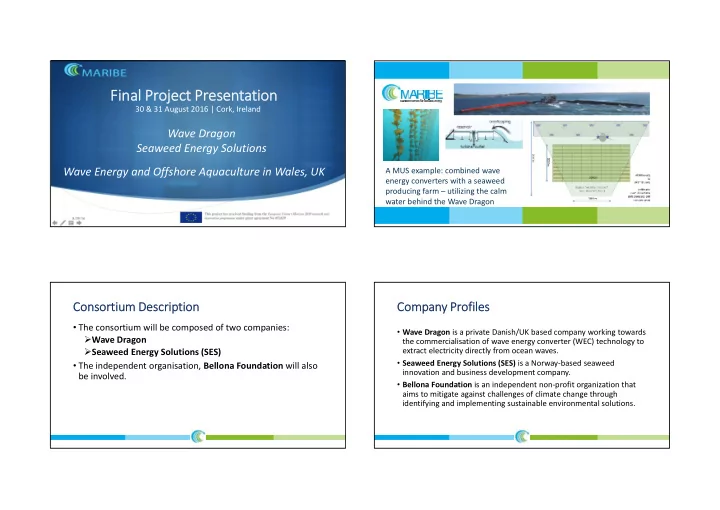
Final Project Presentation 30 & 31 August 2016 | Cork, Ireland Wave Dragon Seaweed Energy Solutions Wave Energy and Offshore Aquaculture in Wales, UK A MUS example: combined wave energy converters with a seaweed producing farm


slide-1
SLIDE 1

Final Project Presentation

30 & 31 August 2016 | Cork, Ireland

Wave Dragon Seaweed Energy Solutions Wave Energy and Offshore Aquaculture in Wales, UK

A MUS example: combined wave energy converters with a seaweed producing farm – utilizing the calm water behind the Wave Dragon

Consortium Description

  • The consortium will be composed of two companies:
  • Wave Dragon
  • Seaweed Energy Solutions (SES)
  • The independent organisation, Bellona Foundation will also

be involved.

Company Profiles

  • Wave Dragon is a private Danish/UK based company working towards

the commercialisation of wave energy converter (WEC) technology to extract electricity directly from ocean waves.

  • Seaweed Energy Solutions (SES) is a Norway-based seaweed

innovation and business development company.

  • Bellona Foundation is an independent non-profit organization that

aims to mitigate against challenges of climate change through identifying and implementing sustainable environmental solutions.

slide-2
SLIDE 2

Hans Christian Soerensen, PhD, Chairman of the board Erik Friis-Madsen, MSc, CEO

The Wave Dragon technology

SES Pilot 2014/15: 100 tons

6

  • Flexible system with 16 LLs; 200m each
  • Innovative substrates; industrial hatchery

Frank Neumann, Technology and Cultivation

AN OCEAN OF OPPORTUNITIES

Illustration: Ocean Forest - no reproduction without written permission

Reservoir Waves overtopping the doubly curved ramp

The Wave Dragon Principle

Wave climate - Power - Production__ 12 kW/m 1.5 MW 4 GWh/y/unit 24 kW/m 4 MW 12 GWh/y/unit 36 kW/m 7 MW 20 GWh/y/unit 48 kW/m 12 MW 35 GWh/y/unit

Turbine outlet Wave reflector

slide-3
SLIDE 3

☺ It works! Power delivered to the grid ☺ 20,000 hours operational track record ☺ Wave energy absorption performance verified ☺ Offshore wave energy is a reality

Why farm seaweed?

  • 50% of the world primary production (phososynthesis)

takes place in the sea

  • Still 99% of our food energy comes from agriculture on

land…

  • Seaweed farming is sustainable: no freshwater, land area
  • r fertilizers are needed (limiting factors on land)
  • Wide range of market opportunities for seaweed biomass
  • Rapidly increasing interest in seaweed products and

seaweed cultivation

“Seaweed is possibly the largest unexploited resource in Europe…”

12

Rough introduction of seaweed market

Total production 28 million ton. Annual growth rate 8-10%. Market value 8 billion USD Markets: food (75 %), hydrocolloids (13 %), feed, fertilizers, cosmetics, pharmaceuticals and chemicals. Main production from cultivation in Asia (95%)

Commodity Mton/y Marine fish 73 Seaweed 28 Molluscs 22 Crustaceans 10 Salmonids 4

slide-4
SLIDE 4

Markets and applications

13

  • 3. Plant health & nutrition

– Growth promoters – Plant defense – Macronutrients (N, P, K) – Micronutrients (Fe, Ca, Cu) – Trace elements

  • 2. Health & nutrition

(humans and animals)

– Gut health (fibers, prebiotics) – Immune stimulation – Anti-oxidants – Anti-inflammatory – Anti-biotic – Protein – Vitamins – Minerals – Fatty acids – Skin health (cosmetics) – Animal fur and mucus health – Pharmaceuticals/bioactives

  • 1. Human food

– Sea vegetables, snacks – Salt replacement – Flavour – Texturizer

  • 5. Industrial fermentation

– Biofuels – Biochemicals – Single cell protein (SCP)

  • 4. Specialty chemicals

– Alginate, carrageenan, agar – Alginate derivatives – Mannitol and derivates – Fiber/textiles – Minerals

(Integrated biorefineries)

Dominating the entire cultivation cycle

14

SES Pilot 2015/16: 20 tons final food product SES exposed offshore farming vision(s)

16

Passive survivability design (structures moving like seaweed) Two distinct approaches analysed/considered: Active submergence in storms (wave power with classical farm designs)

  • Technical challenges (sea operations; wear on

equipment; fewer days with work weather)

  • Logistics: longer journey times and expensive

harvest/transport/delivery sequence

slide-5
SLIDE 5

Description of projects

Pilot project in Wales 1st Commercial project in Wales 2nd Commercial project; new location 3rd commercial project Wave Dragon 1 WD; 4MW 9 WD; 30MW 9 WD; 30MW 45WD; 180MW SES 80 tonnes/y 4000 tonnes /y 4000 tonnes/y 20 000 tonnes/y

Key figures

3rd commercial project

Wave Dragon 45WD@4MW = 180MW SES 20 000 tonnes/y Pay back 4.3 years IRR 24.4%

  • Wave Dragon and SES have solid track records in their fields
  • Joint MUS project WD/SES has been initiated upon invitation of MARIBE
  • SES can cultivate in areas otherwise difficult to work in or inaccessible
  • WD can serve as operational base for (seaweed) aquaculture
  • The combined wave energy and aquaculture farm has a significant better

economy than stand alone solutions (~10% reduction in levelised cost).

  • MARIBE has facilitated significantly the exploration of this MUS, and

provided valuable help and contacts for development of this vision

  • A WD/SES pilot seems realistic in Welsh waters within a short time frame,

provided that appropriate funding can be obtained.

Conclusion

Backup slides Wave Dragon

slide-6
SLIDE 6
  • Wave energy focusing
  • Overtopping

Absorption

  • Above sea level reservoir

Storage

  • Low-head variable speed propeller turbines
  • PM generators & frequency inverters

Power-take-off

The Wave Dragon Technology

Reflector Ramp Reservoir Turbines

Floating Barge + River Hydro Power Station = Wave Dragon

The Wave Dragon Technology

slide-7
SLIDE 7

Wave Dragon

# 25

Erik Friis-Madsen The Danish Academy of Technical Sciences Meeting on Energy Storage

57 m wide 200 tonnes Wave Dragon prototype with 7 turbines deployed and connected to the grid in 2003 as worlds first floating WEC Full scale Wave Dragon device sizes

Wave energy power plants – any need for energy storage?

slide-8
SLIDE 8

Turbine operation and power production

Example:

  • Four power producing turbines in continous
  • peration
  • Three dummy turbines handles overtopping

variation 7 5 ,5 4 2 ,5 1 5 6 7 8 9 1 0 1 1 1 2 1 3 1 4 1 5 1 6 1 7 0 % 1 0 % 2 0 % 3 0 % 4 0 % 5 0 % 6 0 % 7 0 % 8 0 % 9 0 % 1 0 0 % P o w e r W a v e h e ig h t , s ig n if ic a n t , m e t e r s W a v e p e a k p e r io d in s e c o n d s

4 MW Wave Dragon site Wales

Grid connection Ship traffic Wave climate

From the EIA report

How visible is a WD power plant?

Seen from 100 feet above sea level and at a distance of 5km Under the horizon at a distance of 10km

slide-9
SLIDE 9

Wave Dragon

# 33

Erik Friis-Madsen The Danish Academy of Technical Sciences Meeting on Energy Storage

1:50 Model test 100 year wave

Wave Dragon

# 35

Erik Friis-Madsen The Danish Academy of Technical Sciences Meeting on Energy Storage

Cylinder gate turbines running Wave Dragon

# 36

Erik Friis-Madsen The Danish Academy of Technical Sciences Meeting on Energy Storage

Ice and WEC’s is a bad combination!

The prototype was designed for a 3 year life time, but was not scrapped until 2011 after more than 8 years of operations.

slide-10
SLIDE 10

Wave Dragon

# 37

Erik Friis-Madsen The Danish Academy of Technical Sciences Meeting on Energy Storage

Animation: LOKE film

Backup slides SES

Large-scale offshore seaweed farming: a missing link in the food & feed chain?

Frank Neumann, Kaia Kjolbø Rød, Diogo Raposo, Luiza Neves, Maren Sæther, Jon Funderud Offshore Mariculture 2016 Conference, Barcelona

  • Seaweed introduction to food and feed markets
  • State-of the art of offshore seaweed (Kelp) farming in Europe
  • IMTA and synergies to other aquaculture activities

Seaweed as functional feed ingredient

40 An emerging market

  • Brown seaweeds has a high content of

dietary fibers (laminaran, alginate, cellulose)

  • Both soluble and insoluble fibers
  • Seaweed as a functional feed ingredient

(beneficial for digestion and gastrointestinal health)

  • Laminaran (branched β-1,3/1,6-glucan) is

an immunostimulant

  • Several bioactives properties of alginate
  • Antibiotics replacement
  • Seaweed as a sustainable and local feed

ingredient

slide-11
SLIDE 11

Land plants vs. seaweed cultivation

41

Sanggou Bay, China Mato Grosso, Brazil

Challenges for cultivation in Europe

42

Situation:

  • Suitable (protected) sites limited  move
  • ffshore
  • High labour cost  mechanisation needed

To realize the potential of seaweed biomass, new and innovative cultivation technology is needed… Exposed waters seaweed farming: Develop industry in easier waters and gradually move farther out to sea

  • Technically possible – shown in Frøya and Portugal
  • Forces and wear on the equipment
  • Need for new designs (structures/equipment)
  • Operation and Safety - fewer work days at sea
  • Logistics – transport and fuel; buffer storage

Stepping-stone: IMTA

43

  • Bioremediation

Residual nutrients capture (seaweed as a biofilter in integrated aquaculture; large part (50%?) of the feed nutrients are lost in the sea)

  • Recreation of the natural ecologic processes (increased biodiversity)

Attracts marine life, provide shelter and habitat

www.salmonfarmscience.com

  • Positive effect on seaweed

Better growth of the seaweeds close to the fish farms (nutrient availability) Aquaculture Technology Logistics and Operations

 Obvious synergies

  • f salmon

farming and seaweed!

¡Gracias!

44 Large challenges ahead… “One company cannot solve this alone” – need to work together

www.seaweedenergysolutions.com