
SLIDE 1
Fall 2018: Final Review ASTR/PHYS 1060: The Universe
Final Exam Review
1
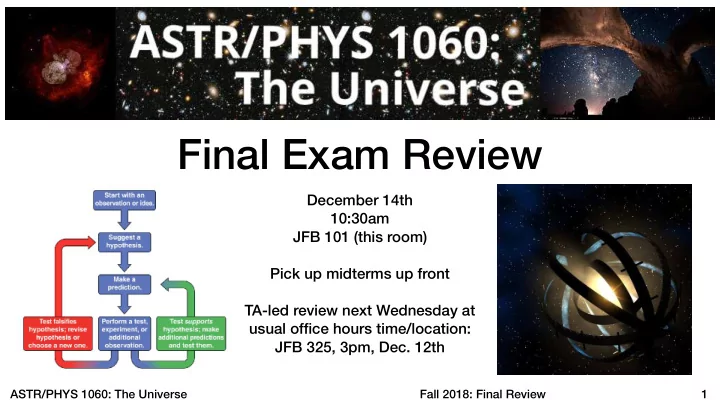
December 14th 10:30am JFB 101 (this room) Pick up midterms up front TA-led review next Wednesday at usual office hours time/location: JFB 325, 3pm, Dec. 12th
Final Exam Review December 14th 10:30am JFB 101 (this room) Pick - - PowerPoint PPT Presentation
Final Exam Review December 14th 10:30am JFB 101 (this room) Pick up midterms up front TA-led review next Wednesday at usual office hours time/location: JFB 325, 3pm, Dec. 12th ASTR/PHYS 1060: The Universe Fall 2018: Final Review 1 Exam
Fall 2018: Final Review ASTR/PHYS 1060: The Universe
1
December 14th 10:30am JFB 101 (this room) Pick up midterms up front TA-led review next Wednesday at usual office hours time/location: JFB 325, 3pm, Dec. 12th
Fall 2018: Final Review ASTR/PHYS 1060: The Universe
2
2hr time limit: 10:30am-12:30pm counts 33% more toward your final grade than a midterm, so the exam will be roughly 33% longer (2hr should be plenty of time in other words) Multiple Choice Questions 60-75% of total score Short Answer Questions 40-25% of total score may require calculations, but calculators not needed (or allowed)
Fall 2018: Final Review ASTR/PHYS 1060: The Universe
3
top view side view top view
Fall 2018: Final Review ASTR/PHYS 1060: The Universe
4
1st Law: Orbits are elliptical 2nd Law: equal areas in equal times 3rd Law: period depends on distance (Period of Planet [in years])2 = (Average Distance of Planet from Star [in AU])3
Fall 2018: Final Review ASTR/PHYS 1060: The Universe
5
Fall 2018: Final Review ASTR/PHYS 1060: The Universe 6
Fall 2018: Final Review ASTR/PHYS 1060: The Universe
7
Fall 2018: Final Review ASTR/PHYS 1060: The Universe
8
Fall 2018: Final Review ASTR/PHYS 1060: The Universe
9
Conservation of Angular Momentum: L = m v r
Fall 2018: Final Review ASTR/PHYS 1060: The Universe
10
Outer Planets 0.134% Terrestrial Planets 0.001%
Fall 2018: Final Review ASTR/PHYS 1060: The Universe
11
the planet eclipses it
planet’s gravity
Direct Imaging Transit Method Radial Velocity Method
0.5” 20 AU
HR 8799
Fall 2018: Final Review ASTR/PHYS 1060: The Universe 12
Luminosity depends on Temperature AND Size Stellar Spectra: blackbody plus absorption lines
Fall 2018: Final Review ASTR/PHYS 1060: The Universe 13
H-R Diagram
Fall 2018: Final Review ASTR/PHYS 1060: The Universe 14
Triple-alpha process, burns He —> C in Horizontal Branch phase proton-proton chain burns H —> He, releasing neutrinos and positrons (gamma rays)
Fall 2018: Final Review ASTR/PHYS 1060: The Universe 15
Fall 2018: Final Review ASTR/PHYS 1060: The Universe 16
White Dwarf <—> electron degeneracy pressure
if mass exceeds Chandrasekhar limit (1.4 Msun)
Fall 2018: Final Review ASTR/PHYS 1060: The Universe 17
Massive stars burn up to Fe (iron) in its core, then go supernovae (Type II) Neutron Star <—> neutron degeneracy pressure
Fall 2018: Final Review ASTR/PHYS 1060: The Universe 18
Neutron Stars Black Holes
Fall 2018: Final Review ASTR/PHYS 1060: The Universe 19
Fall 2018: Final Review ASTR/PHYS 1060: The Universe 20
Hubble’s law demonstrates that the universe is expanding
Fall 2018: Final Review ASTR/PHYS 1060: The Universe
21
Parallax Spectroscopic Parallax Cepheid Variables Type Ia SNe
Fall 2018: Final Review ASTR/PHYS 1060: The Universe
22
Artist top-down view
Fall 2018: Final Review ASTR/PHYS 1060: The Universe
23
Fall 2018: Final Review ASTR/PHYS 1060: The Universe
24
Fall 2018: Final Review ASTR/PHYS 1060: The Universe 25
Angle on the sky Billion light-years
Most Matter (blue) Most Matter (blue) Most normal matter (red)
Fall 2018: Final Review ASTR/PHYS 1060: The Universe 26
Life needs:
The Drake Equation
Dyson Spheres
Fall 2018: Final Review ASTR/PHYS 1060: The Universe
27
And now some final remarks on aliens and the universe
Fall 2018: Chapter 18 ASTR/PHYS 1060: The Universe
28
Artist’s impression of the object: ESO/M. Kornmesser On an unbound orbit, about the speed stars move relative to each other Size uncertain, but likely more cigar shaped spheroidal Found to be accelerating away from the Sun as it left the solar system Could it be an alien probe checking us
Or is it just a rock from another star system (possibly carrying microscopic life)?
Fall 2018: Chapter 18 ASTR/PHYS 1060: The Universe
29 Artist’s conception of a Dyson Sphere (CapnHack) https://earthsky.org/space/what-is-a-dyson-sphere
More correctly called a Stapleton Sphere, after Olaf Stapleton whose 1937 novel Star Maker inspired Freeman Dyson to propose the search for such objects Kardeshev Type II civilization: harnesses all the power
Can search for galaxies with “too much” IR light: sphere would emit waste heat — no evidence of substantial structures yet found Tabby’s star (discovered with Kepler) — alien megastructures or dust? (spoiler, dust) Kardeshev Type III+ civilization could capture stars with these spheres, out to a distance of 10s of millions of light years away, in an attempt to forestall lack of resources due to dark energy
Fall 2018: Chapter 18 ASTR/PHYS 1060: The Universe
30
Contact (1997) movie still frame
Fall 2018: Chapter 1 ASTR/PHYS 1060: The Universe 31
Fall 2018: Final Review ASTR/PHYS 1060: The Universe
32