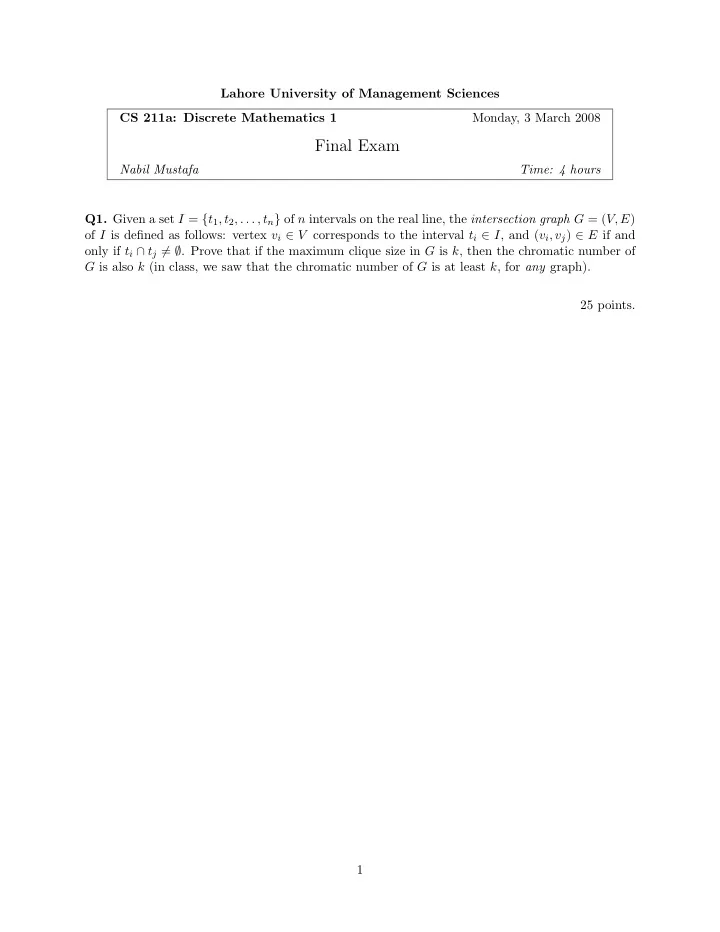
Final Exam Nabil Mustafa Time: 4 hours Q1. Given a set I = { t 1 , - - PDF document

final exam
SMART_READER_LITE
LIVE PREVIEW

Final Exam Nabil Mustafa Time: 4 hours Q1. Given a set I = { t 1 , - - PDF document

Lahore University of Management Sciences CS 211a: Discrete Mathematics 1 Monday, 3 March 2008 Final Exam Nabil Mustafa Time: 4 hours Q1. Given a set I = { t 1 , t 2 , . . . , t n } of n intervals on the real line, the intersection graph G = (


slide-1
SLIDE 1

Lahore University of Management Sciences CS 211a: Discrete Mathematics 1 Monday, 3 March 2008

Final Exam

Nabil Mustafa Time: 4 hours

  • Q1. Given a set I = {t1, t2, . . . , tn} of n intervals on the real line, the intersection graph G = (V, E)
  • f I is defined as follows: vertex vi ∈ V corresponds to the interval ti ∈ I, and (vi, vj) ∈ E if and
  • nly if ti ∩ tj = ∅. Prove that if the maximum clique size in G is k, then the chromatic number of

G is also k (in class, we saw that the chromatic number of G is at least k, for any graph). 25 points. 1

slide-2
SLIDE 2

Empty page 2

slide-3
SLIDE 3
  • Q2. Prove the following:
  • Without using Hall’s theorem, give another proof of the following fact.

We are given a bipartite graph G with n vertices in each partition, and where deg(vi) ≥ n/2 for all i. Show that G must contain a perfect matching. 10 points.

  • A rooted binary tree T = (V, E) is a tree with a specified “root” vertex vr, and each vertex

has degree at most 3 (and the root vertex has degree at most 2). Then, the depth d(v) for any v ∈ V is defined as the length of the path from v to vr. Prove Kraft’s inequality:

  • v

2−d(v) ≤ 1 where the summation is over all end-vertices v, excluding vr. 15 points. 3

slide-4
SLIDE 4

Empty page 4

slide-5
SLIDE 5
  • Q4. Prove the following:
  • 1. The so-called Chv´

atal Principle: Given any graph G = (V, E), where the average degree of G is at least d, there exists a subgraph of G where every vertex has degree at least d/2. 15 points.

  • 2. Every graph G with average degree at least d has, as its subgraph, every possible tree on d/2

vertices. 10 points. 5

slide-6
SLIDE 6

Empty page 6

slide-7
SLIDE 7
  • Q4. Determine the number of graphs on n vertices, with
  • 1. no vertices of degree 0

15 points.

  • 2. at least two vertices of degree 0

5 points.

  • 3. exactly two vertices of degree 0

5 points. 7