Final essay writing The Effectiveness of Reintroducing Przewalski's - - PDF document

final essay writing
SMART_READER_LITE
LIVE PREVIEW

Final essay writing The Effectiveness of Reintroducing Przewalski's - - PDF document

Some example titles from 2007 Final essay writing The Effectiveness of Reintroducing Przewalski's Horses into the Mongolian Wilderness as a Protection Measure Against the Species' Extinction Global Warming: Should we be worried and what can we


slide-1
SLIDE 1

Final essay writing

Title of essay Please write a short paragraph why you write about the chosen topic.

Due date: March 25th

Some example titles from 2007

The Effectiveness of Reintroducing Przewalski's Horses into the Mongolian Wilderness as a Protection Measure Against the Species' Extinction Global Warming: Should we be worried and what can we do to help? Fire or Silviculture: What’s really harming the Flatwoods Salamander Effects of habitat degradation and deforestation on the endemic flora and fauna of Madagascar The effectiveness of protected land on biodiversity Conserving the North Atlantic right whale, Eubalaena glacialis Invasive Species and their Impact on Natural Habitats.

Invasive species

Basics Predicting invasions Managing invasions

Invasive species

Basics How big is the problem? Definitions How do invasives move/spread? Effects of invasives Predicting invasions Managing invasions

How big is the problem?

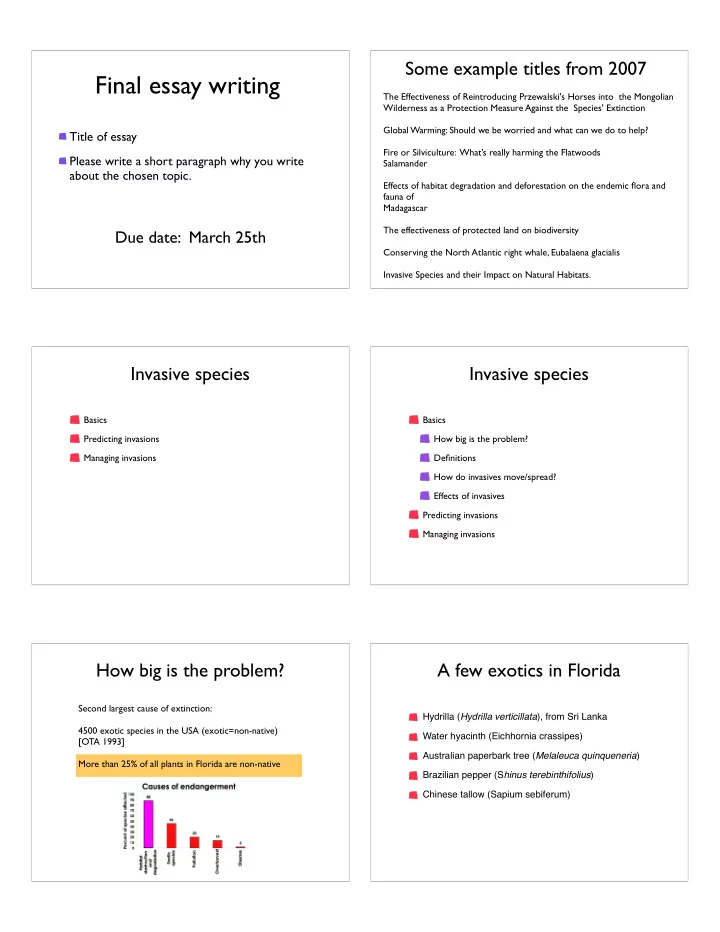
Second largest cause of extinction: 4500 exotic species in the USA (exotic=non-native) [OTA 1993] More than 25% of all plants in Florida are non-native

A few exotics in Florida

Hydrilla (Hydrilla verticillata), from Sri Lanka Water hyacinth (Eichhornia crassipes) Australian paperbark tree (Melaleuca quinqueneria) Brazilian pepper (Shinus terebinthifolius) Chinese tallow (Sapium sebiferum)

slide-2
SLIDE 2

Hydrilla Water hyacinth Brazilian pepper tree Paper bark tree Chinese tallow

Definitions

Introduced (exotic) species = a species living outside its native range Invasive species = introduced species with dramatically expanding populations

slide-3
SLIDE 3

How invasives move/spread

Stow-aways (e.g. ballast water)

slide-4
SLIDE 4

How invasives move/spread

Stow-aways Commerce/Curiosity

Gypsy moth

Introduced 1868/1869 1900 1934 1994

slide-5
SLIDE 5

Rana ridibunda (lake frogs) were accidentally introduced at several places in Switzerland and France

Specialty food Academic education

How invasives move/spread

Stow-aways Commerce/Curiosity Recreation

http://natuurbeleving.scene24.net/zoogdieren/Wild_Zwijn_Sus-scrofa.html

Sus scrofa, wild hog

Introductions for recreation

How invasives move/spread

Stow-aways Commerce/Curiosity Recreation Aesthetics

European Starling

The European starling was first introduced to the United States in New York City, in 1890. Inspired by William Shakespeare's plays, Eugene Scheffland let loose one hundred starlings in Central Park.

How invasives move/spread

Stow-aways Commerce/Curiosity Recreation Aesthetics Biological control

slide-6
SLIDE 6

Cane toads in Australia

Cane toads were deliberately introduced to Australia from Hawaii in 1935 in an attempt to stop French’s Cane Beetle and the Greyback Cane Beetle from destroying sugar cane crops in North Queensland. The Australian Bureau of Sugar Experimental Stations made the release of 101 cane toads at Gordonvale in Queensland in 1935. They were unsuccessful in controlling the cane beetles. Biological control = Introduction of predators to control a prey species

Cane toads in Australia

Cane Toads - An Unnatural History (1987)

Invasion and the evolution of speed in toads

Benjamin L. Phillips1, Gregory P. Brown1, Jonathan K. Webb1 and Richard Shine1 Nature 439 (2006) Cane toads seem to have honed their dispersal ability to devastating effect over the generations. Cane toads (Bufo marinus) are large anurans (weighing up to 2 kg) that were introduced to Australia 70 years ago to control insect pests in sugar-cane fields. But the result has been disastrous because the toads are toxic and highly

  • invasive. Here we show that the annual rate of

progress of the toad invasion front has increased about fivefold since the toads first arrived; we find that toads with longer legs can not only move faster and are the first to arrive in new areas, but also that those at the front have longer legs than toads in older (long-established) populations. The disaster looks set to turn into an ecological nightmare because of the negative effects invasive species can have on native ecosystems1,

2; over many generations, rates of invasion will

be accelerated owing to rapid adaptive change in the invader3, with continual 'spatial selection' at the expanding front favouring traits that increase the toads' dispersal4, 5. are to us- sect he se ly he

  • ad
  • ut

rst ith ve in at an d) set ht- ive ve ny ill id r3,

  • n’

ng ds’

–1,000 –500 500 1,000 1,500 –0.16 –0.12 –0.08–0.04 0.04 0.08 Relative distance moved (m) Relative leg length (ln mm) –0.15 –0.10 –0.05 0.05 0.10 0.15 0.20 10 20 30 40 50 60 70 Relative leg length (ln mm) Time since colonization (yr) –0.15 –0.10 –0.05 0.05 0.10 0.15 200 400 600 800 Relative leg length (ln mm) Order of arrival 1 9 4 5 – 5 4 1 9 5 5 – 6 4 1 9 6 5 – 7 4 1 9 8 – 8 4 2 1 – 5 10 20 30 40 50 60

a c b d

Radial increase in range (km yr1) Period

  • • •
  • •• ••
  • • •
  • • • •
  • • • •
  • • •
  • • •
  • Figure 1 | Morphology of cane toads in relation to their speed and invasion
  • history. a, b,Compared with their shorter-legged conspecifics, cane toads

with longer hind limbs move further over 3-day periods ( r20.34) (a), and are in the vanguard of the invasion front (based on order of arrival at the study site; r20.11) (b). c, Cane toads are relatively long-legged in recent populations, and show a significant decline in relative leg length with time in older populations (r20.05). d, The rate at which the toad invasion has progressed through tropical Australia has increased substantially since toads were first introduced in 1935 (r20.92).

How do invasives move/spread

Pattern of a “typical” invasion Latent phase (small population size) Rapid population growth and spread

Opuntia in South-Africa

Reconstructing 50 years of Opuntia stricta invasion in the Kruger National Park, South Africa: environmental determinants and propagule pressure Llewellyn C. Foxcroft, Mathieu Rouget, David M. Richardson and Sandra Mac Fadyen Diversity and Distributions, (2004) 10: 427–437

Effect of invasive species

Predation
slide-7
SLIDE 7

Brown tree snake (Boiga irregularis)

  • n Guam

Introduction

The brown tree snake was first detected on Guam in the 1950s near the Naval Port (central Guam), but may not have become conspicuous away from the port area until the early 1960s. By the mid 1960s, the snake had colonized over half of the island. In 1968, the snake had reached the extreme northern end of the island and was present throughout the island, although its densities varied widely from region to region.

Threat to other species

Status of forest species on Guam

Other threats Eradication and Detection

slide-8
SLIDE 8

http://www.fort.usgs.gov/Resources/Education/BTS/

Effect of invasive species

Predation Competition (native vs House geckos in the Pacific)

Effect of invasive species

Predation Competition Hybridization West slope cutthroat trout

Effect of invasive species

Predation Competition Hybridization Environmental engineering

Myrica faya on Hawaii

  • Dr. Donald E. Gardner, University of Hawaii,

http://www.botany.hawaii.edu/faculty/gardner/biocontrol/myrica%20faya/myrica.htm

Effect of invasive species

Predation Competition Hybridization Environmental engineering

Myrica faya on Hawaii N-fixing root nodules

  • Dr. Donald E. Gardner, University of Hawaii,

http://www.botany.hawaii.edu/faculty/gardner/biocontrol/myrica%20faya/myrica.htm

Habitat invaded by Myrica faya

  • Dr. Donald E. Gardner, University of Hawaii,

http://www.botany.hawaii.edu/faculty/gardner/biocontrol/myrica%20faya/myrica.htm

slide-9
SLIDE 9

Each year, ~ $23 billion nationwide is lost to the effects of invasive plants

  • n agriculture, industry, recreation, and the environment. An estimated

1860 hectares (4600 acres) of land are invaded daily by invasive plants. (Federal Highway Administration 2000)

Effects of invasive species

Predation Competition Hybridization Environmental engineering Economic effects Invasive species is one of the major environmental issues of this century. The economic cost to the US of invasive species is at least $137B/year. (ESA 2000)

Factors affecting invasion

Basics Factors affecting invasion Introduction history

Factors affecting invasion: Introduction history

Pathways of introduction Propagule pressure counteract small population challenges (e.g. genetic effects) Time since introduction Demographic processes Adaptation

Time since introduction

Opuntia invasion in South-Africa Correlation of area and introduction date

Factors affecting invasion

Basics Factors affecting invasion Introduction history Species characteristics

Characteristics of invasive species

  • Australian Weed Risk Assessment Model:

Predict what introduced species are likely to become invasive based on species traits.

slide-10
SLIDE 10

Factors affecting invasion: species characteristics

High dispersal rate Persistence at low density and fast growth

  • e.g. asexual reproduction

Good ecological match large native range (can adapt to different habitats) generalists Associate with humans

Factors affecting invasion: community characteristics

Basics Predicting invasions Introduction history Species characteristics Characteristics of invasible ecosystems

Characteristics of invasible ecosystems

Disturbed/Early in succession good “Ecological Match”

Characteristics of invasible ecosystems

Disturbed/Early in succession good “Ecological Match” Predators few or absent (=enemy release hypothesis)

Invasible ecosystems: Enemy Release Hypothesis

Native Range Introduced Range

herbivory plant abundance herbivory plant abundance

slide-11
SLIDE 11

Characteristics of invasible ecosystems

Disturbed/Early in succession good “Ecological Match” Predators few or absent (=enemy release hypothesis) Low diversity?

Invasible ecosystems: low diversity?

Islands are more invasible than mainlands (Elton 1958) Low diversity local communities are less invasible (Levine 2000) High diversity habitats are more invaded at large scales (Stohlgren et al. 2003)

Observations from islands, small-scale experiments, and mathematical models have generally supported the paradigm that habitats of low plant diversity are more vulnerable to plant invasions than areas of high plant diversity. We summarize two independent data sets to show exactly the

  • pposite pattern at multiple spatial scales. More significant, and alarming, is that hotspots of

native plant diversity have been far more heavily invaded than areas of low plant diversity in most parts of the United States when considered at larger spatial scales. Our findings suggest that we cannot expect such hotspots to repel invasions, and that the threat of invasion is significant and predictably greatest in these areas.

Invasible ecosystems: low diversity? Invasive species

Basics Predicting invasions Introduction history Characteristics of invasive species Characteristics of invasible ecosystems Managing Invasives

What to do about invasives?

Prevent entry reduce human impact

Invasives: reduce human impact

slide-12
SLIDE 12

What to do about invasives?

Prevent entry reduce human impact public education border control (Australian Weed Risk Assessment) Removal of invasives by hand vs pesticides biological control

What to do about invasives? Biological Control

Host Specificity Agent effectiveness

Biological Control: host specificity

(Soberón 2002)

Biological Control: host specificity

(Soberón 2002)

Biological Control: host specificity

Opuntia spinosissima Opuntia triacantha

Rare in native habitat lower chance of resistance in host Environment matching Using demographic models of evaluate effectiveness (remember PVAs?)

Biological Control: agent effectiveness

slide-13
SLIDE 13

Biological Control: agent effectiveness

  • Scotch broom

Ingrid Parker 2000, PVA

99.9% of seeds in prairies and 70% of seeds in urban populations need to be destroyed to stop invasion

  • f scotch broom

Biological Control: agent effectiveness

Invasion front (fastest growing population) Established population (slowest growing population

PVA: Elasticity analysis of how to stop Scotch broom

Characteristics of invasible ecosystems

Disturbed/Early in succession good “Ecological Match” Predators few or absent (=enemy release hypothesis) Low or High diversity? Fragmentation