Federal subsidies during Programs Ill discuss: COVID19: FOR UNIONS - - PowerPoint PPT Presentation

federal subsidies during
SMART_READER_LITE
LIVE PREVIEW

Federal subsidies during Programs Ill discuss: COVID19: FOR UNIONS - - PowerPoint PPT Presentation

20200506 Federal subsidies during Programs Ill discuss: COVID19: FOR UNIONS AS NOT FOR PROFIT ORGANIZATIONS A primer for unions & related Canada Emergency Business Account organizations (up to $40,000 loan) Prepared for


slide-1
SLIDE 1

2020‐05‐06 1

Federal subsidies during COVID19: A primer for unions & related

  • rganizations

Prepared for Calgary & District Labour Council

Jessie Hadley, McGown Cook Barristers & Solicitors May 6, 2020 at 1:00 PM

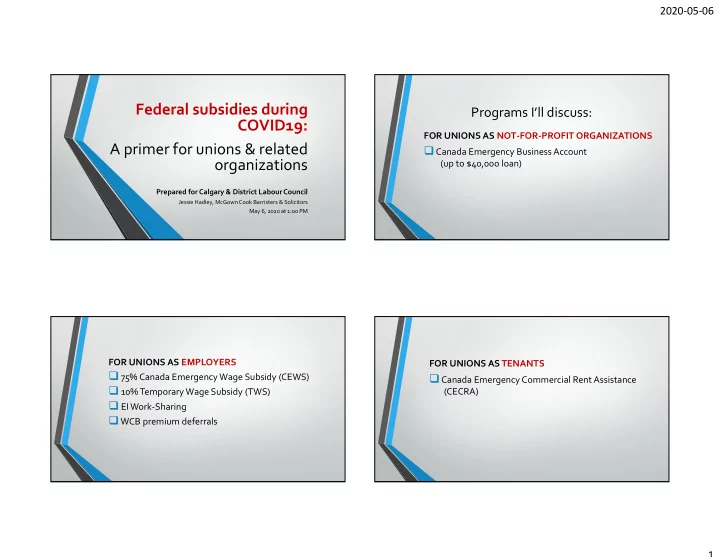
Programs I’ll discuss:

FOR UNIONS AS NOT‐FOR‐PROFIT ORGANIZATIONS

 Canada Emergency Business Account

(up to $40,000 loan) FOR UNIONS AS EMPLOYERS

 75% Canada Emergency Wage Subsidy (CEWS)  10% Temporary Wage Subsidy (TWS)  EI Work‐Sharing WCB premium deferrals

FOR UNIONS AS TENANTS

 Canada Emergency Commercial Rent Assistance

(CECRA)

slide-2
SLIDE 2

2020‐05‐06 2

And one more…

FOR EMPLOYEES OF UNIONS

 Canada Emergency Response Benefit

but first… WHO IS APPLYING FOR THE SUBSIDY?

  • All these subsidies have eligibility requirements that

specify in detail who can apply.

  • So it is important to consider exactly what entity or
  • rganization you are putting forward as an applicant for

the various subsidies.

  • Trade unions are normally unincorporated associations.
  • They aren’t usually (and don’t need to be) formal

corporations, societies or charitable organizations.

  • Trade unions are defined in the federal and provincial

labour codes. In Alberta they are “organizations of employees that have a written constitution, rules or bylaws” and that have as one of their objects the “regulation of relations between employers and unions.” (Labour Relations Code, s. 1)

  • Trade unions are considered to be non‐profit
  • rganizations for tax purposes – assuming they don’t

have profit as one of their purposes!

  • Sometimes unions have holding companies that own

land or buildings, or trusts that administer trust funds, or any number of other associated entities.

  • Who or what entity acts as the employer of your union’s

employees?

slide-3
SLIDE 3

2020‐05‐06 3

BOTTOM LINE:

  • Think carefully to decide whether your union or any

related organizations may be eligible for each of the different subsidies.

FOR UNIONS AS NOT‐FOR‐PROFIT ORGANIZATIONS Canada Emergency Business Account

  • Not just for businesses – non‐profits can also apply.
  • Must have a payroll of between $20K and $1.5M.
  • Is an interest‐free loan of up to $40K. Up to 25% can be

forgiven if loan is repaid by Dec 31, 2022.

  • Apply via your financial institution.
  • https://ceba‐cuec.ca/

FOR UNIONS AS EMPLOYERS

slide-4
SLIDE 4

2020‐05‐06 4

For the next subsidy we need to ask WHAT IS “REVENUE”?

  • Revenue is income generated from an organization’s

normal business operations.

  • For a union, revenue is probably just union dues.
  • The next subsidy is for employers that have

experienced– 15% in March 2020 and 30% in Apria significant reduction in revenue l and May 2020.

75% Canada Emergency Wage Subsidy (CEWS)

  • Purpose is to give employers affected by COVID19 a

wage subsidy so they can keep on paying their employees, through their own payroll, during the 12‐ week period of the program (March 15 to June 6).

  • This includes bringing back employees who have been

laid off, even if the employees are unable to work for the employer.

Emergency Wage Subsidy cont’d

  • Unions who are employers are eligible for this subsidy

(both as non‐profit organizations and also as “labour

  • rganizations or societies”).
  • Must have a payroll account with CRA as of March 15,

2020.

Emergency Wage Subsidy cont’d

  • You must have experienced an “eligible reduction in

revenue”.

  • For baseline, use either revenue from the same

month in 2019, or the average of your Jan and Feb 2020 revenue.

slide-5
SLIDE 5

2020‐05‐06 5

Emergency Wage Subsidy cont’d

What is an eligible reduction in revenue? Your organization needs to have experienced:

  • A 15% revenue drop to be eligible between March 15

and April 11, 2020, and

  • A 30% revenue drop to be eligible between April 12 and

June 6, 2020.

Emergency Wage Subsidy cont’d

  • This subsidy pays for 75% of the remuneration (or

baseline remuneration) of each eligible employee between March 15, 2020 and June 6, 2020, up to a maximum of $847 per week for each employee.

  • Baseline remuneration is what you paid the employee

between January 1 and March 15, 2020. This number comes into play if you want to apply for the CEWS for someone who has been laid off.

Emergency Wage Subsidy cont’d

  • Cannot get CEWS for employees who have been without

remuneration for more than 14 consecutive days in the eligibility period.

  • That is: if the employee was without remuneration for
  • ver 14 days because their employer laid them off and

did not retroactively re‐hire them, then the CEWS is not available for that employee.

Emergency Wage Subsidy cont’d

  • Detailed info and a wage subsidy calculator is online:

https://www.canada.ca/en/revenue‐ agency/services/subsidy/emergency‐wage‐subsidy.html.

  • Employers getting CEWS are supposed to make best

efforts to top up the 75% but it is not clear whether that will be tracked.

slide-6
SLIDE 6

2020‐05‐06 6

Emergency Wage Subsidy cont’d

  • CPP and EI Remittance Refund: Employers who qualify

for CEWS may also receive 100% of their employer‐ portion of CPP and EI remittances back when they apply for CEWS.

10% Temporary Wage Subsidy (TWS)

  • Available to unions (as non‐profit organizations) that

employ staff in Canada.

  • Must have an existing business number and payroll

program account with CRA as of March 18, 2020.

  • No need to show any staffing reductions or any decrease

in revenue to be eligible for this.

Temporary Wage Subsidy cont’d

  • Subsidy is 10% of the remuneration you pay to

employees between March 18 and June 19, 2020.

  • Up to a max of $1375 per employee, and max $25K total

per employer.

  • Is “paid” via the ability to make reduced payroll

remittances for income tax (federal and provincial).

  • You do not need to apply for it – you just calculate it and

then you can start reducing remittances.

Temporary Wage Subsidy cont’d

  • Detailed information, including on how to calculate the

subsidy, is online: https://www.canada.ca/en/revenue‐ agency/campaigns/covid‐19‐update/frequently‐asked‐ questions‐wage‐subsidy‐small‐businesses.html.

  • NOTE: benefit received from the TWS will reduce the

amount you can get from the 75% Canada Emergency Wage Subsidy (see next point).

slide-7
SLIDE 7

2020‐05‐06 7

EI Work‐Sharing

  • This program existed before COVID19 but has now been

extended from 38 weeks to 78 weeks.

  • Idea is that employers and employees can agree to

reduce individual employees’ hours during slower periods as an alternative to lay‐offs.

  • Employer then pays the employees at normal rate for

their hours worked, and the government pays them the EI rate for the work hours they’ve missed.

EI Work‐Sharing

  • For nonprofit employers to be eligible they need to show

a shortage of work due to a reduction of business activity, and/or a reduction in revenue levels due to COVID19.

  • They need to have at least 2 full‐time year‐round

employees to form a workshare unit.

  • The participating employees must all be eligible for EI

benefits.

EI Work‐Sharing

  • The employees in a workshare unit must agree to share

the available work. They and the employer then submit a joint application for work‐sharing.

  • https://www.canada.ca/en/employment‐social‐

development/corporate/notices/coronavirus/employers‐ factsheet.html.

WCB premium deferrals

  • If you have opted in to WCB coverage for your

employees, your 2020 premiums will automatically be deferred to 2021.

  • As small/medium employers (defined as having less than

$10M in insurable earnings), unions will also have 50% of their 2020 premiums waived.

  • https://www.wcb.ab.ca/assets/pdfs/employers/EFS_Pre

mium_relief.pdf.
slide-8
SLIDE 8

2020‐05‐06 8

FOR UNIONS AS TENANTS Canada Emergency Commercial Rent Assistance (CECRA)

  • This program is still pending – process not in place yet.
  • Offers forgivable loans to landlords of small businesses

and non‐profits

  • Tenant must have temporarily closed operations or

experienced a 70% drop in revenues due to COVID19.

  • Landlord & tenant must have agreed to a minimum 75%

rent reduction for April, May and June 2020.

Canada Emergency Commercial Rent Assistance (CECRA)

  • It’s the landlord that needs to apply for the subsidy.
  • The idea is that the government will pay the landlord

50% of the normal rent in a forgivable loan.

  • https://www.cmhc‐schl.gc.ca/en/finance‐and‐

investing/covid19‐cecra‐small‐business

FOR EMPLOYEES

slide-9
SLIDE 9

2020‐05‐06 9

Canada Emergency Response Benefit

  • Available to any person who has lost employment

income as a result of COVID‐19.

  • $500 per week for the period between March 15 and

October 3, 2020.

  • Employees can apply through CRA or Service Canada.
  • Numerous “terms and conditions apply”:

https://www.canada.ca/en/services/benefits/ei/cerb‐ application.html

Q&A