FAFSA and Financial Aid Presented by: Brooke Geraghty Interim - - PDF document

fafsa and financial aid
SMART_READER_LITE
LIVE PREVIEW

FAFSA and Financial Aid Presented by: Brooke Geraghty Interim - - PDF document

10/1/2019 FAFSA and Financial Aid Presented by: Brooke Geraghty Interim Director of Admissions Topics of Discussion FAFSA Deadlines EFC, Cost of Attendance, and Financial Need Types of Aid Budgets Appeals


slide-1
SLIDE 1

10/1/2019 1

FAFSA and Financial Aid

Presented by: Brooke Geraghty Interim Director of Admissions

  • Topics of Discussion

– FAFSA – Deadlines – EFC, Cost of Attendance, and Financial Need – Types of Aid – Budgets – Appeals – Questions

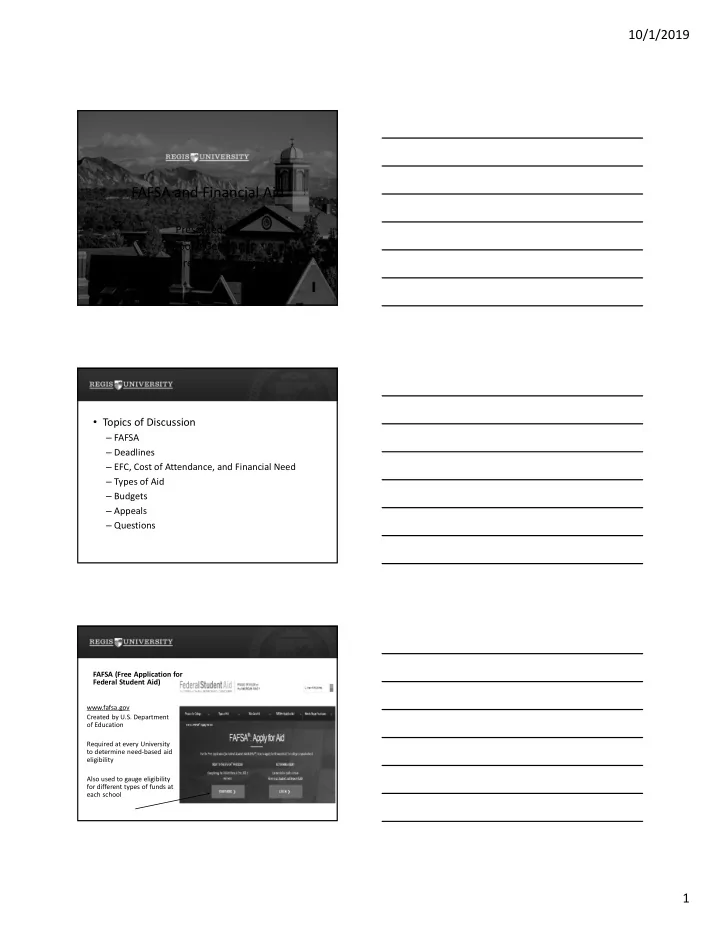
FAFSA (Free Application for Federal Student Aid)

www.fafsa.gov Created by U.S. Department

  • f Education

Required at every University to determine need-based aid eligibility Also used to gauge eligibility for different types of funds at each school

slide-2
SLIDE 2

10/1/2019 2

FAFSA (Free Application for Federal Student Aid) My Student Aid app As of October 1st, upcoming year FAFSA is available (2020-2021) App limitations:

  • English only
  • cannot make

corrections on app

Why FAFSA?

  • Ensures consistent information

is received at each school the student applies to

  • In each respective financial aid
  • ffice, the FAFSA allows us to

equitably evaluate each family’s financial circumstances and help provide access to higher education opportunities

How to Apply?

  • https://fsaid.ed.gov/npas/in

dex.htm

  • Both student and parent

must have respective FSA ID’s to sign the FAFSA

  • www.studentaid.gov/fsaid

– Info & tips for creating FSA ID

  • The new FSA ID consists of a user-

created username and password

  • You can use your FSA ID

immediately to sign your FAFSA

  • Must wait for the Social Security

Administration to verify your information before you can use the FSA ID to create a renewal FAFSA, make corrections to your FAFSA, or view your SAR (student aid report).

slide-3
SLIDE 3

10/1/2019 3 How to Apply?

  • After both parent and student

have their respective FSA IDs, you can start a new FAFSA

  • Follow the process step by

step

– READ each question carefully and double-check all answers, especially name and SSN

  • FAFSA will ask for financial

information, including federal tax information and value of assets

– The 2020-2021 FAFSA will ask for student AND parent 2018 federal tax return information (Prior-Prior year) – Have a copy of completed returns, 2018 w-2’s and asset information on hand

How to Apply?

  • Taxes and the IRS Data

Retrieval Tool (DRT)

  • DRT option allows for faster

processing and guarantees accuracy

  • DRT not required
  • Parents cannot use DRT if

tax filing status is married filing separately or if marital status recently changed and does not match tax return filing status Frequent FAFSA issues

  • If you have any questions

while filing a FAFSA, make sure to call 1-800-433-3243 or you can access real-time private

  • nline chat with a customer

service rep on the FAFSA site.

  • You can also reach out to the

financial aid office directly

  • www.studentaid.gov
  • Parent and Student SSN’s

– Always double check for accuracy

  • Divorced/remarried parent

information

  • Household size
  • Number of household members in

college

  • Asset information

– The house you live in is not considered an investment – 401k/403b are not considered assets

  • FAFSA signature with FSA IDs

– Both student AND parent must sign

  • School codes
slide-4
SLIDE 4

10/1/2019 4

FAFSA results

  • Student Aid Report (SAR)
  • Students receive an email

with a direct link to view their SAR online once their FAFSA is processed

  • Review the SAR
  • SAR will also notify you if

FAFSA was selected for verification

Verification

  • A certain percentage of student FAFSAs are selected for this

federally required process

– School must verify a student’s FAFSA information to ensure accuracy so that a student receives maximum aid eligibility

  • Institutions may require that you submit additional

documentation to verify information provided:

  • Tax return transcript, bank statements, institutional forms, etc.
  • Financial Aid Award notification may be delayed or in a tentative

status until verification is complete

  • Completing the FAFSA using the IRS data retrieval tool will often

eliminate or speed the verification process

Deadlines

  • 2020-2021 FAFSA available after October 1
  • Regis University FAFSA priority deadline March 1

– Deadlines at each school may vary – Some funds run out – Use estimated tax return information, if necessary

  • National Candidate Reply Date for Admissions is

May 1st

– The sooner the FAFSA is complete, the more time the FA Office has to award and notify the student so the family can make an informed decision/deposit on or before May 1st

slide-5
SLIDE 5

10/1/2019 5

EFC Expected Family Contribution

  • EFC is a measure of your family’s

financial strength and is calculated according to a formula established by federal law.

  • Your EFC is not the amount of

money your family will have to pay for college nor is it the amount of federal student aid you will receive. It is a number used by each school to calculate the amount of student aid you are eligible to receive.

– EFC numbers are used to determine federal and state dollars, but schools may also use this figure to determine how to award their institutional dollars

Financial Need Cost of Attendance A figure provided by colleges and/or college financial offices that estimates the total costs

  • f attending that particular

school for a period of one year.

  • Tuition
  • Fees
  • Room and Board

– (set by institution)

  • Books and supplies
  • Transportation
  • Personal

– (variable – schools use average amounts provided by the state)

slide-6
SLIDE 6

10/1/2019 6

Financial Need Calculation

  • School A: $30,000 need
  • School B: $15,000 need
  • School C: $0 need
  • Schools base awards on

financial need. School A has the highest cost but also the highest need. The student may qualify for more aid which can make the higher cost school actually more affordable

$0 $5,000 $10,000 $15,000 $20,000 $25,000 $30,000 $35,000 $40,000 $45,000 School A School B School C COA EFC NEED

Net Price Calculator

  • Required at all schools
  • Can review basic income

information, GPA and test scores to estimate financial aid awards

  • This can give families an

idea of “net price”

  • As explained looking at

financial need, the highest priced school may end up being the most affordable

  • ption once you look at “net

price” (sticker price minus aid

  • ffered).
  • The net price calculator does

not guarantee awards, but it can be a great conversation starter for families

  • Regis University:

http://www.regis.edu/netprice

Types of Aid

  • Scholarships
  • Grants
  • Student Employment (work-study)
  • Student Loans
  • Parent Loans
slide-7
SLIDE 7

10/1/2019 7

Merit-Based Scholarships

  • Awarded based on factors

such as GPA, SAT/ACT scores, or other talents

  • Not awarded based on

financial need

  • Institutions offer different

scholarships and amounts External Scholarships

  • Merit or need-based

scholarships awarded through external

  • rganizations (not specific

institutions)

  • All students should be

researching databases and applying for any that may be applicable

  • www.fastweb.com
  • www.finaid.org
  • www.scholarships.com
  • https://bigfuture.collegeboard.org/

scholarship-search

  • https://secure.collegeincolorado.or

g/Financial_Aid_Planning/Scholars hips/_default.aspx

  • https://www.unigo.com/scholarshi

ps/undergraduate- students/scholarships-for-college- freshmen

  • http://www.denverfoundation.org/

Scholarships/For-High-School- Students

External Scholarships--Scams

  • Always read the fine print
  • No company can guarantee

a scholarship

  • Never pay money to apply
  • r receive an award
  • Never provide confidential

information, i.e. SSN, bank account or credit card numbers

slide-8
SLIDE 8

10/1/2019 8

Grants (need-based)

  • Federal
  • State
  • Institutional
  • Federal Grants are based on

FAFSA, i.e. Federal Pell Grant, FSEO Grant

  • State of Colorado offers a

Colorado Student Grant based on FAFSA (funding varies at institutions)

  • Institutional Grants based
  • n FAFSA and CSS Profile)

– Amounts vary

College Opportunity Fund (COF)

  • Provides a stipend for new

and continuing in-state students going to college in

  • Colorado. Students must

apply for and authorize the use of the stipend at their respective institutions.

  • https://cof.college-

assist.org/

  • Public institutions, student must:

– Be enrolled, classified as in-state

  • Private institutions, student must:

– Be enrolled, be Pell grant eligible based on FAFSA, classified as in-state and have graduated from a Colorado high school

  • Qualifications are different as private

schools receive less funding from the state Current stipend amounts 2019-2020: $94/credit hour at Public College $47/credit hour at Private College

Student Employment

  • Student Employment (also

known as work-study) is a program that allows students to work on- campus to earn money toward educational

  • expenses. This program
  • ffers valuable work

experience to complement students’ career goals after graduation.

slide-9
SLIDE 9

10/1/2019 9

Student Employment

  • Funding provided through

federal dollars, state dollars or the institutions themselves.

  • Limited funding results in

limited awards, either # of students who qualify for the award OR total amount of the award

– Example: Regis University awards student employment to ALL students who complete a FAFSA on-time. – Other schools may only offer it to students up to a certain EFC

Student Employment

  • How it works
  • Students can find available jobs on

campus and apply directly with supervisors

  • Once hired, students receive a

paycheck based on the hours they work every 2 weeks

  • Earnings are NOT credited directly

towards an outstanding bill with the University

  • Students may earn up to their total

award amount during the year, but are not required to do so

– i.e. if a student is awarded $2,800 for the year, they may choose to earn

  • nly $1,000.

Student Employment

  • Benefits
  • Builds a resume
  • Supervisors can be great

references after graduation

  • Opportunity to meet new

students, interact with faculty and staff

  • Helps with time-management
  • Allows students to budget

their own money to help with personal expenses, books, sometimes even rent if living
  • ff-campus
slide-10
SLIDE 10

10/1/2019 10

Federal Direct Student Loans

  • Opportunity to borrow

given to students who complete a FAFSA

  • Valuable form of financial

aid

  • Not based on credit
  • Freshmen $5,500

$3,500 may be subsidized

  • Sophomore$6,500

$4,500 may be subsidized

  • Junior & Senior $7,500

$5,500 may be subsidized

  • Cumulative Maximum

$31,000

Federal Student Loans

Subsidized

  • Need-based
  • 2019-2020 interest rate

4.53%

  • Government pays interest

while student is enrolled at least half-time

  • Repayment begins 6 months

after graduation or after 6 months of non-enrollment Unsubsidized

  • Non-need based
  • 2019-2020 interest rate is

4.53%

  • Government does NOT pay

interest (student may choose to pay interest quarterly)

  • Repayment begins 6 months

after graduation or 6 months of non-enrollment

Alternative Student Loans

  • Also known as private loans
  • Based on credit through outside banking

institutions

– Students may need a cosigner in order to qualify

  • Interest rates and repayment schedule may vary

from lender to lender

– Important to read the fine-print and make sure you are getting the best rate

slide-11
SLIDE 11

10/1/2019 11 Parent PLUS Loans

  • Available to parents (not students), after completing a FAFSA
  • Often used to help cover the gap after all other aid is taken into account

(scholarships, grants, student loans)

  • Ability to borrow is a factor: parents must apply for the loan and be approved

based on credit

  • Interest rate is 7.08% for July 2019-July 2020
  • Repayment begins while student is in school, although parents can appeal to defer

repayment after graduation (not guaranteed)

  • No annual/aggregate federal limit, but parents cannot borrow more than the cost
  • f attendance allows

Parent PLUS Loans

  • If denied via the credit check, parents may opt to use a co-

signer or appeal the credit decision

  • If no co-signer is available, student may qualify for an

additional unsubsidized loan

– In some cases, that additional student loan covers the gap that is necessary

  • If the additional student loan does not cover all costs, or if

the parent is unwilling/unable to borrow a PLUS loan, students may seek alternative student loans OR consult the school to try to set up a payment plan each semester Loan Repayment

  • Loans can be a very valuable

resource, but know what you are borrowing

  • As a general rule, multiply

what is necessary to borrow by 4 years and start looking at the loan calculators available

  • nline: www.studentloans.gov
  • Start a budget, make a plan,

understand your responsibility upon graduation

slide-12
SLIDE 12

10/1/2019 12 Appeals

  • The FAFSA is based on prior-prior tax year information

– Example: 2020-2021 FAFSA uses 2018 taxes

  • After you receive your initial financial aid award, you can

appeal to respective FA offices due to extenuating circumstances

  • Extenuating circumstances include:

– Loss of income/reduction in hours – Elementary and secondary private school tuition – Significant medical expenses – One-time adjustments to income

Appeals

  • Different offices may ask for different forms or documentation

during this process

  • Appeals do not guarantee an increase to existing financial aid award
  • ffers
  • Financial Aid offices cannot review appeals due to cost of living:

– High mortgage, car repair, home repair, etc.

  • Connect with each financial aid office to learn more or ask

questions

Negotiating Awards

  • It’s important to note that some schools may “price-match” or be willing

to negotiate, but some schools award all available funding up front

  • Consider Net Price

– Some schools may offer more awards, but their costs (the sticker price) are

  • higher. The school offering a “smaller” award package may still be your most

affordable option based on their costs

  • Know the school’s policy

– If they offer the majority of aid during the first year, you may find that subsequent years are less affordable. – Some schools offer the same aid package all 4 years – Some schools review new FAFSA information each year and aid may change according to new information (more or less).

slide-13
SLIDE 13

10/1/2019 13

Special Offers!

  • Connect with each school during the

admission process. Some schools may have “extras” that make the school a more attractive or a financially feasible

  • ption
  • Regis University offers the “Earn and

Learn Program” which guarantees a student employment award

  • pportunity to all students who apply
  • n time
  • Summer programs or combined

Bachelors to Masters programs

  • The Regis Payment Option: allows

students/parents to pay their bill in monthly payments during the semester

  • Regis University offers the “Regis

Guarantee”

– If students do their part, students will graduate in four years or take the additional course work at Regis University necessary to complete their baccalaureate degree at no additional tuition cost

FAFSA completion assistance

  • Tuesday, October 22nd from

4:30pm-6:30pm at Horizon High School in the Library

  • Colorado Free Application

Day is Tuesday, October 15th

– Save money on application fees at four year and two year colleges

College in Colorado

  • www.collegeincolorado.org

– Financial Aid Planning tab

  • Financial Aid 101
  • Financial Aid Calculators
  • Find Scholarships
  • Build Your Financial Plan
  • Money 101
  • Financial Fitness

Questions?

Thank you! Brooke Geraghty, Interim Director of Admissions 303-396-8737 or bgeraghty@regis.edu 303-458-4900 or RUAdmissions@regis.edu