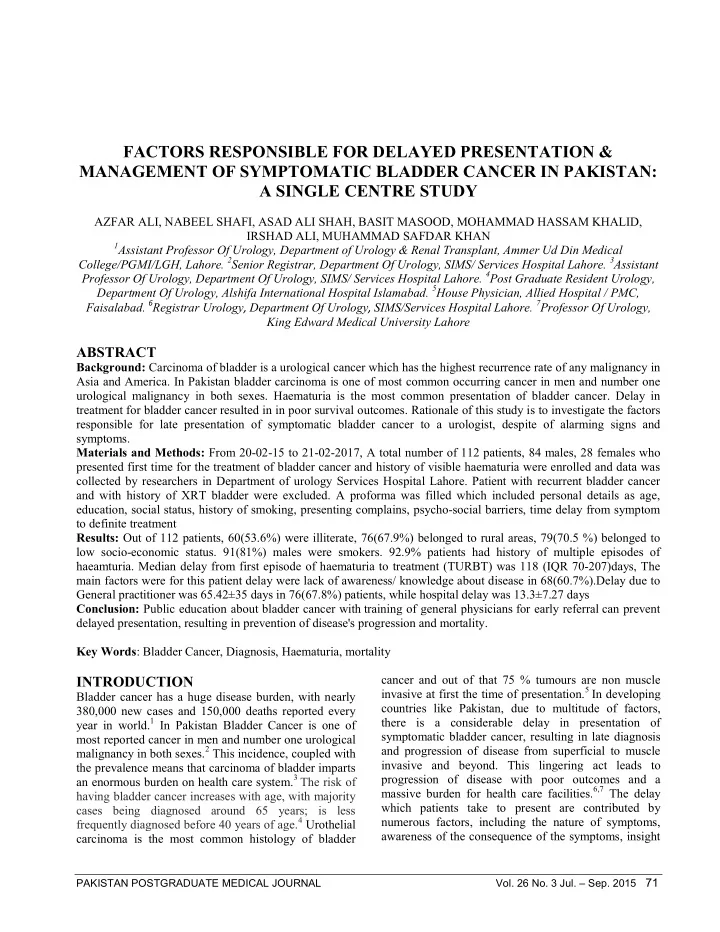
FACTORS RESPONSIBLE FOR DELAYED PRESENTATION & MANAGEMENT OF - - PDF document

factors responsible for delayed presentation amp
SMART_READER_LITE
LIVE PREVIEW

FACTORS RESPONSIBLE FOR DELAYED PRESENTATION & MANAGEMENT OF - - PDF document

FACTORS RESPONSIBLE FOR DELAYED PRESENTATION & MANAGEMENT OF SYMPTOMATIC BLADDER CANCER IN PAKISTAN: A SINGLE CENTRE STUDY AZFAR ALI, NABEEL SHAFI, ASAD ALI SHAH, BASIT MASOOD, MOHAMMAD HASSAM KHALID, IRSHAD ALI, MUHAMMAD SAFDAR KHAN 1


slide-1
SLIDE 1

PAKISTAN POSTGRADUATE MEDICAL JOURNAL

  • Vol. 26 No. 3 Jul. – Sep. 2015 71

FACTORS RESPONSIBLE FOR DELAYED PRESENTATION & MANAGEMENT OF SYMPTOMATIC BLADDER CANCER IN PAKISTAN: A SINGLE CENTRE STUDY

AZFAR ALI, NABEEL SHAFI, ASAD ALI SHAH, BASIT MASOOD, MOHAMMAD HASSAM KHALID, IRSHAD ALI, MUHAMMAD SAFDAR KHAN

1Assistant Professor Of Urology, Department of Urology & Renal Transplant, Ammer Ud Din Medical

College/PGMI/LGH, Lahore. 2Senior Registrar, Department Of Urology, SIMS/ Services Hospital Lahore. 3Assistant Professor Of Urology, Department Of Urology, SIMS/ Services Hospital Lahore. 4Post Graduate Resident Urology, Department Of Urology, Alshifa International Hospital Islamabad. 5House Physician, Allied Hospital / PMC,

  • Faisalabad. 6Registrar Urology, Department Of Urology, SIMS/Services Hospital Lahore. 7Professor Of Urology,

King Edward Medical University Lahore

ABSTRACT

Background: Carcinoma of bladder is a urological cancer which has the highest recurrence rate of any malignancy in Asia and America. In Pakistan bladder carcinoma is one of most common occurring cancer in men and number one urological malignancy in both sexes. Haematuria is the most common presentation of bladder cancer. Delay in treatment for bladder cancer resulted in in poor survival outcomes. Rationale of this study is to investigate the factors responsible for late presentation of symptomatic bladder cancer to a urologist, despite of alarming signs and symptoms. Materials and Methods: From 20-02-15 to 21-02-2017, A total number of 112 patients, 84 males, 28 females who presented first time for the treatment of bladder cancer and history of visible haematuria were enrolled and data was collected by researchers in Department of urology Services Hospital Lahore. Patient with recurrent bladder cancer and with history of XRT bladder were excluded. A proforma was filled which included personal details as age, education, social status, history of smoking, presenting complains, psycho-social barriers, time delay from symptom to definite treatment Results: Out of 112 patients, 60(53.6%) were illiterate, 76(67.9%) belonged to rural areas, 79(70.5 %) belonged to low socio-economic status. 91(81%) males were smokers. 92.9% patients had history of multiple episodes of

  • haeamturia. Median delay from first episode of haematuria to treatment (TURBT) was 118 (IQR 70-207)days, The

main factors were for this patient delay were lack of awareness/ knowledge about disease in 68(60.7%).Delay due to General practitioner was 65.42±35 days in 76(67.8%) patients, while hospital delay was 13.3±7.27 days Conclusion: Public education about bladder cancer with training of general physicians for early referral can prevent delayed presentation, resulting in prevention of disease's progression and mortality. Key Words: Bladder Cancer, Diagnosis, Haematuria, mortality

INTRODUCTION

Bladder cancer has a huge disease burden, with nearly 380,000 new cases and 150,000 deaths reported every year in world.1 In Pakistan Bladder Cancer is one of most reported cancer in men and number one urological malignancy in both sexes.2 This incidence, coupled with the prevalence means that carcinoma of bladder imparts an enormous burden on health care system.3 The risk of having bladder cancer increases with age, with majority cases being diagnosed around 65 years; is less frequently diagnosed before 40 years of age.4 Urothelial carcinoma is the most common histology of bladder cancer and out of that 75 % tumours are non muscle invasive at first the time of presentation.5 In developing countries like Pakistan, due to multitude of factors, there is a considerable delay in presentation of symptomatic bladder cancer, resulting in late diagnosis and progression of disease from superficial to muscle invasive and beyond. This lingering act leads to progression of disease with poor outcomes and a massive burden for health care facilities.6,7 The delay which patients take to present are contributed by numerous factors, including the nature of symptoms, awareness of the consequence of the symptoms, insight

slide-2
SLIDE 2

FACTORS RESPONSIBLE FOR DELAYED PRESENTATION & MANAGEMENT OF SYMPTOMATIC BLADDER CANCER

72 Vol. 26 No. 3 Jul. – Sep. 2015

PAKISTAN POSTGRADUATE MEDICAL JOURNAL

  • f personal risk of cancer, and physical, social and

psychological obstacles to health care.8 Early diagnosis

  • f cancer is dependent on patients presenting with

potential cancer symptoms and on primary care practitioners responding promptly to those symptoms, either by arranging further investigation or referring to higher centers. Delay commonly occurs at three phases during the diagnostic process: 1st; in the interval between the patient first observing a symptom and seeing a doctor (patient delay), 2nd,between first consultation and referral by a G.P (doctor delay) and finally, 3rd , between referral and diagnosis (hospital delay).9 In this study we looked into considerations all

  • f these factors and tailored a questionnaire which

encompassed all the categories and phases. The main driving force behind this study was increasing prevalence and rate of high grade, advanced tumors with huge burden on our health care facilities. To our knowledge no study of this aim and scope has been done in Pakistan for bladder cancer patients. The goal was to identify factors which were evident in delayed presentation of patients to a urologist / specialized unit and to advise strategies; nationwide, to reduce this lag.

MATERIALS AND METHODS

Study Design: Cross sectional study. A total of 112 patient of bladder cancer with history of visible haematuria of either sex were interviewed from 20.02.2015 to 21.02.2017. These patients were admitted through emergency and outdoor department in department of Urology Services Hospital

  • Lahore. The patient with history of recurrent bladder

tumor or history of chemo radiation were excluded. They patients were explained about the motives and goals of this study and assured of no bias or prejudice befalling their management. All the personal data e.g name, address and contact number were assured not to be publicized and informed consent was taken from all before filling up of Performa by assigned doctor. A Performa was filled which included personal details as age, occupation, education, marital status, social status, history of smoking, presenting complains, psycho-social barriers, self-interpretation of symptoms, Service barriers time delay from symptom to presentation, Patient, doctor and hospital delays, operative findings after undergoing surgery with histo-pathological stage

  • f tumor.

RESULTS

Out of 112 patients , male to female ratio was 4:1, 60(53.6%) were illiterate while 32(28.6%) had only primary education(less than 5th class), 20(17.8%)had education more than grade 5, 76(67.8%) belonged to rural area, 78(69.6 %) belonged to low socio-economic status with monthly income less than 15000 Rupees/month, while other 30.3% belonged to middle class with income between 15000-30000 Rupees/month, Table 01: Demographic & Clinical Characteristic of Patients Characteristics Number (%) Total number of Patients Mean Age ± SD Gender Male Female Marital Status Single Married Area Of Living Urban Rural Education Level illiterate Primary Higher (> primary) Smoking Never Smoker Mean duration of smoking Mean pack year Mode of Admission A & E Department Outpatient Department Number of episodes of Haematuria Single Multiple Patient delay(D1) General Practitioner delay(D2) Hospital Delay(D3) Total Delay (D1+D2+D3) 112 54±13.35 84 (75.0%) 28 (25.0%) 04 (03.60%) 108 (96.4%) 36 (32.1%) 76 (87.9%) 60 (53.6%) 32 (28.6%) 20 (17.8%) 37 (33.0%) 75 (66.0%) 10±2 years 240 28 (25.0%) 84 (75.0%) 08 (07.1%) 104 (92.9%) 60 (IQR 56-150) days 65.0±35.0 days 13.3±7.20 days 118 (IQR 70-207) Days No one was in upper social bracket with income > 30000 Rupees per month. 91(81%) males were smokers

slide-3
SLIDE 3

AZFAR ALI, NABEEL SHAFI, ASAD ALI SHAH et al PAKISTAN POSTGRADUATE MEDICAL JOURNAL

  • Vol. 26 No. 3 Jul. – Sep. 2015 73

as compared to 7(6.2%) females. The mean duration of smoking was 10±02 years with 20 cigarettes per day (Table 1). 92.9% patients had history of multiple episodes of haeamturia. Median delay from first episode

  • f haematuria to treatment (TURBT) was 118 (IQR 70-

207)days.(Table 2) Regarding factors for this delay ,84(75.0%) presented late due to patients factors (1st symptom to doctor) with median delay of 60 days(IQR 56-150). The main factors were for this patient delay were lack of awareness/ knowledge about disease in 68(60.7%) , low confidence to see a doctor 16(14.2%) and low socio-economic status 83(74.1%). Around 24 (21.4%) patients found difficulty to find transport or attendant to accompany them to doctor. The mean practitioner delay (General practitioner to Urologist delay D2) was observed in 76 patient with mean delay

  • f 65.42±35 days. Most of patients 36(32.1%) were

treated without any investigation for Haematuria. Only 20(17.9%) patients were directly referred to urologist by General practitioner. The mean hospital delay from 1st O.P.D visit to surgery was 13.3±7.27 days and main causes for this delay was optimization for anesthesia 24(21.4%) & short of operative time in 56 (50.4%)

  • patients. Operative findings showed 67(59.8%) tumors

were papillary, 18(16.0%) were solid, while 27(24.1%) were mixed. In 58 % patients , there was single growth in bladder and size was less than 3 cm in 53% cases. The Histo-pathology data showed Non-Muscle invasive bladder cancer in 81(72.3%) cases while 31(27.6%) were muscle – invasive. Table 02 Details of Delay Variables Numbers (%) 1 Patient Delay D1 84(75.0%) a Symptoms Interpretation 72 (64.2%) i Unawareness about disease / benign disease 68 (94.4%) ii Forgotten & believe that symptoms have gone 04 (05.6%) b Emotional Barrier 24(21.4%) i Not confident to talk about / Too embarrassed 16(66.6%) ii Worried about what doctor might find / fear of cancer 08 (33.3%) c Practical Barrier 28 (25.5%) i Other things to worry about/Too busy 04 (14.3%) ii Difficult to arrange transport / attendant 24 (85.7%) d Service Barrier 26 (23.0%) i Difficult to consult specialist 10(38.5%) ii Fear of not meeting expenses 16 (61.5%) 2 Practitioner delay (D2) 76 (67.85) Symptomatic treatment i Without investigation 36 (47.3%) ii With investigation 04(05.3%) iii First without & then advised investigation 36 (47.3%) 3 Hospital Delay (D3) 80 (71.4%) i Optimization for anesthesia 24 (30.0%) ii Short of operative time 56 (70.0%)

DISCUSSION

Bladder cancer is associated with significant morbidity and mortality.10 Delay treatment is related to overall poor survival outcome. Delay in diagnosis of bladder cancer is an independent risk factor for death due to bladder cancer disease.11 Reasons of delay to definite treatment is complex and multifactorial. Delay means time interval from first symptoms to definite treatment. When we further breakdown this time interval, first delay is by patient that is greater than practitioner delay.12 Women showed more emotional barriers to report her symptoms and on the other hand men have more practical barriers to seek earlier treatment. 13 The most common cause of delays presentation is misinterpretation of symptoms patients with vague symptoms presented as compared to patient with alarming symptoms.14 Bladder cancer patients with Lower urinary symptoms only usually presented late as compared to patients with gross haematuria. Patients assumed that symptoms are due to benign disease rather than cancer. They believed that haematuria is due to just cystitis & remained in state of denial even in repeated

slide-4
SLIDE 4

FACTORS RESPONSIBLE FOR DELAYED PRESENTATION & MANAGEMENT OF SYMPTOMATIC BLADDER CANCER

74 Vol. 26 No. 3 Jul. – Sep. 2015

PAKISTAN POSTGRADUATE MEDICAL JOURNAL

episodes of haematuria. This is also evident from others cancers patients presentations like in breast cancer. Breast cancer patients with palpable mass presented earlier than patients with non-lump symptoms.8 In our study, the misinterpretation was most common reason for delay that was observed 72(64.28%) patients. Financial constraints is next important factors. The patients from low socioeconomic group presented late for cancer treatment.15 This may be due to their priority to fulfil basic day to day needs over to visit doctor for their healthy. Most of our patients (64.3%) were from rural area & they have to travel to big cities for

  • treatment. For that they need an attendant to accompany

to the hospital. To arrange an attendant with limited financial resources leads to further delay in treatment. The next important reason for delayed presentation is related to general practitioner. General physicians , being a front liner health provider are supposed to diagnose malignancy related symptoms and hence early referral to urologist.16 The reasons for practitioner delay are ignorance about cancer related symptoms, misdiagnosis, irrelevant investigations and symptomatic treatment without investigation. Shauli Shahid etal suggested that general practitioner should advised only appropriate investigations for suspicious cancer to facilitate early diagnosis and definite treatment.17 In our cohort, delay in 76(67.8%) patients was due to general

  • physicians. 36(32.1%) patients with symptoms of

haematuria were treated symptomatically without any investigations and this leads to mean delay of 65.42 days±35. Lack of proper structured training of family physicians is main cause of this delay and even no clinical guidelines like NICE guidelines in UK, is available for practitioner in Pakistan.18 No general practitioner is trained about how to investigate a patient

  • f haematuria and which patients required early referral

to urologist. Use of local referral guidelines by local health authorities depending upon available resources may reduce this delay. Limitations of our study are small sample size and single centre study. To reduce this delay, we have to educate public about symptoms of bladder cancer. Richard G Kyle et al investigated the impact of school base intervention about 09 common cancer and he concluded that common cancer symptoms were significantly recognize after just 02 weeks

  • f

education.19 Considering these findings, and based on awareness regarding diseases like polio, hepatitis and T.B, we should revamp our national strategy and initiate awareness programs in educational institutes. Government should collaborate with local urological associations and start programs for training of family physicians, in the form of seminars and workshops. It will require an organised effort on part of all stake holders(government, doctors and general public) but resulting early treatment and decreased morbidity, with lessened healthcare cost, would be extremely beneficial to all.

REFERENCES

1. Knowles MA, Hurst CD. Molecular biology of bladder cancer: new insights into pathogenesis and clinical diversity. Nat Rev Cancer. 2015;15:25-41. 2. Role of intravenous urography and transabdominal ultrasonography in the diagnosis of bladder carcinoma.Rafique M, Javed AA. Int Braz J Urol. 2004;303:185-90. 3. Sievert KD, Amend B, Nagele U, et al. Economic aspects of bladder cancer: what are the benefits and costs? World J Urol 2009;27:295–300. 4. Siegel R, Naishadham D, Jemal A. Cancer statistics, 2012. CA Cancer J Clin. 2012.62:10-29. 5. Burger M,Catto JW,Dalbagni G, Grossman HB, Herr H, Karakiewicz P, et al. Epidemiology and risk factors of urothelial bladder cancer. Eur

  • Urol. 2013;63:234-41.

6. Mommsen S, Aagaard J, Sell APresenting symptoms, treatment delay and survival in bladder

  • cancer. Scand J Urol Nephrol. 1983;17:163-7.

7. Neal RD. Do diagnostic delays in cancer matter? Br J Cancer 2009;101:9–12. 8. Macleod U, Mitchell ED, Burgess C, MacDonald S, Ramirez AJ. Risk factors for delayed presentation and referral of symptomatic cancer: evidence for common cancers. Br J Cancer 2009;101: 92–101 9. Wallace DM, Bryan RT, Dunn JA, Begum G, Bathers S.Delay and survival in bladder cancer. BJU Int. 2002;89(9):868-78.

  • 10. Antoni

S, Ferlay J, Soerjomataram I, Znaor A, Jemal A, Bray F. Bladder Cancer Incidence and Mortality: A Global Overview and Recent Trends. Eur Urol. 2017;71:96-108.

  • 11. Hollenbeck BK, Dunn RL, Ye Z, Hollingsworth

JM, Skolarus TA, Kim SP, et al. Delays in Diagnosis and Bladder Cancer Mortality. Cancer 2010;15:5235-42.

  • 12. Macdonald S, Macleod U, Campbell NC, Weller

D, Mitchell E. Systematic review of factors influencing patient and practitioner delay in diagnosis of upper gastrointestinal cancer. Br J

  • Cancer. 2006;8;94:1272-80
  • 13. Waller J, Robb K, Stubbings S, Ramirez A,

Macleod U, Austoker J, Hiom S, WardleJ. Awareness of cancer symptoms and anticipated

slide-5
SLIDE 5

AZFAR ALI, NABEEL SHAFI, ASAD ALI SHAH et al PAKISTAN POSTGRADUATE MEDICAL JOURNAL

  • Vol. 26 No. 3 Jul. – Sep. 2015 75

help seeking among ethnic minority groups in

  • England. BJC 2009;101:24–30.
  • 14. McCombie SP, Bangash HK, Kuan M, Thyer

I, Lee F, Hayne D. Delays in the diagnosis and initial treatment of bladder cancer in Western

  • Australia. BJU Int. 2017;120:28-34.
  • 15. McCutchan G, Wood F, Smits S, Edwards A,

Brain K. Barriers to cancer symptom presentation among people from low socioeconomic groups: a qualitative study. BMC Public Health 2016;16:1052.

  • 16. McIlfatrick S, Keeney S, McKenna H, McCarley

N, McElwee G. Investigating the role of the general practitioner in cancer prevention: a mixed methods study. BMC Fam Pract. 2013;7:14:58

  • 17. Shahid S, Teng T-HK, Bessarab D, Samar Aoun S,

Baxi S, Thompson SCl. Factors contributing to delayed diagnosis of cancer among Aboriginal people in Australia: a qualitative study. BMJ Open 2016;6:e010909.

  • 18. Rubin

GP,Saunders CL, Abel GA, McPhail S, Lyratzopoulos G, Neal RD. Impact

  • f

investigations in general practice on timeliness of referral for patients subsequently diagnosed with cancer: analysis of national primary care audit

  • data. Br J Cancer. 2015; 17;112:676-87.
  • 19. Kyle RG, Forbat L, Rauchhaus P, Hubbard

G.Increased cancer awareness among British adolescents after a school-based educational intervention: a controlled before-and-after study with 6-month follow-up. BMC Public

  • Health. 2013; 13: 190