FAA reviewed 46 loss of control incidents 734 voluntary reports - - PDF document

faa reviewed
SMART_READER_LITE
LIVE PREVIEW

FAA reviewed 46 loss of control incidents 734 voluntary reports - - PDF document

Della M. Lin, M.D. Senior Fellow, Patient Safety and System Design FAA reviewed 46 loss of control incidents 734 voluntary reports 9000 observed flights Colgan Flight 3407: Pilots programming computers rather than


slide-1
SLIDE 1

Della M. Lin, M.D. Senior Fellow, Patient Safety and System Design

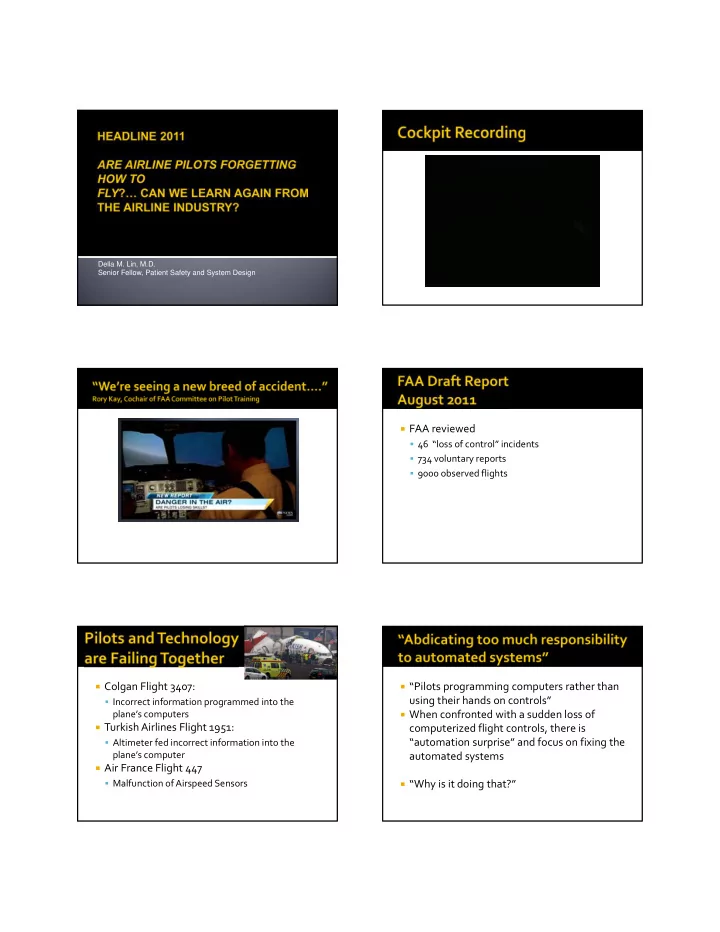
 FAA reviewed

  • 46 “loss of control” incidents
  • 734 voluntary reports
  • 9000 observed flights

 Colgan Flight 3407:

  • Incorrect information programmed into the

plane’s computers

 Turkish Airlines Flight 1951:

  • Altimeter fed incorrect information into the

plane’s computer

 Air France Flight 447

  • Malfunction of Airspeed Sensors

 “Pilots programming computers rather than

using their hands on controls”

 When confronted with a sudden loss of

computerized flight controls, there is “automation surprise” and focus on fixing the automated systems

 “Why is it doing that?”

slide-2
SLIDE 2

Remember the human touch

 Fuel Economy  Efficiency  Accuracy  Smooth Passenger Experience  Narrower Vertical Safety Buffer  GPS Navigation  Autopilot

slide-3
SLIDE 3

 Airlines and Regulators mandate use of autopilot in

most situations

  • Autopilot is off for 80 seconds of a 2 hour commuter flight
  • Autopilot is off for 3 minutes on a typical flight

 Majority of pilots no longer have military

training

  • Manual skills
  • Recognition of a sudden unexpected state

(autopilot off)

Be conscious of latent errors

  • drifts in training
  • protocol/policy making

 Average Starting Salary for Major Airline Pilots is

$36,293

We can’t transform on fumes

slide-4
SLIDE 4

Simulation of “loss of control” stall scenarios Shadowing of Air Traffic Control in Cockpit Review regulations/prohibitions to allow increased manual flying at altitude

Imagine you're driving a car at night. You come down a hill and you feel the cruise control back

  • ff on the gas to prevent the car from going

too fast. Just as you look down at your speed noticing that it is, in fact increasing, a siren and lights go off behind you. A police car has woken you up from your late night drive. Instinctively you kick off the cruise control and apply the brakes. The speedometer indicates you're still accelerating, so you press harder on the brakes. Your car has now decided that because you're trying to slow so quickly, it will shut off the anti‐skid braking system and allow you to use manual brakes. You then skid

  • ff the road and into a ditch.