
SLIDE 1
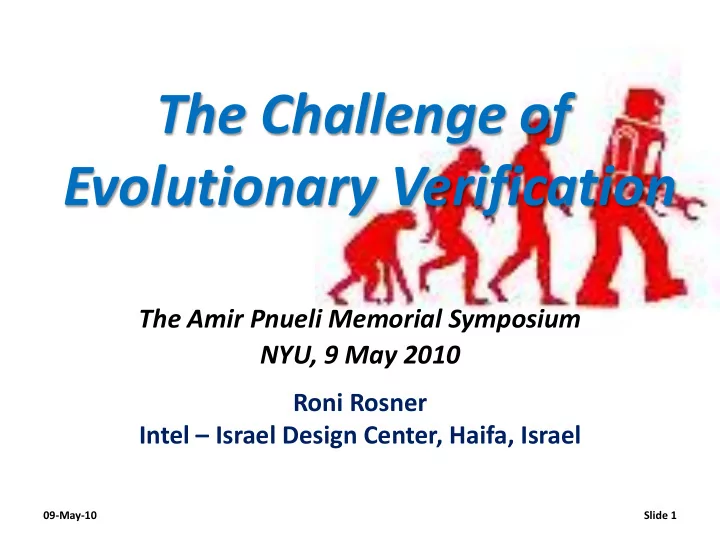
The Challenge of Evolutionary Verification
The Amir Pnueli Memorial Symposium NYU, 9 May 2010
Roni Rosner Intel – Israel Design Center, Haifa, Israel
09-May-10 Slide 1
Evolutionary Verification The Amir Pnueli Memorial Symposium NYU, 9 - - PowerPoint PPT Presentation
The Challenge of Evolutionary Verification The Amir Pnueli Memorial Symposium NYU, 9 May 2010 Roni Rosner Intel Israel Design Center, Haifa, Israel 09-May-10 Slide 1 The Four-Color Theorem 1852 : Guthrie conjectured Every planar map
The Amir Pnueli Memorial Symposium NYU, 9 May 2010
Roni Rosner Intel – Israel Design Center, Haifa, Israel
09-May-10 Slide 1
Every planar map is four-colorable
assembly program on a IBM 370-168 computer
Coq proof checker
Last doubts removed about the proof of the Four Color Theorem
kernel of Coq, using HOL light itself
09-May-10 Slide 2
Even for most non-typically well defined problem - math, formalization and verification are not so easily attainable
1976 layers
VM!)
2004 layers
09-May-10 Slide 3
2010 layers
Dynamic aspects
scripts
09-May-10 Slide 4
The interfaces between abstraction layers as well as inside layers get more complex, dynamic and unstable – more reasons for doubts!!!
09-May-10 Slide 5
– Given model, system, assumptions, specification – Apply an algorithmic verification process – Desired correctness outcome: once proved - done forever
– Systems evolve, assumptions change – Underlying models adapt, correctness criteria get refined – Verification methods improve, adjust – Correctness concerns are never fully satisfied
– System’s fast evolution and complexity make it increasingly inefficient / impossible to target system time-snapshots by isolated verification tasks
09-May-10 Slide 6
Challenge: Extend the scope of formal-methods research from (isolated) verification tasks to the context of (evolutionary) verification process This requires the development of a formal framework that can adapt to and express the evolution of
… and their ongoing integration into the implementation process.
09-May-10 Slide 7
Strongly Inspired by some of Amir Pnueli’s Major Contributions
09-May-10 Slide 8
Transformational System Reactive System Adding time and state to the system and its spec Verification Task Verification Task
Valid! Valid!
Input
Input*
Evolving System Verification Process
Valid for P!
Compiler Verification Task
Input P
Adding time and state to the verification process??? Adding laziness to the verification process
– Systems are too complex to fully verify in advance – System’s (at least initial) reaction/output is required earlier than full verification can complete
– Just in time (JIT) compilation – Dynamic binary optimizers (DBO) – Virtualization layers
09-May-10 Slide 9
– System behavior is changing dynamically – Modes of operations / usage environments are amorphous / not known in advance
– WEB applications, e.g. Java scripts – Viruses and anti viruses – Operating systems – Server networks – Cloud computing
09-May-10 Slide 10
– Optimized systems – Explicit interfaces (e.g. ISA, programming model) are preserved, yet implicit assumptions of the applications are broken – Knowledge of implementation details enables unexpected attacks
– Side channel attack on the Secure Socket Layer (SSL) protocol (protecting online transactions) – Exploits intimate knowledge of HW optimizations such as caches and branch prediction – Exploit intimate knowledge of the algorithmic implementation of the protocol – Utilize “innocent” OS features such time sharing to “spy” into the protocol – Gain observability into tiny timing effects uncovering the private key
09-May-10 Slide 11
characteristics in common
– Complexity – Impossibility to validate in advance – A sense of continuous struggle for correctness – Need to tolerate intermediate failures
evolutionary model?
– Specification, verification are building blocks of the continuous design process
– How to manage the evolving specification, correctness status – What to do about incorrect output? – How to fix a failing system? – How to improve verification over time (learn)?
09-May-10 Slide 12
– Addressing some fundamental questions about the very nature of formal models
formal model?
– Allowing for better design engineering
09-May-10 Slide 13
– Separation of concerns
– Assertions – Artificial intelligence methods – SHADOWS
– Bounded model checking
symposium
09-May-10 Slide 14
09-May-10 Slide 15