EthPloit : From Fuzzing to Efficient Exploit Generation against - - PowerPoint PPT Presentation

ethploit from fuzzing to efficient exploit generation
SMART_READER_LITE
LIVE PREVIEW

EthPloit : From Fuzzing to Efficient Exploit Generation against - - PowerPoint PPT Presentation

EthPloit : From Fuzzing to Efficient Exploit Generation against Smart Contracts Qingzhao Zhang 1,2 , Yizhuo Wang 1 , Juanru Li 1 , Siqi Ma 3 1 Shanghai Jiao Tong University , China 2 University of Michigan , America 3 Data 61, CSIRO , Australia


slide-1
SLIDE 1

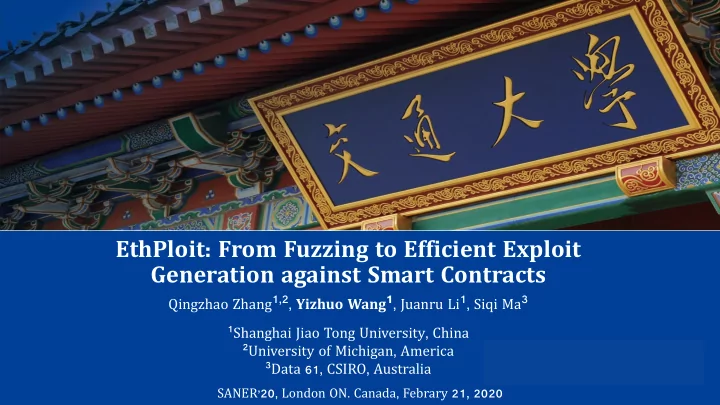
EthPloit: From Fuzzing to Efficient Exploit Generation against Smart Contracts

Qingzhao Zhang1,2, Yizhuo Wang1, Juanru Li1, Siqi Ma3

1Shanghai Jiao Tong University, China 2University of Michigan, America 3Data 61, CSIRO, Australia

SANER’20, London ON. Canada, Febrary 21, 2020

slide-2
SLIDE 2

Contents

1

Background

2 3 4 5

Motivation EthPloit Fuzzer Evaluation Conclusion

slide-3
SLIDE 3

Contents

1

Background

2 3 4 5

Motivation EthPloit Fuzzer Evaluation Conclusion

slide-4
SLIDE 4

▪ A programmable blockchain ▪ A platform for decentralized applications.

Overview of Ethereum

▪ A transaction-based state machine ▪ The heart is Ethereum Virtual Machine (EVM) ▪ Based on Turing-complete programming language (Solidity) In General In Detail

8 Eth 6 Eth 5 Eth Ethereum is the second-largest blockchain system

slide-5
SLIDE 5

▪ A programmable blockchain ▪ A platform for decentralized applications.

Overview of Ethereum

▪ A transaction-based state machine ▪ The heart is Ethereum Virtual Machine (EVM) ▪ Based on Turing-complete programming language (Solidity) In General In Detail

8 Eth 6 Eth 5 Eth

Blockchain level EVM level Contract level

Ethereum is the second-largest blockchain system

slide-6
SLIDE 6

▪ Source code written in Solidity ▪ Compiled by Solc to get bytecode ▪ Bytecode run on EVM

Smart Contract

Contract Code ▪ Created by External Owned Account ▪ Executed on incoming transactions Contract Action

External Owned Account

Address storage code Balance

Contract Account

Address Balance

Crowdfunding

Schemes

Shared Wallets Games

slide-7
SLIDE 7

▪ From: Sender’s Address ▪ To: Receiver’s Address ▪ Value: Amount of Currency ▪ Data: Various situations

▪ Empty (just transfer currency) ▪ Init code of contract ▪ Called function with arguments

Transaction

Basic Fields

Balance Balance storage Result

EVM

Call a function

  • f contract

▪ Change the balance ▪ Update the storage

  • - State variable

Run the code

Simulate a scene

slide-8
SLIDE 8

According to the cause of damages: ▪ Balance Increment ▪ Self-destruction ▪ Code Injection

Exploitation of Smart Contract

Balance

Balance

storage

What is the exploitation Categories of exploitation ▪ From attacker to target contract ▪ A sequence of transactions

Attacker

EVM

TXn-1 TXn-2

TX1 TX0

Exploit

slide-9
SLIDE 9

▪ Misuse of this.balance ▪ Unlimited profit

Exploitable Vulnerabilities

Unchecked Transfer Value Vulnerable Access Control

Exposed Secret

▪ Newly identified vulnerability ▪ Previous tools cannot exploit ▪ Missing & misuse of check

  • before sensitive operation
slide-10
SLIDE 10

▪ Misuse of this.balance ▪ Unlimited profit

Exploitable Vulnerabilities

Unchecked Transfer Value Vulnerable Access Control

Exposed Secret

▪ Newly identified vulnerability ▪ Previous tools cannot exploit ▪ Missing & misuse of check

  • before sensitive operation

Secret checker Secret setter

slide-11
SLIDE 11

▪ Misuse of this.balance ▪ Unlimited profit

Exploitable Vulnerabilities

Unchecked Transfer Value Vulnerable Access Control

Exposed Secret

▪ Newly identified vulnerability ▪ Previous tools cannot exploit ▪ Missing & misuse of check

  • before sensitive operation

Secret checker Secret setter

Attackers inspect the secret from the data of previous transactions Attackers break the secret checking to gain profit

slide-12
SLIDE 12

Contents

1

Background

2 3 4 5

Motivation EthPloit Fuzzer Evaluation Conclusion

slide-13
SLIDE 13

Goal of the Work

Unchecked Transfer Value Vulnerable Access Control Exposed Secret

Vulnerabilities Detected

Vulnerabilities Exploited

Fuzzing Efficient Exploit Generation

slide-14
SLIDE 14

Challenges of Exploit Generation

Challenge-1: Unsolvable Constraint

Condition restricting sensitive operations

  • Involve complicated operation like hash

Previous tools (e.g., Teether, Mythril) rely on SMT solver

  • Cannot solve cryptographic constraint
  • Ignore the runtime value
  • not stored in contract state

< Situation in smart contract > < Previous solution>

slide-15
SLIDE 15

Challenges of Exploit Generation

Challenge-2: Blockchain Effects

Blockchain effects of blockchain system affect the execution of smart contracts

  • E.g., blockchain properties

Previous tools have difficulties on manipulating blockchain effect:

  • Lack of considering the syntax
  • f blockchain properties

e.g., invalid timestamp

  • Ignore the possibility of call

reverting, thus lose coverage e.g., Teether, ContractFuzzer < Situation in smart contract > < Previous solution>

slide-16
SLIDE 16

Our Solution

Feedback of runtime value Manipulation of blockchain execution Record the runtime values of arguments and variables ▪ Create a blank seed set ▪ Update the seed set ▪ Use for the next generation By instrumenting the execution environment Indicated information: ▪ Execution history ▪ e.g., the hash image ▪ State of the contract ▪ i.e., the state variable Fuzzing EthPloit: a smart contract specific fuzzer

slide-17
SLIDE 17

Contents

1

Background

2 3 4 5

Motivation EthPloit Fuzzer Evaluation Conclusion

slide-18
SLIDE 18

Workflow of EthPloit 1 2 5 3 4

slide-19
SLIDE 19

Taint Analyzer

1

Workflow

Extract variable-level dependencies ▪ Variable-Data Dependency ▪ Variable-Control Dependency EthPloit applies static taint analysis to discover dependencies of modifying contract states: ▪ Generate control flow graph ▪ Label taint sources and sinks ▪ Perform taint propagation Knowledge of dependencies of modifying contract state improves fuzzing efficiency

slide-20
SLIDE 20

Taint Analyzer

1

Workflow

Extract variable-level dependencies ▪ Variable-Data Dependency ▪ Variable-Control Dependency EthPloit applies static taint analysis to discover dependencies of modifying contract states: ▪ Generate control flow graph ▪ Label taint sources and sinks ▪ Perform taint propagation Knowledge of dependencies of modifying contract state improves fuzzing efficiency

slide-21
SLIDE 21

Test Case Generator

2

Workflow

Function Selection Arguments Generation Blockchain Properties Generation

Taint Relation Graph

Optimize the test case by analyzing how inputs affect the execution of exploits Extend in-function dependencies to dependencies among functions ▪ Add suitable functions into a set of candidates ▪ Select function from candidates based on probability distribution ▪ From pseudo-random generator ▪ From dynamic seed set Based on Instrumented EVM Environment

slide-22
SLIDE 22

Instrumented EVM Environment

3 EthPloit environment ▪ Based on remix-debugger ▪ Deploy contract ▪ Execute transaction ▪ Extract full execution trace Compared to private Ethereum chain ▪ More light-weight ▪ More flexible for configure Three instrumentations Configure accounts

  • For each test case

Configure block properties

  • For each execution of transaction

Force external calls to revert

  • For each external call
  • Revert the 2nd execution of call

Workflow

slide-23
SLIDE 23

Trace Analyzers

Coverage Guider 4 Balance Increment oracle

▪ If attackers’ balance is increased

Self-Destruction oracle

▪ If the opcode SELFDESTRUCTION is found

Code Injection oracle

▪ If opcodes CALLCODE, DELEGATECALL are found ▪ If destination is controlled by attackers

Exploit Detector Measure the progress of exploit-

  • riented fuzzing

Construct feedback as rewards

𝑸 𝒈 = 𝒅𝟏 + 𝑶𝒅 𝑶𝒖 𝒅𝟐 − 𝒅𝟏 Workflow

Critical instruction coverage Feedback construction

▪ Seed feedback ▪ Function distribution feedback

slide-24
SLIDE 24

Feedback Handler

Dynamic Seed Strategy 5

Workflow

Aim to guide the test case generator to produce proper function arguments For the whole process of fuzzing

▪ Perform more mutation based on interesting cases ▪ Select global seeds which have a lifetime during fuzzing one contract ▪ All arguments of interesting cases causing coverage increment

For each test case

▪ Make use of connections among transactions ▪ Select local seeds after each execution of transaction: ▪ Previous arguments ▪ State variables ▪ I/O of complicated calls ▪ Constant values

slide-25
SLIDE 25

Workflow of EthPloit 1 2 5 3 4

slide-26
SLIDE 26

Contents

1

Background

2 3 4 5

Motivation EthPloit Fuzzer Evaluation Conclusion

slide-27
SLIDE 27

Environment

Dataset

Totally 45,308 contracts Teether[1] and MAIAN[2] with a timeout of 5 minutes

Comparison Environment

Two 3.60GHz Xeon CPUs with 128GB RAM

Fuzzing Configuration

▪ Maximum test cases as 1,000 ▪ Maximum length as 3 for each case

[1] Krupp, Johannes, and Christian Rossow. "teether: Gnawing at ethereum to automatically exploit smart contracts." 27th {USENIX} Security Symposium ({USENIX} Security 18). 2018. [2] Nikolić, Ivica, et al. "Finding the greedy, prodigal, and suicidal contracts at scale." Proceedings of the 34th Annual Computer Security Applications Conference. 2018.

slide-28
SLIDE 28

Evaluation of Contract Exploit

EthPloit ▪ Totally generated 644 exploits ▪ No false positive, verified using real-world EVM

▪ 600 Balance Increment, 59 Self-destruction, 4 Code Injection

Teether / MAIAN ▪ unable to analyze 5,123 contracts and 102 contracts ▪ Teether generated 14 false positive ▪ MAIAN cannot exploit lots of vulnerable contracts

slide-29
SLIDE 29

Evaluation of Contract Exploit

Summary of exploits generated based on triggered vulnerabilities

EthPloit

▪ For Exposed Secret, 104 out of 112 exploits have cryptographic checks in the execution path ▪ For Unchecked Transfer Value, 144 out of 351 exploits are caused by Unlimited Profit

Comparison ▪ EthPloit has huge advantage over teether and MAIAN

  • Especially in exploiting Exposed Secret and Unchecked Transfer Value
slide-30
SLIDE 30

Evaluation of Contract Exploit Tools Cryptographic Checks Unlimited Profit EthPloit

104 144

Teether 30 MAIAN 31 Dynamic Seed Strategy: ▪ Fetch secret value ▪ Solve hash checks Instrumented EVM Environment : ▪ simulate block properties ▪ Exploit lottery games

▪ block properties as random seed

Summary of exploits generated based on two typical vulnerabilities

slide-31
SLIDE 31

Impact of Vulnerabilities Identified Exposed Secret exploited in total: 32 contract, lost 37.3 ETH, about $6,485 Unchecked Transfer Value & Vulnerable Access Control affect lots of widely used contracts, e.g., DailyRoi:

4,888 transactions, maximum balance of 397.1 ETH ($87k)

Information of typical contracts exploited by EthPloit

slide-32
SLIDE 32

Evaluation of Core Techniques

Benchmarks : newly discovered 554 exploitable contracts Four different configuration of EthPloit:

  • Without EVM instrumentation
  • Without dynamic seed strategy
  • Without taint constraints
  • Baseline: All techniques are enabled

Benchmark is tested for 10 times under each configuration, respectively

1 2 3

slide-33
SLIDE 33

Evaluation of Core Techniques

Number of generated exploits under various configuration Without dynamic seed strategy

EthPloit miss most Exposed Secret

Without EVM instrumentation

EthPloit miss 69 Unchecked Transfer Value

slide-34
SLIDE 34

Evaluation of Core Techniques

Use the number of test cases to represent fuzzing efficiency

  • The overall fuzzing efficiency is damaged when taint analysis is removed
  • With taint constraints, over 90% exploits can be found in 100 test cases

Count of exploits with regards to count of test cases

slide-35
SLIDE 35

Contents

1

Background

2 3 4 5

Motivation EthPloit Fuzzer Evaluation Conclusion

slide-36
SLIDE 36

Conclusion

Design EthPloit

Automatically generate exploits of contracts Deploy light-weight approaches to solve:

▪ Unsolvable Constraints ▪ Blockchain Effects Fuzz 45,308 contracts in real world Introduce a new vulnerability: Exposed Secret

1 2 3 4

slide-37
SLIDE 37

In memory of medical staff who bravely fight COVID

During the new coronavirus infection in 2020:

  • Li Wenliang and 8 other doctors died of illness
  • More than 3,000 health workers infected

Pay the highest respect to all the medical staff !

slide-38
SLIDE 38

Thank you & Question ?