Estimating with uncertainty 1 0.5 Chapter 4 X = 13.5 5 10 15 - - PowerPoint PPT Presentation

estimating with uncertainty
SMART_READER_LITE
LIVE PREVIEW

Estimating with uncertainty 1 0.5 Chapter 4 X = 13.5 5 10 15 - - PowerPoint PPT Presentation

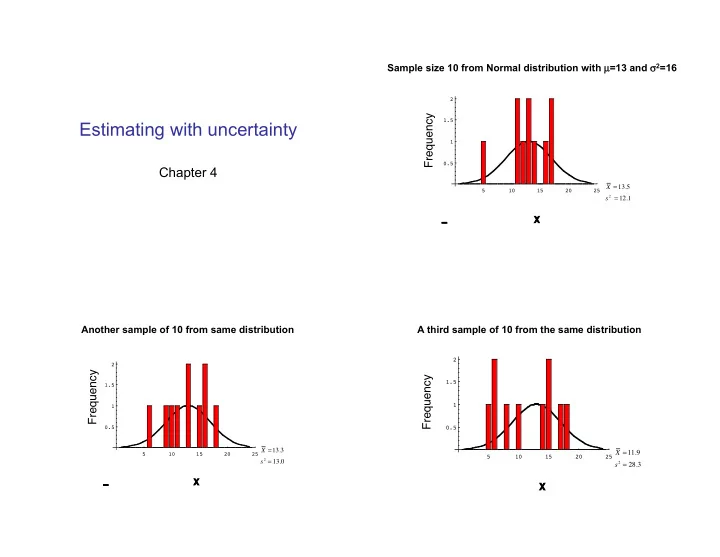
Sample size 10 from Normal distribution with =13 and 2 =16 2 Frequency 1.5 Estimating with uncertainty 1 0.5 Chapter 4 X = 13.5 5 10 15 20 25 s 2 = 12.1 _ X Another sample of 10 from same distribution A third sample of 10


slide-1
SLIDE 1

Estimating with uncertainty

Chapter 4

5 10 15 20 25 0.5 1 1.5 2

X = 13.5

s 2 = 12.1

_ X

Sample size 10 from Normal distribution with µ=13 and 2=16

Frequency

Another sample of 10 from same distribution

5 10 15 20 25 0.5 1 1.5 2

X =13.3 s 2 = 13.0

_ X

Frequency

A third sample of 10 from the same distribution

5 10 15 20 25 0.5 1 1.5 2

X =11.9 s 2 = 28.3

X

Frequency

slide-2
SLIDE 2

Distribution of the means of 1000 samples, each of sample size 10

  • A sample of 100 from the same population distribution

Sam Sampl pl e e siz ize e 100 100

5 10 15 20 25 2 4 6 8 10 12

X =13.0 s 2 = 15.6

X

Frequency

Sam Sampl pl e e siz ize e 1000 1000

5 10 15 20 25 20 40 60 80 100

X =12.9 s 2 = 16.3

X

Frequency

A sample of 1000 from the same population distribution

Distribution of the means of 1000 samples, each of sample size 100

slide-3
SLIDE 3

n = 100 n = 10 Variation in sample means decreases with sample size

1000 samples each

The standard error of an estimate is the standard deviation of its sampling

  • distribution. The standard

error predicts the sampling error of the estimate.

µ = 67.4 = 3.9 SD =1.7 mean = 67.4

N

Standard error of the mean

Y = n

slide-4
SLIDE 4

µ = 67.4 = 3.9

µY = µ = 67.4 Y = n = 3.9 5 =1.7

SD =1.7 mean = 67.4

N

The math works! The problem is, we rarely know .

  • Estimate of the standard error
  • f the mean

SEY = s n

This gives us some knowledge of the likely difference between our sample mean and the true population mean. µ = 67.4

= 3.9

N

In most cases, we dont know the real population distribution. We only have a sample.

SEY = s n = 3.1 5 =1.4

We use this as an estimate of Y

s = 3.1 Y = 67.1

Confidence interval

The 95% confidence interval provides a plausible range for a parameter. All values for the parameter lying within the interval are plausible, given the data, whereas those outside are unlikely.

slide-5
SLIDE 5

The 2SE rule-of-thumb

The interval from - 2 to + 2 provides a rough estimate of the 95% confidence interval for the mean.

SEY SEY Y Y

(Assuming normally distributed population and/or sufficiently large sample size.)

Use correct language when talking about confidence intervals

Not correct: “There is a 95% probability that the population mean is within a particular 95% confidence interval” Correct: “95% of all 95% confidence intervals calculated from samples include the population mean.”

  • r:

“We are 95% confident that the population mean lies within the 95% confidence interval.”

Sample means of gene sizes

slide-6
SLIDE 6

Confidence interval

US counties with high kidney cancer death US counties with low kidney cancer death Variation in cancer rates decreases with population size of counties

Wainer (2007) The most dangerous equation. American Scientist 95: 249-256.

slide-7
SLIDE 7

Pseudoreplication

The error that occurs when samples are not independent, but they are treated as though they are.

Example: Pseudoreplication

You are interested in average pulse rate of mountain

  • climbers. Since they are hard to find, you decide to take

10 measurements from each climber. You study 6 climbers, so you have 60 measurements. What is your sample size (n)?

Avoiding pseudoreplication

You are interested in average pulse rate of mountain

  • climbers. Since they are hard to find, you decide to take

10 measurements from each climber. You study 6 climbers, so you have 60 measurements. Take the mean blood pressure for each climber, so that you have 6 pulse rates, one for each climber (n = 6).