Essential Hypertension Historical Perspectives The treatment of - - PowerPoint PPT Presentation

essential hypertension
SMART_READER_LITE
LIVE PREVIEW

Essential Hypertension Historical Perspectives The treatment of - - PowerPoint PPT Presentation

Essential Hypertension Historical Perspectives The treatment of hypertension itself is a difficult and almost hopeless task, and in fact for aught we know...the hypertension may be an important compensation mechanism which should not


slide-1
SLIDE 1

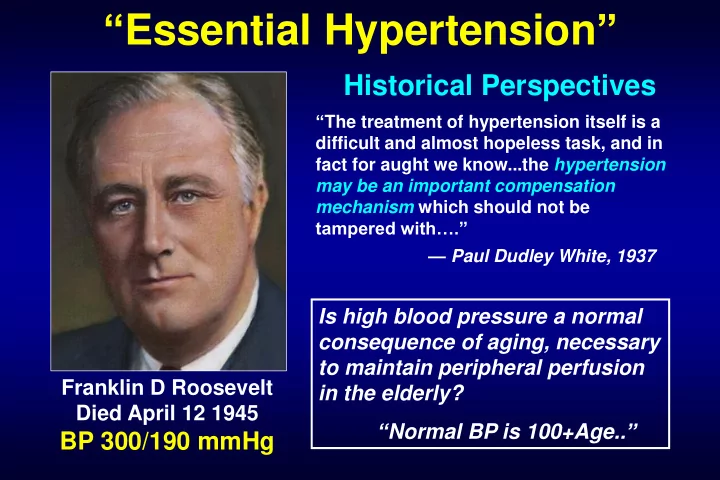
“Essential Hypertension”

Franklin D Roosevelt Died April 12 1945

BP 300/190 mmHg

Historical Perspectives

“The treatment of hypertension itself is a difficult and almost hopeless task, and in fact for aught we know...the hypertension may be an important compensation mechanism which should not be tampered with….” — Paul Dudley White, 1937

Is high blood pressure a normal consequence of aging, necessary to maintain peripheral perfusion in the elderly? “Normal BP is 100+Age..”

slide-2
SLIDE 2

Hypertension Contributes to the Development of Cardiovascular Disease

Framingham Heart Study Follow-Up of Participants Aged 35-64 years for 36 years

slide-3
SLIDE 3

Hypertension Remains Common

World population is 6 Billion 1 in 6 have a Mobile phone 1 in 6 have Hypertension

slide-4
SLIDE 4

IHD mortality (floating absolute risk and 95% CI) Usual SBP (mm Hg) Prospective Studies Collaboration. Lancet. 2002;360:1903-1913. 120 140 160 180 256 128 64 32 16 8 4 2 1 SBP 40-49 y Age at risk: 70-79 y 60-69 y 50-59 y 80-89 y Usual DBP (mm Hg) 70 80 90 110 100 256 128 64 32 16 8 4 2 1 DBP

Ischemic Heart Disease Mortality Rate in Each Decade of Age

slide-5
SLIDE 5

Stable Angina (n=3949) Myocardial Infarction (n=4486) Ischaemic Stroke (n=937) Cerebral Haemorrhage (n=434)

Rapsomaniki Lancet 2014; 383: 1899-1911

CV complications of BP in the population(>1m Subjects)

slide-6
SLIDE 6

BP-Lowering Treatment Trialists

RR of Outcome Event

Stroke

Systolic BP Difference Between Randomized Groups (mm Hg) 0.25 0.50 0.75 1.00 1.25 1.50

  • 10
  • 8
  • 6
  • 4
  • 2

2 4 Systolic BP Difference Between Randomized Groups (mm Hg) 0.25 0.50 0.75 1.00 1.25 1.50

  • 10
  • 8
  • 6
  • 4
  • 2

2 4

CHD

A = CA vs placebo; B = ACE inhibitor vs placebo; C = more intensive vs less intensive blood- pressure- lowering; D = ARB vs control; E = ACE inihibitor vs CA; F = CA vs diuretic or β-blocker; G = ACE inhibitor vs diuretic and β-blocker.

RR of Outcome Event A B C D EF G A B C D E F G

BP Lowering Treatment Trialists’ Collaboration. Lancet. 2003;362:1527-1535.

slide-7
SLIDE 7

What is new about BP detection and pathophysiology?

slide-8
SLIDE 8

ABPM for the Diagnosis of Hypertension

 ABPM is a better predictor of clinical

  • utcomes than clinic BP

 ABPM is the reference standard used in

clinical practice when there is uncertainty about the diagnosis

 ABPM improves the specificity and

sensitivity of diagnosis versus clinic and home BP measurement

 Avoids treatment in people who are not

hypertensive – as many as 25% with “white coat hypertension”

slide-9
SLIDE 9

Net Resource Costs of Implementing ABPM for Diagnosis of Hypertension for England and Wales

http://guidance.nice.org.uk/CG127

slide-10
SLIDE 10

MUCH: Masked Untreated

Hypertension 31% of apparently controlled Patient with Hypertension (< 140/90 mmHg) in the

  • ffice have elevated ABPM

values during 24 hours

Banegas Eur Heart 2014

slide-11
SLIDE 11

Masked Hypertension has poor prognosis…

Angeli et al. Am J Hypertens 2010; 23:941-948

slide-12
SLIDE 12

BP Is Variable: 24h Short-term

Thomas N Engl J Med 2006; 354: 2368-74

30 60 90 120 150 180 210 240

Dipper Daytime BP HMBP

BP Variability

24h Average BP Clinic BP Morning BP Nighttime BP

Noon 3 PM 6 PM 9 PM Midnight 3 AM 6 AM 9 AM

slide-13
SLIDE 13

Rothwell Lancet 2010; 375: 895–905

Visit-to-visit variability in SBP and maximum SBP are strong predictors of stroke, independent of mean SBP. Increased residual variability in SBP in patients with treated hypertension is associated with a high risk of vascular events.

slide-14
SLIDE 14

Webb Lancet 2010

slide-15
SLIDE 15

What have we learnt about BP treatment?

slide-16
SLIDE 16

Cost Effectiveness of Antihypertensive Treatment 2011

“Treating high blood pressure is cheaper than doing nothing”

Base case results |(65-year-old, 2% cardioscular risk, 1.1% diabetes risk, 1% HF risk)

QALYs = quality-adjusted life years

slide-17
SLIDE 17

Combining antihypertensive agents is more efficacious than uptitration of monotherapy

Wald Am J Med 2009; 122: 290–300

Beta blocker ACE inhibitor Calcium channel blocker Thiazide

Incremental SBP reduction ratio

  • f observed to expected additive effects

1.4 1.2 1.0 0.8 0.6 0.4 0.2

All Classes

1.04 (0.88–1.20) 1.00 (0.76–1.24) 1.16 (0.93–1.39) 0.89 (0.69–1.09) 1.01 (0.90–1.12) 0.19 (0.08–0.30) 0.23 (0.12–0.34) 0.20 (0.14–0.26) 0.37 (0.29–0.45) 0.22 (0.19–0.25)

Adding a drug from another class (on average standard doses) Doubling dose of same drug (from standard dose to twice standard)

slide-18
SLIDE 18

Most patients require combination therapy to achieve their target BP

slide-19
SLIDE 19

19% fewer CVD events with good adherence to anti HT Rx

Chowdhury et al EHJ (2013) 34, 2940–2948

slide-20
SLIDE 20

NICE Guidelines 2011

Antihypertensive Drug Treatment

Aged <55yrs Aged ≥55yrs Step 1

A C* A + C* A + C + D

A + C + D + Further Diuretic+

Consider specialist Advice Step 2 Step 3 Step 4

Resistant Hypertension

A = ACEi or ARB C = CCB D = Thiazide-like diuretic C* = CCB preferred but D is an alternative in people intolerant of C or at high risk of heart failure Further Diuretic: Consider low dose spironolactine or higher dose thiazide

slide-21
SLIDE 21

Summary of Questions

Pathway 1

Could aggressive early treatment of raised blood pressure prevent subsequent treatment resistance?

Pathway 2

Is resistant hypertension usually due to excessive Na+ retention? Is spironolactone superior to other potential add on drugs?

Pathway 3 Are K+ sparing diuretics neutral or beneficial in their effect on glucose tolerance?

slide-22
SLIDE 22

PATHWAY 2:Home systolic and diastolic blood pressures comparing spironolactone with each of the other cycles

Williams Lancet Published Online September 21, 2015

slide-23
SLIDE 23

How to get best benefit from treatment

  • f Hypertension?

Lower? Broader? Earlier?

slide-24
SLIDE 24

"Will lower blood pressure reduce the risk of heart and kidney diseases, stroke, or age-related declines in memory and thinking?"

Systolic Blood Pressure Intervention Trial

slide-25
SLIDE 25

SPRINT: Research Question

Examine effect of more intensive high blood pressure treatment than was recommended

Randomized Controlled Trial Target Systolic BP

Intensive Treatment Goal SBP < 120 mm Hg Standard Treatment Goal SBP < 140 mm Hg

slide-26
SLIDE 26

Cumulative Hazards for SPRINT Primary Outcome and All-Cause Mortality in Participants 75 and Older

slide-27
SLIDE 27

BP Measurement in 2013 ESH-ESC Hypertension Guidelines:

“If feasible, automated recording of multiple BP readings in the office with the patient seated in an isolated room … might be considered as a means to improve reproducibility and make

  • ffice BP values closer to those provided by

daytime ABPM or HBPM …”

European Heart Journal (2013) 34, 2159–2219

slide-28
SLIDE 28
slide-29
SLIDE 29

Optimal Blood Pressure Lowering in Coronary Artery Disease Patients: Blood Pressure In CAD Is There A J Curve Phenomenon? The Clarify Study

  • P. G. STEG. (Paris, FR), FP 5732
slide-30
SLIDE 30

Study Design and Objectives

 Prospective longitudinal registry study of

  • utpatients with stable CAD in 45 countries,

treated for hypertension  They used an arithmetic mean of all BP values measured throughout follow-up, with a Cox proportional hazards model, adjusted for all CV risk factors and treatments  Primary outcome: composite of death, MI or stroke  Secondary outcome: Each primary component, all cause death or hospitalised heart failure

  • P. G. STEG. (Paris, FR), FP 5732
slide-31
SLIDE 31

Primary Outcome as a function of achieved BP

  • P. G. STEG. (Paris, FR), FP 5732
slide-32
SLIDE 32

But…Hypertension is more than just Blood Pressure!

slide-33
SLIDE 33

640M also have other uncontrolled CV risk factors

80%

800 million people (1 in 8) have a BP ≥140/90 mmHg

Coexistence of Multiple CV Risk Factors

slide-34
SLIDE 34

Hypertension

Increased Triglycerides Decreased HDL-Cholesterol Small Dense LDL-Cholesterol Hyperuricaemia Impaired Glucose tolerance Increased Visceral Fat Insulin Resistance Fatty Liver

The Hypertensive Metabolic Phenotype

slide-35
SLIDE 35

Pathophysiology: Additive Effect of Cholesterol and BP on CHD Risk

Neaton et al. Arch Intern Med. 1992;152:56-64. 142+ 125-131 <182 182-202 203-220 221-244 <118 118-124 132-141

34 21 13 6 23 12 10 6 18 11 9 6 4 17 8 8 6 3

Deaths /10,000 Patient-years

245+

14 5 6 3 12 17

N=316,099

slide-36
SLIDE 36

ASCOT-LLA: non-fatal MI and fatal CHD

Sever PS, et al. Lancet 2003;361:1149–58

slide-37
SLIDE 37

Combined Effect of LDL-C and SBP

  • n Cardiovascular Events
  • B. Ference (Plymouth, US), FP 3163

N = 14,368 Major Vascular Events

slide-38
SLIDE 38

What is the best approach to modern treatment

  • f blood pressure to reduce risk?

 RAS blockade – ARB to reduce/regress structural

damage, reduce inflammation and perhaps reduce risk of developing diabetes +

 CCB (Amlodipine) – complements ARB (potent BP

reduction) and optimally reduces BP variability

+

 Statin for most hypertensives – irrespective of

baseline cholesterol to reduce cardiac and stroke risk

slide-39
SLIDE 39

How Early Should We Treat Blood Pressure?

slide-40
SLIDE 40

ALSPAC: Vascular Risk Factors at 9-11 yrs v. BMI

5 4 3 2 1

Cholesterol (mmol/L)

15 20 25 30 BMI (Kg/m2) HDL Cholesterol Non-HDL Cholesterol 120 100 80 60

Blood pressure (mm Hg)

15 20 25 30 BMI (Kg/m2) Diastolic Systolic

slide-41
SLIDE 41

Childhood Obesity and Premature Death

Franks NEJM 2010 363;6 485-493

 Glucose Intolerance

1 v. 4th quartile 73% higher deaths  Childhood Hypertension 1 v. 4th quartile 57% higher deaths

slide-42
SLIDE 42

Impact of High-Normal Blood Pressure on Risk

  • f Major Cardiovascular Events* in Men

Vasan RS. N Engl J Med. 2001;345:1291-1297. Cumulative Incidence of Major CV Events (%)

16 12 10 8 6 4 2 14 2 4 6 8 10 12

Time (Years) Optimal

<120/80 mm Hg

Normal

120–129/80–84 mm Hg

High-Normal

130–139/85–89 mm Hg

Blood Pressure:

slide-43
SLIDE 43

BMI and Hypertension: Johns Hopkins Precursor Study

Shihab Circulation. 2012; 126: 2983-2989 508 of 1337 subjects developed hypertension over 46 years

slide-44
SLIDE 44

Ghosh Heart 2016;102:1380–1387

slide-45
SLIDE 45

BP (1990-92) Gottesman JAMA Neurol 2014; 1646: E1-10

slide-46
SLIDE 46
  • B. Ference (Plymouth, US), FP 3163

Effect of 1 mmol/L lower LDL-C & 10 mmHg lower SBP on Major Cardiovascular Events

SBP and LDL-C have independent, multiplicative and cumulative effects on CVD risk

0.25 0.50 0.75 1.00

slide-47
SLIDE 47

Short-term (10-year) risk underestimates lifetime CV risk of young people with hypertension... Lifetime risk with untreated stage 1 hypertension in this age group could be substantial. Lifetime risk assessments may be a better way to inform treatment decisions and evaluate cost effectiveness of earlier drug therapy.

Lifetime Risk from Blood Pressure: NICE

slide-48
SLIDE 48

3g/day Reduction in Population Salt Intake

Bibbins-Domingo NEJM 2010; 362: 590-599

200 160 120 80 40 New CHD Stroke MI Death Cost saving after a decrease of even 1g/day achieved

slide-49
SLIDE 49

Mente Lancet 2016; 388: 465–75

Urinary Na Excretion and CV Events with and without Hypertension

slide-50
SLIDE 50

Falaschetti Lancet 2014; 383: 1912–19

Hypertension Management in England:

A Serial Cross-Sectional Study from 1994 - 2011

slide-51
SLIDE 51

Some Closing thoughts…

BP remains major cause of premature

death and disability

Treatment reduces risk but ongoing

challenges regarding detection , effective BP lowering and adherence

 Home monitoring and ABPM

advantageous for diagnosis pathophysiology and monitoring of treatment

slide-52
SLIDE 52

Some More Closing thoughts…!

Effective population strategy would

prevent CVD and save many lives

But BP treatment is often too little and

too late. Resistant hypertension is due to delayed treatment and vascular damage!

Risk reduction requires going beyond

BP control and combining other CV

treatments such as statins- should be routine clinical practice!