
SLIDE 1
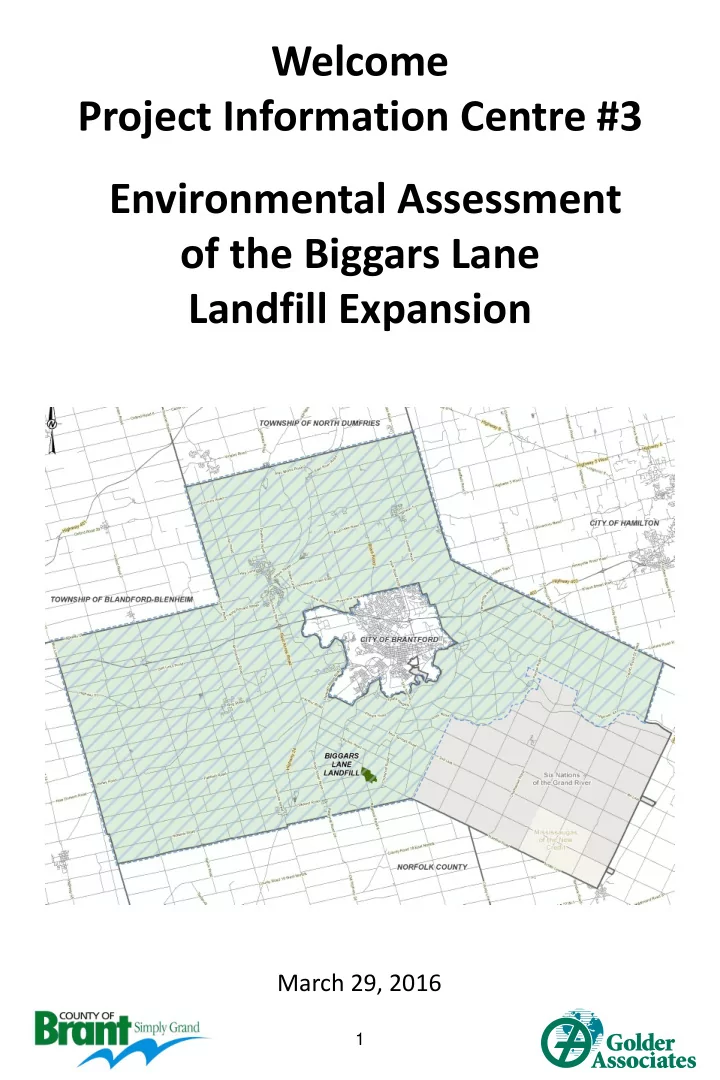
Welcome Project Information Centre #3 Environmental Assessment
- f the Biggars Lane
Landfill Expansion
1
March 29, 2016
Environmental Assessment of the Biggars Lane Landfill Expansion - - PDF document
Welcome Project Information Centre #3 Environmental Assessment of the Biggars Lane Landfill Expansion March 29, 2016 1 Objectives Announce the Approval of the Terms of Reference (TOR) for the Environmental Assessment (EA) by the
1
March 29, 2016
(TOR) for the Environmental Assessment (EA) by the Ministry of the Environment and Climate Change (MOECC)
Environmental Assessment
compare alternative methods of landfill expansion
identify the preferred method of landfill expansion
and provide their input to the process
added to the Communication List for the Project
2
expansion alternative at the Biggars Lane Landfill
meet their solid waste disposal needs until 2050
Landfill Expansion EA was approved by the MOECC in May 2015
Commencement for the Environmental Assessment Study to:
3
4
We are here
Main Activities
Develop and Submit Draft Terms of Reference Develop and Submit Final Terms of Reference Minister Approves Terms of Reference Finalize Concepts for Alternative Methods
Studies to Confirm Existing Environmental Conditions Construction of Landfill Expansion Detailed Design, ECA Application and Approval MOECC Review Process and EA Approval by Minister Submit Environmental Assessment Report to MOECC If Required, Assess Options for Leachate Management and Treatment, and Identify Preferred Option Identification of Preferred Expansion Alternative Comparative Evaluation of Expansion Alternatives Assess Environmental Impacts
PIC #3 PIC #4 Public Comment
Public and Agency Consultation
TOR PIC #1 June 2012 PIC #2 December 2012 Mid 2016 – Mid 2017 Mid 2017 Fall 2017 Fall 2017 Fall 2017 Draft EA Mid 2017 Final EA Late 2018 Mid 2019 2019 – 2021 2021/2022 May 2015 May 2014
Schedule
Landfill Expansion Alternative 1 Existing Landfill
Alternative 1 Area: 15.1 hectares Alternative 1 Height: 12 -13 metres
5
Landfill Expansion Alternative 2 Existing Landfill
Alternative 2 Area: 14.3 hectares Alternative 2 Height: 14 -15 metres
6
Landfill Expansion Alternative 3 West Cell Existing Landfill Landfill Expansion Alternative 3 East Cell
West Cell East Cell Alternative 3 Area 10.9 hectares 4.7 hectares Alternative 3 Height 12-13 metres 8-9 metres
7
Landfill Expansion Alternative 4 West Cell Existing Landfill Landfill Expansion Alternative 4 East Cell
West Cell East Cell Alternative 4 Area 11.7 hectares 8.2 hectares Alternative 4 Height 12 metres 11-12 metres
8
and/or snowmelt) percolates downward through waste and dissolves constituents present in the waste
required for landfill expansion alternatives 2 and 4, where there is a proposed bottom liner and leachate collection system
is independent from the selection of a preferred leachate treatment option
County owned Paris Water Pollution Control Plant (WPCP);
County owned St. George WPCP;
County owned Paris and St. George WPCPs; and
to the Unnamed Creek on the south portion of property.
9
used to compare the alternative methods of landfill expansion and identify the preferred method
perceived importance on other projects; however, you are invited to provide input on the criteria and rank the relative importance of the criteria during or after today’s PIC on the comment sheet provided
Typical Very Important Components Component Criteria Indicators
Geology and Hydrogeology Which alternative expansion design is preferred for protection
Predicted changes in groundwater quality for indicator compounds at the property boundary Surface Water Which alternative expansion design is preferred for protection
Predicted changes in surface water quality on-site and off-site Which alternative expansion design is preferred with regard to change to surface water quantity? Predict the need for existing stormwater management infrastructure upgrades to meet O.Reg. 232/98 Predicted occurrence and degree of
Natural Environment Which alternative expansion design is preferred with regard to protection of aquatic ecosystems? Predicted changes in baseflow and surface water quality Predicted effect on aquatic habitat Predicted effect on aquatic biota including rare, threatened or endangered species Which alternative expansion design is preferred with regard to protection of terrestrial ecosystems? Predicted effect on vegetation communities Predicted effect on wildlife and wildlife habitat Identification of any sensitive or significant species or their habitat potentially affected (direct or indirect) Atmosphere Which alternative expansion is preferred regarding potential effects to air quality? Predicted concentrations of indicator compounds at the property boundary and at off-site sensitive receptors Which alternative expansion is preferred regarding potential changes to odour? Predicted odour emissions at off-site existing sensitive receptors Which alternative expansion is preferred regarding potential changes to noise? Predicted noise levels beyond the project property boundary and at the discrete off-site sensitive Points of Reception (POR) (existing and vacant lots)
10
Typical Important Components Component Criteria Indicators
Transportation Which alternative expansion design is preferred with respect to potential effects from site-related truck traffic? Predicted traffic changes and effects
the site Which alternative expansion design is preferred regarding increased potential for bird attraction? Determination of distance to an airfield and, if required, predicted flight pattern from roosts to the landfill expansion Land Use Which alternative expansion design is preferred with respect to compatibility with current and proposed planned future land uses
Current land use Certain and probable planned future land use Proximity to off-site sensitive land uses (i.e., dwellings, churches, parks) Which alternative expansion design is preferred in terms of the view from off-site? Predicted changes in landscapes and views Visibility of project features from selected receptor locations Level of visual contrast of project features from selected receptor locations Which alternative expansion design is preferred with regard to potential for effects on agriculture? Percentage of on-site lands with soil capability classes 1 to 3 Amount, type(s) and quality of on-site improvements for agricultural purposes (i.e., structures, tile drainage) Percentage of on-site land being used for agricultural purposes Types(s) and extent of agricultural
(i.e., organic, cash crop, livestock) Economic Which alternative expansion design is preferred with regard to potential for effects on the local economy? Predicted effects to local businesses Employment at site (number and duration) Opportunities to provide products or services Which alternative expansion design is preferred regarding the capital,
for the landfill expansion? Predicted capital costs Predicted operation and monitoring costs for the duration of the active service of the landfill and the on-going post-closure care
11
Typical Less Important Components Component Criteria Indicators
Cultural and Heritage Resources Which alternative expansion design is preferred with regard to heritage resources and the cultural heritage landscape? Predicted effects to identified cultural landscapes off-site Predicted effects to the heritage attributes of identified heritage resources Which alternative expansion design is preferred with regard to protection of archaeological resources? Presence of archaeological resources on- site Technical and Operational Considerations Which alternative expansion design is preferred with regard to landfill gas subsurface migration potential? Predicted landfill gas subsurface migration distance from landfill footprint and distance to property boundary Which alternative expansion design is preferred with regard to potential to attract vectors and vermin? Predicted potential for attraction of vectors and vermin Which alternative expansion design is preferred from a geotechnical perspective? Predicted slope stability, settlement and
Which alternative expansion design is preferred regarding the requirement for operational infrastructure? Predicted need for leachate collection and associated disposal and/or treatment Predicted need for landfill gas collection and associated handling
12
satisfy the requirements of the Ontario EA Act (1990) and in accordance with the approved ToR include:
13
14
The Assessment of Geology and Hydrogeology will evaluate the proposed landfill expansion alternatives in consideration of:
– Groundwater quality, groundwater flow and groundwater and surface water interaction The geology and hydrogeology assessments will assess predicted changes in groundwater quality for indicator compounds (chloride and other parameters as necessary to calibrate groundwater models and/or as a result of using engineered systems as landfill liners) at the Biggars Lane Landfill property boundary Studies will be undertaken to investigate:
landfill leachate parameters in groundwater Data for the assessments will come from the following sources:
reports (MOECC, MNRF, Conservation Authority)
The alternative expansion methods will be compared to identify the most preferred expansion alternative in terms of acceptable changes to groundwater quality.
15
The Assessment of the Surface Water will evaluate the proposed landfill expansion alternatives in consideration of:
– Effects on surface water quality on-site and off-site
– Potential to change on-site surface drainage patterns and alter runoff and peak flows The surface water assessment will identify any potential effects that the landfill expansion may have on surface water quality. It will also identify any requirements for upgrades to existing stormwater management infrastructure to meet O.Reg. 232/98 Data for the assessments will come from the following sources:
Environment Canada and Conservation Authority)
The alternative expansion methods will be compared to identify the most preferred expansion alternative in terms of acceptable changes to surface water
16
The Assessment of the Natural Environment will evaluate the proposed landfill expansion alternatives in consideration of:
– Aquatic habitats and species
– Terrestrial habitats, species and vegetation The natural environment assessment will assess potential effects on habitat, vegetation and aquatic and wildlife species, including endangered species or sensitive and significant species in consideration of potential direct and indirect effects Data for the assessments will come from the following sources:
watershed / sub-watershed plans
Resources and Forestry (MNRF), Environment Canada)
The alternative expansion methods will be compared to identify the most preferred expansion alternative in terms of acceptable changes to the natural environment
The Assessment of Atmospheric Effects will evaluate the proposed landfill expansion alternatives in consideration of:
– In term of air emissions
The atmospheric assessment will consider changes to the air quality and odour at the property boundary and off-site sensitive receptors (as applicable). The atmospheric assessment will consider changes to noise levels at off-site sensitive receptors Data for the assessments will come from the following sources:
meteorological data and climate normals
data
guidance documents
The alternative expansion methods will be compared to identify the most preferred expansion alternative in terms of acceptable changes to atmospheric indicators
17
18
The Assessment of Transportation effects will evaluate the proposed landfill expansion alternatives in consideration of:
– Site-related truck traffic on road and intersection level of service
– Potential for bird collisions with aircraft Potential effects from traffic are not anticipated to be a discriminator in the evaluation of alternative landfill expansion methods since the expansion is a continuation of existing operations with the same service area. Data for the assessments will come from the following sources:
municipality
highway/road closures
expansion
The alternative expansion methods will be compared to identify the most preferred expansion alternative in terms of Transportation effects.
The Assessment of the Land Use Effects will evaluate the proposed landfill expansion alternatives in consideration of:
– Compatibility with current and proposed planned future land uses on and
– Actual and/or perceived effects to Agriculture
– View from off-site
Data will be compiled from Provincial Policy Statements, Official Plans, Zoning Bylaws, MNRF Digital Surface Models, aerial photographs and satellite imagery, soil mapping and municipal drain mapping, interviews with County of Brant representatives, input from local farmers and residents The alternative expansion methods will be compared to identify the most preferred expansion alternative in terms of land use The Assessment of the Economic Effects will evaluate the proposed landfill expansion alternatives in consideration of:
— Employment opportunities — Effects to local businesses — Opportunities to provide goods and services during construction and operation
Maintenance Costs over the entire project lifecycle Data will be compiled for this assessment through publically available desktop research (Statistics Canada, Provincial and Municipal Data), interviews with County of Brant representatives and cost estimates for the Project’s construction, operation and maintenance The alternative expansion methods will be compared to identify the most preferred expansion alternative in terms of economics
19
20
The Assessment of Cultural and Heritage Resources will evaluate the proposed landfill expansion alternatives in consideration of:
– Effects on cultural landscape and heritage resources
– Potential disturbance by construction activities All work conducted by the cultural and heritage resources component will follow guidance provided in the Ministry of Tourism, Culture and Sport (MTSC) Ontario Heritage Toolkit series, as well as other relevant publications such as the Parks Canada Standards and Guidelines for the Conservation of Historic Places in Canada for the built heritage and cultural landscape criterion. Data for the assessments will come from the following sources:
and guidelines
records, local architectural conservation advisory committee and/or municipal heritage building / district listings)
The alternative expansion methods will be compared to identify the most preferred expansion alternative in terms of acceptable changes to Cultural Heritage and Archaeological Resources
The Assessment of Technical and Operational Considerations will evaluate the proposed landfill expansion alternatives in consideration of:
— Migration of landfill gas
— Predicted slope stability, settlement and other geotechnical considerations
– Infrastructure needed for landfill gas collection system, and for leachate collection system, if required The technical and operational assessment encompass multiple unique
attraction and operational infrastructure requirements will all be considered in a qualitative way understanding existing landfill conditions and locations
assessed quantitatively, although all alternatives must be geotechnially stable or they would not present a viable option for expansion Data for the assessments will come from the following sources:
The alternative expansion methods will be compared to identify the most preferred expansion alternative in terms of Technical and Operational Considerations.
21
22
Landfill expansion alternatives 2 and 4 incorporate an engineered base containment design approach, which includes a low permeability base liner and leachate collection system. If landfill expansion alternative 2 or 4 is selected as preferred, only then will the evaluation of leachate management and treatment options be required. The leachate management and treatment options will be evaluated to select the preferred option, in consideration
leachate volume)
haulage)
activities
aboriginal communities, government agencies and other interested parties are invited to become involved throughout the Project
milestones and will include at a minimum:
comment form provided. You can also indicate if you are interested in being added to the Communications List
about the Project sent directly to them
http://www.brant.ca/en/explore-our-services/solid- waste-environmental-assessment.asp
23
approved TOR, including:
based on the results of the EA studies; identification
and disadvantages; and development of monitoring and contingency plans
and treatment option
results of the EA studies and preferred expansion alternative for public comment (late 2017 or early 2018)
board 4
24
If you have any comments / questions,
Project Communication List, please complete a comment form.
For additional information please contact:
Matthew D’Hondt, C.E.T. Corporation of the County of Brant 26 Park Avenue, P.O. Box 160 Burford, ON NOE 1AO Telephone: (519) 449-2451 (ext 2204) Fax: (519) 449-3382 email: solidwasteEA@brant.ca Trish Edmond Golder Associates Ltd. 1931 Robertson Road Ottawa, ON K2H 5B7 Telephone: (613) 592-9600 Fax: (613) 592-9601 email: Trish_Edmond@golder.com
25