environment: how can complexity and uncertainty be factored into - - PowerPoint PPT Presentation

environment how can complexity and uncertainty
SMART_READER_LITE
LIVE PREVIEW

environment: how can complexity and uncertainty be factored into - - PowerPoint PPT Presentation

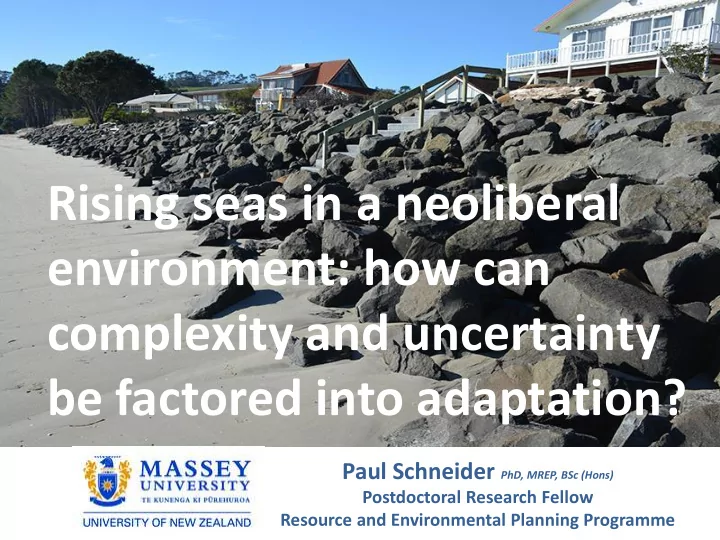
Rising seas in a neoliberal environment: how can complexity and uncertainty be factored into adaptation? Paul Schneider PhD, MREP, BSc (Hons) Postdoctoral Research Fellow Resource and Environmental Planning Programme [ f]orward planning is

slide-1
SLIDE 1

Paul Schneider PhD, MREP, BSc (Hons)

Postdoctoral Research Fellow Resource and Environmental Planning Programme

Rising seas in a neoliberal environment: how can complexity and uncertainty be factored into adaptation?

slide-2
SLIDE 2
slide-3
SLIDE 3
slide-4
SLIDE 4
slide-5
SLIDE 5
slide-6
SLIDE 6

“[f]orward planning is crucial to adapt to potential impacts of climate change at the coast” (NIWA, 2011, para. 9).

slide-7
SLIDE 7
  • In 2010 the wealthiest 1% of Kiwis owned

18% of the wealth,

  • the wealthiest 10% had 54%, and
  • the wealthiest 50% had 96% of the wealth.

http://morganfoundation.org.nz. Retrieved 08.11.2015

slide-8
SLIDE 8

http://morganfoundation.org.nz. Retrieved 08.11.2015

slide-9
SLIDE 9

1989 2016

slide-10
SLIDE 10

“The financial power of special interests”

Hansen et al., 2012, p. 17

slide-11
SLIDE 11
slide-12
SLIDE 12
slide-13
SLIDE 13
slide-14
SLIDE 14

The Coromandel Peninsula

slide-15
SLIDE 15
slide-16
SLIDE 16
slide-17
SLIDE 17

Whitianga Waterways, 2012

slide-18
SLIDE 18
slide-19
SLIDE 19

http://www.climate-lab- book.ac.uk/files/2016/05/spiral_optimized.gif

slide-20
SLIDE 20
  • http://www.theguardian.com/environment/n

g-interactive/2015/apr/10/how-much-fossil- fuel-are-we-using-right-now

slide-21
SLIDE 21

Sanford, Frumhoff, Luers, & Gulledge, 2014

1988: IPCC established 1992: Rio Earth Summit 2009: Copenhagen Accord 2012: Rio+20 Event on Sustainable Development 2015: Sendai Framework 2015: New Sustainable Development Agenda 2015: Paris Agreement

slide-22
SLIDE 22
slide-23
SLIDE 23

In the future, the tide gauges at the four ports will record exceedances of today’s 100 year events more and more often (“Preparing New Zealand for Rising Seas” Parliamentary Commissioner for the Environment Report, 2015, p. 30)

slide-24
SLIDE 24

“We design for the 100 year event but I ask why not for the 500 year event? Why the 100 year event? The 100 year event in ten years time is possibly going to be twofold if we continue to go down the path we’re going. So why? “ (beachfront property

  • wner, 2012, pers. comm.).

You just shouldn’t be there at all. Because a hundred years will be over, the house will be under threat, a problem has been created that everyone knew existed and the response will damage and impact on the emotions

  • f the home-owner, society and the economy. Why create a problem in

the first place? (Regional Council Coastal Manager, 2013, pers. comm.)

slide-25
SLIDE 25

Does policy rhetoric advance climate change adaptation?

slide-26
SLIDE 26
slide-27
SLIDE 27

“Climate change […] may change the frequency and intensity of hazards.” (p. 50)

slide-28
SLIDE 28

“Often you have powerful councillors who have doubts about the science and then hold on to uncertainties so they don’t have to consider it....”.

MFE spokesperson, pers. comm., 2012

slide-29
SLIDE 29

“New development now has appropriate set-backs

and consideration of the environment. We now need to pay attention to what the natural environment is going to do . The coastal environment is very dynamic”

Project Manager, Regional Council, 2012.

slide-30
SLIDE 30

Mercury Bay, 2012

slide-31
SLIDE 31

Hahei, 2016

“Things like this are happening all over the coast” (beachfront property owner, 2012, pers. comm.)

slide-32
SLIDE 32

“Any one of those guys has more access to political power than half of the rest of the community put together. You don’t buy a beachfront property if you are poor, so people have a lot of economic and political power. These people are simply the movers and shakers in

  • ur society. Beachfront properties, that’s how it

is... erosion reaches their boundary and it gets stopped and environmental regulations go out the window, public interests go out the window.” (Coastal Scientist, 2012, pers. comm.)

slide-33
SLIDE 33

“It boils down to who has the most power and at the moment the power is not with the community…”

Local Council Project Manager (2012, pers. comm.)

slide-34
SLIDE 34

“Don’t know. Do I care ... mmmh, don’t know. All the global warming and sea rising, I don’t think it’s a major issue really. Although if anybody is affected ... (pauses) ... we are”.

Beachfront property owner, pers. comm., 2012

slide-35
SLIDE 35

“There is a lot of science that says that climate change is not the case”.

New Zealand Transport Agency Executive, 2012, pers. comm.

slide-36
SLIDE 36

“I don’t believe we are making that huge an impact.”

National Party MP, 2012, pers. comm.

slide-37
SLIDE 37

It’s a cycle. It doesn’t mean that we are putting out more gases or anything necessarily, it’s just a cycle”.

Waikato Regional Council Representative

Hazards and Emergency Management

(2012, pers. comm.)

slide-38
SLIDE 38

“Politics at the local level are fuzzy. It’s a tricky one”.

Thames Coromandel District Mayor, pers. comm., 2012

slide-39
SLIDE 39

Of course we all know that probably with a storm raging and if an elected member is there, even if they are not allowed to, they’ll say “yes – for heaven’s sake: dump rocks!”. What is supposed to happen in that situation is that the rocks have to either be removed ... who pays for that? Or a resource consent is sought ... who goes for the resource consent? Who pays for the resource consent?

Local Council Senior Planner, 2012, pers. comm.)

slide-40
SLIDE 40
slide-41
SLIDE 41

“Well, one way or the other we pay for it. We either lose land or we pay for these ugly rocks and the loss of the beach and tourism. We’ve already thrown millions of dollars at the coastal erosion problem and we are worse off than ever before because we are not addressing the bigger picture”.

Local longtime resident, 2012, pers. comm.

slide-42
SLIDE 42

“Council should say [to beachfront owners]:

you’ve got no one to blame but yourself, so why do you now expect the public agency to rush around in small circles trying to – again – put more rocks on the beach, compromising public values, certainly looking after private interests but not looking after anyone else’s interest”.

MFE spokesperson, 2012, pers. comm.

slide-43
SLIDE 43

“We have to draw a line […] we won't abandon private homeowners. We need direct action rather than a managed retreat […] before we start losing any houses.

TCDC Mayor, 2014

slide-44
SLIDE 44

“You can’t just let nature take its course. We are dealing with people who have invested money in the area. Authorities are here to provide services”.

NZTA representative 2012, pers. comm.

slide-45
SLIDE 45
slide-46
SLIDE 46

“Business as usual prevails”.

Thames Coromandel District Council spokesperson, 2013

slide-47
SLIDE 47
slide-48
SLIDE 48

(after Moser & Ekstrom, 2010)

slide-49
SLIDE 49

Adaptation pathway

  • 1. understanding needs to be created
  • 2. Community Vision
  • 3. Sequenced manageable steps (choice sets):

adaptation tipping points

  • 4. Readiness is key
slide-50
SLIDE 50

collective risk management (understand) Agree on triggers / adaptation tipping poin (plan)

Must be followed by steps that have

previously been agreed on (manage)