Enrica Bellocchi 21 November 2016, Universidad Autnoma de Madrid 1 - - PowerPoint PPT Presentation

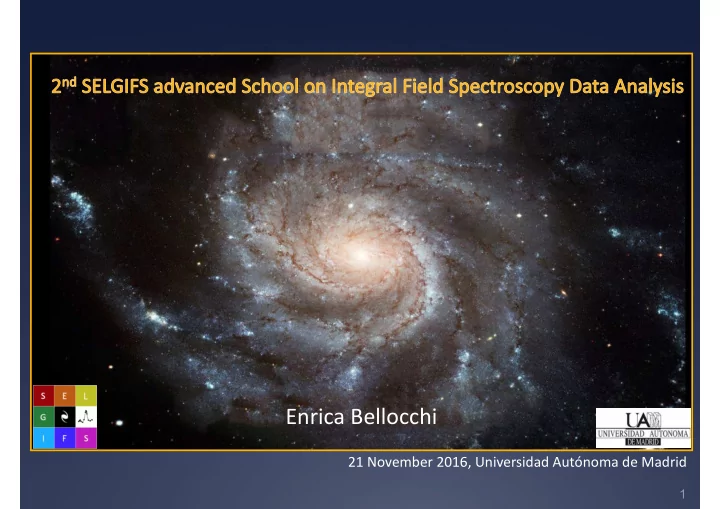
enrica bellocchi
SMART_READER_LITE
LIVE PREVIEW

Enrica Bellocchi 21 November 2016, Universidad Autnoma de Madrid 1 - - PowerPoint PPT Presentation

Enrica Bellocchi 21 November 2016, Universidad Autnoma de Madrid 1 SELGIFS (international collaboration focused on the Study of Emission-Line Galaxies with Integral-Field Spectroscopy) 2 Main objecCve Study of potenCal systemaCc


slide-1
SLIDE 1

21 November 2016, Universidad Autónoma de Madrid

Enrica Bellocchi

1
slide-2
SLIDE 2

“SELGIFS”

(international collaboration focused on the Study of Emission-Line Galaxies with Integral-Field Spectroscopy)

2

slide-3
SLIDE 3

3

“Study of potenCal systemaCc effects on the derivaCon of pure gas kinemaCc parameters”

Main objecCve

Integral Field Spectroscopy (IFS) is the suitable technique to record SIMULTANEOUSLY spaCally resolved spectra over a 2D field !

… focusing on the differences arising from the way the stellar continuum is subtracted as well as the presence of non-Gaussian line profiles and/or multiple kinematic components

slide-4
SLIDE 4

The role of the spaCally resolved kinemaCcs

4

1) to infer the main source of dynamical support (v/σ <, > 1); 2) to disCnguish between relaxed virialized systems and merger events; 3) to detect and characterized radial moCon associated with feedback mechanisms (like ou^lows); 4) to infer fundamental quanCCes like dynamical masses; 5) to constrain modes of star-formaCon (mergers vs steady cool gas accreCon) in galaxies with ambiguous morphologies:

  • Major merger complex morphology and kinemaCcs (mergers)
  • Steady accreCon regular morphology and kinemaCcs (disks)
  • But.. In some cases we see irregular morphology characterized by regular

kinemaCcs!! Morphology could be misleading….

2D kinemaCc characterizaCon of galaxies provides a powerful diagnosCc:

slide-5
SLIDE 5

5

Stellar conCnuum subtracCon

1 ) To derive the pure gas kinemaCcs (Hα) we have to perform the stellar conCnuum substracCon

Line figng analysis

2 ) To characterize the Hα profile (λ, σ) and reveal non-Gaussian profiles (secondary broad component ou^low, SN event…)

λ1, σ1 λ2, σ2

Main general steps of this work

slide-6
SLIDE 6

GeneraCon of the kinemaCc maps:

Hα velocity field and velocity dispersion maps

6

NGC 2906

CompuCng the kinemaCc parameters

e.g., dynamical raCo v/σ, velocity amplitude, central velocity dispersion, etc

(gas + stellar emission)

Comparing the v/σ results among different methods and discussion …

slide-7
SLIDE 7

Things to do (I)

7

The target

  • - We select one galaxy from the AMUSING survey (Lluis Galbany): NGC 2906

spiral galaxy, z = 0.07138 (vsys = 2140 km/s) + SN2005ip studied at different wavelengths

Data analysis

  • - We select the preferred tools to remove the stellar conCnuum (Wednesday’s

talks!): maybe, we are mainly interested in Starlight, pyParadise, Pipe3D …

  • - Apply these tools to generate the pure gas cubes
slide-8
SLIDE 8

Line figng analysis

we focus on Ha + [NII] λλ6548, 6583 Å lines to derive the velocity field and velocity dispersion maps (v, d)

1) Spectra fived automaCcally to (single) Gaussian profiles using an IDL/python rouCne (MPFITEXPR) [Method 1]

  • - The total emission = conCnuum (straight line + slope) + 3 (6) Gaussians
  • - The three lines are kinemaCcally linked: they follow the same kinemaCcs

(λHa – λNII)obs = (1 + z) x (λHa – λNII)em σHa = σNII and σHa , σNII > σINST

  • - The flux raCos are fixed according to atomic physics:

Flux [NII] λ6583 Å : Flux [NII] λ6548 Å = 3:1 Aim: to derive λHa ( vHa) and σHa ( velocity dispersion) and flux intensity of the line and generate their relaCve maps!

Things to do (II)

8

λ1, σ1 λ2, σ2

slide-9
SLIDE 9

Things to do (II contd)

9

Line figng analysis

2) Bayesian line figng approach [Method 2] CompuCng the likelihood in reproducing the observed data when considering different models for each line: L (Data| vmodel, σmodel) = ?

  • - For each line and for each spaxel we compute L using different models (vmodel, σmodel)
  • - We derive the mean value of L in each spaxel and extrapolate the velocity field

and velocity dispersion maps associated to such L.

(… but it is quite Cme consuming when consdering a large quanCty of spectra, as when using MUSE data!)

L1 (v1

mod,σ1 mod)

L2 (v2

mod,σ2 mod)

Width σ Wavelength λ

3) Try to use other line figng methods will be described during the school !

slide-10
SLIDE 10

Products of the line figng analysis: e.g., velocity field map

1) CALIFA (only gas emission, R~850, 1”/spaxel): stellar conCnuum subtracted by Ruben García Benito using STARLIGHT [line figng Method 1] 2) MUSE (gas + stars emissions, R~3000, 0.2”/spaxel): from AMUSING (Lluis Galbany) [line figng Method 2]

10

NGC 2906 NGC 2906 CALIFA Gas + stars

  • Only gas

MUSE Gas + stars

  • Only gas

[NII] Hα [NII] [NII] Hα [NII] FoV 1’x1’

slide-11
SLIDE 11

11

With CALIFA data: only gas emission + 2 component figng

NGC 2906 Narrow comp Broad comp (SN2005ip)

slide-12
SLIDE 12

12

KinemaCc results from 2-D data

  • 1-D kinemaCc results derived from 2-D kinemaCc data

derive 1-D kinemaCc parameters for the narrow

and broad components (dynamical raCo v/σ, v, σ) & comparison with other local samples

  • 2-D kinemaCc results characterizCon of the

kinemaCc asymmetries using “kinemetry” to disCnguish between disks and mergers (vasym, σasym) (in the next future… e.g., Bellocchi+2016)

slide-13
SLIDE 13

13

Things to do (III)

  • Derive mean kinemaCc values
  • Compare the (v, σ) results derived using the different tools

vamp = 0.5 (vmax – vmin) vshear = 0.5 (v5%

max – v5% min)

σmean mean velocity dispersion σc central velocity dispersion

Sp E/S0 LBA (U)LIRGs Bellocchi+2013

slide-14
SLIDE 14

The target: NGC 2906 obserbed with MUSE (AMUSING survey, Lluis Galbany) Select the preferred tools (stellar conCnuum subtracCon): Starlight, Pipe3D… GeneraCon of the pure gas cubes Line figng analysis (using the methods proposed in the school) Generate the v, σ maps:

  • Is there any evidence of a broad secondary component?

Compute the kinemaCc parameters (vshear, σmean, v/σ) and compare them when

using different approach. Draw your conclusions!

14

Summary Future work

  • Bever kinemaCc characterizaCon of the broad component
  • ApplicaCon of the “kinemetry” method to quanCfy the kinemaCc asymmetries

vasym, σasym in the derived velocity field and velocity dispersion maps

  • Study any kinemaCc relaConships between the different gas phases (if present)
slide-15
SLIDE 15

The target: NGC 2906 obserbed with MUSE (AMUSING survey, Lluis Galbany) Select the preferred tools (stellar conCnuum subtracCon): Starlight, Pipe3D… GeneraCon of the pure gas cubes Line figng analysis (using the methods proposed in the school) Generate the v, σ maps:

  • Is there any evidence of a broad secondary component?

Compute the kinemaCc parameters (vshear, σmean, v/σ) and compare them when

using different approach. Draw your conclusions!

15

Summary Future work

  • Bever kinemaCc characterizaCon of the broad component
  • ApplicaCon of the “kinemetry” method to quanCfy the kinemaCc asymmetries

vasym, σasym in the derived velocity field and velocity dispersion maps

  • Study any kinemaCc relaConships between the different gas phases (if present)

W a i C n g f

  • r

t

  • m
  • r

r

  • w

’ s a n d W e d n e s d a y ’ s t a l k s & W

  • r

k s

  • n

a s c i e n c e c a s e ! ! !