SLIDE 1
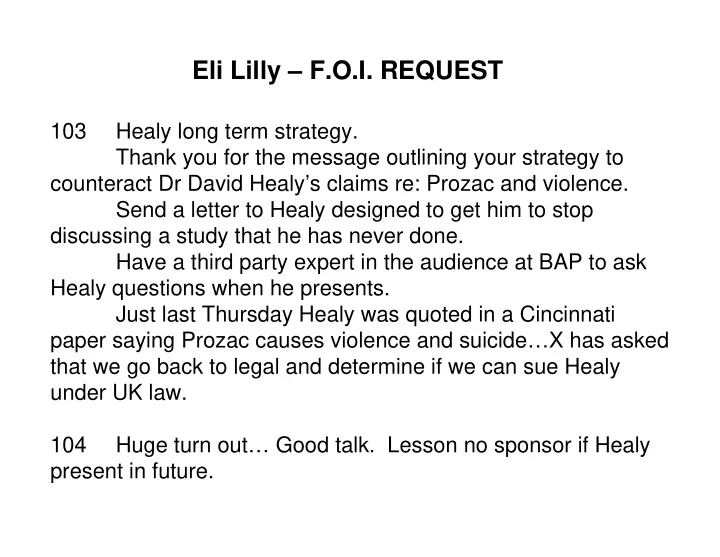
103 Healy long term strategy. Thank you for the message outlining your strategy to counteract Dr David Healy’s claims re: Prozac and violence. Send a letter to Healy designed to get him to stop discussing a study that he has never done. Have a third party expert in the audience at BAP to ask Healy questions when he presents. Just last Thursday Healy was quoted in a Cincinnati paper saying Prozac causes violence and suicide…X has asked that we go back to legal and determine if we can sue Healy under UK law. 104 Huge turn out… Good talk. Lesson no sponsor if Healy present in future.
Eli Lilly – F.O.I. REQUEST
SLIDE 2
SLIDE 3 Dr Healy has distorted and mischaracterized the evidence… many erroneous statements, unsupported contentions and data distortions Dr Healy has been hired by lawyers representing civil-litigation plaintiffs and criminal defendants to criticise SSRIs in at least 8
- cases. Although he is a psychiatrist and reader at the
University of North Wales, he is primarily known for his work as a medical historian. He has little scientific experience in conducting and interpreting the results of controlled clinical research. Before becoming a litigation expert witness testifying against SSRI manufacturers, Dr Healy published views opposite to those he now espouses on the question of whether SSRIs induce suicide.
SLIDE 4
But there is still money to be made, cashing in on credentials and providing distorted interpretations of the literature for a hefty fee. DH is now out pounding the pavement hustling business. J Coyne June 3rd 2000 We should ask: what is H up to? Apparently he is bypassing experimental design and peer review and running his "experiment" and putting this claim in a newspaper but without key details of his "study"? It fits with his solicitation of business as an expert witness with a predictable position for sale. It does not fit with ethical guidelines that are generally accepted by serious medical researchers J Coyne June 5th 2000
SLIDE 5 Having followed the controversy concerning DH and the UoT with .. fascination, I am convinced that .. the key persons involved never familiarized themselves with Dr. H's record. This includes whoever was responsible for making the original
- ffer to him, the newspaper who declared him a world class
researcher .. Dr. H has almost no published scientific research The "research" which has caused all the furor in Toronto involved giving antidepressants to 20 underlings... The colleagues were undoubtedly aware of his hypothesis that antidepressants cause suicide because he had made a reputation and lots of money making that claim before he collected his data. All of the usual scientific controls including a placebo control were missing from this "experiment". The whole project was ethically and scientifically suspect. I think the fuss, if there is to be any, should be about his being deemed a researcher or made an offer in the first place.
J Coyne Letter: Globe and Mail Sept 7th 2001
SLIDE 6 Well, finally the H study was uncovered, having been buried away beyond scrutiny because no original source was given and it was not in a MEDLINE reviewed journal. We find that the study was bogus or incompetent in its design because only it has only 20 subjects and no placebo condition were included in what we are asked to believe was a scientific study of quality of life. No statistical power for the stated purpose of the study. The subjects were colleagues and underlings of Dr. H and the study postdated his widely publicized claims for his
- hypothesis. Is this scientifically appropriate or ethical?
Was there a conflict of interest on Healy's part? Do you see an ethical issue or an outright scam here (I guess incompetence is a defense against the latter charge)? J Coyne May 1st 2001
SLIDE 7
Dear Dr Healy, Thank you very much for all your hard work on this article. I'm afraid we've run into a legal wall with our libel lawyer reluctant for us to publish your piece… I remain supportive of publication but obviously can't do this against legal advice. Our lawyer has several questions that he wants us to address at this stage. He isn't ruling out publication, but we need to reassure him about the facts first. Best wishes, XX Editor Big 4 Journal
SLIDE 8 He had not only BEEN an expert witness when he published that article, he was ACTIVELY a witness in unresolved civil suit in which it was crucial that he be able to cite data for his otherwise unsubstantiated position that ssri's make people suicidal. Releasing the paper to accomplish that was both timely and sleazy, and all the more so because he did not disclose his relevant financial interests in the study having a particular outcome. His testimony and soliciting of law suits was quite germane to any effort to make sense
- f his bizarre report and I doubt many readers understood the
- connection. Your claim that the connection was so obvious that no
mention was needed is hypocritical horseshit. Incidently, when it is convenient, Healy accepts considerable money from drug companies, more than most people I know. that is not mentioned either. J Coyne Sept 11th 2001
SLIDE 9 On Sun, 16 Sep 2001, James Coyne wrote:
- Dr. Miller, although you sometimes personally have
intelligent things to say on sscpnet, some of your postings convey the critical faculties of a broken lawn chair. I am referring in particular to your postings concerning my role in the reporting in the Canadian press of the rescinding of an offer to H from the U of Toronto. Wed Nov 7th 2001 I wonder if Dr. Elliott would like to revise his account
- f the Hastings Center caper? Might he concede that his
bad judgment may have been damaging to the credibility of the Hastings Center Report and may have given H the added claim of having "results" published in Hastings Center Report in his promotion of the interests of an Evil Pharmaceutical Company and his own consulting activities?
SLIDE 10 Since Dr Coyne has felt the need to post a diatribe against me - a UK journalist - on this list, I am posting my reply to
- him. I hope that will be the end of the matter.
Dear Dr Coyne For the record, I have no connection whatsoever with the Scientologists. If you looked further back you might find an article which was an attempt to expose their cult in the UK. I am not able to prevent them putting my articles on any website they have (I have never seen this site and was not aware they had done so). They have mailed me various things about drugs, but I always bin them.
SLIDE 11 I'm sorry you take exception to what I wrote about
- you. I felt it was fair. We obviously disagree. I note that
you didn't reply to my second email, asking what you meant when you said you had received "hate mail" from Healy supporters. If you could have substantiated your allegations, I would have been happy to include those too. I make no apology for having written plenty of stories about Dr Healy. I have done so because I find his allegations about the SSRIs disturbing and because I have yet to receive convincing evidence that he is wrong. When and if I do receive such evidence I will cease to write about these issues. Can I say that I take exception to what I consider your bullying and intimidatory behaviour. Sarah Boseley May 23rd 2002
SLIDE 12
To: Society for a Scientific Clinical Psychology SSCPNET@listserv.it.northwestern.edu 2005 From: James C Coyne jcoyne@mail.med.upenn.edu Subject: new UK guidelines for antidepressant use in children … [SB and DA] share a penchant for professing to be vigilant about conflict of interests, but nonetheless promoting the paid testimony of David Healy, who, for fees greater than 30,000 Euros will show up as an expert witness armed with his junk science "normal volunteers" study and data that have been repeatedly shown to be cooked.
SLIDE 13
Date: Sat, 24 Sep 2005 17:49:54 -0400 To: "David Goldstein" davidgoldstein715@msn.com From: James C Coyne jcoyne@mail.med.upenn.edu Subject: Re: Xavier Amador, PhD. clinical psychologist and the Abu Ghraib courtmartials Cc: sscpnet@listserv.it.northwestern.edu A little bit of googling of Amador's name will provide some fascinating quotes from him. there are lots. he is quite a publicity hound. He is a lot like David Healy, although I am not aware of Amador cooking up data. he seems to rely on the projection of some sort of special clinical expertise.
SLIDE 14
SLIDE 15
We would consider any advertisement or promotion labeling for RISPERDAL false, misleading or lacking fair balance under Section 502 of the Act if there is a presentation of data that conveys the impression that Risperidone is superior to haloperidol or any other marketed antipsychotic drug product with regard to safety or effectiveness. FDA Review of Risperdal 1993
SLIDE 16
SLIDE 17
SLIDE 18
SLIDE 19
SLIDE 20
SLIDE 21
SLIDE 22
SLIDE 23
SLIDE 24
Current Medical Directions “to deliver scientifically accurate information strategically developed for specific target audiences” CMD writes up studies, review articles, abstracts, journal supplements, product monographs, expert commentaries and textbook chapters. It conducts meta-analyses, & organizes journal supplements, satellite symposia, and consensus conferences as well as advisory boards for its clients [CMD] “strives to exceed the expectations of our clients and to assist them in achieving their strategic objectives”.
SLIDE 25
SLIDE 26 10 20 30 40 50 60 70 Impact Factor Medline Cite Rate
Analysis of CMD Articles
CMD Other
Healy & Cattell 2003, British J Psychiatry 183, 22-27
SLIDE 27
Subject: Study 334 Manuscript Author: Ian W. Henry Date: 16/10/95 … It is also important we publish this study soon given the imminence of the ZOLOFT launch in France … Finally K could you please forward to me the list of French investigators identifying the proposed authors. I would like to give Pfizer France the chance to comment on these.
SLIDE 28 1 290
Placebo
?? 6 2993 GEODON ?? 1 951
Comparator Placebo Comparator
SERTINDOLE
Placebo Comparator
SEROQUEL
Placebo Comparator
ZYPREXA
Placebo Comparator
RISPERDAL
DRUG
424 632 2194 206 426 2523 236 810 2500 195 601 2607
PATIENT NO
5 1 0 (1) 1 12 1 9
SUICIDES
?? 2 20 2 4 ? ? ? 1 5 43
SUICIDAL ACTS
SUICIDAL ACTS IN ANTIPSYCHOTIC TRIALS
SLIDE 29 Alderman et al 1998 – “sertraline is safe and likely to be effective in pediatric patients.” (9%) Ambrosini, Wagner et al 1999 – “sertraline is effective safe and well tolerated” (5.7%) Keller, Wagner et al 2001 – “study provide[s] evidence
- f the safety & efficacy of paroxetine in the
treatment of adolescent depression (5.4%) Wagner et al 2002 – “these results indicate that treatment of children and adolescents with paroxetine is safe and generally well-tolerated. Geller, Wagner et al 2002 – “paroxetine is a safe and effective treatment for OCD in pediatric pts” Wagner et al 2003 – “sertraline is an effective and well tolerated treatment for children and adolescents with MDD”
SLIDE 30
SLIDE 31
SLIDE 32
SLIDE 33
SLIDE 34 Alderman et al 1998 – “sertraline is safe and likely to be effective in pediatric patients.” (9%) Ambrosini, Wagner et al 1999 – “sertraline is effective safe and well tolerated” (5.7%) Keller, Wagner et al 2001 – “study provide[s] evidence
- f the safety & efficacy of paroxetine in the
treatment of adolescent depression (5.4%) Wagner et al 2002 – “these results indicate that treatment of children and adolescents with paroxetine is safe and generally well-tolerated. Geller, Wagner et al 2002 – “paroxetine is a safe and effective treatment for OCD in pediatric pts” Wagner et al 2003 – “sertraline is an effective and well tolerated treatment for children and adolescents with MDD”
SLIDE 35
“The Task Force concluded that taking SSRIs or other new generation antidepressant drugs does not increase the risk of suicidal thinking or suicide attempts.”
SLIDE 37 P-Value Function
95% confidence interval
Relative risk Beneficial effect Adverse effect
0.10 1.00 10.00
0.2 0.4 0.6 0.8 1.0
P-value
Point estimate P-value
SLIDE 38
HOMMES v MESSORI
SLIDE 39 The paper by Hommes et al reports a meta- analysis of 6 RCTs comparing subcutaneous heparin with continuous I/V heparin for the treatment of DVT. The result of our calculation was an odds ratio of 0.61 (95% CI, 0.298 to 1.251; P > 0.05); this figure differs greatly from the value reported by Hommes et al,odds ratio, 0.62 (95% CI, 0.39 to 0.98; P < 0.05) Based on our recalculation of the overall odds ratio, we concluded that subcutaneous heparin is not more effective than intravenous heparin, exactly the
- pposite to that of Hommes and colleagues....”
Messori et al, Ann Intern Med 1993,118, 77-78.
SLIDE 40
Critical Reviews in Psychiatry Brown T, Wilkinson G Gaskell 1998 p 177
SLIDE 41
Would your decision about whether to use this intervention be the same at the upper confidence limit as at the lower confidence limit? Critical Appraisal Skills Programme (CASP) Oxman AD et al JAMA 1994 272, 1367-1371
SLIDE 42 P=.09 P=.04
Drug A Drug B
What the data show
SLIDE 43
RR=1.9 (0.2, 16) RR=1.9 (0.2, 16)
SLIDE 44 screening randomization drug pbo Run-in/wash out Stop treatment Start treatment
FLUOXETINE – PAROXETINE - SERTRALINE ADULT TRIALS Occurrence of suicidal acts
follow-up
SLIDE 45 screening randomization drug pbo Run-in/wash out follow - up Stop treatment Start treatment
FLUOXETINE – PAROXETINE - SERTRALINE ADULT TRIALS Reporting of suicidal acts
SLIDE 46 RR=1.5 (0.3, 6.9)
“Analysis of the incidence of suicidal acts did not indicate an increased risk with patients with bulimia nervosa treated with fluoxetine compared to placebo”
SLIDE 47 “The only possible conclusion supported by the present data is that prescription of SSRI antidepressants is not associated with greater risk of completed suicide.”
RR=1.4 (0.56, 3.62)
SLIDE 48 “We found .. suicide risk among patients with anxiety disorders is higher than in the general population by a factor of 10 or
- more. Such a finding was unexpected….
11 Suicides in 12,914 on Drug v 0 Suicides in 3875 on Placebo
SLIDE 49 ♦ ♦
p < 0.05 p > 0.05
WHAT DATA MEANS FISHER v NEYMANN
SLIDE 50
FDA will send out this information which they concede is just early signal information .. it sounds good in principle. But I want you to think about it in terms of your reputation. It is really the reputation of a brand that is being signalled. Imagine someone reporting that they had early information that you may be a child molester. I know that sounds extreme but it is that type of thing... It is just an allegation.. (but) that is what people will remember, and that is the reason there is a lot of concern about presenting early signal information when you don’t really have any proof. It is very different than the kind of rigorous process we had in the past, where you had to do a trial and it had to be statistically significant before you presented that”.
Paul Anthony, PhARMA, June 2005
SLIDE 51
HOSTAGE TO POWER Low power = Problem not Real Prblm nt real = Overestimate benefit Overestimate Benefit = Overuse Overuse = Unnecessary Death & Injury
SLIDE 52 Imagine for a moment that you have a pistol with a barrel having 100 chambers. Now, randomly place 95 bullets in those
- chambers. The gun represents a drug and
the bullets represent a serious safety problem. Using FDA’s standard, only when you have 95 bullets or more in the gun will you agree that the gun is loaded and a safety problem exists. David Graham Nov 18th 2004
SLIDE 53 Odds Ratio with 95% CI
0.001 0.01 0.1 0.2 0.5 1 2 5 10 100 2003 2.280 (1.140, 4.550) 2002 2.050 (0.990, 4.240) 2001 2.250 (1.080, 4.730) 2000 2.070 (0.870, 4.960) 1999 2.070 (0.870, 4.960) 1998 1.950 (0.710, 5.300) 1997 1.950 (0.710, 5.300) 1996 1.900 (0.680, 5.280) 1995 2.190 (0.730, 6.560) 1994 2.590 (0.660, 10.210) 1993 2.590 (0.660, 10.210) 1992 2.060 (0.430, 9.770) 1991 1.770 (0.320, 9.560) 1990 1.770 (0.320, 9.560) 1989 1.770 (0.320, 9.560) 1988 2.930 (0.450, 18.900) 1987 1.280 (0.110, 15.550) 1986 1.036 (0.065, 16.580) 1985 1.036 (0.065, 16.580) 1984 0.135 (0.003, 6.800)
1983
0.135 (0.003, 6.800)
SLIDE 54
EWG Placebo Controlled Suicides: RR = 2.66 95% C.I. 0.90, 7.90, p = 0.067 Sertraline, Fluvoxamine, Citalopram, Paroxetine, Escitalopram, Venlafaxine & Mirtazapine
SLIDE 55 RR=1.9
Columbia/FDA meta-analysis of pediatric trials “The data in aggregate indicate an increased risk
- f suicidality,in pediatric patients.”
- Thomas Laughren, FDA, 2004.
SLIDE 56 The Use of Medication in Treating Childhood and Adolescent Depression: Information for Patients and Families
Prepared by the
American Psychiatric Association and American Academy of Child and Adolescent Psychiatry In consultation with A National Coalition of Concerned Parents, Providers, and Professional Associations
Do antidepressants increase the risk of suicide? There is no evidence that antidepressants increase the risk of suicide.
SLIDE 57
It does appear that these medications may affect the likelihood that a patient will actually tell someone about their suicidal thoughts or even a suicide attempt. From my perspective as a child and adolescent psychiatrist this is actually a good thing, because it means you have the opportunity to intervene and keep the child safe. David Fassler for APA and AACAP 2005
SLIDE 58
“The American Psychiatric Association believes that antidepressants save lives.”
SLIDE 59 No effect RR = 1 Risk difference (%) = 0 Positive effect RR > 1.0 Risk difference > 0
♦ ♦
p < 0.05
p > 0.05
EFFICACY FOCUS
SLIDE 60
How do we interpret... two positive results in the context of several more studies that fail to demonstrate that effect? I am not sure I have an answer to that but I am not sure that the law requires me to have an answer to that—fortunately or unfortunately. That would mean, in a sense, that the sponsor could just do studies until the cows come home until he gets two of them that are statistically significant by chance alone, walks them out and says he has met the criteria. Paul Leber, Sertraline Approval Hearings 1991
SLIDE 61 0% 5% 10% 15% 20% 25% 30% 35% 40% 45% 50%
Response Rate%
Drug v Placebo
Active Drug Placebo
SLIDE 62 0% 5% 10% 15% 20% 25% 30% 35% 40%
Response Rate%
Drug v Placebo
Active Drug Placebo
SLIDE 63 0% 10% 20% 30% 40% 50% 60% 70% 80%
Response Rate%
Drug v Placebo
Active Drug Placebo
SLIDE 64 For security against robbers who snatch purses, rifle luggage and crack safes,
- ne must fasten property with ropes
lock it up with locks, bolt it with bolts. This – for property owners – is elementary good sense.
SLIDE 65
But when a strong thief comes along he picks up the whole lot, puts it on his back, and goes on his way with only one fear – that ropes, and locks and bolts may give way Chuang Tzu 323 B.C.