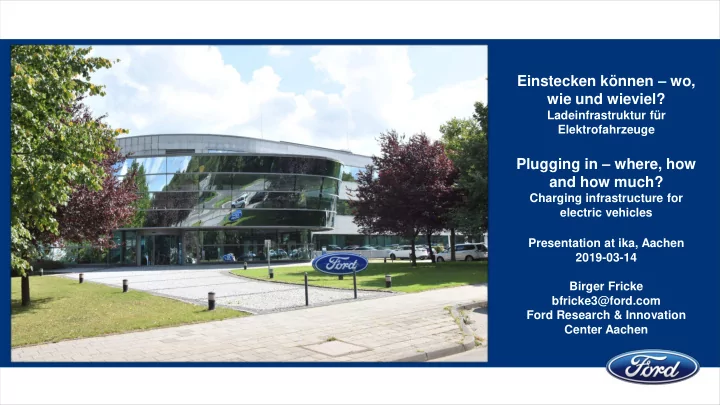
Einstecken knnen wo, wie und wieviel? Ladeinfrastruktur fr - - PowerPoint PPT Presentation

einstecken k nnen wo wie und wieviel
SMART_READER_LITE
LIVE PREVIEW

Einstecken knnen wo, wie und wieviel? Ladeinfrastruktur fr - - PowerPoint PPT Presentation

Einstecken knnen wo, wie und wieviel? Ladeinfrastruktur fr Elektrofahrzeuge Plugging in where, how and how much? Charging infrastructure for electric vehicles Presentation at ika, Aachen 2019-03-14 Birger Fricke


slide-1
SLIDE 1

Einstecken können – wo, wie und wieviel?

Ladeinfrastruktur für Elektrofahrzeuge

Plugging in – where, how and how much?

Charging infrastructure for electric vehicles Presentation at ika, Aachen 2019-03-14 Birger Fricke bfricke3@ford.com Ford Research & Innovation Center Aachen

slide-2
SLIDE 2

FORD MOTOR COMPANY OVERVIEW

  • 62 plants worldwide
  • 200 markets
  • 203,000 employees, 53,000 in Europe
  • $141,5 billion revenues, $ 28,5 billion in Europe
  • 6.6 million vehicle units, 1.5 million in Europe
  • $ 7.3 billion expenses for engineering, research and

development

slide-3
SLIDE 3
  • Ford Motor Company founded 1903
  • European production started 1911
  • Vehicles sold in 50 countries

in Europe

  • Designing, engineering, building, selling and

servicing Ford brand vehicles in Europe

  • Headquarters in Cologne, Germany
  • 54.000 employees
  • 69.000 people incl. joint ventures
  • 24 manufacturing facilities, 16 wholly-owned
  • 8 unconsolidated joint venture facilities

FORD OF EUROPE

slide-4
SLIDE 4

Istanbul (Turkey) Kocaeli (Ford Otosan)

  • Tourneo Courier, Transit

Connect & Custom Craiova (Romania)

  • EcoSport, engines

Dunton (UK)

  • Product Development
  • Transit Custom

Dagenham (UK)

  • Engines

Bridgend (UK)

  • Engines

Valencia (Spain)

  • Mondeo, S-MAX, Galaxy,

Kuga, Transit Connect, engines Chelny (Russia)

  • EcoSport
  • St. Petersburg (Russia)
  • Focus, Mondeo

Elabuga (Russia)

  • Kuga, Explorer,

Mondeo, Tourneo Custom, S-MAX, Galaxy Ford Werke GmbH Bordeaux (France)

  • Transmissions

Cologne (Germany)

  • Niehl:
  • Headquarter Ford of Europe
  • Fiesta, engines, transmissions
  • Merkenich:
  • Development Center

Lommel (Belgium)

  • Proving Ground

Aachen (Germany)

  • Research & Innovation Center

Saarlouis (Germany)

  • Focus, C-MAX
slide-5
SLIDE 5

FORD RESEARCH & INNOVATION CENTER AACHEN

  • 1995 founded, only research facility of Ford outside the US
  • 350 employees from 28 different nations (US: approx. 1200)
  • Locations: Aachen, Cologne, Lommel (test track, Belgium)
slide-6
SLIDE 6

ADVANCED POWERTRAINS AND ELECTRIFICATION

Advanced powertrains to meet future CO2 and tailpipe emission targets by:

  • Increasing efficiency of combustion

engines

  • Enhanced aftertreatment systems
  • Increased electrification
  • 40 highly electrified vehicles until 2022
  • Mild hybridization (48V)
  • From 2017: co-development with

Streetscooter

  • 2020: Launch of all-new small utility BEV
  • IONITY
  • New (Bio-)Fuels
  • Fuel Cell Technology
slide-7
SLIDE 7

PLUG-IN ELECTRIC VEHICLES BY FORD

  • Historical
  • Focus BEV
  • C-Max PHEV
  • Ford Transit PHEV

7 14/03/2019

slide-8
SLIDE 8
  • Ford
  • Why?
  • Fundamentals
  • Types of plugin electric vehicles
  • Energy consumption (How much?)
  • Range extension
  • Charging systems (How?)
  • Where?
  • High-power charging
  • User Behaviour and Smart Charging
  • Automatic charging
  • Historical comparison
  • Government regulations and funding
  • Behind the scenes: Interoperability
  • Summary

OVERVIEW

8 14/03/2019

slide-9
SLIDE 9
  • „Start with why“
  • Why electric vehicles?
  • CO2 targets
  • Limited supply of fossil fuels
  • Great acceleration
  • Low noise
  • Why this presentation?
  • Plug-in electric vehicles need to be charged.
  • Present status quo and future of charging infrastructure
  • Basis for further discussion

WHY?

9 14/03/2019

slide-10
SLIDE 10

TYPES OF PLUGIN ELECTRIC VEHICLES

  • Short range
  • ~100 km range, sufficient for daily trips
  • fast charging for range anxiety
  • „somewhere in the middle“
  • fast charging for occasional long-distance

travel

  • Long range
  • >500 km range
  • fast charging or high-power charging for

range extension

  • Plugin hybrid
  • electric range for typical daily trips
  • gasoline for faster acceleration, higher top

speed, longer range How much range is needed?

  • average travel distance: 30 to 37 km/d

(MiD 2017)

10 14/03/2019

slide-11
SLIDE 11

ENERGY CONSUMPTION Input:

  • 15 kWh / 100 km (actual value varies)
  • 15 000 km/a (MiD 2017: 14653 km/a)

Calculation:

  • Consumption of one vehicle: 2250 kWh/a
  • Average power for charging one EV:

2250 kWh / 8760 h ≈ 250 W

  • 1 million EVs => 2,25 TWh, 0,25 GW
  • 40 million EVs => 90 TWh, 10 GW

Comparison (Germany):

  • Average consumption of one household:

3200 kWh/a

  • Production of electricity (2018):

> 600 TWh/a, ~ 100 GW base, ~ 200 GW peak

11 14/03/2019

Short term effect: Local increase of consumption Long term effect: Opportunity to make use of peak production

slide-12
SLIDE 12

RANGE EXTENSION

  • Rule of thumb:

Charge power P in kW ≈ Range extension in km within 10 minutes

  • 50 kW ∙ 0,9 ∙ 10min / (15 kWh/100km) = 50 km
  • However:
  • Vehicle efficiency can differ from 15 kWh/100 km.
  • Charging efficiency can be worse than 0,9.
  • Increased duration due to limited charge

acceptance, e.g. when battery is hot/cold.

  • Increased duration due to consumption of other

consumers while slow-charging.

𝑄  Δ𝑡

12 14/03/2019

Rule of thumb is not precise but useful for quick assessment of needs and capabilities.

slide-13
SLIDE 13

CHARGING SYSTEMS

  • AC:
  • Household socket-outlet: ~ 2 kW
  • Charging station: 3, 7, 11, 22 kW (max 43

kW)

  • IEC 62196-2 Type 2
  • DC:
  • 50 kW (fast charging)
  • 350 kW (high power charging)
  • actual power depends on battery
  • IEC 62196-3 Configuration FF („Combo 2“)
  • WPT:
  • ~ 11 kW
  • Under preparation

13 14/03/2019

200 400 600 800 1000 100 200 300 400 500

Voltage / V Current / A

DC Charging

slide-14
SLIDE 14
  • Slow charging: Where vehicle is parked for a long time and installation is cheap. (Home / work)
  • Fast charging: Easy accessibility (Near major roads), things to do (e.g. short rest, eat, ...)
  • Different solutions apply for fleet operators.

WHERE?

14 14/03/2019

slide-15
SLIDE 15
  • Liquid-cooled charge cables support up to 500 A
  • Output voltage up to 1000 V
  • Ionity: Joint venture of BMW, Daimler, Ford, VAG
  • 350 kW per charge pole
  • More than 400 sites in Europe with 4 to 6 charge poles
  • Other companies are planning additional sites.
  • Well suited for range extension of long-distance vehicles.

HIGH-POWER CHARGING

15 14/03/2019

slide-16
SLIDE 16
  • Vehicles need to be plugged in – to support flexible charging.
  • Users are lazy and only plug in when needed.
  • If every vehicle is plugged in every day, low probability of simultaneous load. First full before last is

plugged in. However, this is changing with larger batteries and lazy users.

  • High peak loads create problems for the grid.
  • Countermeasures:
  • Load management
  • Financial incentives (cheaper electricity for flexible loads)
  • Stationary battery buffers
  • Automatic charging

USER BEHAVIOUR AND SMART CHARGING

16 14/03/2019

Lazy users are a problem for smart charging. Technical solutions needed.

slide-17
SLIDE 17
  • Wireless charging (limited power, frequency assignment)
  • Battery swapping(?)
  • Automatic plugging
  • Pantograph (buses)
  • Robotized conventional coupler
  • From bottom of vehicle

AUTOMATIC CHARGING

17 14/03/2019

slide-18
SLIDE 18

HISTORICAL COMPARISON

  • 1888: First cross-country automobile

journey by Bertha Benz

  • Fuel infrastructure: Three liters of

ligroin (Leichtbenzin) from pharmacy

  • 1909: More than 2500 drugstores, general

stores, hotels etc. sell gasoline in Germany.

  • 1913: First drive-in gas station in Pittsburgh
  • 1922: First gas station in Hannover,

Germany.

18 14/03/2019

Public Domain

Worldwide production

  • f automobiles:
  • 1909: 200k
  • 1913: 600k
  • 1922: 2.8M

(incl. 1.3M Model T)

  • 2017: >1M EVs
  • 2018: >2M EVs

1896: Ford Quadricycle 1908 – 1927: Ford Model T

Slow start, fast ramp-up?

slide-19
SLIDE 19
  • EU Directive on Alternative Fuels Infrastructure 2014/94/EU: Public charging stations shall be equipped

with Type 2 and Combo 2

  • EU Directive on Energy Performance of Buildings (EU) 2018/844: New buildings shall be prepared for

installation of charging stations.

  • German subsidies for installation of charging stations.

GOVERNMENT REGULATIONS AND FUNDING

19 14/03/2019

Government is pushing for fast adoption.

slide-20
SLIDE 20

BEHIND THE SCENES: INTEROPERABILITY

20 14/03/2019

Source: Kevin Forsberg and Hal Mooz 2006 (CC-by-3.0)

  • Charging systems cross traditional system

boundaries, require participation of many stakeholders.

  • “Dual Vee model” of development process.
  • System: Complete charging system
  • Subsystems:
  • EVs (from several

manufacturers)

  • Charging stations (from several

manufacturers)

  • ..
  • m x n validation is only possible while m

and n are very small.

  • Validation tests were carried out by OEMs

and at JRC Ispra.

  • Standards are updated to prevent

problems.

Robustness requires a lot of work.

slide-21
SLIDE 21
  • Ford
  • Fundamentals
  • State-of-the-art solutions (e.g. high-power charging)
  • Future solutions (e.g. automatic charging)
  • Ramp-up
  • Robustness

SUMMARY

21 14/03/2019