EFFECTS OF PAYMENTS FOR ECOSYSTEM SERVICES ON WILDLIFE IN - - PowerPoint PPT Presentation

effects of payments for ecosystem services on wildlife in
SMART_READER_LITE
LIVE PREVIEW

EFFECTS OF PAYMENTS FOR ECOSYSTEM SERVICES ON WILDLIFE IN - - PowerPoint PPT Presentation

EFFECTS OF PAYMENTS FOR ECOSYSTEM SERVICES ON WILDLIFE IN FANJINGSHAN NATIONAL NATURE RESERVE, CHINA HSIANG LING CHEN PROJECT SUMMIT MEETING LINK PES TO BIODIVERSITY Grain to Green Program From land cover & land use to biodiversity

slide-1
SLIDE 1

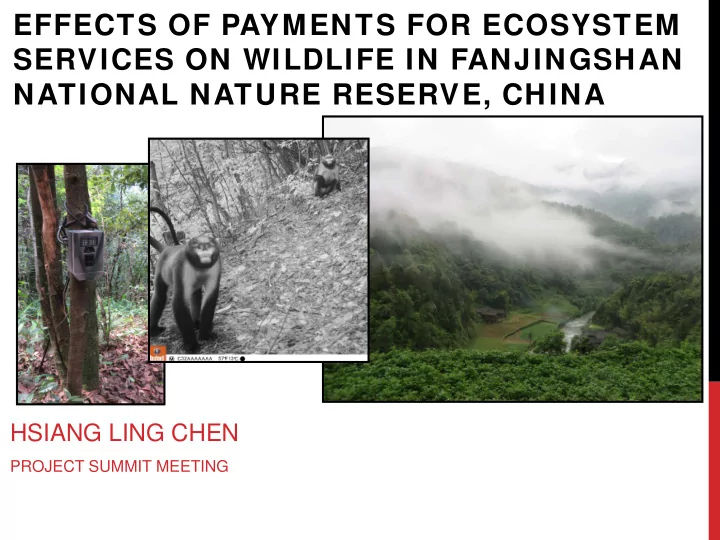
EFFECTS OF PAYMENTS FOR ECOSYSTEM SERVICES ON WILDLIFE IN FANJINGSHAN NATIONAL NATURE RESERVE, CHINA

HSIANG LING CHEN

PROJECT SUMMIT MEETING

slide-2
SLIDE 2

LINK PES TO BIODIVERSITY

  • Grain to Green Program
  • From land cover & land use to biodiversity / ecosystem

functions

  • Increased forest cover  improved environment 

higher biodiversity?

slide-3
SLIDE 3

RESEARCH GOAL & QUESTIONS

Assess ecological outcomes of PES programs and evaluate whether PES programs are beneficial for conservation of biodiversity.

  • How do environment and human activities affect species

richness and occupancy of wildlife?

  • What are changes in environment and human activities

associated with PES programs?

  • Are PES programs beneficial for conservation of wildlife?
  • Are land cover & land use good enough for monitoring

effects of PES programs?

slide-4
SLIDE 4

FANJINGSHAN NATIONAL NATURE RESERVE (FNNR)

(41,900 Ha)

slide-5
SLIDE 5

FNNR

  • Elevation: 500 -2500 m
  • High botanic diversity: ~ 4000 species
  • Evergreen broadleaf forest to deciduous forest
  • Local community: 11,000 local residents, > 70,000

tourists, PES

  • Home to many wildlife species
slide-6
SLIDE 6

CAMERA TRAPPING

Non PES: 55 sites PES: 16 sites

slide-7
SLIDE 7

ENVIRONMENT

  • Forest type
  • Cover
  • Canopy fractional cover (CFC)
  • Understory cover
  • Diversity & richness of plant species
  • ground, midstory, overstory
  • Forest structure
  • Tree height
  • Diameter at breast height (DBH)
  • Number of tree
  • Topography
  • Slope
  • Aspect
  • Elevation
  • Human activity
  • Signs of human activity
  • Distance to villages
  • Distance to roads
  • Distance to trails
slide-8
SLIDE 8

HUMAN ACTIVITY

slide-9
SLIDE 9

DATA ANALYSIS

  • Poisson regression – species richness of wildlife (n = 42)
  • Occupancy modeling
  • Survey covariates: camera settings & season
  • Site covariates: environmental characteristics recorded at each

plot

  • PES vs. non-PES: differences in environment and human activity

(n= 71)

slide-10
SLIDE 10

RESULTS- WILDLIFE IN FNNR

  • 18 species of medium

to large mammals and birds, including the golden monkeys.

  • 10 species are either

protected in China or listed as endangered, vulnerable or nearly threatened on the IUCN Red List.

(0 – 12)

slide-11
SLIDE 11

RESULTS- WILDLIFE IN FNNR

  • Common species ( > = 20 sites): Elliot's pheasant, Golden pheasant,

Hog badger, Temminck's Tragopan, Tibetan macaque, Tufted deer, Wild boar

slide-12
SLIDE 12

RESULTS- WILDLIFE IN FNNR

  • Rare species (< 5 sites): Asian black bear, Chinese ferret badger,

crab-eating mongoose, golden monkeys

slide-13
SLIDE 13

ENVIRONMENT & SPECIES RICHNESS

slide-14
SLIDE 14

ENVIRONMENT &SPECIES RICHNESS

  • Overall species richness
  • CFC: positive effect
  • Presence of livestock: negative effect
  • Species richness of wildlife with conservation concern
  • CFC: positive effect
  • Number of tree: positive effect
slide-15
SLIDE 15

WILDLIFE OCCUPANCY

2015/4/17-2016/4/15, 26 surveys, each survey is 2 weeks, single season

  • Vegetation type: not so important
  • CFC: influential on occupancy of 7/16 species
  • Positive: Tibetan macaque, Temminck tragopan, porcupine
  • Negative: Wild boar, palm civet, weasel, golden pheasant
  • Plant diversity: not so important
  • Forest structure: influential but has mixed effects
  • Human activity: influential on occupancy of 10/16 species
  • Positive: 3 species
  • Negative: 7 species
slide-16
SLIDE 16

PES VS. NATURAL FOREST

Vegetation Type

Bamboo Conifer Evergreen Mixed Deciduous

Number of plots

5 10 15 20 25 30 35

PES Non-PES

slide-17
SLIDE 17

PES VS. NATURAL FOREST

Environment PES

Cover Average no difference, low er variation Plant diversity Low er overstory diversity & richness Forest structure Low er Max. DBH Low er SD. Of DBH Elevation Low er Human activity More signs of human activity Higher detection of human & livestock Closer to roads & village

slide-18
SLIDE 18

CONCLUSION

  • Can PES programs be beneficial for conservation of wildlife? YES!
  • By increasing CFC, increasing the number of tree, reducing

human activity

  • May provide habitat for some species of wildlife
slide-19
SLIDE 19

CONCLUSION

  • Can PES programs be beneficial for conservation of wildlife? YES!
  • By increasing CFC, increasing the number of tree, reducing human

activity

  • May provide habitat for some species of wildlife
  • But…is not restoring original landscape (rehabilitation vs. restoration)
  • Vegetation types in PES areas are different than natural forest
  • PES sites are still impacted
  • Lower species richness of wildlife
  • Higher human activity
  • Are land cover & land use enough to monitor effects of PES programs?
  • Land cover & land use are important as wildlife does respond
  • But…not enough
  • To track true ecological effects of PES requires more information on
  • ther ecological dimensions
slide-20
SLIDE 20

FUTURE PLAN

  • Papers:
  • Effects of PES on wildlife biodiversity, community
  • Effects of human activity particularly livestock on presence of

wildlife

  • Effects of PES on conservation of golden monkeys
  • Plan (Oct. 2016 – March 2017)
  • Collecting camera trapping data: Dec. 2016
  • Finish most of data analysis for both papers by Dec. 2016
  • Submit 1st paper by the end of Jan. 2017
  • Submit 2nd paper by the end of Mar. 2017
slide-21
SLIDE 21

DATA WANTED

  • Maps of locations of PES (GTGP and NFCP) with attributes
  • btained by household survey, including time of

enrollment of PES (by the end of Oct. 2016)

  • Information about PES programs in FNNR
  • Conditions before implementation of PES programs (land

cover, land use)

  • Wildlife observed near farmlands
slide-22
SLIDE 22

THANK YOU!