
SLIDE 1
18TH INTERNATIONAL CONFERENCE ON COMPOSITE MATERIALS
Effect of cyclic hygrothermal aging and drying temperature on the interfacial properties of BMI/Carbon fiber composite
- P. Sun1, Y. Zhao1*, Y. F. Luo1, Y. X. Duan1, L. Zhang2
1 School of Materials Science and Engineering, Beihang University, Beijing, China* 2 Machinery and automation institute, Beihang University, Beijing, China.
*Corresponding author:No.37, Xueyuan Road, Haidian District, Beijing, China jennyzhaoyan@buaa.edu.cn
Keywords: carbon fiber; composite; cyclic hygrothermal aging;drying temperature
1 Introduction In aerospace and other applications, fiber- reinforced polymer matrix composites’ performance in ‘hot-wet’ environments is an important assessment indexes [1]. Polymer-based materials are
- ften exposed to hygrothermal environments, where
water molecules can easily migrate into the polymeric matrix and reached at the interface between fiber and matrix resin [2,3]. Some physical and chemical variations generate with immersing of
- water. Physical changes such as micro-cracks
propagation and swelling, as well as chemical changes such as hydrolysis and chemical scission can degrade properties of the materials. Also, the fiber/matrix interface can be damaged by moisture absorption [4–6] because resin is easy to absorb water which leads to volume expansion, while carbon fiber is hard to absorb water, and the resin’s swelling generates stress and can cause interface de- bonding [7,8]. Stresses and micro-cracks can be caused not
- nly during water’s absorbing but also water’s dry,
so some researchers focused on the influence of the wet–dry cycling on composites and matrix[9,10,11]. As a macro-mechanical test method, the ILSS can be used to characterize the interfacial bond between fiber and matrix. In this work, the objective is to investigate the influence of cyclic water absorption
- n
the interfacial properties
- f
composites using interlaminar shear strength test. Electron microscopy was used to observe the microstructure of material changes during cyclic hygrothermal aging 2.1 Materials The Thermoplastic resin toughened BMI resin QY9511 used in this paper was supplied by Beijing Aeronautical Manufacturing Technology Research Institute, Polyacryloniltrile based carbon fibers (CCF300) were produced by Weihai Tuozhan Fiber
- Co. Ltd.
The unidirectional composite panels were manufactured by autoclave molding according to curing process specified by resin manufacturers, and the fiber volume fraction (Vf) was 62±2%. 2.2 Heat-moisture treatment Specimens with dimensions of 60×60×2 mm3 (length×width×thickness) were dried in a vacuum
- ven at 70℃ under a vacuum until a constant weight
was achieved. Then they were put into a humidity chamber and immersed in distilled water at 71℃. Specimens were taken out as planned during heat- miosture treatment , dry with gauze and weighed using the analytical balance (with a precision of ± 0.1mg). After heat-moisture treatment for 7 days, specimens were removed from water and dried at 85℃ in a desiccators until a constant weight was
- btained. These specimens were then used in the
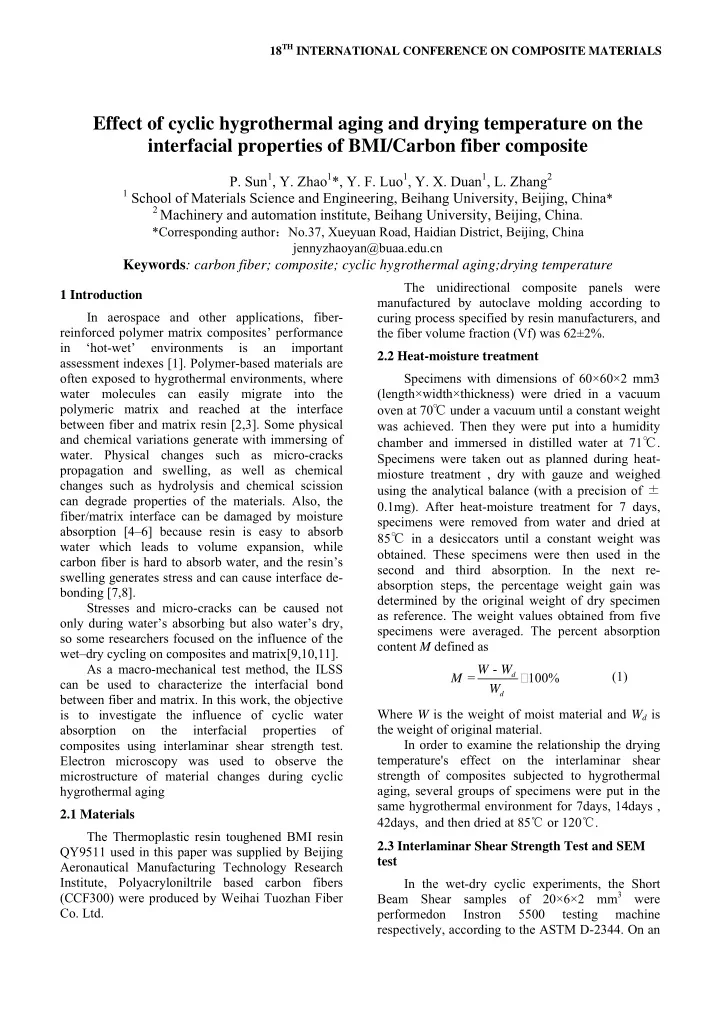
second and third absorption. In the next re- absorption steps, the percentage weight gain was determined by the original weight of dry specimen as reference. The weight values obtained from five specimens were averaged. The percent absorption content M defined as 100%
d d
W W M W
- =
- (1)