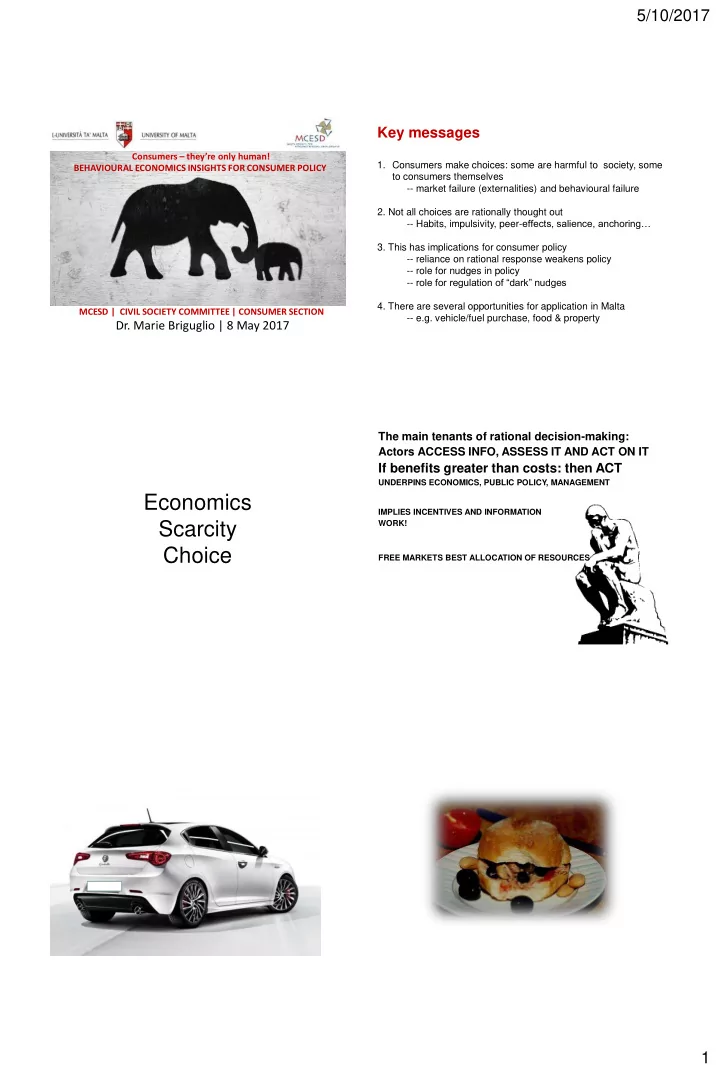
Economics IMPLIES INCENTIVES AND INFORMATION Scarcity WORK! - - PDF document

economics
SMART_READER_LITE
LIVE PREVIEW

Economics IMPLIES INCENTIVES AND INFORMATION Scarcity WORK! - - PDF document

5/10/2017 Key messages Consumers theyre only human! 1. Consumers make choices: some are harmful to society, some BEHAVIOURAL ECONOMICS INSIGHTS FOR CONSUMER POLICY to consumers themselves -- market failure (externalities) and


slide-1
SLIDE 1

5/10/2017 1

MCESD | CIVIL SOCIETY COMMITTEE | CONSUMER SECTION

  • Dr. Marie Briguglio | 8 May 2017

Consumers – they’re only human! BEHAVIOURAL ECONOMICS INSIGHTS FOR CONSUMER POLICY

Key messages

  • 1. Consumers make choices: some are harmful to society, some

to consumers themselves

  • - market failure (externalities) and behavioural failure
  • 2. Not all choices are rationally thought out
  • - Habits, impulsivity, peer-effects, salience, anchoring…
  • 3. This has implications for consumer policy
  • - reliance on rational response weakens policy
  • - role for nudges in policy
  • - role for regulation of “dark” nudges
  • 4. There are several opportunities for application in Malta
  • - e.g. vehicle/fuel purchase, food & property

Economics Scarcity Choice

The main tenants of rational decision-making: Actors ACCESS INFO, ASSESS IT AND ACT ON IT

If benefits greater than costs: then ACT

UNDERPINS ECONOMICS, PUBLIC POLICY, MANAGEMENT IMPLIES INCENTIVES AND INFORMATION WORK! FREE MARKETS BEST ALLOCATION OF RESOURCES

slide-2
SLIDE 2

5/10/2017 2

POLICY IMPLICATIONS OF MARKET FAILURE?

Information Education Pricing (PPP) Regulation Infrastructure To fix MARKET failure and bring economy back on track

Sustainable Lifestyles Project

CANA TALKS

ABOUT MAKING DECISIONS The rational way… Comparing costs and benefits, now and in future, for us and

  • thers we care about.

The less rational way… Automatically, intuitively, and often correct…

Human beings are “cognitive misers”

Fiske and Taylor 1984

24 X 18=

TEST

Humans use certain rules of thumb, mental shortcuts, or simply rely on inherent behavioural biases to make decisions

Kahneman and Tversky 1974

slide-3
SLIDE 3

5/10/2017 3

BEHAVIOURAL HEURISTICS We fall into habits We stick with the status quo We are short-sighted We fear losses more than we love gains We follow the herd We are mostly influenced by what we see We are easily primed into decisions Especially when… Decisions are Infrequent (car, property) Delayed effect, poor feedback (food) Wrong time (after work?) distracted, angry.. What if we consider that consumers are actually human? Re-thinking how people actually make decisions, suggests re-thinking ... how to design interventions NUDGES Attention to information and incentives but also… Who delivers policy message? What is the perceived norm? Can we make good behaviour the DEFAULT? Can we introduce commitment devises? Can we SIMPLIFY the right choice? Can we check for predatory priming? Can we control dark nudges like present benefits?

Can we teach PUBLIC policy a few behavioural tricks? Front runners: USA, UK, EU Can we regulate predatory behavioural tricks?

DEFAULT CHOICES IN ORGAN DONATION Johnson and Goldstein 2003

Pichert & Katsikopoulos (2008) DEFAULT IN ELECTRICY CONSUMPTION

slide-4
SLIDE 4

5/10/2017 4

The BIT tested whether using social proof could increase charitable giving among employees. The control group received an e-card from an existing donor simply explaining why that person donates and asking to join them. The treatment group received the same card but with an attached picture of the existing donor. Picture increased the number of new donors

Part 3 SALIENCE: In contrast to McDonald’s old policy of asking whether you want to super-size your order, these 3 field experiments asked customers in a Chinese restaurant if they wanted to down-size their portions of side

  • dishes. The 14-33% of customers who did so did not compensate by
  • rdering more in other areas and ate 200 less calories on average.

SALIENCE & EASE: Hanks et al. looked at encouraging healthier eating in school lunchrooms through strategic placement of certain foods. In the healthier line, sales of healthier food increased by 18% and grams of less healthy food consumed decreased by 28%.

e.g. make it salience, make it easy in FOOD

CONSIDER UNINTENDED CONSEQUENCES

E.g. from Botti et al 2006: 800,000 eligible employees at 657 companies, 401(k) plans ranged from 2 to 60 investment options, As choices increased what happened to the likelihood of investing?

FOOD & DRINK Market Failure? Food Waste Resource depletion Behavioural Failure? Low nutrition food, obesity Smoking Alcohol Low spend on education

Policy Implications? Polluter pays Labelling Default options Availability Teach decision making skills Control dark nudges

PASSENGER VEHICLES, FUEL, REPAIRS Market Failure? Traffic Congestion Air Pollution Accidents Behavioural Failure? Overspending on vehicle repair, Herding, default option Low salience of walking benefits Drink driving

Policy Implications? Polluter pays (e.g. per mile, per emission) Change the default (e.g. infrastructure), Make it less automatic (e.g. loan cooling off), Control dark nudges Teach decision making skills (de-biasing)

slide-5
SLIDE 5

5/10/2017 5

E.g. of practical consumer education

* CRITICAL THINKING/MINDFULNESS vs PEER PRESSURE, MEDIA INFLUENCE e.g. STOP TO THINK. * PROMOTION OF UNDERCONSUMED GOODS/SERVICES Exercise, art, social interaction, volunteering, learning * DECISION MAKING GRID

Hastings G. Social Marketing: Why should the devil have all the best Tunes? (2007) Elsevier, Oxford Thaler and Sunstein “Nudge: Improving Decisions about Health, Wealth, and Happiness”. (2008) Yale University Press Briguglio M. 2016 “Humans Behave!” in Outreach On Climate Change and Sustainable Development, Edition COP 21 Paris, 5. Business Investment and Innovation, Available: http://outreach.stakeholderforum.org/index.php/previous

  • editions/cop-21-paris/edition-5-business-investment-

and-innovation/11950-humans-behave

Resources Tutor

Marie Briguglio Lecturer in behavioural Economics, Research Methods, Social Marketing, Environmental Economics (University of Malta). | PhD Economics (Stirling); MSc Environmental and Resource Economics (UCL), BA Honours Economics (Malta). | On-going research on circular economy (by Horizon 2020), environmental indicators (Environment and Resources Authority), cultural participation (Malta Arts Council, European Capital of Culture). | Previously Deputy Director at the Malta Environment and Planning Authority (Environment) and National Focal point to the United Nations Framework Convention on Climate Change. | Award winning television writer/producer. | Active in behavioural change campaigns, outreach, co-Chairperson of the Forum for Active Community Engagement within the President of Malta's Foundation for the Wellbeing of Society. | Representation on several boards. | Main areas of expertise: Behavioural Economics, Environmental Economics, Market Failure, Communication, Social Marketing. marie.briguglio@um.edu.mt