EBOLA LA: LESSONS LEAR ARNED NINTH NTH ANNU NNUAL CONF - - PowerPoint PPT Presentation

ebola la lessons lear arned
SMART_READER_LITE
LIVE PREVIEW

EBOLA LA: LESSONS LEAR ARNED NINTH NTH ANNU NNUAL CONF - - PowerPoint PPT Presentation

EBOLA LA: LESSONS LEAR ARNED NINTH NTH ANNU NNUAL CONF NFERENCE: HEAL ALTH TH W WATCH U USA SA NOVEMBER 13, 13, 2015 2015, LEXINGTON, K KY M M JOYCE CELYN ELDERS, MD MD EPIDEMIOLOGY Total cases 28,636


slide-1
SLIDE 1

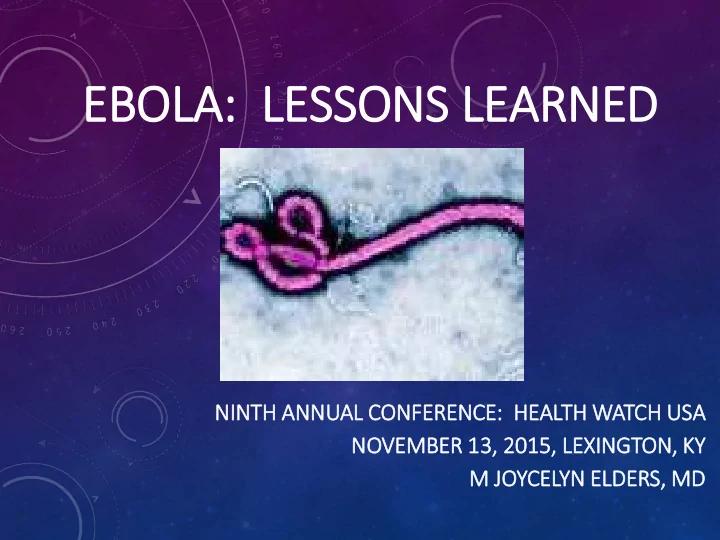
EBOLA LA: LESSONS LEAR ARNED

NINTH NTH ANNU NNUAL CONF NFERENCE: HEAL ALTH TH W WATCH U USA SA NOVEMBER 13, 13, 2015 2015, LEXINGTON, K KY M M JOYCE CELYN ELDERS, MD MD
slide-2
SLIDE 2

EPIDEMIOLOGY

  • Total cases

28,636

  • Laboratory-confirmed cases

15,246

  • Total deaths

11,314

  • Mortality rate

90 - 23%

  • Deployed medical teams

50

  • Mobile laboratories

28

  • Trained experts

7,000

slide-3
SLIDE 3

HOW DO YOU GET THE EBOLA VIRUS?

Direct contact with:

  • 1. Body fluids of a person who is sick with or

has died from Ebola (blood, vomit, urine, feces, sweat, semen, spit, other fluids)

  • 2. Objects contaminated with the virus (needles,

medical equipment)

  • 3. Infected fruit bats or primates (apes and

monkeys)

CDC

slide-4
SLIDE 4

"Ebola Hemorrhagic Fever Signs and Symptoms".

  • CDC. 28 January 2014. Retrieved 2 August 2014.
slide-5
SLIDE 5

08/08/2014

International Ebola Emergency Declared by the Global Health Security Agenda

slide-6
SLIDE 6

GLOBAL HEALTH STRATEGY

Strengthen public health systems

  • Prevent when possible
  • Detect rapidly
  • Respond effectively

Iden entify S Stop

  • p

Preven ent

slide-7
SLIDE 7

3 CORE INTERVENTIONS TO STOP EBOLA OUTBREAK

  • Exhaustive case and contact findings
  • Effective response to patient and

community

  • Isolate and treat patients.
  • Monitor each contact for 21 days.
slide-8
SLIDE 8

KEY PREVENTIVE INTERVENTIONS

  • Meticulous information control in healthcare setting
  • Education of community
  • Cultural sensitivity
  • Avoid handling of bush meat and contact with bats.
  • Stringent control efforts
  • Safe burial
  • Vaccine
slide-9
SLIDE 9

“Outbreak anywhere can be a risk everywhere.”

Thomas Frieden, MD Director of CDC

slide-10
SLIDE 10

APIC A Assoc

  • ciation
  • n for P

Professionals i in Infection

  • n Control
  • l

Nov, 4 4, 2015 S 15 Survey o

  • f Members o
  • n Ebola P

Prepa parednes edness s in US US Hea Healthcare F e Facilities s On One Y Year L r Later r - 15,00 000 0 mem embe bers / s / 981 981 respo ponden ndents

  • 92

92% t thin ink f facilit litie ies a are b better prepa epared

  • 55% f

facilit litie ies n not provid vided a addit itio ional r l resources

  • 62

62% c contin inue t train inin ing

  • 25%

25% l lack P PPE per per CDC g gui uidelines

  • 722,

2,00 000 p 0 patien ents s contract H H/C-assc. I Inf nfection n (2011) 011)

  • 53% of
  • f IPs report
  • rt that t

they a are s sol

  • lo
  • physicians
  • 59%

59% o

  • f PICs c

cover er m more t e tha han o

  • ne

ne facility

92% think facilities are better prepared

slide-11
SLIDE 11

LESSONS LEARNED

  • Every country needs core public health functions to identify a threat

when it occurs.

  • Must stop outbreak by moving immediately and decisively. (HCWs 42 X

 vs. Non HCWs)

  • Must have effective infection prevention and control procedures in

hospitals and other healthcare facilities.

  • Must have:
  • appropriate triage procedures
  • adequate personnel preventive equipment
  • adequate infection control practices
slide-12
SLIDE 12

Study and implement CDC Guidelines in preparation for Ebola Epidemic

slide-13
SLIDE 13

RECOMMENDATIONS FOR PREPARING FOR FUTURE EPIDEMICS

  • Be coordinated by a global institution that is given enough

authority and funding to be effective.

  • Enable fast decision-making at a global level.
  • Expand investment in research and development and clarify

regulatory pathways for developing new tools and approaches.

  • Improve early warning and detection systems, including scalable

everyday systems that can be expanded during an epidemic.

  • Involve a reserve corps of trained personnel and volunteers,
  • Strengthen health systems in low- and middle-income countries.
  • Incorporate preparedness exercises to identify the ways in which

the response system needs to improve. (NEJM.org, April 9, 2015)