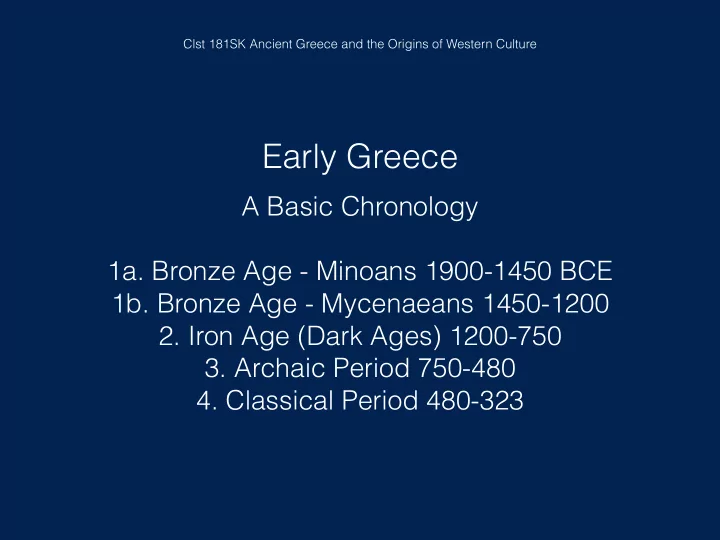
SLIDE 1 Early Greece
Clst 181SK Ancient Greece and the Origins of Western Culture
A Basic Chronology
- 1a. Bronze Age - Minoans 1900-1450 BCE
- 1b. Bronze Age - Mycenaeans 1450-1200
- 2. Iron Age (Dark Ages) 1200-750
- 3. Archaic Period 750-480
- 4. Classical Period 480-323
SLIDE 2
- 1a. Bronze Age Greece - Minoans
The Minoan Civilization (1900-1450 BCE)
SLIDE 3
SLIDE 4
- 1b. Bronze Age Greece - Mycenaeans
The Mycenaean Civilization (1450-1200 BCE) Mainland Greece, especially the Peloponnesus
Mycenae – Palace Megaron
SLIDE 5 Mycenae – Demons?
SLIDE 6 The Bronze Age - Collapse
- Greek Palace structures are destroyed in about 1200-1150 BCE
- Knossos
Mycenae Pylos Thebes Tiryns Troy(!)
We do not know how or by whom the devastation occurred - the Greeks told a story of invaders (the “Dorian invasion”)
SLIDE 7
- 2. The Greek “Dark Age” - the Iron Age
- 1200-750 BCE
Lefkandi – Heroön plan
SLIDE 8
- 2. The Iron Age
- 1200-750 BCE
Early Geometric Vase 850 BCE
SLIDE 9
Iron Age – Movement to the Archaic Period
SLIDE 10 Early Greece
Clst 181SK Ancient Greece and the Origins of Western Culture
A Basic Chronology
- 1a. Bronze Age - Minoans 1900-1450 BCE
- 1b. Bronze Age - Mycenaeans 1450-1200
- 2. Iron Age (Dark Ages) 1200-750
- 3. Archaic Period 750-480
- 4. Classical Period 480-323
SLIDE 11
- 3. The Archaic Period
- 750-480 BCE
750 BCE 700 BCE 600 BCE 560 BCE 530 BCE
SLIDE 12 The Archaic Period 750-480 BCE
Clst 181SK Ancient Greece and the Origins of Western Culture
Background to the “Classical Moment”
SLIDE 13 The Archaic Period
Mantiklos Apollo, 700-650 BC
SLIDE 14 The Archaic Period
Mantiklos Apollo, 700-650 BC
SLIDE 15 The Archaic Period
Geometric bronze horse, c. 700 BC
SLIDE 16 The Archaic Period
New York Kouros
SLIDE 17 The Archaic Period
Kouros
Mentuemhet, Egypt, 7th c.
SLIDE 18 The Archaic Period
Kleobis & Biton, c. 590 BC
SLIDE 19 The Archaic Period
Calf Bearer Kouros, 560 BC
SLIDE 20 The Archaic Period
Kroisos (Anavysos ) Kouros c. 530 BC
SLIDE 21 The Archaic Period – Movement to the Classical
SLIDE 22 The Archaic Period
Maiden from Auxerre, c. 650 BC
SLIDE 23 The Archaic Period
Phrasikleia Kore, c. 550 BC
SLIDE 24 The Archaic Period
Peplos Kore c. 530 BC
SLIDE 25 The Archaic Period
Maiden of Chios, c. 510 BC
SLIDE 26
- Cf. Caryatids from the Porch of Maidens,
Erechtheion, Acropolis; Stele of Ampharete
The Archaic Period – Movement to the Classical
SLIDE 27 A Basic Chronology
- 1a. Bronze Age - Minoans 1900-1450 BCE
- 1b. Bronze Age - Mycenaeans 1450-1200
- 2. Iron Age (Dark Ages) 1200-750
- 3. Archaic Period 750-480
- 4. Classical Period 480-323
SLIDE 28
- 3. Archaic Period 750-480
SLIDE 29
480 BCE
SLIDE 30
480 BCE The Persian War
SLIDE 31
480 The Persian War
SLIDE 32
480 The Persian (Achaemenid) Empire
SLIDE 33
Herodotus “The History of the Persian Wars” “The History of the Persian Wars” “The Father of History”
SLIDE 34
Herodotus What is “History”?
SLIDE 35
Herodotus What does it mean to write “History” before “History” has been invented?
SLIDE 36
Herodotus But what does it mean to “invent” history?
SLIDE 37
Herodotus History as a formal narrative about the past (the study of such narratives is call historiography)
SLIDE 38 Herodotus History as a formal narrative about the past
- NOT “A COLLECTION OF FACTS ABOUT THE PAST”
- NOT “WHAT HAPPENED IN THE PAST”
… AT LEAST NOT SIMPLY THAT
SLIDE 39 Herodotus History as a formal narrative about the past
- Story (narrative)
- Memorialization
- Analysis
- Selection
- Meaning
Herodotus, proem: “presentation to the public,” “researches” = historiê, “time not erase”, “great and marvelous deeds,” “glory” = kleos, “why”, “war/quarrel”
SLIDE 40 The Snatchings of Women
IONIA
Erythraean Sea
Herodotus
SLIDE 41 The Snatchings of Women
IONIA
Erythraean Sea
Herodotus Io Europa Medea Helen
SLIDE 42 The Snatchings of Women
IONIA
Erythraean Sea
Herodotus Io Europa Medea Helen “The Persians Say” “The Greeks Say” “The Phoenicians Say”
SLIDE 43 The Snatchings of Women
IONIA
Erythraean Sea
Herodotus “The Persians Say” “The Greeks Say” “The Phoenicians Say”
WEST / EAST
Themes:
SLIDE 44 The Snatchings of Women
IONIA
Erythraean Sea
Herodotus “The Persians Say” “The Greeks Say” “The Phoenicians Say” WEST / EAST Themes: Cause of the quarrel Women as objects Refusal of ransom
SLIDE 45 The Story of Gyges Herodotus
I O N I A
LYDIA
Corinth •
SLIDE 46 The Story of Gyges Herodotus
H a l y s r i v e r
- 1.3s Lydia, Sardis, Ephesus, Miletus. The Maeander River flows just north of Miletus, and
the town of Assessus is also in the area near Miletus (Milesia).
SLIDE 47
The Story of Gyges Herodotus Themes