Drafting Insurance Requirement Provisions in Commercial Contracts - - PowerPoint PPT Presentation

drafting insurance requirement provisions in commercial
SMART_READER_LITE
LIVE PREVIEW

Drafting Insurance Requirement Provisions in Commercial Contracts - - PowerPoint PPT Presentation

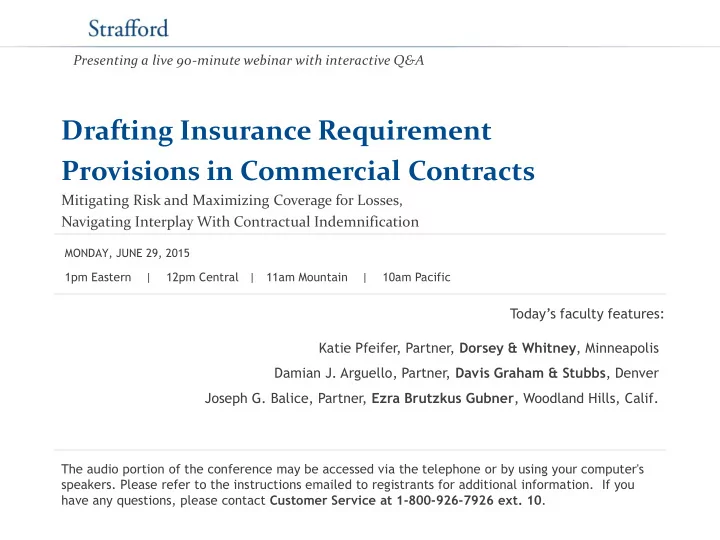
Presenting a live 90-minute webinar with interactive Q&A Drafting Insurance Requirement Provisions in Commercial Contracts Mitigating Risk and Maximizing Coverage for Losses, Navigating Interplay With Contractual Indemnification MONDAY,


slide-1
SLIDE 1

The audio portion of the conference may be accessed via the telephone or by using your computer's

  • speakers. Please refer to the instructions emailed to registrants for additional information. If you

have any questions, please contact Customer Service at 1-800-926-7926 ext. 10.

Presenting a live 90-minute webinar with interactive Q&A

Drafting Insurance Requirement Provisions in Commercial Contracts

Mitigating Risk and Maximizing Coverage for Losses, Navigating Interplay With Contractual Indemnification

Today’s faculty features:

1pm Eastern | 12pm Central | 11am Mountain | 10am Pacific MONDAY, JUNE 29, 2015

Katie Pfeifer, Partner, Dorsey & Whitney, Minneapolis Damian J. Arguello, Partner, Davis Graham & Stubbs, Denver Joseph G. Balice, Partner, Ezra Brutzkus Gubner, Woodland Hills‎ , Calif.

slide-2
SLIDE 2

Tips for Optimal Quality

Sound Quality If you are listening via your computer speakers, please note that the quality

  • f your sound will vary depending on the speed and quality of your internet

connection. If the sound quality is not satisfactory, you may listen via the phone: dial 1-866-755-4350 and enter your PIN when prompted. Otherwise, please send us a chat or e-mail sound@straffordpub.com immediately so we can address the problem. If you dialed in and have any difficulties during the call, press *0 for assistance. Viewing Quality To maximize your screen, press the F11 key on your keyboard. To exit full screen, press the F11 key again.

FOR LIVE EVENT ONLY

slide-3
SLIDE 3

Continuing Education Credits

In order for us to process your continuing education credit, you must confirm your participation in this webinar by completing and submitting the Attendance Affirmation/Evaluation after the webinar. A link to the Attendance Affirmation/Evaluation will be in the thank you email that you will receive immediately following the program. For additional information about CLE credit processing call us at 1-800-926-7926

  • ext. 35.

FOR LIVE EVENT ONLY

slide-4
SLIDE 4

Program Materials

If you have not printed the conference materials for this program, please complete the following steps:

  • Click on the ^ symbol next to “Conference Materials” in the middle of the left-

hand column on your screen.

  • Click on the tab labeled “Handouts” that appears, and there you will see a

PDF of the slides for today's program.

  • Double click on the PDF and a separate page will open.
  • Print the slides by clicking on the printer icon.

FOR LIVE EVENT ONLY

slide-5
SLIDE 5

Drafting Insurance Requirement Provisions In Commercial Contracts

Part I: Determining The Type And Amount of Insurance Coverage

Joseph G. Balice Ezra Brutzkus Gubner LLP

jbalice@ebg-law.com

slide-6
SLIDE 6

 Disclaimer

The views expressed by the participants in this program are not those of the participants’ employers, their clients, or any

  • ther organization. The opinions expressed

do not constitute legal advice, or risk management advice. The views discussed are for educational purposes only, and provided only for use during this session.

6

slide-7
SLIDE 7

As a partner in the commercial civil litigation team at Ezra Brutzkus Gubner in Los Angeles, Joe’s core practice is representing policyholders when insurance company carriers deny claims. Prior to joining EBG, Joe worked as part of the nationally-recognized Insurance Recovery practice group in the firm of Anderson Kill. He has worked on virtually all lines of commercial and professional insurance (CGL, D&O, E&O, EPLI, property, crime, etc.), and has personally helped clients collectively recover over $400 million in insurance policy benefits throughout his career. http://www.ebg-law.com/our- professionals/joseph-g-balice

7

slide-8
SLIDE 8

 Insurance Requirement Clauses

  • What Are They?

 A provision in a contract requiring one of the parties to buy insurance to cover risk associated with the transaction  Two Varieties:

  • Party Must Buy Insurance Covering Itself
  • Party Must Buy Insurance Covering Others

8

slide-9
SLIDE 9

 Why Do We Care?

  • Risk Management

 Decreasing Risk Of Peril  Shifting Financial Consequences of Peril

  • Financial Resources For Obligations/Liabilities

 Show Me The Money

9

slide-10
SLIDE 10

 Two Strategic Concerns

  • Drafting

 How do we write provisions that protect us?

  • Enforcement

 How do get the most of our contract rights?

10

slide-11
SLIDE 11

 Proactive vs. Retroactive Enforcement

  • Enforce compliance or recover damages?
  • Purpose Of Provision: Ensure Financial Resources
  • Failure To Comply: Breach of Contract Claim
  • Breach Claim Only As Valuable As Contracting Party’s

Financial Resources

 This Is Why You Required They Get Insurance In the First Place  Insurance Requirement Clauses Are Useful If Proactively Enforced

11

slide-12
SLIDE 12

 What To Include:

  • Lines of Insurance
  • Who is Covered?
  • Limits of Liability – How Much Coverage?
  • Carrier Rating
  • Right To Receive Coverage Documents, Carrier Notices
  • Other Essential Terms of Coverage

Enforcement Tip: Specificity in drafting facilitates a clearer path to recovery for breach and enforcement.

12

slide-13
SLIDE 13

 How Do We Know What To Require:  Two Step Process:

  • Identify Risks Associated With The Transaction
  • Identify The Insurance Products Available To

Cover Those Risks

 Call The Brokers: This Is What They Do.

13

slide-14
SLIDE 14

 What Lines of Coverage To Get, Part 1:

  • Commercial General Liability
  • Property
  • Workers’ Compensation
  • Automobile Liability

14

slide-15
SLIDE 15

 What Lines Of Coverage To Get, Part 2

  • Fidelity Bond/Crime Coverage
  • Errors & Omissions Liability
  • Directors & Officers Liability
  • Employment Practices Liability

15

slide-16
SLIDE 16

 What Lines Of Coverage To Get, Part 3

  • Cyber Risk Coverage
  • Intellectual Property
  • Key Person Insurance

16

slide-17
SLIDE 17

 Evolving Risks

  • Risk Over Life of Transaction Not Static
  • Risks Can Change In Both Nature and Scope
  • Long Term Contract Without Provisions To

Revisit Insurance Requirements Dangerous

17

slide-18
SLIDE 18

 Coverage Reviews

  • The Right To Review The Coverage Requirements

Under The Contract And Request Changes

 All Requirements Subject To Review: Lines of Coverage, Limits, Terms, Etc.  Right To Demand Reasonable Changes To Coverage

  • Regularly Scheduled/As Reasonably Necessary

18

slide-19
SLIDE 19

Davis Graham & Stubbs LLP DGSLAW.COM

DRAFTING INSURANCE REQUIREMENT PROVISIONS IN COMMERCIAL CONTRACTS JUNE 29, 2015

ADDITIONAL INSURED COVERAGE DAMIAN J. ARGUELLO, PARTNER DAVIS GRAHAM & STUBBS LLP DENVER, COLORADO DAMIAN.ARGUELLO@DGSLAW.COM

slide-20
SLIDE 20

Davis Graham & Stubbs LLP DGSLAW.COM

20

SPEAKER’S BIO

Damian Arguello is the co-leader of the insurance and risk management practice group at Davis Graham & Stubbs LLP in Denver, Colorado. Damian primarily represents policyholders with respect to insurance coverage issues. Before law school, Damian was the claims manager and errors & omissions coordinator for Talbot, a major insurance brokerage, where he mediated coverage disputes between policyholders and insurers, and also led the brokerage’s internal risk management program. Prior to that, Damian was multi-line claims adjuster for Crawford & Company and CNA Insurance Companies.

slide-21
SLIDE 21

Davis Graham & Stubbs LLP DGSLAW.COM

21

WHAT IS ADDITIONAL INSURED COVERAGE?

  • Form of contractual risk transfer
  • Require other “downstream” party to contract

to name requesting party as an additional insured under downstream party’s insurance

  • Force downstream party’s insurer to bear

primary risk of loss

  • Preserve upstream party’s insurance and

reduce insurance costs

slide-22
SLIDE 22

Davis Graham & Stubbs LLP DGSLAW.COM

22

WHAT IS ADDITIONAL INSURED COVERAGE?

  • Problems for downstream party:

– Could be insuring upstream party’s sole negligence – Insured claims could be only tangentially connected to downstream party’s operations, resulting in disproportionate risk transfer – Dilution of downstream party’s policy limits – Increased insurance costs

slide-23
SLIDE 23

Davis Graham & Stubbs LLP DGSLAW.COM

23

REQUIRED INSURANCE VS. ADDITIONAL INSURED COVERAGE

  • Merely requiring downstream/opposing party

to carry insurance does not automatically equate to additional insured coverage

– Language unequivocally requiring additional insured coverage usually necessary

  • Certain policies not amenable to additional

insured coverage

– Professional – Workers’ compensation

slide-24
SLIDE 24

Davis Graham & Stubbs LLP DGSLAW.COM

24

ADDITIONAL INSURED COVERAGE VS. COVERAGE FOR INDEMNITY OBLIGATIONS

  • Contrary to popular belief, CGL does not

exclude contractual liability (not entirely)

– Standard ISO form provides limited “give-back” coverage for named insured’s assumption of another’s tort liability in an “insured contract” – Indemnitee becomes another claimant under policy, indemnification coverage subject to limits – No direct rights as an “insured” – Defense could be in addition to limits if numerous conditions met

slide-25
SLIDE 25

Davis Graham & Stubbs LLP DGSLAW.COM

25

ADDITIONAL INSURED COVERAGE VS. COVERAGE FOR INDEMNITY OBLIGATIONS

  • additional insured gets direct policy rights as an insured

– Right to defense in addition to limits (most policies) – Separation of insureds clause – policy applies to each insured separately – Get own separate counsel – Insurer owes duties to additional insured, including good faith

  • Fewer conditions to meet to reap defense and indemnity

benefits

slide-26
SLIDE 26

Davis Graham & Stubbs LLP DGSLAW.COM

26

ADDITIONAL INSURED COVERAGE VS. COVERAGE FOR INDEMNITY OBLIGATIONS

  • Insurers claim original intent was merely to insure

upstream party’s exposure to vicarious liability to downstream party’s negligence

– Insurers reason that is why additional insured coverage provided at no cost to additional insured – Insurers also claim that additional insured endorsements have become increasingly restrictive to respond to courts’ overly expansive interpretations of additional insured coverage

  • Examination of evolving language shows coverage

restrictions go beyond vicarious liability intent

slide-27
SLIDE 27

Davis Graham & Stubbs LLP DGSLAW.COM

27

EVOLUTION OF ADDITIONAL INSURED COVERAGE

  • CG 20 10 22 85

– Gold standard – “liability arising out of ‘your work’”

  • “But for” causation standard, courts interpret broadly

– Still required in many contracts, but hard to get

  • CG 20 10 10 93

– Replaces “your work” with “ongoing operations” – Attempts to exclude claims originating from named insured's completed operations – Litigation continues to be brought over what constitutes “ongoing operations”

slide-28
SLIDE 28

Davis Graham & Stubbs LLP DGSLAW.COM

28

EVOLUTION OF ADDITIONAL INSURED COVERAGE

  • CG 20 10 10 01 & 20 37 10 01

– Two separate endorsements required for ongoing

  • perations and completed operations coverage
  • CG 20 10 07 04 & 20 37 07 04

– Still two separate endorsements – “Arising out of” language replaced with “caused, in whole or in part, by [named insured’s] “acts or

  • missions”

– Intent to exclude AI’s sole negligence

slide-29
SLIDE 29

Davis Graham & Stubbs LLP DGSLAW.COM

29

EVOLUTION OF ADDITIONAL INSURED COVERAGE

  • 2013 additional insured endorsements = 3 new

restrictions

– Coverage provided only “to the extent permitted by law”

  • Relates to anti-indemnity statutes

– Coverage “will not be broader than which you are required by the contract or agreement to provide”

  • Expressly ties additional insured coverage to contractual

requirements

– Limits are lesser of contract requirement or policy declarations

  • Creates possibility of coverage gap
slide-30
SLIDE 30

Davis Graham & Stubbs LLP DGSLAW.COM

30

EVOLUTION OF ADDITIONAL INSURED COVERAGE

  • 2013 additional insured endorsements – some

good news

– Blanket additional insured form provides coverage to parties the named insured is required to name as additional insured, even if no contractual privity

  • Limited to vicarious liability of named insured

– Optional “primary and noncontributory” endorsement when agreed to by named insured in writing

  • Still some issues with excess policies’ other insurance

provisions, which can require horizontal exhaustion

slide-31
SLIDE 31

Davis Graham & Stubbs LLP DGSLAW.COM

31

SCOPE OF ADDITIONAL INSURED COVERAGE

  • Temporal

– Named insured’s “ongoing operations”

  • Drafting options

– Request the 11/85 form – Request something equivalent for ongoing

  • perations

– Define downstream contractor’s operations or involvement to include supplemental and follow- up tasks, or conclude when whole project done

slide-32
SLIDE 32

Davis Graham & Stubbs LLP DGSLAW.COM

32

SCOPE OF ADDITIONAL INSURED COVERAGE

  • Monetary

– Lesser of contract requirement or policy limit

  • Drafting options

– Specify limits of “not less than $X” – Specify aggregate dollar amount of primary & umbrella to be satisfied as downstream contractor sees fit – Could create issues with defense as transition to excess occurs, particularly if primary limits are low

slide-33
SLIDE 33

Davis Graham & Stubbs LLP DGSLAW.COM

33

SCOPE OF ADDITIONAL INSURED COVERAGE

  • Degree of liability

– Limited to vicarious liability for named insured’s conduct, or includes additional insured’s sole or concurrent negligence?

  • Drafting options

– Request 11/85 form or other pre-2004 form – Specify that additional insured coverage be “at least as broad as” named insured’s coverage under its policies – Permissible under anti-indemnity statutes?

slide-34
SLIDE 34

Davis Graham & Stubbs LLP DGSLAW.COM

34

SCOPE OF ADDITIONAL INSURED COVERAGE

  • Contractual privity

– Many contracts require named insured to name strangers as additional insured on policies, e.g., affiliated parties, officers, etc.

  • Drafting options

– Specify use of new forms, or issuance of separate additional insured endorsements for each required party – Can be problem with older additional insured forms, e.g., CG 20 33 07 04 provides cover only to party with whom named insured contracts

slide-35
SLIDE 35

Davis Graham & Stubbs LLP DGSLAW.COM

35

CONTRACTUAL LIMITATIONS

  • BP and the $750 million comma

– Transocean required to name BP et al. “as additional insureds in each of [Transocean’s] policies, except Workers’ Compensation for liabilities assumed by [Transocean] under the terms of [the Drilling] Contract.” – Absent an additional insured endorsement or certificate of insurance specifically naming BP, policy provided additional insured coverage coextensive with Transocean’s indemnity obligation under the contract

slide-36
SLIDE 36

Davis Graham & Stubbs LLP DGSLAW.COM

36

CONTRACTUAL LIMITATIONS

  • New ISO additional insured endorsements

attempt to link additional insured requirements to contractual limitations, e.g., required limits and “to extent required” in contract

– If broader coverage desired, need to use unequivocal language in additional insured requirements of contract – Many contracts seek to tie additional insured coverage to scope of indemnity, which may be too narrow in some cases

slide-37
SLIDE 37

Davis Graham & Stubbs LLP DGSLAW.COM

37

CONTRACTUAL LIMITATIONS

  • Include language making failure to name as

additional insured a material breach

  • Contra proferentum – upstream party may

have contractual requirements strictly construed against it as the drafter & party with more leverage

  • Downstream parties – try to limit

requirements to extent “commercially reasonable” or “commercially available”

slide-38
SLIDE 38

Davis Graham & Stubbs LLP DGSLAW.COM

38

CERTIFICATES OF INSURANCE

  • Certificate generally cannot create or alter

coverage in policies

– Merely a temporally limited “snapshot” representation by agent or broker – Many courts have declined to find justifiable reliance when cert holder has access to actual policy

  • Note, agent/broker legal status often murky

– May be agent of insurer, policyholder, dual agent

slide-39
SLIDE 39

Davis Graham & Stubbs LLP DGSLAW.COM

39

CERTIFICATES OF INSURANCE

  • Some contracts attempt to require detailed

certificates, even quoting policy language or endorsements, or requiring agent/broker to draft standalone certification letters

– New ACORD forms designed to resist such efforts – State insurance departments sometimes expressly prohibit altering certificates or otherwise misrepresenting policy provisions

  • Better practice is to get copy of endorsement

and/or declarations page to evidence coverage

slide-40
SLIDE 40

Davis Graham & Stubbs LLP DGSLAW.COM

40

NOTICE OF CANCELLATION/LAPSE

  • Many contracts purport to require insurer or

downstream party to provide notice to additional insured of cancellation, lapse, erosion of limits, etc.

– Insurers generally not bound by contract provisions – Imprudent to rely on these provisions to extent they purport to bind insurer – As with certificates, burden remains on additional insured to monitor to ensure coverage viable

slide-41
SLIDE 41

Davis Graham & Stubbs LLP DGSLAW.COM

41

CONCLUSION

  • Effective use of additional insured coverage

requires diligence in drafting contracts and policy documents

– Need to pay careful attention to interplay between contract and insurance policies

  • Diligence requires that insurance provisions

receive priority consideration, not “afterthought” treatment

slide-42
SLIDE 42

Katie C. Pfeifer Dorsey & Whitney, LLP Minneapolis, MN (612) 492-6947

The Interplay of Indemnification and Insurance

slide-43
SLIDE 43

Indemnification Agreements

Simple concept: A contract that transfers risk.

43

slide-44
SLIDE 44

Purposes of Indemnification Agreements

  • Allocation and risk transfer, including in many

instances the risk of cost of defending against third- party claims

  • Avoid application of strict contributory negligence

doctrines in some states

  • Avoid (or attempt to avoid) fight amongst various

parties (e.g., participants on a construction project)

  • Obtain benefit of (typically) longer contract statute of

limitations (versus tort statute of limitations)

44

slide-45
SLIDE 45

But Is Indemnification Enough?

  • Ask yourself:

– Is there money to back-up the indemnification

  • bligation?

– What happens if you are sued and the indemnitor refuses to defend you? Who will pay your defense?

45

slide-46
SLIDE 46

Distinct Ways in Which Indemnification and Insurance Intersect

  • Insurance requirements in the contract may provide a

potential pool of money to pay an indemnification claim (i.e., backs-up the obligation)

  • Potential defense to indemnitee under

Supplementary Payments provision of CGL policy

– Limited to claim against indemnitee for damages that insured has assumed the liability for in an “insured contract” – Only applies where “insured contract” includes a defense obligation – Can be no conflict between indemnitor and indemnitee – Indemnitor and indemnitee must use same attorney – Indemnitee has no insured status

46

slide-47
SLIDE 47

Supplementary Payments (CGL Policy)

47

slide-48
SLIDE 48

Distinct Ways in Which Indemnification and Insurance Intersect (con’t)

  • Insurance requirements often require that indemnitee

be named an Additional Insured on a policy, allowing the indemnitee to tap the policy directly

– Most commonly the CGL policy

48

slide-49
SLIDE 49

Four Issues

  • Anti-Indemnity Statutes: What Are They And How Do

They Affect Your Ability To Tap Additional Insured Coverage?

  • Which Documents Control the Additional Insured

Determination: The Policy Alone, Or The Indemnification Agreement As Well?

  • Waiver of Subrogation: It is Necessary If You Are An

Additional Insured?

  • Who Pays First When You Are An Additional Insured:

The Indemnitor Or The Insurer?

49

slide-50
SLIDE 50

Anti-Indemnity Statutes

50

slide-51
SLIDE 51

Anti-Indemnity Statutes

  • Prohibit indemnification agreements in certain

contexts (e.g., requiring Party A to indemnify for Party B’s own sole negligence)

  • Most states have enacted some type of anti-

indemnity statute

  • Most commonly impact oil & gas and construction-

related contracts

  • Can also impact contractual insurance obligations

51

slide-52
SLIDE 52

Construction Industry

  • Vast majority of states have some form of anti-

indemnity statute applicable to construction

– Different standards regarding what types of construction contracts/projects are affected – Different scopes

  • Some prohibit broad form indemnity agreements (e.g.,

transferring entire risk of loss to the indemnitor, regardless of fault)

  • Others prohibit intermediate form indemnity agreements

(e.g., requiring indemnitor to assume responsibility for either partial or full liability when partially at fault)

52

slide-53
SLIDE 53

Oil Industry

  • Louisiana, New Mexico, Texas and Wyoming have

anti-indemnification statutes specifically for the oil industry

– La. Rev. Stat. § 9:2780 – N.M. Stat. Ann. § 56-7-2 – Tex. Civ. Prac. & Rem. Code § 127.001 et seq. – Wyo. Stat. § 30-1-131 et seq.

53

slide-54
SLIDE 54

Motor Carrying Industry

  • Majority of states have some type of anti-indemnity

statute applicable to the transportation industry

– Some prohibit motor carriers from being required to indemnify a shipper against the shipper’s negligent and intentional acts – Some prohibit unspecified third parties (i.e., a shipper, broker, etc.) or non-motor carriers from requiring motor carriers to indemnify the third party for negligent and intentional acts – Some prohibit indemnification for negligence-based or intentional act-based liability in any provision that affects a motor carrier agreement

54

slide-55
SLIDE 55

Health Care Industry

  • Some jurisdictions prohibit indemnification of

hospitals or other essential public services for their

  • wn negligence

– Illinois: 215 ILCS 134/95 (“Nothing in this Section shall relieve any person or health care provider from liability for his, her, or its own negligence in the performance of his, her, or its duties arising from treatment of a patient.”). – California: Tunkl v. UC Regents, 60 Cal.2d 92 (Cal. 1963)

55

slide-56
SLIDE 56

Common Law “Anti-Indemnity”: One’s Own Negligence

  • More generally, assuming no statutory anti-

indemnification provision applies, in order to transfer risk of your own negligence to another party, you need to be unequivocal in your indemnification agreement about that intent

56

slide-57
SLIDE 57

Effect of Anti-Indemnification on Additional Insured Status?

  • Construction Industry

– An exception to the prohibition against indemnification for one’s own negligence: “the Additional Insured Loophole”

  • Require Party A to purchase insurance to cover Party B
  • See, e.g., Ark. Stat. Ann. § 4-56-104

– But some states extend their anti-indemnity prohibition to additional insured requirements

  • E.g., Arizona, California, Colorado, Kansas, Louisiana,

Montana, New Mexico, Oklahoma, Oregon, Texas and Utah

  • Minnesota recently moved away from the loophole: see
  • Minn. Stat. § 337.05 (2013)

57

slide-58
SLIDE 58

Effect of Anti-Indemnification on Additional Insured Status?

– Gilbane Bldg. Co. v. Empire Steel Erectors, L.P., 691 F. Supp.2d 712 (S.D.Tex. 2010), rev’d in part 664 F. 3d 589 (5th Cir. 2011)

  • Employee of a subcontractor fell off a ladder and sued the

general contractor

  • Insurer argued that indemnity in the Contractor

Agreement was unenforceable under Texas law and, therefore, general contractor was not covered as an Additional Insured

  • District Court disagreed: indemnity and insurance

provisions were separate clauses

  • 5th Circuit affirmed this decision
  • Still good law after Deepwater Horizon?

58

slide-59
SLIDE 59

Effect of Anti-Indemnification on Additional Insured Status?

  • Oilfield Industry

– Texas: § 127.005

  • The act does not apply to an indemnity agreement “if the

parties agree in writing that the indemnity obligation will be supported by liability insurance coverage to be furnished by the indemnitor,” subject to limitations enumerated in the statute

– New Mexico: § 56-7-2

  • “A provision in an insurance contract indemnity

agreement naming a person as an additional insured … that would, if it were a direct or collateral agreement described in … this section, be void, is against public policy and void.”

59

slide-60
SLIDE 60

Effect of Anti-Indemnification on Additional Insured Status?

  • More generally:

– Kansas Stat. § 16-121:

(b) An indemnification provision in a contract which requires the promisor to indemnify the promisee for the promisee’s negligence or intentional acts or omissions is against public policy and is void and unenforceable. (c) A provision in a contract which requires a party to provide liability coverage to another party, as an additional insured, for such party’s own negligence or intentional acts is against public policy and is void and unenforceable.”

– Applicable to construction contracts, motor carrier transportation contracts, dealer agreements, and franchise agreements – Some important carve-backs

60

slide-61
SLIDE 61

Effect of Anti-Indemnification on Additional Insured Status?

  • Norfolk & Dedham Mut. Fire Ins. Co. v. Morrison, 456
  • Mass. 463 (2010), aff’d 79 Mass. App. Ct. 1128 (Mass.
  • App. Ct. 2011)

– Lease required Tenant to indemnify Landlord against third party liability and to add Landlord as additional insured to CGL policy – Tenant’s patient tripped and sued both Tenant and Landlord – Tenant’s insurer refused to defend and indemnify Landlord, claiming Massachusetts statute voided Tenant’s obligation to indemnify Landlord – Court: Statutory prohibition against indemnity agreements did not apply to the lease’s insurance requirement

61

slide-62
SLIDE 62

Effect of Anti-Indemnification on Additional Insured Status?

“[A]n agreement in a lease that the tenant indemnify or hold harmless the landlord is distinct from an agreement to purchase insurance on the landlord’s behalf, which covers the liability of both in the event of a negligently caused injury.” Norfolk, 456 Mass. at 473.

62

slide-63
SLIDE 63

Practice Tips: Anti-Indemnification Statutes

  • Consider any applicable legislation which may

impact the additional insured’s right to coverage

  • Consider language in the contract to avoid

potential “death penalty” for overreaching: voiding of the indemnification or additional insured requirement

63

slide-64
SLIDE 64

Sample Language

  • “To the fullest extent permitted by law the Contractor shall indemnify and

hold harmless the Owner, Architect, Architect’s consultants, and agents and employees of any of them from and against claims, damages, losses and expenses, including but not limited to attorneys’ fees, arising out of

  • r resulting from performance of the Work, provided that such claim,

damage, loss or expense is attributable to bodily injury, sickness, disease

  • r death, or to injury to or destruction of tangible property (other than the

Work itself), but only to the extent caused by the negligent acts or

  • missions of the Contractor, a Subcontractor, anyone directly or

indirectly employed by them or anyone for whose acts they may be liable, regardless of whether or not such claim, damages, loss or expense is caused in part by a party indemnified hereunder.” AIA A201 (2007) General Conditions § 3.18.1.

  • “It is agreed that with respect to any legal limitations now or hereafter in

effect and affecting the validity and enforceability of the indemnification

  • bligation under this Section [ ], such legal limitations are made a part of

the indemnification obligation to the minimum extent necessary to bring Section [ ] into conformity with the requirements of such limitations and, as so modified, the indemnification obligation shall continue in full force and effect.”

64

slide-65
SLIDE 65

Sample Language

  • “Owner shall be included under Contractor’s insurance as

an additional insured with respect to claims and/or liability arising out of Work performed for Owner by Contractor, but only to the extent of Contractor’s indemnity obligation in Section [ ] herein. In no event shall Owner be an additional insured with respect to claims and/or liability that do not arise out of the sole negligence or other actionable fault of Contractor.”

65

slide-66
SLIDE 66

How Broad Is Additional Insured Coverage,

  • r Which Document Do I Need to Review?
  • Does the insurance obligation essentially back-stop

the contractual indemnity obligation, or

  • Does it cover more than the Additional Insured would

be able to recover under the indemnity agreement?

  • In other words, does the language of the relevant

contract control the scope of coverage afforded to the Additional Insured, or does the insurance policy stand on its own?

  • Answer: It Depends.

66

slide-67
SLIDE 67

Case study: In re Deepwater Horizon, 2015 WL 674744 (Tex. Feb. 13, 2015)

  • April 2010 explosion and sinking of the Deepwater Horizon
  • il-drilling rig (owned by Transocean), and the resulting

discharge of oil into the Gulf of Mexico

– BP was the oilfield developer

  • Damage resulted in much litigation, including an insurance

coverage dispute

67

slide-68
SLIDE 68

Deepwater Horizon: The Indemnification Obligation

  • “Knock-for-knock” allocation of risk

– Transocean to indemnify BP for above-surface pollution, regardless of fault – BP to indemnify Transocean for all pollution risk Transocean did not assume, i.e., subsurface pollution

68

slide-69
SLIDE 69

Deepwater Horizon: The Additional Insured Obligation in the Drilling Contract

“[BP], its subsidiaries and affiliated companies, co-

  • wners, and joint venturers, if any, and their employees,
  • fficers and agents shall be named as additional

insureds in each of [Transocean’s] policies, except Workers’ Compensation for liabilities assumed by [Transocean] under the terms of this Contract.”

69

slide-70
SLIDE 70

Deepwater Horizon: The Additional Insured Coverage in the Relevant Policy

  • Extended “Insured” status to include “[a]ny person
  • r entity to whom the ‘Insured’ is obligated by oral or

written ‘Insured Contract’ … to provide insurance such as afforded by [the] Policy.”

  • “Insured Contract”: “[A]ny written or oral contract or

agreement entered into by the ‘Insured’ … and pertaining to your business under which the ‘Insured’ assumes the tort liability of another party to pay for ‘Bodily Injury’ [or] ‘Property Damage’ to a ‘Third Party’ or organization.”

70

slide-71
SLIDE 71

Deepwater Horizon: The Issue

  • BP sought coverage under Transocean’s primary and

excess policies, claiming additional insured status

– BP was self-insured for much of its liability – Transocean had a potential of $750M of coverage

  • Insurers (supported by Transocean) denied coverage,

claiming the Drilling Contract made clear that Transocean was not responsible for liability for subsurface pollution and BP could not claim Additional Insured status for such claims

  • Question: Does the Court look only to the Policy to

determine BP’s Additional Insured status, or to the Drilling Contract as well?

71

slide-72
SLIDE 72

Deepwater Horizon: The Decision

  • Texas Supreme Court (on certified question from the

5th Circuit)

– Because the grant of Additional Insured status incorporates definition of “Insured Contract,” it is necessary to look to the “Insured Contract” to determine the scope of coverage – “[W]e determine the scope of coverage from the language employed in the insurance policy, and if the policy directs us elsewhere, we will refer to an incorporated document to the extent required by the policy.” – Lesson: The policy controls in the first instance, but can direct you to look elsewhere

72

slide-73
SLIDE 73

Deepwater Horizon: The Lack of a Comma

“[BP], its subsidiaries and affiliated companies, co-

  • wners, and joint venturers, if any, and their employees,
  • fficers and agents shall be named as additional

insureds in each of [Transocean’s] policies, except Workers’ Compensation__ for liabilities assumed by [Transocean] under the terms of this Contract.”

  • BP argued that the limitation on BP’s Additional

Insured status to the liability Transocean assumed under the Drilling Contract applied only to workers’ compensation policies due to the lack of the comma

  • Texas Supreme Court disagree: unreasonable

interpretation

73

slide-74
SLIDE 74

The Additional Insured Endorsement Matters

  • Multiple ISO endorsements available

– Who will be an “additional insured”

  • Specifically named
  • Category, e.g., vendors, owners, contractors,

lessors of equipment

  • Agreed in writing

74

slide-75
SLIDE 75

Practice Tips: Additional Insured Endorsements

  • Additional insured coverage may provide more,

less, or exactly what coverage the parties anticipated

  • Review indemnity and insurance provisions

before contracts are signed AND

  • Review the actual insurance policy or the

additional insured endorsements

  • Try to ensure the two match the intent of the

parties, or at least identify the gaps

75

slide-76
SLIDE 76

Waivers of Subrogation

  • Subrogation: allows a party that has paid a loss on

behalf of someone to recover from the party that actually caused the loss

– Common issue for insurers who pay a claim

  • Waiver of subrogation: prevents the insurer from

suing the party at fault (if within the waiver)

  • Waivers of subrogation are common and are

enforceable

  • Ideally require two steps

– The waiver in the contract itself – An acknowledgment of the waiver by the insurer

76

slide-77
SLIDE 77

Waivers of Subrogation

  • Do you need a waiver if you have Additional Insured

status?

– Insurer generally cannot subrogate against an insured, so if you are an Additional Insured, insurer should not be able to seek subrogation – BUT: What if outside the Additional Insured endorsement?

77

slide-78
SLIDE 78

Practice Tip: Waivers of Subrogation

  • Bottom line: generally a good idea to get a waiver of

subrogation

78

slide-79
SLIDE 79

Indemnitors versus Insurers: Who Pays First?

  • Blessed by a wealth of risk transfer mechanisms:

both indemnitee and Additional Insured status

  • But who is on the hook first:

– Generally insurer, and CGL insurers do not typically dispute this issue – But, there have been instances where insurer claims its policy is excess over other insurance AND available indemnification – Places everyone in an precarious situation – Limited case law

79

slide-80
SLIDE 80

Indemnitors versus Insurers: Who Pays First?

  • Be proactive: Include language in the contract itself

that the Additional Insured coverage will be primary and non-contributory to both any other insurance carried by the Additional Insured, as well as any indemnification obligation

  • Be wary of any language in the policy that converts

the typical “Other Insurance” clause into an “Other Insurance and Indemnification” clause

80

slide-81
SLIDE 81

Final Practice Pointers: Interplay of Insurance and Indemnification

  • Be aware of possible statutory limitations on

indemnification, and any resulting effects on additional insured requirements

  • Consider specifying the Additional Insured endorsement in

the insurance provision

– Be careful, though, and ask: Is it feasible?

  • Be aware of the interplay between the additional

insured requirement in the contract and the policy itself

  • Consider and likely request waivers of subrogation
  • Specify who pays first: generally the Insurer

81

slide-82
SLIDE 82

QUESTIONS?

  • Ms. Pfeifer is a trial attorney and a partner in the Minneapolis office of Dorsey & Whitney and the co-

Chair of the Insurance Law practice group. She represents clients in all types of complex commercial litigation, with a particular emphasis on insurance coverage disputes, construction litigation, and health care litigation. Her clients include public and private corporations, for-profit and non-profit entities, financial institutions, and individuals. Through her work with the Tort Trial and Insurance Practice Section (TIPS) of the ABA, Ms. Pfeifer also serves as a Senior Editor of the CGL Reporter Editorial Board. Written by practicing attorneys, the CGL Reporter, published by IRMI, provides annotations of important coverage decisions from across the nation involving general liability and other business-related policies, and provides commentary on cases and their implications to risk management, insurance, and legal professionals. Katie Pfeifer Partner Dorsey & Whitney LLP 50 South Sixth Street, Suite 1500 Minneapolis, MN 55402-1498 (612) 492-6947 : phone (612) 340-2777 : fax pfeifer.katie@dorsey.com

82